Results by title
22279 books match the query 'Social Science' and 684 start with e
Economies of Violence
Transnational Feminism, Postsocialism, and the Politics of Sex TraffickingJennifer Suchland
Duke University Press, 2015
Economy of Words
Communicative Imperatives in Central BanksDouglas R. Holmes
University of Chicago Press, 2013
Holmes examines the New York District Branch of the Federal Reserve, the European Central Bank, Deutsche Bundesbank, and the Bank of England, among others, and shows how officials there have created a new monetary regime that relies on collaboration with the public to achieve the ends of monetary policy. Central bankers, Holmes argues, have shifted the conceptual anchor of monetary affairs away from standards such as gold or fixed exchange rates and toward an evolving relationship with the public, one rooted in sentiments and expectations. Going behind closed doors to reveal the intellectual world of central banks,Economy of Words offers provocative new insights into the way our economic circumstances are conceptualized and ultimately managed.
Econophonia
Music, Value, and Forms of LifeGavin Steingo and Jairo Moreno, special issue editors
Duke University Press, 0
This issue theorizes what questions of value might contribute to our understanding of sound and music. Divesting sound and music from notions of intrinsic value, the contributors follow various avenues through which sound and music produce value in and as history, politics, ethics, epistemology, and ontology. As a result, the very question of what sound and music are—what constitutes them, as well as what they constitute—is at stake. Contributors examine the politics of music and crowds, the metaphysics of sensation, the ecological turn in music studies, and the political resistance inherent to sound; connect Karl Marx to black music and slave labor; look at Marx, the Marx Brothers, and fetishism; and explore the tension between the voice of the Worker who confronts Capital head-on and the voices of actual workers.
Contributors: Amy Cimini, Bill Dietz, Jairo Moreno, Rosalind Morris, Ana María Ochoa Gautier, Ronald Radano, Gavin Steingo, Peter Szendy, Gary Tomlinson, Naomi Waltham-Smith
Edgar Heap of Birds
Bill Anthes
Duke University Press, 2015
Edges of Care
Living and Dying in No Man’s LandNoam Leshem
University of Chicago Press, 2025
“No man’s land” invokes stretches of barren landscape, twisted barbed wire, desolation, and the devastation of war. But this is not always the reality. According to Noam Leshem in Edges of Care, the term also reveals radical abandonment by the state. From the Northern Sahara to the Amazon rainforests, people around the world find themselves in places that have been stripped of sovereign care. Leshem is committed to defining these spaces and providing a more intimate understanding of this urgent political reality.
Based on nearly a decade of research in some of the world’s most challenging conflict zones, Edges of Care offers a profound account of abandoned lives and lands, and how they endure and sometimes thrive once left to fend for themselves. Leshem interrogates no man’s land as a site of radical uncaring: abandoned by a sovereign power in a relinquishment of responsibility for the space or anyone inside it. To understand the ramifications of such uncaring, Leshem takes readers through a diverse series of abandoned places, including areas in Palestine, Syria, Colombia, Sudan, and Cyprus. He shows that no man’s land is not empty of life, but almost always inhabited and, in fact, often generative of new modes of being. Beautifully written and evocative, Edges of Care reveals the unexamined complexities and political dynamics hidden within and around places governed by callous indifference.

Edges of Exposure
Toxicology and the Problem of Capacity in Postcolonial SenegalNoémi Tousignant
Duke University Press, 2018
Edible Medicines
An Ethnopharmacology of FoodNina L. Etkin
University of Arizona Press, 2006
This book investigates the health implications of foods from the cuisines of peoples around the world to describe the place of food in health maintenance. In this wide-ranging book, Nina Etkin reveals the pharmacologic potential of foods in the specific cultural contexts in which they are used. Incorporating co-evolution with a biocultural perspective, she addresses some of the physiological effects of foods across cultures and through history while taking into account both the complex dynamics of food choice and the blurred distinctions between food and medicine. Showing that food choice is more closely linked to health than is commonly thought, she helps us to understand the health implications of people’s food-centered actions in the context of real-life circumstances.
Drawing on an extensive literature that transects food and culture, the history of medicine, ethnopharmacology, food history, nutrition, and human evolution, Edible Medicines demonstrates the intricate relationship between culture and nature. It will appeal to a wide range of scholars and professionals, from anthropologists to nutritionists, as well as general readers seeking a greater understanding of the medicinal aspects of food.
Edible Memory
The Lure of Heirloom Tomatoes and Other Forgotten FoodsJennifer A. Jordan
University of Chicago Press, 2015
Jordan begins with the heirloom tomato, inquiring into its botanical origins in South America and its culinary beginnings in Aztec cooking to show how the homely and homegrown tomato has since grown to be an object of wealth and taste, as well as a popular symbol of the farm-to-table and heritage foods movements. She shows how a shift in the 1940s away from open pollination resulted in a narrow range of hybrid tomato crops. But memory and the pursuit of flavor led to intense seed-saving efforts increasing in the 1970s, as local produce and seeds began to be recognized as living windows to the past. In the chapters that follow, Jordan combines lush description and thorough research as she investigates the long history of antique apples; changing tastes in turnips and related foods like kale and parsnips; the movement of vegetables and fruits around the globe in the wake of Columbus; and the poignant, perishable world of stone fruits and tropical fruit, in order to reveal the connections—the edible memories—these heirlooms offer for farmers, gardeners, chefs, diners, and home cooks. This deep culinary connection to the past influences not only the foods we grow and consume, but the ways we shape and imagine our farms, gardens, and local landscapes.
From the farmers’ market to the seed bank to the neighborhood bistro, these foods offer essential keys not only to our past but also to the future of agriculture, the environment, and taste. By cultivating these edible memories, Jordan reveals, we can stay connected to a delicious heritage of historic flavors, and to the pleasures and possibilities for generations of feasts to come.

Edited Clean Version
Technology and the Culture of ControlRaiford Guins
University of Minnesota Press, 2009
Where is censorship in the age of digital technology?
Not long ago it would have been an absurd idea to purchase a television, CD or MP3 or DVD player, computer software, or game console with the intention of limiting its capabilities. However, as Raiford Guins demonstrates in Edited Clean Version, today’s media technology is marketed and sold for what it does not contain and what it will not deliver.
TVs equipped with V-chips, Internet filters, editing DVD players, clean-version CDs and MP3s, and game consoles with parental control features can block out, monitor, disable, and filter information. As Guins argues in this provocative book, consumers now find themselves in new relationships with their everyday media in which they inscribe their viewing, listening, and playing experiences with self-prescribed and technologically enabled values and morals. Censorial practices are not so much enacted on media by regulatory bodies today as they are in our media technology.According to Guins, these new “control technologies” are designed to embody an ethos of neoliberal governance—through the very media that have been previously presumed to warrant management, legislation, and policing. Repositioned within a discourse of empowerment, security, and choice, the action of regulation, he reveals, has been relocated into the hands of users.
Edith Wharton and the Making of Fashion
Katherine Joslin
University of New Hampshire Press, 2011
Edith Wharton and the Making of Fashion places the iconic New York figure and her writing in the context of fashion history and shows how dress lies at the very center of her thinking about art and culture. The study traces American patronage of the Paris couture houses from Worth and Doucet through Poiret and Chanel and places Wharton's characters in these establishments and garments to offer fresh readings of her well-known novels. Less known are Wharton's knowledge of and involvement in the craft of garment making in her tales of seamstresses, milliners, and textile workers, as well as in her creation of workshops in Paris during the First World War to employ Belgian and French seamstresses and promote the value of handmade garments in a world given to machine-driven uniformity of design and labor. Pointing the way toward further research and inquiry, Katherine Joslin has produced a truly interdisciplinary work that combines the best of literary criticism with an infectious love and appreciation of material culture.
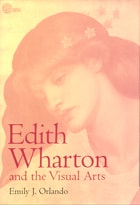
Edith Wharton and the Visual Arts
Emily J. Orlando
University of Alabama Press, 2008
An insightful look at representations of women’s bodies and female authority.
This work explores Edith Wharton's career-long concern with a 19th-century visual culture that limited female artistic agency and expression. Wharton repeatedly invoked the visual arts--especially painting—as a medium for revealing the ways that women's bodies have been represented (as passive, sexualized, infantalized, sickly, dead). Well-versed in the Italian masters, Wharton made special use of the art of the Pre-Raphaelite Brotherhood, particularly its penchant for producing not portraits of individual women but instead icons onto whose bodies male desire is superimposed.
Emily Orlando contends that while Wharton's early work presents women enshrined by men through art, the middle and later fiction shifts the seat of power to women. From Lily Bart in The House of Mirth to Undine Spragg in The Custom of the Country and Ellen Olenska in The Age of Innocence, women evolve from victims to vital agents, securing for themselves a more empowering and satisfying relationship to art and to their own identities.
Orlando also studies the lesser-known short stories and novels, revealing Wharton’s re-workings of texts by Browning, Poe, Balzac, George Eliot, Sir Joshua Reynolds, and, most significantly, Dante Gabriel Rossetti. Edith Wharton and the Visual Arts is the first extended study to examine the presence in Wharton's fiction of the Pre-Raphaelite poetry and painting of Rossetti and his muses, notably Elizabeth Siddall and Jane Morris. Wharton emerges as one of American literature's most gifted inter-textual realists, providing a vivid lens through which to view issues of power, resistance, and social change as they surface in American literature and culture.
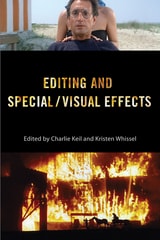
Editing and Special/Visual Effects
Keil, Charlie
Rutgers University Press, 2016

Edna Ferber's Hollywood
American Fictions of Gender, Race, and HistoryBy J. E. Smyth
University of Texas Press, 2009
Edna Ferber's Hollywood reveals one of the most influential artistic relationships of the twentieth century—the four-decade partnership between historical novelist Edna Ferber and the Hollywood studios. Ferber was one of America's most controversial popular historians, a writer whose uniquely feminist, multiracial view of the national past deliberately clashed with traditional narratives of white masculine power. Hollywood paid premium sums to adapt her novels, creating some of the most memorable films of the studio era—among them Show Boat, Cimarron, and Giant. Her historical fiction resonated with Hollywood's interest in prestigious historical filmmaking aimed principally, but not exclusively, at female audiences.
In Edna Ferber's Hollywood, J. E. Smyth explores the research, writing, marketing, reception, and production histories of Hollywood's Ferber franchise. Smyth tracks Ferber's working relationships with Samuel Goldwyn, Leland Hayward, George Stevens, and James Dean; her landmark contract negotiations with Warner Bros.; and the controversies surrounding Giant's critique of Jim-Crow Texas. But Edna Ferber's Hollywood is also the study of the historical vision of an American outsider—a woman, a Jew, a novelist with few literary pretensions, an unashamed middlebrow who challenged the prescribed boundaries among gender, race, history, and fiction. In a masterful film and literary history, Smyth explores how Ferber's work helped shape Hollywood's attitude toward the American past.
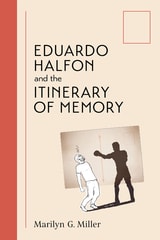
Eduardo Halfon and the Itinerary of Memory
Marilyn G. Miller
Vanderbilt University Press, 2024
Marilyn G. Miller has written the first study to focus exclusively on this important voice in Jewish–Latin American letters. Only after returning to Guatemala and regaining his command of Spanish through reading literature did Halfon begin to build his life as a writer and translator. Nonetheless, the author admits that “one thing is stubbornly true, and it’s this: every sentence that I write, every verb or adjective that I painstakingly insert or remove, every literary thought that I have while writing, always . . . begins and ends in English.” Halfon’s translated works are never parallel texts, however. Thus, translation and its side effects (foreign words, linguistic lacunae, multilingual modes of perception) offer us crucial keys to understanding the author’s fictional world as a vehicle for retelling and surviving Jewish trauma and finding his own particular plurilingual voice.
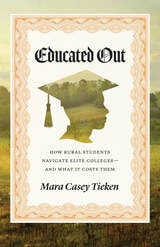
Educated Out
How Rural Students Navigate Elite Colleges—And What It Costs ThemMara Casey Tieken
University of Chicago Press, 2025
A former third-grade teacher in rural Tennessee, education researcher Mara Casey Tieken watched as her former students graduated high school. She was shocked at how few were heading to college—and none were going to elite four-year schools. These students were representative of a larger national phenomenon: In 2021, 31 percent of rural adults aged twenty-five and older held a postsecondary degree, compared to 45 percent of urban adults, and rural students are especially unlikely to pursue degrees from private, selective schools. Why, Tieken wondered? And what happens to the handful of rural students who do attend elite colleges, colleges that may feel worlds away from home?
Tieken addresses these questions in Educated Out—a study that shows how geography shapes rural, first-generation students’ access to college, their college experiences, and their postgraduation plans and opportunities. Tieken closely follows a group of nine students for their college years and beyond at an elite New England private school that she calls Hilltop. Interviews with these students reveal the critical moments in the students’ educational careers when their rural origins mattered most: when applying to college, she shows how students are hindered by limited college counseling resources. Once on campus, they learn that many of the school’s opportunities are not available to them: they cannot access spring break trips, job networks, or low-pay-but-important internships. These students discover that home and college are very different worlds with different academic, social, and political climates—and, over time, they start to question both. As they near graduation and navigate a job market in which the highest-paying and most prestigious opportunities are located in urban centers, they begin to feel the complicated burden of their schooling: they’ve been “educated out.” Their stories show the costs of college for rural students: If they do not pursue higher education, they lose the opportunity for social mobility; if they do, they face a more permanent departure. These costs are individual, but rural families and communities also suffer—they lose young people with talent and skills.
In addition to advocating for a higher education landscape that truly includes rural students, Tieken critiques a system that requires people to leave their rural homes in search of opportunities. Our current economy depends on inexpensive rural labor. Without meaningful change, some students will have to make the impossible decision to leave home—and far more will remain there, undereducated and overlooked.
Both engaging and accessible, Educated Out presents important and timely questions about rurality, identity, education, and inequality.
Educated Out
How Rural Students Navigate Elite Colleges—And What It Costs ThemMara Casey Tieken
University of Chicago Press, 2025
Through the stories of nine rural, first-generation students and their families, Educated Out shows how geography shapes college opportunities, from admission to postgraduation options.
A former third-grade teacher in rural Tennessee, education researcher Mara Casey Tieken watched as her former students graduated high school. She was shocked at how few were heading to college—and none were going to elite four-year schools. These students were representative of a larger national phenomenon: In 2021, 31 percent of rural adults aged twenty-five and older held a postsecondary degree, compared to 45 percent of urban adults, and rural students are especially unlikely to pursue degrees from private, selective schools. Why, Tieken wondered? And what happens to the handful of rural students who do attend elite colleges, colleges that may feel worlds away from home?
Tieken addresses these questions in Educated Out—a study that shows how geography shapes rural, first-generation students’ access to college, their college experiences, and their postgraduation plans and opportunities. Tieken closely follows a group of nine students for their college years and beyond at an elite New England private school that she calls Hilltop. Interviews with these students reveal the critical moments in the students’ educational careers when their rural origins mattered most: when applying to college, she shows how students are hindered by limited college counseling resources. Once on campus, they learn that many of the school’s opportunities are not available to them: they cannot access spring break trips, job networks, or low-pay-but-important internships. These students discover that home and college are very different worlds with different academic, social, and political climates—and, over time, they start to question both. As they near graduation and navigate a job market in which the highest-paying and most prestigious opportunities are located in urban centers, they begin to feel the complicated burden of their schooling: they’ve been “educated out.” Their stories show the costs of college for rural students: If they do not pursue higher education, they lose the opportunity for social mobility; if they do, they face a more permanent departure. These costs are individual, but rural families and communities also suffer—they lose young people with talent and skills.
In addition to advocating for a higher education landscape that truly includes rural students, Tieken critiques a system that requires people to leave their rural homes in search of opportunities. Our current economy depends on inexpensive rural labor. Without meaningful change, some students will have to make the impossible decision to leave home—and far more will remain there, undereducated and overlooked.
Both engaging and accessible, Educated Out presents important and timely questions about rurality, identity, education, and inequality.
Educated Youth and the Cultural Revolution in China
Martin Singer
University of Michigan Press, 1971
Educated in Romance
Women, Achievement, and College CultureDorothy C. Holland and Margaret A. Eisenhart
University of Chicago Press, 1990
Educating Across Borders
The Case of a Dual Language Program on the U.S.-Mexico BorderMaría Teresa de la Piedra, Blanca Araujo, and Alberto Esquinca; Foreword by Concha Delgado Gaitan
University of Arizona Press, 2018
The authors, who themselves live and work on the border, question artificially created cultural and linguistic borders. To explore this issue, they employed participant-observation, focus groups, and individual interviews with teachers, administrators, and staff members to construct rich understandings of the experiences of transfronterizx students. These ethnographic accounts of their daily lives counter entrenched deficit perspectives about transnational learners.
Drawing on border theory, immigration and border studies, funds of knowledge, and multimodal literacies, Educating Across Borders is a critical contribution toward the formation of a theory of physical and metaphorical border crossings that ethnic minoritized students in U.S. schools must make as they traverse the educational system.

Educating Angels
Teaching for the Pursuit of HappinessTony Armstrong, Ph.D
Parkhurst Brothers, Inc., 2013
Educating Women
Cultural Conflict and Victorian LiteratureLaura Morgan Green
Ohio University Press, 2001
In 1837, when Queen Victoria came to the throne, no institution of higher education in Britain was open to women. By the end of the century, a quiet revolution had occurred: women had penetrated even the venerable walls of Oxford and Cambridge and could earn degrees at the many new universities founded during Victoria's reign. During the same period, novelists increasingly put intellectually ambitious heroines students, teachers, and frustrated scholars—at the center of their books. Educating Women analyzes the conflict between the higher education movement's emphasis on intellectual and professional achievement and the Victorian novel's continuing dedication to a narrative in which women's success is measured by the achievement of emotional rather than intellectual goals and by the forging of social rather than institutional ties.
Focusing on works by Charlotte Brontë, George Eliot, Anna Leonowens, and Thomas Hardy, Laura Morgan Green demonstrates that those texts are shaped by the need to mediate the conflict between the professionalism and publicity increasingly associated with education, on the one hand, and the Victorian celebration of women as emblems of domesticity, on the other. Educating Women shows that the nineteenth-century “heroines” of both history and fiction were in fact as indebted to domestic ideology as they were eager to transform it.
Educating in the Divine Image
Gender Issues in Orthodox Jewish Day SchoolsChaya Rosenfeld Gorsetman and Elana Maryles Sztokman
Brandeis University Press, 2013
Educating the Enemy
Teaching Nazis and Mexicans in the Cold War BorderlandsJonna Perrillo
University of Chicago Press, 2022
Educating the Enemy begins with the 144 children of Nazi scientists who moved to El Paso, Texas, in 1946 as part of the military program called Operation Paperclip. These German children were bused daily from a military outpost to four El Paso public schools. Though born into a fascist enemy nation, the German children were quickly integrated into the schools and, by proxy, American society. Their rapid assimilation offered evidence that American public schools played a vital role in ensuring the victory of democracy over fascism.
Jonna Perrillo not only tells this fascinating story of Cold War educational policy, but she draws an important contrast with another, much more numerous population of children in the El Paso public schools: Mexican Americans. Like everywhere else in the Southwest, Mexican American children in El Paso were segregated into “Mexican” schools, where the children received a vastly different educational experience. Not only were they penalized for speaking Spanish—the only language all but a few spoke due to segregation—they were tracked for low-wage and low-prestige careers, with limited opportunities for economic success. Educating the Enemy charts what two groups of children—one that might have been considered the enemy, the other that was treated as such—reveal about the ways political assimilation has been treated by schools as an easier, more viable project than racial or ethnic assimilation.
Listen to an interview with the author here and read an interview in Time and a piece based on the book in the Boston Review.
Educating the New Southern Woman
Speech, Writing, and Race at the Public Women's Colleges, 1884-1945David Gold and Catherine L. Hobbs
Southern Illinois University Press, 2014
From the end of Reconstruction through World War II, a network of public colleges for white women flourished throughout the South. Founded primarily as vocational colleges to educate women of modest economic means for life in the emerging “new” South, these schools soon transformed themselves into comprehensive liberal arts–industrial institutions, proving so popular that they became among the largest women’s colleges in the nation. In this illuminating volume, David Gold and Catherine L. Hobbs examine rhetorical education at all eight of these colleges, providing a better understanding of not only how women learned to read, write, and speak in American colleges but also how they used their education in their lives beyond college.
With a collective enrollment and impact rivaling that of the Seven Sisters, the schools examined in this study—Mississippi State College for Women (1884), Georgia State College for Women (1889), North Carolina College for Women (1891), Winthrop College in South Carolina (1891), Alabama College for Women (1896), Texas State College for Women (1901), Florida State College for Women (1905), and Oklahoma College for Women (1908)—served as important centers of women’s education in their states, together educating over a hundred thousand students before World War II and contributing to an emerging professional class of women in the South. After tracing the establishment and evolution of these institutions, Gold and Hobbs explore education in speech arts and public speaking at the colleges and discuss writing instruction, setting faculty and departmental goals and methods against larger institutional, professional, and cultural contexts. In addition to covering the various ways the public women’s colleges prepared women to succeed in available occupations, the authors also consider how women’s education in rhetoric and writing affected their career choices, the role of race at these schools, and the legacy of public women’s colleges in relation to the history of women’s education and contemporary challenges in the teaching of rhetoric and writing.
The experiences of students and educators at these institutions speak to important conversations among scholars in rhetoric, education, women’s studies, and history. By examining these previously unexplored but important institutional sites, Educating the New Southern Woman provides a richer and more complex history of women’s rhetorical education and experiences.
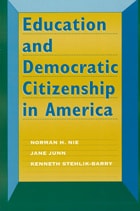
Education and Democratic Citizenship in America
Norman H. Nie, Jane Junn, and Kenneth Stehlik-Barry
University of Chicago Press, 1996
Norman H. Nie, Jane Junn, and Kenneth Stehlik-Barry provide answers by uncovering the causal relationship between education and democratic citizenship. They argue that citizenship encompasses both political engagement in pursuit of interests and commitment to democratic values that temper what citizens can do to win in politics. Education affects the two dimensions in distinct ways. Especially significant is the influence of education on political engagement through occupational prominence and position in social networks. Formal education orders the distribution of social position and connections and creates an uneven political playing field.
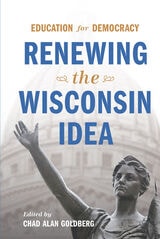
Education for Democracy
Renewing the Wisconsin IdeaEdited by Chad Alan Goldberg
University of Wisconsin Press, 2020
Using the Wisconsin Idea as a lens, Education for Democracy argues that public higher education institutions remain a bastion of collaborative problem solving. Examinations of partnerships between the state university and people of the state highlight many crucial and lasting contributions to issues of broad public concern such as conservation, LGBTQ+ rights, and poverty alleviation. The contributors restore the value of state universities and humanities education as a public good, contending that they deserve renewed and robust support.

Education in Tokugawa Japan
R. P. Dore
University of Michigan Press, 1992
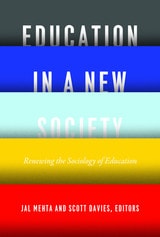
Education in a New Society
Renewing the Sociology of EducationEdited by Jal Mehta and Scott Davies
University of Chicago Press, 2018
The sociology of education, the contributors show, largely works with themes, concepts, and theories that were generated decades ago, even as both the actual world of education and the discipline of sociology have changed considerably. The moment has come, they argue, to break free of the past and begin asking new questions and developing new programs of empirical study. Both rallying cry and road map, Education in a New Society will galvanize the field.

Education, Culture, and Identity in Twentieth-Century China
Glen Peterson, Ruth Hayhoe, and Yongling Lu, Editors
University of Michigan Press, 2001
Unlike most studies of modern Chinese education that focus exclusively on the post-1949 era, Education, Culture, and Identity in Twentieth-Century China represents a deliberate attempt to break through the 1949 barrier and embrace the entire century. Culture emerges in this study as a deeper level factor that underlay the development of education in each period and shaped certain recurrent patterns, while identity involves a search for individual and collective meaning that went on under different regimes.
The product of a genuinely multidisciplinary effort to promote cross-fertilization among an international team of scholars in a wide range of disciplines, Education, Culture, and Identity in Twentieth-Century China will interest students and scholars of modern China, comparative and international education, educational policy, and international relations. It will also appeal to policy makers and professionals associated with international organizations.
Glen Peterson is Associate Professor of History, University of British Columbia. Ruth Hayhoe is Director, Hong Kong Institute of Education. Yongling Lu is a graduate student in the History Department, Stanford University.
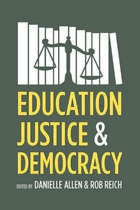
Education, Justice, and Democracy
Edited by Danielle Allen and Rob Reich
University of Chicago Press, 2013
Educational and Psychological Testing
A Study of the Industry and its PracticesMartin Holeman
Russell Sage Foundation, 1972
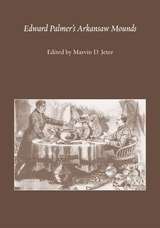
Edward Palmer's Arkansaw Mounds
Edited and preface by Marvin D. Jeter
University of Alabama Press, 2010
"This thoroughly researched volume is highly recommended to anyone—at any level—who is interested in the archaeology of the Southeast." —CHOICE
During the 1880s a massive scientific effort was launched by the Smithsonian Institution to discover who had built the prehistoric burial mounds found throughout the United States. Arkansaw Mounds tells the story of this exploration and of Edward Palmer, one of the nineteenth century’s greatest natural historians and archaeologists, who was recruited to lead the research project. Arkansas was unusually rich in prehistoric remains, especially mounds, and became a major focus of the study. Palmer and his team of researchers discovered that the mounds had been built by the ancestors of the historic North American Indians, shattering the then-popular theory that a lost non-Indian race had built them.

Een spiering uitwerpen om een kabeljauw te vangen
How and why the Dutch fished for cod 1818-1911Overgaard Christine
Amsterdam University Press, 2015

Effective Journalism
How the Information Ecosystem Works and What Journalists Should Do About ItJessica Roberts
Intellect Books, 2024
The central argument of this book is that journalists and audiences can no longer afford to pretend that all information is competing on an even playing field and that it is enough for journalists to simply publish “the facts.” Effective Journalism attempts to explain the reality, rather than the ideal, of how people seek and process information, and what journalists and their audiences can do to try to create an informed public in the face of that reality.
Effective Social Science
Eight Cases in Economics, Political Science, and SociologyBernard Barber
Russell Sage Foundation, 1987
Effeminism
The Economy of Colonial DesireRevathi Krishnaswamy
University of Michigan Press, 2011
Effeminism
The Economy of Colonial DesireRevathi Krishnaswamy
University of Michigan Press, 1999
Efficacy of Sound
Power, Potency, and Promise in the Translocal Ritual Music of Cuban Ifá-ÒrìsàRuthie Meadows
University of Chicago Press, 2023
Hailing from Cuba, Nigeria, and various sites across Latin America and the Caribbean, Ifá missionary-practitioners are transforming the landscape of Ifá divination and deity (òrìṣà/oricha) worship through transatlantic travel and reconnection. In Cuba, where Ifá and Santería emerged as an interrelated, Yorùbá-inspired ritual complex, worshippers are driven to “African traditionalism” by its promise of efficacy: they find Yorùbá approaches more powerful, potent, and efficacious.
In the first book-length study on music and Ifá, Ruthie Meadows draws on extensive, multisited fieldwork in Cuba and Yorùbáland, Nigeria, to examine the controversial “Nigerian-style” ritual movement in Cuban Ifá divination. Meadows uses feminist and queer of color theory along with critical studies of Africanity to excavate the relation between utility and affect within translocal ritual music circulations. Meadows traces how translocal Ifá priestesses (ìyánífá), female batá drummers (bataleras), and priests (babaláwo) harness Yorùbá-centric approaches to ritual music and sound to heighten efficacy, achieve desired ritual outcomes, and reshape the conditions of their lives. Within a contentious religious landscape marked by the idiosyncrasies of revolutionary state policy, Nigerian-style Ifá-Òrìṣà is leveraged to transform femininity and masculinity, state religious policy, and transatlantic ritual authority on the island.
Egalitarian Capitalism
Jobs, Incomes, and Growth in Affluent CountriesLane Kenworthy
Russell Sage Foundation, 2004
Egotopia
Narcissism and the New American LandscapeJohn Miller
University of Alabama Press, 1999
Egotopia explains why individual political and economic interests have eclipsed aesthetic considerations in the rampant billboards, malls, and urban sprawl of the New American Landscape
Egotopia begins where other critiques of the American landscape end: identifying the physical ugliness that defines and homogenizes America's cities, suburbs, and countryside. Believing that prevailing assessments of the American landscape are inadequate and injudicious, John Miller calls into question the conventional wisdom of environmentalists, urban planners,and architects alike. In this precedent-shattering examination of what he sees as the ugliness that is the American consumer society, Miller contends that our aesthetic condition can be fully understood only by explorers of the metaphoric environment.Metaphorically, the ugliness of America's great suburban sprawl is the physical manifestation of our increasing narcissism- our egotopia. The ubiquity of psychotherapy as a medium promoting self-indulgence has deified private man as it has demonized public man. The New American Landscape, Miller argues, is no longer the physical manifestation of public and communal values. Instead it has become a projection of private fantasies and narcissistic self-indulgence. Individual interests and private passions can no longer tolerate, nor even recognize, aesthetic concerns in such a landscape dedicated to uncompromising notions of utility.
Egypt Land
Race and Nineteenth-Century American EgyptomaniaScott Trafton
Duke University Press, 2004
Drawing on literary and cultural studies, art and architectural history, political history, religious history, and the histories of archaeology and ethnology, Trafton illuminates anxieties related to race in different manifestations of nineteenth-century American Egyptomania, including the development of American Egyptology, the rise of racialized science, the narrative and literary tradition of the imperialist adventure tale, the cultural politics of the architectural Egyptian Revival, and the dynamics of African American Ethiopianism. He demonstrates how debates over what the United States was and what it could become returned again and again to ancient Egypt. From visions of Cleopatra to the tales of Edgar Allan Poe, from the works of Pauline Hopkins to the construction of the Washington Monument, from the measuring of slaves’ skulls to the singing of slave spirituals—claims about and representations of ancient Egypt served as linchpins for discussions about nineteenth-century American racial and national identity.
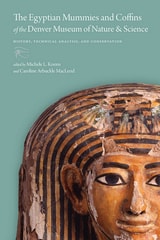
Egyptian Mummies and Coffins of the Denver Museum of Nature & Science
History, Technical Analysis, and ConservationMichele L. Koons
University Press of Colorado, 2020
This interdisciplinary volume provides a history of the mummies’ discovery and relocation to Colorado. It guides the reader through various analytical techniques, detailing past research and introducing new data and best practices for future conservation efforts. The new analysis includes more accurate radiocarbon dating, fully comprehensive data from updated CT scans, examples of Egyptian blue and yellow pigments on the coffins uncovered by non-invasive x-ray fluorescence, unprecedented analysis of the coffin wood, updated translations and stylistic analysis of the text and imagery on the coffins, gas chromatography of the paints and resins, linen analysis, and much more.
The Egyptian Mummies and Coffins of the Denver Museum of Nature & Science provides replicable findings and consistent terminology for institutions performing holistic studies on extant museum collections of a range of material types. It will add substantially to what we know about the effective conservation of Egyptian mummies and coffins.
Contributors: Christopher H. Baisan, Hans Barnard, Bonnie Clark, Pearce Paul Creasman, Farrah Cundiff, Jessica M. Fletcher, Kari L. Hayes, Kathryn Howley, Stephen Humphries, Keith Miller, Vanessa Muros, Robyn Price, David Rubinstein, Judith Southward, Jason Weinman
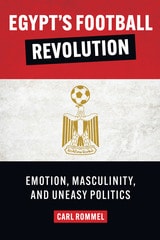
Egypt’s Football Revolution
Emotion, Masculinity, and Uneasy PoliticsBy Carl Rommel
University of Texas Press, 2021
Both a symbol of the Mubarak government’s power and a component in its construction of national identity, football served as fertile ground for Egyptians to confront the regime’s overthrow during the 2011 revolution. With the help of the state, appreciation for football in Egypt peaked in the late 2000s. Yet after Mubarak fell, fans questioned their previous support, calling for a reformed football for a new, postrevolutionary nation.
In Egypt’s Football Revolution, Carl Rommel examines the politics of football as a space for ordinary Egyptians and state forces to negotiate a masculine Egyptian chauvinism. Basing his discussion on several years of fieldwork with fans, players, journalists, and coaches, he investigates the increasing attention paid to football during the Mubarak era; its demise with the 2011 uprisings and 2012 Port Said massacre, which left seventy-two fans dead; and its recent rehabilitation. Cairo’s highly organized and dedicated Ultras fans became a key revolutionary force through their antiregime activism, challenging earlier styles of fandom and making visible entrenched ties between sport and politics. As the appeal of football burst, alternative conceptions of masculinity, emotion, and politics came to the fore to demand or prevent revolution and reform.
Eight Words for the Study of Expressive Culture
Edited by Burt Feintuch
University of Illinois Press, 2003
No matter where we are--in academic institutions, in cultural agencies, at home, or in a casual conversation--these are words we use when we talk about creative expression in its cultural contexts. Eight Words for the Study of Expressive Culture is a thoughtful, interdisciplinary examination of the keywords that are integral to the formulation of ideas about the diversity of human creativity, presented as a set of essays by leading folklorists.
Many of us use these eight words every day. We think with them. We teach with them. Much of contemporary scholarship rests on their meanings and implications. They form a significant part of a set of conversations extending through centuries of thought about creativity, meaning, beauty, local knowledge, values, and community. Their natural habitats range across scholarly disciplines from anthropology and folklore to literary and cultural studies and provide the framework for other fields of practice and performance as well.
Eight Words for the Study of Expressive Culture is a much-needed study of keywords that are frequently used but not easily explained. Anchored by Burt Feintuch’s cogent introduction, the book features essays by Dorothy Noyes, Gerald L. Pocius, Jeff Todd Titon, Trudier Harris, Deborah A. Kapchan, Mary Hufford, Henry Glassie, and Roger D. Abrahams.
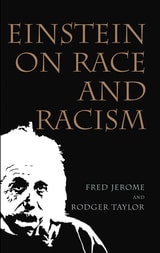
Einstein on Race and Racism
Einstein on Race and Racism, First Paperback EditionJerome, Fred
Rutgers University Press, 2005
Nearly fifty years after his death, Albert Einstein remains one of America's foremost cultural icons. A thicket of materials, ranging from scholarly to popular, have been written, compiled, produced, and published about his life and his teachings. Among the ocean of Einsteinia-scientific monographs, biographies, anthologies, bibliographies, calendars, postcards, posters, and Hollywood films-however, there is a peculiar void when it comes to the connection that the brilliant scientist had with the African American community. Nowhere is there any mention of his close relationship with Paul Robeson, despite Einstein's close friendship with him, or W.E.B. Du Bois, despite Einstein's support for him.
This unique volume is the first to bring together a wealth of writings by the scientist on the topic of race. Although his activism in this area is less well known than his efforts on behalf of international peace and scientific cooperation, Einstein spoke out vigorously against racism both in the United States and around the world. Fred Jerome and Rodger Taylor suggest that one explanation for this historical amnesia is that Einstein's biographers avoided "controversial" topics, such as his friendships with African Americans and his political activities, including his involvement as co-chair of an antilynching campaign, fearing that mention of these details may tarnish the feel-good impression his image lends topics of science, history, and America.
Combining the scientist's letters, speeches, and articles with engaging narrative and historical discussions that place his public statements in the context of his life and times, this important collection not only brings attention to Einstein's antiracist public activities, but also provides insight into the complexities of antiracist culture in America. The volume also features a selection of candid interviews with African Americans who knew Einstein as children.
For a man whose words and reflections have influenced so many, it is long overdue that Einstein's thoughts on this vital topic are made easily accessible to the general public.
Ejidos and Regions of Refuge in Northwestern Mexico
Edited by N. Ross Crumrine and Phil C. Weigand
University of Arizona Press, 1987
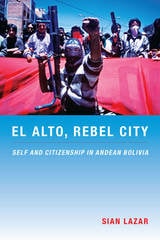
El Alto, Rebel City
Self and Citizenship in Andean BoliviaSian Lazar
Duke University Press, 2007
Drawing on ethnographic fieldwork conducted between 1997 and 2004, Lazar contends that in El Alto, citizenship is a set of practices defined by one’s participation in a range of associations, many of them collectivist in nature. Her argument challenges Western liberal notions of the citizen by suggesting that citizenship is not only individual and national but in many ways communitarian and distinctly local, constituted through different kinds of affiliations. Since in El Alto these affiliations most often emerge through people’s place of residence and their occupational ties, Lazar offers in-depth analyses of neighborhood associations and trade unions. In so doing, she describes how the city’s various collectivities mediate between the state and the individual. Collective organization in El Alto and the concept of citizenship underlying it are worthy of attention; they are the basis of the city’s formidable power to mobilize popular protest.
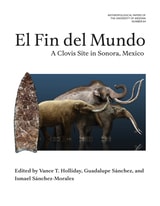
El Fin del Mundo
A Clovis Site in Sonora, MexicoVance T. Holliday, Guadalupe Sánchez, and Ismael Sánchez-Morales
University of Arizona Press, 2024
El Fin del Mundo presents and synthesizes the archaeological, geological, paleontological, and paleoenvironmental records of an important Clovis site.
Contributors
Joaquín Arroyo-Cabrales
Jordan Bright
James K. Feathers
Edmund P. Gaines
Thanairi Gamez
Gregory W. L. Hodgins
Vance T. Holliday
Susan M. Mentzer
Carmen Isela Ortega-Rosas
Manuel R. Palacios-Fest
Guadalupe Sánchez
Ismael Sánchez-Morales
Kayla B. Worthey
Kristen Wroth
El Monte's New Itineraries
Afrodiasporic Spirituality in the Contemporary CaribbeanAlberto Sosa-Cabanas
Rutgers University Press, 2025
El Monte's New Itineraries is the first book fully devoted to the study of Cuban author and ethnographer Lydia Cabrera’s El Monte (1954), one of the most influential books in Caribbean cultural history. Highly referenced, if understudied, El Monte is a comprehensive work that intertwines ethnobotany, popular orality, and Afro-Cuban traditions. Its pages have enjoyed a transnational influence, enriching domains such as ethnography, politics, theater, and even science fiction literature in the Caribbean, and the knowledge contained in it lies at the heart of Afrodiasporic spirituality and ethnomedicinal practices across Hispanic Caribbean cultures and beyond.
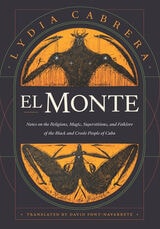
El Monte
Notes on the Religions, Magic, and Folklore of the Black and Creole People of CubaLydia Cabrera
Duke University Press, 2023