Results by title
155 books match the query 'Civil rights movements' and 9 start with f
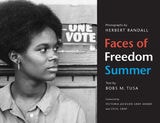
Faces of Freedom Summer
Herbert Randall and Bobs M. Tusa
University of Alabama Press, 2001
Witness the faces that defined a movement for freedom and equality
The old adage “One picture is worth ten thousand words” is definitely true for Faces of Freedom Summer. There are simply not enough words to describe the period in our history that is recorded by the pictures in this book.
As this book afirms, the resurgence of overt activities by hate groups—both the old traditional ones (e.g., the Ku Klux Klan) and the new ones (e.g., the Skin Heads)—however much the hard work and sacrifices of the modern civil rights movement humanized American society, much still remains to be done. The modern civil rights movement associated with the 1960s was not in vain, yet it did not eradicate from our society the evils of racism and sexism. While we activists made the United States more of an open society than it has ever been in its history, our vision and desire for the beloved community did not reach into all sectors of American society. “Freedom,” it has been said, “is a constant struggle, a work of eternal vigilance.”
Faces of Freedom Summer brings to life that there was such a time and there were such people and, if such a people were once, then they are still among us. Yet, they may only become aware of themselves when they are confronted with visible evidence, such as the evidence contained in the pictures of Herbert Randall.
Faith in the City
Preaching Radical Social Change in DetroitAngela D. Dillard
University of Michigan Press, 2009
“The dynamics of Black Theology were at the center of the ‘Long New Negro Renaissance,’ triggered by mass migrations to industrial hubs like Detroit. Finally, this crucial subject has found its match in the brilliant scholarship of Angela Dillard. No one has done a better job of tracing those religious roots through the civil rights–black power era than Professor Dillard.”
—Komozi Woodard, Professor of History, Public Policy & Africana Studies at Sarah Lawrence College and author of A Nation within a Nation: Amiri Baraka (LeRoi Jones) and Black Power Politics
“Angela Dillard recovers the long-submerged links between the black religious and political lefts in postwar Detroit. . . . Faith in the City is an essential contribution to the growing literature on the struggle for racial equality in the North.”
—Thomas J. Sugrue, University of Pennsylvania, author of The Origins of the Urban Crisis: Race and Inequality in Postwar Detroit
Spanning more than three decades and organized around the biographies of Reverends Charles A. Hill and Albert B. Cleage Jr., Faith in the City is a major new exploration of how the worlds of politics and faith merged for many of Detroit’s African Americans—a convergence that provided the community with a powerful new voice and identity. While other religions have mixed politics and creed, Faith in the City shows how this fusion was and continues to be particularly vital to African American clergy and the Black freedom struggle.
Activists in cities such as Detroit sustained a record of progressive politics over the course of three decades. Angela Dillard reveals this generational link and describes what the activism of the 1960s owed to that of the 1930s. The labor movement, for example, provided Detroit’s Black activists, both inside and outside the unions, with organizational power and experience virtually unmatched by any other African American urban community.
Angela D. Dillard is Associate Professor of Afroamerican and African Studies at the University of Michigan. She specializes in American and African American intellectual history, religious studies, critical race theory, and the history of political ideologies and social movements in the United States.
Father Groppi
Marching for Civil RightsStuart Stotts
Wisconsin Historical Society Press, 2013
Father Groppi Marched to Change Milwaukee
"Father Groppi: Marching for Civil Rights" tells the story of Father James Groppi, a Catholic priest from Milwaukee, Wis., who stood up for civil rights in the 1960s and 1970s.
This important new addition to the Badger Biographies series for young readers also tells about a turbulent time in Wisconsin history and sheds light on the civil rights movement and its place in the North.
Growing up on the south side of Milwaukee as the son of Italian immigrants, young James Groppi learned early on what it felt like to be made fun of just because of who you are, and he learned to respect people from other races and ethnic groups. Later, while studying to become a priest, he saw the discrimination African Americans faced. It made him angry, and he vowed to do whatever he could to fight racism.
Father Groppi marched with Dr. Martin Luther King Jr. and other leaders of the civil rights movement. But he knew there was work to be done in his own city. In Milwaukee, he teamed up with the NAACP and other organizations, protesting discrimination and segregation wherever they saw it. It wasn't always easy, and Father Groppi and the other civil rights workers faced great challenges.

For Freedom's Sake
The Life of Fannie Lou HamerChana Kai Lee
University of Illinois Press, 1999
The youngest of twenty children of sharecroppers in rural Mississippi, Fannie Lou Hamer witnessed throughout her childhood the white cruelty, political exclusion, and relentless economic exploitation that defined African American existence in the Delta.
In this intimate biography, Chana Kai Lee documents Hamer's lifelong crusade to empower the poor through collective action, her rise to national prominence as a civil rights activist, and the personal costs of her ongoing struggle to win a political voice and economic self-sufficiency for blacks in the segregated South. Lee looks at Hamer's early work as a field secretary for the Student Nonviolent Coordinating Committee in Mississippi, her dramatic appearance at the 1964 Democratic National Convention, and her ongoing work as a militant grassroots leader in her own community.
For Jobs and Freedom
Selected Speeches and Writings of A. Philip RandolphAndrew E. Kersten
University of Massachusetts Press, 2014
This volume documents Randolph's life and work through his own writings. The editors have combed through the files of libraries, manuscript collections, and newspapers, selecting more than seventy published and unpublished pieces that shed light on Randolph's most significant activities. The book is organized thematically around his major interests—dismantling workplace inequality, expanding civil rights, confronting racial segregation, and building international coalitions. The editors provide a detailed biographical essay that helps to situate the speeches and writings collected in the book. In the absence of an autobiography, this volume offers the best available presentation of Randolph's ideas and arguments in his own words.
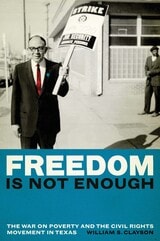
Freedom Is Not Enough
The War on Poverty and the Civil Rights Movement in TexasBy William S. Clayson
University of Texas Press, 2010
Led by the Office of Economic Opportunity, Lyndon Johnson's War on Poverty reflected the president's belief that, just as the civil rights movement and federal law tore down legalized segregation, progressive government and grassroots activism could eradicate poverty in the United States. Yet few have attempted to evaluate the relationship between the OEO and the freedom struggles of the 1960s. Focusing on the unique situation presented by Texas, Freedom Is Not Enough examines how the War on Poverty manifested itself in a state marked by racial division and diversity—and by endemic poverty.
Though the War on Poverty did not eradicate destitution in the United States, the history of the effort provides a unique window to examine the politics of race and social justice in the 1960s. William S. Clayson traces the rise and fall of postwar liberalism in the Lone Star State against a backdrop of dissent among Chicano militants and black nationalists who rejected Johnson's brand of liberalism. The conservative backlash that followed is another result of the dramatic political shifts revealed in the history of the OEO, completing this study of a unique facet in Texas's historical identity.
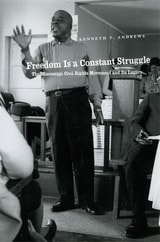
Freedom Is a Constant Struggle
The Mississippi Civil Rights Movement and Its LegacyKenneth T. Andrews
University of Chicago Press, 2004
Freedom Is a Constant Struggle is also the first book of its kind to detail the activities of white supremacists in Mississippi, revealing how white repression and intimidation sparked black activism and simultaneously undermined the movement's ability to achieve far-reaching goals. Andrews shows that the federal government's role was important but reactive as federal actors responded to the sustained struggles between local movements and their opponents. He tracks the mobilization of black activists by the NAACP, the creation of Freedom Summer, efforts to galvanize black voters, the momentous desegregation of public schools and the rise of all-white private academies, and struggles over the economic development of black communities. From this complex history, Andrews shows how the civil rights movement built innovative organizations and campaigns that empowered local leadership and had a lasting legacy in Mississippi and beyond.
Based on an original and creative research design that combines extensive archival research, interviews with activists, and quantitative historical data, Freedom Is a Constant Struggle provides many new insights into the civil rights struggle, and it presents a much broader theory to explain whether and how movements have enduring impacts on politics and society. What results is a work that will be invaluable to students of social movements, democratic politics, and the struggle for racial freedom in the U.S.
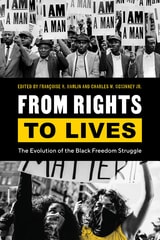
From Rights to Lives
The Evolution of the Black Freedom StruggleEdited by Françoise N. Hamlin and Charles W. McKinney Jr.
Vanderbilt University Press, 2024
From Rights to Lives critically engages the dynamic relationship between these two moments of liberatory possibility on the Black Freedom Struggle timeline. The book’s contributors explore what we can learn when we place these moments of struggle in dialogue with each other. They grapple with how our understanding of the postwar moment shapes our analysis of #BLM and wherein lie the discontinuities, in order to glean lessons for future moments of insurgency.
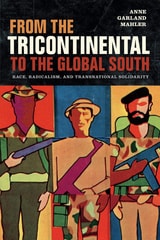
From the Tricontinental to the Global South
Race, Radicalism, and Transnational SolidarityAnne Garland Mahler
Duke University Press, 2018