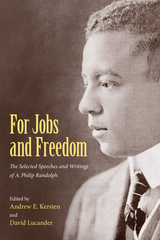
For Jobs and Freedom: Selected Speeches and Writings of A. Philip Randolph
University of Massachusetts Press, 2014
Cloth: 978-1-62534-115-0 | Paper: 978-1-62534-116-7 | eISBN: 978-1-61376-389-6 (ePub) | eISBN: 978-1-61376-340-7 (PDF)
Library of Congress Classification E185.97.R27A25 2014
Dewey Decimal Classification 305.800973
Cloth: 978-1-62534-115-0 | Paper: 978-1-62534-116-7 | eISBN: 978-1-61376-389-6 (ePub) | eISBN: 978-1-61376-340-7 (PDF)
Library of Congress Classification E185.97.R27A25 2014
Dewey Decimal Classification 305.800973
ABOUT THIS BOOK | AUTHOR BIOGRAPHY | REVIEWS | TOC
ABOUT THIS BOOK
As the head of the Brotherhood of Sleeping Car Porters and a tireless advocate for civil rights, A. Philip Randolph (1889–1979) served as a bridge between African Americans and the labor movement. During a public career that spanned more than five decades, he was a leading voice in the struggle for black freedom and social justice, and his powerful words inspired others to join him.
This volume documents Randolph's life and work through his own writings. The editors have combed through the files of libraries, manuscript collections, and newspapers, selecting more than seventy published and unpublished pieces that shed light on Randolph's most significant activities. The book is organized thematically around his major interests—dismantling workplace inequality, expanding civil rights, confronting racial segregation, and building international coalitions. The editors provide a detailed biographical essay that helps to situate the speeches and writings collected in the book. In the absence of an autobiography, this volume offers the best available presentation of Randolph's ideas and arguments in his own words.
This volume documents Randolph's life and work through his own writings. The editors have combed through the files of libraries, manuscript collections, and newspapers, selecting more than seventy published and unpublished pieces that shed light on Randolph's most significant activities. The book is organized thematically around his major interests—dismantling workplace inequality, expanding civil rights, confronting racial segregation, and building international coalitions. The editors provide a detailed biographical essay that helps to situate the speeches and writings collected in the book. In the absence of an autobiography, this volume offers the best available presentation of Randolph's ideas and arguments in his own words.
See other books on: . Philip Randolph | Activism & Social Justice | Brotherhood of Sleeping Car Porters | Civil rights movements | Freedom
See other titles from University of Massachusetts Press