157 books match the query 'English' and 6 start with f
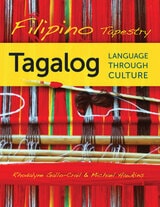
cover of Filipino Tapestry: Tagalog Language through Culture

Filipino Tapestry

Tagalog Language through Culture

Rhodalyne Gallo-Crail

University of Wisconsin Press, 2012

An official language of the Philippines, Filipino is based on Tagalog, with elements of Spanish, English, and Chinese mixed in. The result is a rich, expressive language spoken in the Philippines and throughout the far-reaching Filipino diaspora.
    Filipino Tapestry offers an innovative approach to learning language by emphasizing the critical intersection of language and culture. It provides activities and exercises that immerse beginning and intermediate students of Filipino in a variety of authentic situations to simulate an in-country experience. Starting with chapters on such topics as family, friends, and home, it then expands the student’s world in chapters prompting conversation about food, shopping, parties, and pastimes. Its later chapters push learners to discuss city and country life, cultural traditions, religion, history, and politics.
    Features include:
•    background chapters on phonology, sentence construction, and common expressions
•    photos and cultural notes about chapter themes
•    grammar, reading, listening, and speaking exercises
•    glossaries of words and additional expressions
[more]
cover of Forms of Discovery: Critical and Historical Essays on the Forms of the Short Poem in English

Forms of Discovery

Critical and Historical Essays on the Forms of the Short Poem in English

Yvor Winters

Ohio University Press, 1967
With Forms of Discovery, Yvor Winters completes his critical canon. The distinguished poet-critic defines by analysis and example the development of the method that he has called “post-Symbolist.” Starting with the styles of the English Renaissance, Winters discusses at length the felicities and shortcomings of these traditions, the main defect being that sensory imagery was little more than ornament. This sets the problem: to discover a style wherein both the conceptual and the perceptual are given their fullest expression In the work of Charles Churchill, Winters explores the development of a complexly controlled associational procedure. Here is a richly varied conceptual method, though the sensory is still almost totally absent. Churchill’s methods and those of the Renaissance masters are then contrasted with the work of the Romantics, who wrote a great deal about nature without bothering to look at it, and whose most lasting contribution would appear to be pathetically sentimental fallacies. The turn of the century, in France, Britain, and America, sees the beginning of the post-Symbolist methods, while Yeats continues the retrograde movement of the Romantics. It is in the work of poets like Tuckerman, Hardy, Bridges, Stevens, T. Sturge Moore, and Paul Valéry that rational discourse combines richly with the perceptual universe in which we live: the particular perception is enhanced by reference to general concepts, the general given substance by the particular exemplifying it. The post-Symbolist methods result in a poetry that unifies the diverse fields of human experience and employs all aspects of language. Style in Winters’ sense is not simply a way of gracefully combining words. It is the way a man lives, the method or art wherein he discovers to the best of his ability the real nature of the world in which he lives. It is in this sense that Forms of Discovery is a philosophical work, not a miscellaneous collection of essays; this book is, as Winters remarks, “an act of piety, not an act of destruction.”
[more]
cover of French Verbs Made Simple(r)

French Verbs Made Simple(r)

By David Brodsky

University of Texas Press, 2006

It's time for a new approach to learning French verbs. Unlike popular verb guides that require the rote memorization of hundreds of verb forms, this book clearly explains the rules that govern the conjugation of all classes of French verbs—especially the irregular ones that give second-language learners the most trouble. These straightforward, easy-to-understand rules for conjugating French verbs are effective learning tools for both beginning students and more advanced speakers who want to perfect their usage of French verb forms.

French Verbs Made Simple(r) has many helpful features that you won't find in any other verb guide:

  • Clear explanations of all verb tenses and forms.
  • The simple patterns and rules that govern the conjugation of all verbs—including those verbs whose irregularities follow patterns that can be easily learned.
  • A detailed discussion of how each verb form is used, with numerous examples.
  • A full explanation of whether a verb should be conjugated with avoir or être, and the conditions under which the past participle is variable—two of the thorniest problems for students of French.
  • An extended treatment of the subjunctive that will help you understand why it is used in some situations but not others.
  • Complete conjugations for 57 basic model verbs (along with 27 "variants") and a comprehensive listing of some 6,200 verbs that indicates which of the models each verb follows.

Going well beyond any other guide in the clarity and detail of its explanations—as well as the innovative manner in which individual verbs are linked to model conjugations—French Verbs Made Simple(r) is the only guide to French verbs a learner needs.
[more]
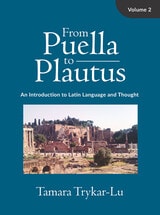
cover of From Puella to Platus: An Introduction to Latin Language and Thought, Volume 2

From Puella to Platus

An Introduction to Latin Language and Thought, Volume 2

Tamara Trykar-Lu

Catholic University of America Press, 2019
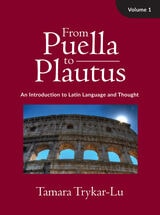
Whether to enlarge your general education, improve your English, or just because you are curious about the society that has had such a lasting influence on our history, our language, our thoughts, and our culture, you should and can learn Latin. Tamara Trykar-Lu's charming and delightful introduction to Latin, From Puella to Plautus, Part I, is designed for beginning to intermediate Latin study, at the high school or college level, either with the aid of a teacher and classroom or simply for personal enjoyment and enrichment. A thorough review of English grammar with detailed explanations makes it easy for the reader to grasp new concepts in Latin. Learning Latin vocabulary becomes manageable once you realize how much ‘Latin’ vocabulary there is in English. You will quickly learn to read Latin with short stories and, gradually, more demanding selections. Readers will translate the story of Romulus and Remus and the founding of Rome, but also the tale of Nivea -- Snow White -- and some parts of Shakespeare's plays. Short sections show how English developed, how Latin influenced it, and where they both belong in the world of languages. Each chapter ends with a brief outline of some aspect of Roman culture, such as housing, fauna and flora, games, crafts, water supply, and cooking – with recipes. And last but not least there are informative tidbits, drawings, cartoons, jokes, riddles, crossword puzzles, and, of course, pictures distributed throughout the book. For while foreign-language study should be logical, coherent, and rigorous, it need not be heavy-handed or pedantic, and certainly not dull. Ideal for use in courses or for brushing up your language skills, From Puella to Plautus is a lively and engaging book about the Latin language and life in the Roman Empire.
[more]
cover of From Puella to Plautus: An Introduction to Latin Language and Thought, Volume 1

From Puella to Plautus

An Introduction to Latin Language and Thought, Volume 1

Tamara Trykar-Lu

Catholic University of America Press, 2019
Whether to enlarge your general education, improve your English, or just because you are curious about the society that has had such a lasting influence on our history, our language, our thoughts, and our culture, you should and can learn Latin. Tamara Trykar-Lu's charming and delightful introduction to Latin, From Puella to Plautus, Part I, is designed for beginning to intermediate Latin study, at the high school or college level, either with the aid of a teacher and classroom or simply for personal enjoyment and enrichment. A thorough review of English grammar with detailed explanations makes it easy for the reader to grasp new concepts in Latin. Learning Latin vocabulary becomes manageable once you realize how much ‘Latin’ vocabulary there is in English. You will quickly learn to read Latin with short stories and, gradually, more demanding selections. Readers will translate the story of Romulus and Remus and the founding of Rome, but also the tale of Nivea -- Snow White -- and some parts of Shakespeare's plays. Short sections show how English developed, how Latin influenced it, and where they both belong in the world of languages. Each chapter ends with a brief outline of some aspect of Roman culture, such as housing, fauna and flora, games, crafts, water supply, and cooking – with recipes. And last but not least there are informative tidbits, drawings, cartoons, jokes, riddles, crossword puzzles, and, of course, pictures distributed throughout the book. For while foreign-language study should be logical, coherent, and rigorous, it need not be heavy-handed or pedantic, and certainly not dull. Ideal for use in courses or for brushing up your language skills, From Puella to Plautus is a lively and engaging book about the Latin language and life in the Roman Empire.
[more]
cover of Fulfulde (Maasina) - English - French Lexicon: A Root-Based Compilation Drawn from Extant Sources

Fulfulde (Maasina) - English - French Lexicon

A Root-Based Compilation Drawn from Extant Sources

Donald W. Osborn

Michigan State University Press, 1993

The Lexicon brings together lexical material from a wide range of published and non-published sources to create an extensive compilation of the vocabulary of Fulfulde as it is spoken in that part of central Mali known as Masina (in Fulfulde, Maasina). The Lexicon is intended primarily for non-Fulfulde speakers who are learning the language at the intermediate or advanced levels and who need access to a comprehensive reference source on Fulfulde vocabulary. Scholars, development workers, and others whose research or fieldwork involves use of the Fulfulde of Masina may find it helpful as well in clarifying nuances of meaning and standardized spelling for the less familiar terms they might encounter. It is also intended that the present work, beyond the matter of organizing vocabulary, will contribute significantly to the expanding lexicographical and linguistic investigations of Fulfulde.

[more]