Results by title
135 books match the query 'Faith' and 33 start with f
Faith In The Future
Healthcare, Aging and the Role of ReligionHarold Koenig
Templeton Press, 2012
After an interview in Newsweek about his book Spirituality in Patient Care and his research in religion and health, Dr. Harold Koenig became the international voice on spirituality, health, and aging. In this book, Faith in the Future, he is joined by two other experts on aging and human development. They present a compelling look at one of the most severe issues in today’s society: health care in America.
How will we provide quality healthcare to older adults needing it during the next thirty to fifty years? Who will provide this care? How will it be funded? How can we establish systems of care now to be in place as demographic and health-related economic pressures mount?
Alongside the sobering reality of our country’s challenges, there are reasons for optimism. Innovative programs created and maintained by volunteers and religious congregations are emerging as pivotal factors in meeting healthcare needs. Summarizing decades of scientific research and providing numerous inspirational examples and role models, the authors present practical steps that individuals and institutions may emulate for putting faith into action.
<
Faith and Community
How Engagement Strengthens Members, Places of Worship, and SocietyRebecca A. Glazier
Temple University Press, 2024
Faith and Community shows the benefits of religious people taking action in their communities. Through more than a decade of multi-method data collection, Rebecca Glazier surveyed over 4,000 congregants and nearly 500 clergy in Little Rock, Arkansas to gather opinions from members and leaders on community issues and engagement. Together with interviews and case studies, her findings indicate that active congregants are happier and more civically involved.
Faith and Community provides valuable insights into the relationship between religion and community engagement. The data illustrates how community engagement benefits individuals, congregations, and democracy and offers one solution to what ails religion in America today.
Faith and Doubt as Partners in Mormon History
Gregory A. Prince
Utah State University Press, 2014
Volume 19, The Leonard J. Arrington Lecture Series
The Special Collections and Archives of Utah State University's Merrill-Cazier Library houses the personal and historical collection of Leonard J. Arrington, renowned scholar of the American West.
The Leonard J. Arrington Mormon History Lecture annually hosts the presentation of current research by a leading scholar. Among the lecturers have been such notable historians as Thomas G. Alexander, Richard L. Bushman, Sarah Barringer Gordon, Howard Lamar, Jan Shipps, Donald Worster, and Pulitzer Prize-winner Laurel Thatcher Ulrich.
Faith and Fat Chances
A NovelCarla Trujillo
Northwestern University Press, 2015
Finalist, 2012 PEN/Bellwether Prize for Socially Engaged Fiction
Carla Trujillo brings to life another side of the fabled city of Santa Fe in this rollicking novel set in Dogtown, a dilapidated neighborhood on the outskirts of town. Home to a hardscrabble community of working people struggling to make a living on meager means, Dogtown is worlds apart from the tourists, artists, and upscale eateries just a stone’s throw away. The close-knit neighborhood thrives in its own way, until an entrepreneur arrives with a plan to cast out its occupants and construct a winery in its place.
Led by Dogtown’s unofficial mayor, Pepa Romero—an irreverent healer with old-world wisdom and new-age knowledge—the citizens of Dogtown revolt. Using everything at their disposal, including spying, supernatural powers, the law, and individual cunning, they set in motion a thrilling and at times hilarious chain of events that culminates in a storm of epic proportions. With an unforgettable cast of characters, Faith and Fat Chances illuminates the ingenuity and resilience of people fighting to preserve their way of life.
Faith and Feminism in Nineteenth-Century Religious Communities
Michaela Sohn-Kronthaler
SBL Press, 2019
Explore a diversity of feminist readings of the Bible
This latest volume in the Bible and Women series is concerned with documenting, through word and image, both well-known and largely unknown women and their relationship to the Bible from the period of the late eighteenth century up to the beginning of the twentieth century. The essays in this collection illustrate the broad range of treatment of the Holy Scripture. Paul Chilcote, Marion Ann Taylor, Christiana de Groot, Elizabeth M. Davis, and Pamela S. Nadell offer perspectives on the Anglo-American sphere during this period. Marina Cacchi, Adriano Valerio, Inmaculada Blasco Herranz, and Alexei Klutschewski and Eva Maria Synek illuminate the areas of southern and eastern Europe. Angela Berlis, Ruth Albrecht, Doris Brodbeck, Ute Gause, and Michaela Sohn-Kronthaler examine women from the German-speaking world and their texts. Bernhard Schneider, Magda Motté, Katharina Büttner-Kirschner, and Elfriede Wiltschnigg treat the subject area of religious literature and art.
Features
- Insight into how women participated in academic exegesis and applied biblical figures as models for structuring their own lives
- Exploration of genres used by women, including letters, diaries, autobiographical records, stories, novels, songs, poems, and specialized exegetical treatises and commentaries on individual books of the Bible
- Detailed analyses of women’s interpretations ranging from those that sought to confirm traditions to those that challenged them
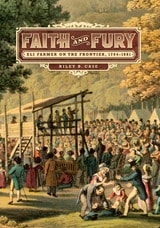
Faith and Fury
Eli Farmer on the Frontier, 1794–1881Riley B. Case
Indiana Historical Society Press, 2018
Faith and History in the Old Testament
R.A.F. MacKenzie
University of Minnesota Press, 1963
Faith and History in the Old Testament was first published in 1963. Minnesota Archive Editions uses digital technology to make long-unavailable books once again accessible, and are published unaltered from the original University of Minnesota Press editions.
This absorbing and readable account of the religion of ancient Israel is presented against the background of other cultures of the time. Father MacKenzie traces the development of Israel's belief and draws upon modern knowledge of the cultures of the ancient Near East to illuminate the history. But the main stress is on the religious meaning which the Israelites themselves perceived in the events they experienced, a meaning which is accepted and extended in different ways by modern Jews and by Christians.
The author explains, in non-technical style, the distinctive features of the faith of the Old Testament as evident in such themes as covenant, creation, retribution, the pursuit of wisdom, and the hope of salvation. At the outset, he defines the study of theology and places the study of Chrisson with that of Israel. He analyzes Israel's concept of God and the character of the covenant between God and the people of Israel, discusses the Israelite literature on the creation of earth and its creatures, and considers the interrelationship between myth and history. He discusses the search for wisdom in Israel, the public prayers, and the concept of a promise from the deity. In conclusion, he presents the interpretation by the Old Testament authors of these distinctive features of Israel's religion.
The book is intended for lay people interested in modern Bible interpretation, as well as for priests, ministers, and rabbis who wish a general survey of the Old Testament. It is suitable for use as a text or supplementary reading in religion or theology courses.
Faith and Intellect
The Lives and Contributions of Latter-day Saint ThinkersLeonard J Arrington
Signature Books, 2019

Faith and Meaning in the Southern Uplands
Loyal Jones
University of Illinois Press, 1999
In Faith and Meaning, one of Appalachian religion's most eloquent spokesmen reveals a people devoted to and thoughtful about their religion, and profoundly influenced by it. Loyal Jones's three decades of conversations and interviews, supplemented by documents such as sermons, testimonies, and articles of faith, articulate Southern Upland views on basic issues of the human condition—faith, God, the world, the Word, and the devil—as well as on community issues such as racial integration and women in the church. In their own voices these people describe their beliefs, their churches, and their lives, exposing a deep conviction tempered with humanity and humor.
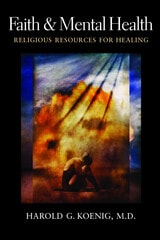
Faith and Mental Health
Religious Resources for HealingHarold G. Koenig
Templeton Press, 2005
Dr. Harold Koenig opens a window on mental health, providing an unprecedented source of practical information about the relationship between religion and mental health. He examines how Christianity and other world religions deliver mental health services today, and he makes recommendations, based on research, expertise, and experience, for new programs to meet local needs.
Meticulously researched and documented, Faith and Mental Health includes
- Research on the relationship between religion and positive emotions, psychiatric illnesses, and severe and persistent mental disorders
- Ways in which religion has influenced mental health historically, and how now and in the future it can be involved with mental health
- A comprehensive description and categorization of Christian and non-Christian faith-based organizations that provide mental health resources
- Resources for religious professionals and faith communities on how to design effective programs
Presenting a combination of the history and current research of mental health and religion along with a thorough examination of faith-based organizations operating in the field, this book is a one-of-a-kind resource for the healthcare community; its valuable research and insights will benefit medical and religious professionals, and anyone concerned with the future of mental health care.
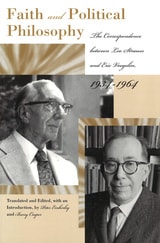
Faith and Political Philosophy
The Correspondence Between Leo Strauss and Eric Voegelin, 1934-1964Edited & Intro by Peter Emberley & Barry Cooper
University of Missouri Press, 2004
Faith and Political Philosophy consists of fifty-three letters between Leo Strauss and Eric Voegelin, two of the most important political theorists of the twentieth century. In this correspondence, Strauss and Voegelin explore the nature of their similarities and differences, offering insightful observations about one another's work, about the state of the discipline, and about the influences working on them. The letters shed light on many assumptions made in their published writings, often with an openness that removes all vestiges of uncertainty.
Faith and Reason through Christian History
A Theological EssayGrant Kaplan
Catholic University of America Press, 2022
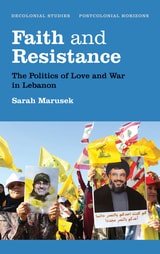
Faith and Resistance
The Politics of Love and War in LebanonSarah Marusek
Pluto Press, 2018
Faith and the Fragility of Justice
Responses to Gender-Based Violence in South AfricaMeredith Whitnah
Rutgers University Press, 2025
Faith and the Historian
CATHOLIC PERSPECTIVESEdited by Nick Salvatore
University of Illinois Press, 2006
Faith and the Historian collects essays from eight experienced historians discussing the impact of being "touched" by Catholicism on their vision of history. That first graduate seminar, these essays suggest, did not mark the inception of one's historical sensibilities; rather, that process had deeper, and earlier, roots. The authors--ranging from "cradle to the grave" Catholics to those who haven’t practiced for forty years, and everywhere in between--explicitly investigate the interplay between their personal lives and beliefs and the sources of their professional work. A variety of heartfelt, illuminating, and sometimes humorous experiences emerge from these stories of intelligent people coming to terms with their Catholic backgrounds as they mature and enter the academy. Contributors include: Philip Gleason, David Emmons, Maureen Fitzgerald, Joseph A. McCartin, Mario T. Garcia, Nick Salvatore, James R. Barrett, and Anne M. Butler.
Faith and the Pursuit of Health
Cardiometabolic Disorders in SamoaHardin, Jessica
Rutgers University Press, 2019
Faith and the Sacraments
A Commentary on The International Theological Commission's <i>The Reciprocity of Faith and Sacraments in the Sacramental Economy</i>: With Official Revised English TranslationThomas G. International Theological Comission
Catholic University of America Press, 2022
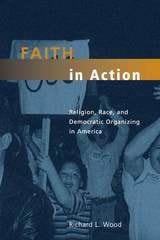
Faith in Action
Religion, Race, and Democratic Organizing in AmericaRichard L. Wood
University of Chicago Press, 2002
To find out how this faith-based form of community organizing succeeds, Richard L. Wood spent several years working with two local groups in Oakland, California—the faith-based Pacific Institute for Community Organization and the race-based Center for Third World Organizing. Comparing their activist techniques and achievements, Wood argues that the alternative cultures and strategies of these two groups give them radically different access to community ties and social capital.
Creative and insightful, Faith in Action shows how community activism and religious organizations can help build a more just and democratic future for all Americans.
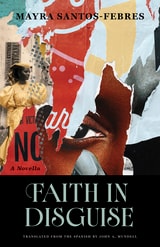
Faith in Disguise
A NovellaMayra Santos-Febres; Translated from the Spanish by John A. Mundell
Vanderbilt University Press, 2026
Faith in Paper
The Ethnohistory and Litigation of Upper Great Lakes Indian TreatiesCharles E. Cleland
University of Michigan Press, 2011
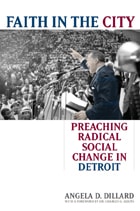
Faith in the City
Preaching Radical Social Change in DetroitAngela D. Dillard
University of Michigan Press, 2009
“The dynamics of Black Theology were at the center of the ‘Long New Negro Renaissance,’ triggered by mass migrations to industrial hubs like Detroit. Finally, this crucial subject has found its match in the brilliant scholarship of Angela Dillard. No one has done a better job of tracing those religious roots through the civil rights–black power era than Professor Dillard.”
—Komozi Woodard, Professor of History, Public Policy & Africana Studies at Sarah Lawrence College and author of A Nation within a Nation: Amiri Baraka (LeRoi Jones) and Black Power Politics
“Angela Dillard recovers the long-submerged links between the black religious and political lefts in postwar Detroit. . . . Faith in the City is an essential contribution to the growing literature on the struggle for racial equality in the North.”
—Thomas J. Sugrue, University of Pennsylvania, author of The Origins of the Urban Crisis: Race and Inequality in Postwar Detroit
Spanning more than three decades and organized around the biographies of Reverends Charles A. Hill and Albert B. Cleage Jr., Faith in the City is a major new exploration of how the worlds of politics and faith merged for many of Detroit’s African Americans—a convergence that provided the community with a powerful new voice and identity. While other religions have mixed politics and creed, Faith in the City shows how this fusion was and continues to be particularly vital to African American clergy and the Black freedom struggle.
Activists in cities such as Detroit sustained a record of progressive politics over the course of three decades. Angela Dillard reveals this generational link and describes what the activism of the 1960s owed to that of the 1930s. The labor movement, for example, provided Detroit’s Black activists, both inside and outside the unions, with organizational power and experience virtually unmatched by any other African American urban community.
Angela D. Dillard is Associate Professor of Afroamerican and African Studies at the University of Michigan. She specializes in American and African American intellectual history, religious studies, critical race theory, and the history of political ideologies and social movements in the United States.
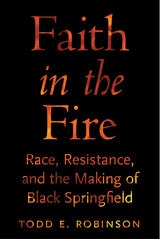
Faith in the Fire
Race, Resistance, and the Making of Black SpringfieldTodd E. Robinson
University of Massachusetts Press, 2027
An intimate history that puts the Black church at the heart of New England’s struggle with race, power, and belonging
On the eve of Barack Obama’s historic election in 2008, the Macedonia Church of God in Christ in Springfield, Massachusetts—a church built by historian Todd E. Robinson’s family—was set ablaze in an act of racial terror. This devastating event echoes a long history of attacks on Black churches, institutions that have served as vital centers of faith, civic life, and community organization.
In Faith in the Fire, Robinson charts the evolution of Springfield’s Black community from its seventeenth-century beginnings through the Great Migration and into the twenty-first century. Centering the Black church, he demonstrates how African Americans shaped the city’s industrial, cultural, and civic landscape, building social networks and organizations that became enduring anchors of community life. From the League of Gileadites, an all-Black armed anti-slavery militia, to twentieth-century initiatives like the Springfield Plan—a pioneering but short-lived experiment in interracial education—Robinson uncovers the city’s deep history of Black resistance to white supremacy. In doing so, he exposes the limits of New England’s mythic racial tolerance. Racial violence, police brutality, economic inequality, educational disparities, and housing segregation, Robinson argues, are not aberrations of the South but also enduring features of Northern life and culture.
Drawing on extensive archival research and his own family’s experience, Robinson offers a powerful and deeply personal narrative that links past and present. Through the intertwined story of Springfield’s Black community and the destruction of one of its most cherished institutions, he illuminates how the long struggle for freedom, justice, and belonging continues to shape the life of Black Americans and the nation as a whole.
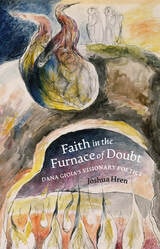
Faith in the Furnace of Doubt
Dana Gioia's Poetics of BeliefJoshua Hren
Catholic University of America Press, 2025
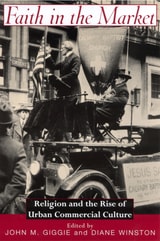
Faith in the Market
Religion and the Rise of Urban Commercial CultureEdited by John M. Giggie and Diane Winston
Rutgers University Press, 2002
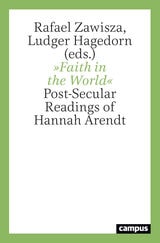
Faith in the World
Post-Secular Readings of Hannah ArendtLudger Hagedorn and Rafael Zawisza
Campus Verlag, 2021
This volume is a manifold approach to a less evident and much-neglected undercurrent in the work of Hannah Arendt, namely her ambiguous relation to the Judeo-Christian religious heritage. It contains discussions about strictly theological motives—like salvation or original sin—but it also explores topics such as forgiveness, love, natality, and the world within the religious aura.
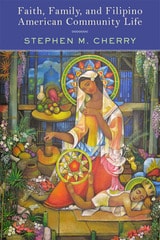
Faith, Family, and Filipino American Community Life
Cherry, Stephen M
Rutgers University Press, 2014
Stephen M. Cherry draws upon a rich set of ethnographic and survey data, collected over a six-year period, to explore the roles that Catholicism and family play in shaping Filipino American community life. From the planning and construction of community centers, to volunteering at health fairs or protesting against abortion, this book illustrates the powerful ways these forces structure and animate not only how first-generation Filipino Americans think and feel about their community, but how they are compelled to engage it over issues deemed important to the sanctity of the family.
Revealing more than intimate accounts of Filipino American lives, Cherry offers a glimpse of the often hidden but vital relationship between religion and community in the lives of new immigrants, and allows speculation on the broader impact of Filipino immigration on the nation. The Filipino American community is the second-largest immigrant community in the United States, and the Philippines is the second-largest source of Catholic immigration to this country. This ground-breaking study outlines how first-generation Filipino Americans have the potential to reshape American Catholicism and are already having an impact on American civic life through the engagement of their faith.

Faith, Family, and Flag
Branson Entertainment and the Idea of AmericaJoanna Dee Das
University of Chicago Press, 2025
Branson, Missouri, the Ozark Mountain mecca of wholesome entertainment, has been home to countless stage shows espousing patriotism and Christianity, welcoming over ten million visitors a year. Some consider it “God’s Country” and others “as close to Hell as anything on Earth.” For Joanna Dee Das, Branson is a political, religious, and cultural harbinger of a certain enduring dream of what America is. She takes Branson more seriously than the light-hearted fun it advertises—and maybe we should too.
For Das, Branson’s performers offer visions of the American Dream that embody a set of values known as the three Fs: faith, family, and flag. Branson boosters insist that these are universal values that welcome all people; the city aims to capture as many tourists as possible. But over the past several decades, faith, family, and flag have become markers of contemporary conservatism. The shows and culture of Branson, for all their fun and laughter, have been a galvanizing political force for white, working-and-middle class, Christian Americans. For social and economic conservatives alike, Branson is practically proof-of-concept for America as they want it to be.
Faith, Family, and Flag is a comprehensive history of the Branson entertainment industry, within the context of America’s long culture wars. Das reveals how and why a town known for popular entertainment, a domain associated most often with the political left (“Hollywood liberals”), came to be so important to the political right and its vision for America.
Faith, Family, and Flag
Branson Entertainment and the Idea of AmericaJoanna Dee Das
University of Chicago Press, 2025
Sons of Britches. The Great American Chuckwagon Dinner Show. The Haygoods. The Grand Jubilee. These are just a couple of the many shows performed in Branson, MO, a popular tourist destination that has played a role in the nation’s culture wars for over one hundred years.
Branson, Missouri, the Ozark Mountain mecca of wholesome entertainment, has been home to countless stage shows espousing patriotism and Christianity, welcoming over ten million visitors a year. Some consider it “God’s Country” and others “as close to Hell as anything on Earth.” For Joanna Dee Das, Branson is a political, religious, and cultural harbinger of a certain enduring dream of what America is. She takes Branson more seriously than the light-hearted fun it advertises—and maybe we should too.
For Das, Branson’s performers offer visions of the American Dream that embody a set of values known as the three Fs: faith, family, and flag. Branson boosters insist that these are universal values that welcome all people; the city aims to capture as many tourists as possible. But over the past several decades, faith, family, and flag have become markers of contemporary conservatism. The shows and culture of Branson, for all their fun and laughter, have been a galvanizing political force for white, working-and-middle class, Christian Americans. For social and economic conservatives alike, Branson is practically proof-of-concept for America as they want it to be.
Faith, Family, and Flag is a comprehensive history of the Branson entertainment industry, within the context of America’s long culture wars. Das reveals how and why a town known for popular entertainment, a domain associated most often with the political left (“Hollywood liberals”), came to be so important to the political right and its vision for America.
Faith, Force and Fiction in Medieval Baptismal Debates
Marcia L. Colish
Catholic University of America Press, 2014
Fictions of Certitude
Science, Faith, and the Search for Meaning, 1840–1920John S. Haller Jr.
University of Alabama Press, 2020
The search for belief and meaning among nineteenth-century intellectuals
The nineteenth century’s explosion of scientific theories and new technologies undermined many deep-seated beliefs that had long formed the basis of Western society, making it impossible for many to retain the unconditional faith of their forebears. A myriad of discoveries—including Faraday’s electromagnetic induction, Joule’s law of conservation of energy, Pasteur’s germ theory, Darwin’s and Wallace’s theories of evolution by natural selection, and Planck’s work on quantum theory—shattered conventional understandings of the world that had been dictated by traditional religious teachings and philosophical systems for centuries.
Fictions of Certitude: Science, Faith, and the Search for Meaning, 1840–1920 investigates the fin de siècle search for truth and meaning in a world that had been radically transformed. John S. Haller Jr. examines the moral and philosophical journeys of nine European and American intellectuals who sought deeper understanding amid such paradigmatic upheaval. Auguste Comte, John Henry Newman, Herbert Spencer, Alfred Russel Wallace, Thomas Henry Huxley, John Fiske, William James, Lester Frank Ward, and Paul Carus all belonged to an age in which one world was passing while another world that was both astounding and threatening was rising to take its place.
For Haller, what makes the work of these nine thinkers worthy of examination is how they strove in different ways to find certitude and belief in the face of an epochal sea change. Some found ways to reconceptualize a world in which God and nature coexist. For others, the challenge was to discern meaning in a world in which no higher power or purpose can be found. As explained by D. H. Meyer, “The later Victorians were perhaps the last generation among English-speaking intellectuals able to believe that man was capable of understanding his universe, just as they were the first generation collectively to suspect that he never would.”
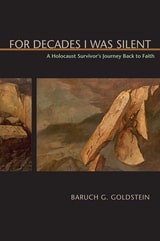
For Decades I Was Silent
A Holocaust Survivor's Journey Back to FaithBaruch G. Goldstein
University of Alabama Press, 2008
A survivor's powerful testament to faith, memory, and the triumph of the human spirit.
A fascinating memoir about a Holocaust survivor's loss of and journey back to faith. In 1939, Baruch Goldstein was a religiously observant adolescent resident of the Jewish community in Mlawa, a town that was then in East Prussia. After war broke out, the Jewish community there was relatively sheltered, as that region was incorporated into the German Reich rather than into the General Government (the German run-fragment of pre-war Poland, where conditions were harsh for everyone). However in 1942, Goldstein was sent to Auschwitz, where he stayed two-and-a-half years. His family was scattered all to their deaths, but he survived the war--barely. For Decades I Was Silent is an account of life in a small Polish-German town and provides information on the religious life of the Jewish citizens. This book creates a direct sense of the random, mystifying personal violence individuals felt at the hands of Germans--not the anonymous industrial death machine, but immediate, face-to-face violence.
After the war, Goldstein drifted as a refugee to UNRR camps in Italy. Over time, young Goldstein had to face the fact that all of his extended family was lost and he had only the possibilities of Palestine or help from distant relatives in the United States as a future. His American relatives urged him to enter the United States as a yeshiva student, and eventually he became a rabbi and started a family. As a young rabbinical student, and then as a rabbi, Goldstein was forced to confront the events of the Holocaust and the damage done to his faith.
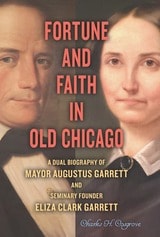
Fortune and Faith in Old Chicago
A Dual Biography of Mayor Augustus Garrett and Seminary Founder Eliza Clark GarrettCharles H. Cosgrove
Southern Illinois University Press, 2020
This engaging biography of Augustus Garrett and Eliza Clark Garrett tells two equally compelling stories: an ambitious man’s struggle to succeed and the remarkable spiritual journey of a woman attempting to overcome tragedy. By contextualizing the couple’s lives within the rich social, political, business, and religious milieu of Chicago’s early urbanization, author Charles H. Cosgrove fills a gap in the history of the city in the mid-nineteenth century.
The Garretts moved from the Hudson River Valley to a nascent Chicago, where Augustus made his fortune in the land boom as an auctioneer and speculator. A mayor during the city’s formative period, Augustus was at the center of the first mayoral election scandal in Chicago. To save his honor, he resigned dramatically and found vindication in his reelection the following year. His story reveals much about the inner workings of Chicago politics and business in the antebellum era.
The couple had lost three young children to disease, and Eliza arrived in Chicago with deep emotional scars. Her journey exemplifies the struggles of sincere, pious women to come to terms with tragedy in an age when most people attributed unhappy events to divine punishment. Following Augustus’s premature death, Eliza developed plans to devote her estate to founding a women’s college and a school for ministerial training, and in 1853 she endowed a Methodist theological school, the Garrett Biblical Institute (now the Garrett-Evangelical Theological Seminary), thereby becoming the first woman in North America to found an institution of higher learning.
In addition to illuminating our understanding of Chicago from the 1830s to the 1850s, Fortune and Faith in Old Chicago explores American religious history, particularly Presbyterianism and Methodism, and its attention to gender shows how men and women experienced the same era in vastly different ways. The result is a rare, fascinating glimpse into old Chicago through the eyes of two of its important early residents.
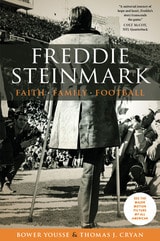
Freddie Steinmark
Faith, Family, FootballBy Bower Yousse and Thomas J. Cryan
University of Texas Press, 2015
Freddie Steinmark tells the story of a legendary University of Texas football player whose courage on the field and in battling cancer still inspires the Longhorn nation.
Freddie Steinmark started at safety for the undefeated University of Texas Longhorns in 1969. In the thrilling “Game of the Century,” a come-from-behind victory against Arkansas that ensured Texas the national championship, Steinmark played with pain in his left leg. Two days later, X-rays revealed a bone tumor so large that it seemed a miracle Steinmark could walk, let alone play football. Within a week of the Arkansas game, his leg was amputated.
A gritty, undersized player, Steinmark had quickly become a fan favorite at Texas. What he endured during the Longhorns’ memorable 1969 season, and what he encountered afterward, captivated not only Texans but the country at large. Americans watched closely as Steinmark confronted life’s ultimate challenge, and his openness during his battle against savage odds helped reframe the national conversation surrounding cancer and the ongoing race for a cure.
Written with unfettered access to the Steinmark family and archives, Freddie Steinmark: Faith, Family, Football is the exploration of a brief but full life, one that began humbly but ended on a grand stage. It is a fitting tribute to a legendary Longhorn whose photograph, emblazoned with the word “Heart,” flashes on the Freddie Steinmark Scoreboard’s Jumbotron prior to each home football game in UT’s Darrell K Royal–Texas Memorial Stadium at Joe Jamail Field.