Results by title
340 books match the query 'Folklore' and 33 start with f

Fan Phenomena
MermaidsEdited by Matthieu Guitton
Intellect Books, 2016
Mermaids, and merfolk more generally, are everywhere you look. Merfolk devotees march in themed parades and practice mermaid-ing—swimming with a mermaid tail. There’s mermaid fiction and mermaid virtual reality; mermaid art and #mermaid trends. You may not know it, but transgenerational merfolk fan communities stretch around the world—from sea to shining sea. And their popularity is only growing.
In Fan Phenomena: Mermaids, Matthieu Guitton assembles a star-studded cast of scholars and popular culture insiders to decode the mermaid phenomenon. The book explores how merfolk have evolved in popular culture and what it is that grants them their privileged status among fantasy creatures. Illustrated throughout with fan photographs and stills from a plethora of films and TV shows, this new addition to the Fan Phenomena series promises to both fascinate and delight readers—earthbound and ocean-going alike.
Feminist Messages
CODING IN WOMEN'S FOLK CULTUREEdited by Joan Newlon Radner
University of Illinois Press, 1993

Feminist Theory and the Study of Folklore
Edited by Susan Tower Hollis, Linda Pershing, and M. Jane Young
University of Illinois Press, 1994

Fictional Blues
Narrative Self-Invention from Bessie Smith to Jack WhiteKimberly Mack
University of Massachusetts Press, 2020
The familiar story of Delta blues musician Robert Johnson, who sold his soul to the devil at a Mississippi crossroads in exchange for guitar virtuosity, and the violent stereotypes evoked by legendary blues “bad men” like Stagger Lee undergird the persistent racial myths surrounding “authentic” blues expression. Fictional Blues unpacks the figure of the American blues performer, moving from early singers such as Ma Rainey and Big Mama Thornton to contemporary musicians such as Amy Winehouse, Rhiannon Giddens, and Jack White to reveal that blues makers have long used their songs, performances, interviews, and writings to invent personas that resist racial, social, economic, and gendered oppression.
Using examples of fictional and real-life blues artists culled from popular music and literary works from writers such as Walter Mosley, Alice Walker, and Sherman Alexie, Kimberly Mack demonstrates that the stories blues musicians construct about their lives (however factually slippery) are inextricably linked to the “primary story” of the narrative blues tradition, in which autobiography fuels musicians' reclamation of power and agency.
First Timers and Old Timers
Kenneth L. Untiedt
University of North Texas Press, 2012
Folk Culture in the Digital Age
The Emergent Dynamics of Human InteractionTrevor J. Blank
Utah State University Press, 2012
Smart phones, tablets, Facebook, Twitter, and wireless Internet connections are the latest technologies to have become entrenched in our culture. Although traditionalists have argued that computer-mediated communication and cyberspace are incongruent with the study of folklore, Trevor J. Blank sees the digital world as fully capable of generating, transmitting, performing, and archiving vernacular culture. Folklore in the Digital Age documents the emergent cultural scenes and expressive folkloric communications made possible by digital “new media” technologies.
New media is changing the ways in which people learn, share, participate, and engage with others as they adopt technologies to complement and supplement traditional means of vernacular expression. But behavioral and structural overlap in many folkloric forms exists between on- and offline, and emerging patterns in digital rhetoric mimic the dynamics of previously documented folkloric forms, invoking familiar social or behavior customs, linguistic inflections, and symbolic gestures.
Folklore in the Digital Age provides insights and perspectives on the myriad ways in which folk culture manifests in the digital age and contributes to our greater understanding of vernacular expression in our ever-changing technological world.

Folk Groups And Folklore Genres Reader
A Readeredited by Elliott Oring
Utah State University Press, 1989
Folk Groups And Folklore Genres
An Introductionedited by Elliott Oring
Utah State University Press, 1986
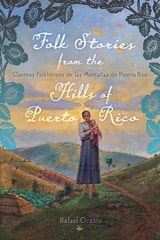
Folk Stories from the Hills of Puerto Rico / Cuentos folklóricos de las montañas de Puerto Rico
Rafael Ocasio
Rutgers University Press, 2021
Some stories provide a distinctive Caribbean twist on classic tales including “Snow White” and “Cinderella.” Others fictionalize the lives of local historical figures, such as infamous pirate Roberto Cofresí, rendered here as a Robin Hood figure who subverts the colonial social order. The collection also introduces such beloved local characters as Cucarachita Martina, the kind cockroach who falls in love with Ratoncito Pérez, her devoted mouse husband who brings her delicious food.
Including a fresh English translation of each folktale as well as the original Spanish version, the collection also contains an introduction from literary historian Rafael Ocasio that highlights the historical importance of these tales and the Jíbaro cultural values they impart. These vibrant, funny, and poignant stories will give readers unique insights into Puerto Rico’s rich cultural heritage.
Esta nueva y emocionante antología reúne cuentos populares puertorriqueños que fueron transmitidos oralmente durante generaciones antes de ser finalmente transcritos comenzando en 1914 por el equipo del famoso antropólogo Franz Boas. Estos encantadores cuentos ofrecen a los lectores un vistazo a la imaginación y las aspiraciones de los jíbaros, los campesinos de Puerto Rico.
Algunas historias brindan un distintivo toque caribeño a cuentos clásicos como "Blanca Nieves" y "Cenicienta". Otros ficcionalizan la vida de personajes históricos locales, como el famoso pirata Roberto Cofresí, representado como una figura al estilo de Robin Hood, quien subvierte el orden social colonial. La colección también presenta personajes locales tan queridos como Cucarachita Martina, la amable cucaracha que se enamora de Ratoncito Pérez, su devoto esposo ratón que le trae deliciosa comida.
Incluyendo una nueva traducción al inglés de estos cuentos populares, así como las versiones originales en español, la colección también contiene una introducción del historiador literario Rafael Ocasio, quien destaca la importancia histórica de estos cuentos y los valores culturales del jíbaro que éstos imparten en los relatos. Estas historias vibrantes, divertidas y conmovedoras brindarán a los lectores una visión única de la rica herencia cultural de Puerto Rico.
Introducción en español (https://d3tto5i5w9ogdd.cloudfront.net/wp-content/uploads/2021/02/03154419/Ocasio_Cuentos_Intro_Espan%CC%83ol.pdf)
Rafael Ocasio will discussing his book, 'Folk Stories from the Hills of Puerto Rico / Cuentos folklóricos de las montañas de Puerto Rico' at Biblioteca Juvenil de Mayagüez in Puerto Rico (https://youtu.be/o6Tub094EoI)

Folklore Genres
Edited by Dan Ben-Amos
University of Texas Press, 1976
The essays in Folklore Genres represent development in folklore genre studies, diverging into literary, ethnographic, and taxonomic questions. The study as a whole is concerned with the concept of genre and with the history of genre theory. A selective bibliography provides a guide to analytical and theoretical works on the topic.
The literary-oriented articles conceive of folklore forms, not as the antecedents of literary genres, but as complex, symbolically rich expressions. The ethnographically oriented articles, as well as those dealing with classification problems, reveal dimensions of folklore that are often obscured from the student reading the folklore text alone. It has long been known that the written page is but a pale reproduction of the spoken word, that a tale hardly reflects the telling. The essays in this collection lead to an understanding of the forms of oral literature as multidimensional symbols of communication and to an understanding of folklore genres as systematically related conceptual categories in culture. What kinship terms are to social structure, genre terms are to folklore. Since genres constitute recognized modes of folklore speaking, their terminology and taxonomy can play a major role in the study of culture and society.
The essays were originally published in Genre (1969–1971); introduction, bibliography, and index have been added to this edition.
Folklore Methodology
Formulated by Julius Krohn and Expanded by Nordic ResearchersBy Kaarle Krohn
University of Texas Press, 1971
Kaarle Krohn's Folklore Methodology was the first systematic attempt to state a method of studying folkloristic materials. For centuries scholars had collected folkloristic texts and had commented on them, but they had not tried to formulate a method of investigating folklore.
Folklore Methodology became the handbook for the great Finnish School of folklore research. It provided for its students a guide to the geographical research of traditional materials, a radical departure from the literary scholarship that had dominated folklore studies.
Krohn's book explores the causes and modes of folklore diffusion, development, and destruction; it outlines the influences that cause change in folklore; it provides valuable insights into the nature of folklore; and, finally, it develops geographic methods for analyzing, classifying, and reconstructing individual items from the folk repertoire.
While many developments have taken place since Krohn first published his guide, important new concepts of folklore research sprang from his efforts. For this reason, Folklore Methodology is mandatory reading for every serious student of folklore.
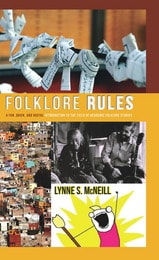
Folklore Rules
A Fun, Quick, and Useful Introduction to the Field of Academic Folklore StudiesS.
Utah State University Press, 2013
- What Is Folklore?
- What Do Folklorists Do
- Types of Folklore
- Types of Folk Groups;
- What Do I Do Now?
These chapters guide students toward a working understanding of the field, learn basic terms and techniques, and learn to perceive the knowledge base and discourse frame for materials used in folklore courses. Folklore Rules has become a classic text, serving instructors and students for a variety of courses, including introductory folklore and comparative studies as well as literature, anthropology, and composition classes that include a folklore component.

Folklore and Culture on the Texas-Mexican Border
By Américo Paredes
University of Texas Press, 1995
In an illustrious career spanning over forty years, Américo Paredes has often set the standard for scholarship and writing in folklore and Chicano studies. In folklore, he has been in the vanguard of important theoretical and methodological movements. In Chicano studies, he stands as one of the premier exponents.
Paredes's books are widely known and easily available, but his scholarly articles are not so familiar or accessible. To bring them to a wider readership, Richard Bauman has selected eleven essays that eloquently represent the range and excellence of Paredes's work. The hardcover edition of Folklore and Culture was published in 1993. This paperback edition will make the book more accessible to the general public and more practical for classroom use.
Folklore and Folklife
An IntroductionRichard M. Dorson
University of Chicago Press, 1982
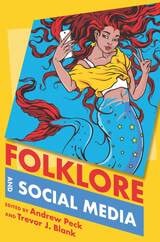
Folklore and Social Media
Andrew Peck
Utah State University Press, 2020
This book features twelve chapters ranging in topics from legend transmission and fake news to case studies of memes, joke cycles, and Twitter hashtag campaigns and offers fresh insights on digital heritage and web archiving. The editors and contributors take both the “digital” and “folklore” elements seriously because social media fundamentally changes folk practices in new, though often invisible, ways. Social media platforms encourage hybrid performances that appear informal and ordinary while also offering significant space to obfuscate backstage behaviors through editing and retakes. The result is that expression online becomes increasingly reminiscent of traditional forms of face-to-face interaction, while also hiding its fundamental differences.
Folklore and Social Media demonstrates various ways to refine methods and analyses in order to develop a better understanding of the informal and traditional dynamics that define an era of folklore and social media. It is an invaluable addition to the literature on digital folklore scholarship that will be of interest to students and scholars alike.
Contributors:
Sheila Bock, Peter M. Broadwell, Bill Ellis, Jeana Jorgensen, Liisi Laineste, John Laudun, Linda J. Lee, Lynne S. McNeill, Ryan M. Milner, Whitney Phillips, Vwani Roychowdhury, Timothy R. Tangherlini, Tok Thompson, Elizabeth Tucker, Kristiana Willsey

Folklore and the Internet
Vernacular Expression in a Digital WorldTrevor J. Blank
Utah State University Press, 2009
A pioneering examination of the folkloric qualities of the World Wide Web, e-mail, and related digital media. These stuidies show that folk culture, sustained by a new and evolving vernacular, has been a key, since the Internet's beginnings, to language, practice, and interaction online. Users of many sorts continue to develop the Internet as a significant medium for generating, transmitting, documenting, and preserving folklore.
In a set of new, insightful essays, contributors Trevor J. Blank, Simon J. Bronner, Robert Dobler, Russell Frank, Gregory Hansen, Robert Glenn Howard, Lynne S. McNeill, Elizabeth Tucker, and William Westerman showcase ways the Internet both shapes and is shaped by folklore
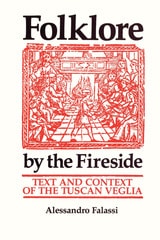
Folklore by the Fireside
Text and Context of the Tuscan VegliaBy Alessandro Falassi
University of Texas Press, 1980
For centuries, social life in rural Tuscany has centered around the veglia, an evening gathering of family and friends at the hearth. Folklore by the Fireside is a thorough and insightful study of this custom—from the tales, riddles, lullabies, and folk prayers performed as the small children are put to bed to the courtship songs and dances later in the evening to the anti-veglia male gossip, card games, and protest songs originating in the tavern.
Alessandro Falassi skillfully correlates the veglia to the rites of passage and family values of an agrarian society. Although the impact of mass media and other factors has tended to weaken the tradition, even today Tuscan children are taught to behave and adolescents are guided along the conventional path to adulthood, courtship, and marriage through veglia folklore.
This is the first work to deal systematically with Tuscan folklore from a semiotic and structural viewpoint and to examine the veglia as a means of handing down traditional values. It is important not only for its careful, detailed description but also for its rigorous methodology and theoretical richness.

Folklore from the Schoharie Hills, New York
Emelyn Elizabeth Gardner
University of Michigan Press, 1937

Folklore in Motion
Texas Travel LoreKenneth L. Untiedt
University of North Texas Press, 2007
Folklore in New World Black Fiction
Writing and the Oral Traditional AestheticsChiji Akoma
The Ohio State University Press, 2007
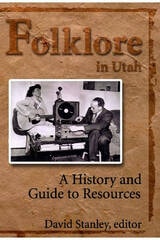
Folklore in Utah
A History and Guide to ResourcesDavid Stanley
Utah State University Press, 2004
Over thirty scholars examine the development of folklore studies through the lens of over one hundred years of significant activity in a state that has provided grist for the mills of many prominent folklorists. In the past the Folklore Society of Utah has examined the work of such scholars in biographical and other essays published in its newsletters. This book incorporates those essays and goes well beyond them to include many other topices, offering a thorough history of folklore studies and a guide to resources for those pursuing research in Utah now and in the future.
The essays survey the development and contributions of folklore studies in Utah from 1892 to 2004 but also represent developments in both academic and public-sector folklore throughout the United States. Following a thorough historical introduction, part I profiles the first folklorists working in the state, including Hector Lee, Thomas Cheney, Austin and Alta Fife, Wayland Hand, and Lester Hubbard. Part II looks at the careers of prominent Utah folklorists Jan Harold Brunvand, Barre Toelken, and William B. Wilson, as well as the works of the next, current generation of folklorists. Part III covers studies in major folklore genres, with essays on the study of material culture, vernacular architecture, and Mormon, ethnic, Native American, and Latino folklore. Part IV examines public folklore programs including organizations, conferences, and tourism. Back matter describes academic programs at Utah institutions of higher education, summarizes the holdings of the various folklore archives in the state, and provides a complete cross-indexed bibliography of articles, books, and recordings of Utah folklore.
Folklore in the Nordic World
Thomas A. DuBois
University of Wisconsin Press, 2024
From methods of preparing suovabiergu (smoked reindeer meat) in Sápmi, to celebrating graduation by “running the falls” at Uppsala University in Sweden, to massive folk music festivals in Finland and tales of supernatural visitors bestowing baby names in Iceland, folklore offers unique insights into the everyday life of Nordic society. The study of Nordic folklore began in the nineteenth century, when early folklorists imagined that the true character of a nation could be found among the tales of the peasantry. Today, the theories, tools, and institutions developed by influential folklorists in the Nordic region continue to lead the way in documentation, preservation, and analysis of folklore.
Folklore in the Public Square
How the Study of Traditional Culture Can Solve Contemporary Social ProblemsAndrea Kitta
Utah State University Press, 2026
Folklore is often positioned at the center of critical social issues. While folklorists have acknowledged this power and explored how folklore has been used for political ends, far less attention has been paid to the role folklorists and folklore scholarship can play in addressing contemporary social issues in public discourse. Folklore in the Public Square explores how folklorists apply their research to engage general audiences and address the challenging issues we face daily.
Folklore in the Public Square brings together folklorists working in the humanities and the social sciences committed to applying their research to help solve contemporary social challenges, formalizing an undercurrent of thought that has gained growing attention. Case studies apply ethical research to address pervasive questions about the environment, poverty, health and healthcare, political partisanship, war, tourism, stigma, racism, and conspiracy theories, among others. Building on conversations raised by folklorists who have contributed to public programming or conducted collaborative research in local communities, this book appeals to anyone interested in contemporary social issues, applied research, or collaborative and ethical fieldwork.
Folklore of the Atayal of Formosa and the Mountain Tribes of Luzon
Edward Norbeck
University of Michigan Press, 1950
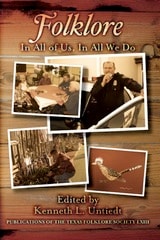
Folklore
In All of Us, In All We DoKenneth L. Untiedt
University of North Texas Press, 2006
Folklorist in the Marketplace
Conversations at the Crossroads of Vernacular Culture and EconomicsWillow G. Mullins
Utah State University Press, 2019
As trade, technology, and geopolitics have led to a rapid increase in the global spread of cultural products like media, knowledge, objects, and folkways, there has been a concomitant rise in fear and anxiety about globalization’s dark other side—economic nativism, neocolonialism, cultural appropriation, and loss. Culture has become a resource and a currency in the global marketplace. This movement of people and forms necessitates a new textual consideration of how folklore and economics interweave. In The Folklorist in the Marketplace, contributors explore how the marketplace and folklore have always been integrally linked and what that means at this cultural and economic moment.
Covering a variety of topics, from creel boats to the history of a commune that makes hammocks, The Folklorist in the Marketplace goes far beyond the well-trod examinations of material culture to look closely at the historical and contemporary intersections of these two disciplines and to provoke cross-disciplinary conversation and collaboration.
Contributors:
William A. Ashton, Halle M. Butvin, James I. Deutsch, Christofer Johnson, Michael Lange, John Laudun, Julie M-A LeBlanc, Cassie Patterson, Rahima Schwenkbeck, Amy Shuman, Irene Sotiropoulou, Yuanhao Zhao
Folktales from Syria
Collected by Samir Tahhan
University of Texas Press, 2004
Syrian poet Samir Tahhan collected folktales from old men sitting outside their houses in Aleppo, drinking tea. Afraid these stories would disappear with the passing of this generation, Tahhan also went to halls and events to hear professional storytellers and record their performances. Anthropologist Andrea Rugh helped translate the resulting two volumes of stories from the original Arabic and wrote the informative introduction to this one-volume collection.
Some of the tales appeared in rhyming verse in Arabic and some were based on events that are said to have actually taken place in Aleppo. Rugh explains the concepts of the most popular types of Syrian story structures: the gissa, the hikaya, and the hudutha. With two of the poems, the Arabic and the English are shown side by side in order to demonstrate the internal poetic structures of the original rhymes.
With their emphasis on morality and social values, the tales will be familiar to Western audiences. Another value for the reader is finding the accepted social values and behaviors that Arab adults try to inculcate in their younger generation, often through complex characterizations. Teasing out these meanings gives the reader an appreciation for the act of translation and hints of the power of the Arabic language in prose and poetry.
Professional illustrator Douglas Rugh has provided the book's black-and-white prints based on the stories and his experiences as a child growing up in the Middle East.
Folktales from the Helotes Settlement
John Igo
University of North Texas Press, 2014
Following Tradition
Folklore in the Discourse of American CultureSimon J. Bronner
Utah State University Press, 1998
Following Tradition is an expansive examination of the history of tradition—"one of the most common as well as most contested terms in English language usage"—in Americans' thinking and discourse about culture. Tradition in use becomes problematic because of "its multiple meanings and its conceptual softness." As a term and a concept, it has been important in the development of all scholarly fields that study American culture. Folklore, history, American studies, anthropology, cultural studies, and others assign different value and meaning to tradition. It is a frequent point of reference in popular discourse concerning everything from politics to lifestyles to sports and entertainment. Politicians and social advocates appeal to it as prima facie evidence of the worth of their causes. Entertainment and other media mass produce it, or at least a facsimile of it. In a society that frequently seeks to reinvent itself, tradition as a cultural anchor to be reverenced or rejected is an essential, if elusive, concept. Simon Bronner's wide net captures the historical, rhetorical, philosophical, and psychological dimensions of tradition. As he notes, he has written a book "about an American tradition—arguing about it." His elucidation of those arguments makes fascinating and thoughtful reading. An essential text for folklorists, Following Tradition will be a valuable reference as well for historians and anthropologists; students of American studies, popular culture, and cultural studies; and anyone interested in the continuing place of tradition in American culture.
Forging Southeastern Identities
Social Archaeology, Ethnohistory, and Folklore of the Mississippian to Early Historic SouthGregory A. Waselkov
University of Alabama Press, 2017
Forging Southeastern Identities explores the many ways archaeologists and ethnohistorians define and trace the origins of Native Americans’ collective social identity.
Forging Southeastern Identities: Social Archaeology and Ethnohistory of the Mississippian to Early Historic South, a groundbreaking collection of ten essays, covers a broad expanse of time—from the ninth to the nineteenth centuries—and focuses on a common theme of identity. These essays represent the various methods used by esteemed scholars today to study how Native Americans in the distant past created new social identities when old ideas of the self were challenged by changes in circumstance or by historical contingencies.
Archaeologists, anthropologists, and folklorists working in the Southeast have always recognized the region’s social diversity; indeed, the central purpose of these disciplines is to study peoples overlooked by the mainstream. Yet the ability to define and trace the origins of a collective social identity—the means by which individuals or groups align themselves, always in contrast to others—has proven to be an elusive goal. Here, editors Gregory A. Waselkov and Marvin T. Smith champion the relational identification and categorical identification processes, taken from sociological theory, as effective analytical tools.
Taking up the challenge, the contributors have deployed an eclectic range of approaches to establish and inform an overarching theme of identity. Some investigate shell gorgets, textiles, shell trade, infrastructure, specific sites, or plant usage. Others focus on the edges of the Mississippian world or examine colonial encounters between Europeans and native peoples. A final chapter considers the adaptive malleability of historical legend in the telling and hearing of slave narratives.
Foxboy
Intimacy and Aesthetics in Andean StoriesBy Catherine J. Allen
University of Texas Press, 2011
Once there was a Quechua folktale. It begins with a trickster fox's penis with a will of its own and ends with a daughter returning to parents who cannot recognize her until she recounts the uncanny adventures that have befallen her since she ran away from home. Following the strange twists and turnings of this tale, Catherine J. Allen weaves a narrative of Quechua storytelling and story listening that links these arts to others—fabric weaving, in particular—and thereby illuminates enduring Andean strategies for communicating deeply felt cultural values.
In this masterful work of literary nonfiction, Allen draws out the connections between two prominent markers of ethnic identity in Andean nations—indigenous language and woven cloth—and makes a convincing case that the connection between language and cloth affects virtually all aspects of expressive culture, including the performing arts. As she explores how a skilled storyteller interweaves traditional tales and stock characters into new stories, just as a skilled weaver combines traditional motifs and colors into new patterns, she demonstrates how Andean storytelling and weaving both embody the same kinds of relationships, the same ideas about how opposites should meet up with each other. By identifying these pervasive patterns, Allen opens up the Quechua cultural world that unites story tellers and listeners, as listeners hear echoes and traces of other stories, layering over each other in a kind of aural palimpsest.
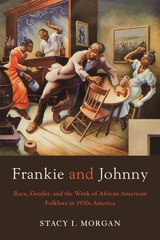
Frankie and Johnny
Race, Gender, and the Work of African American Folklore in 1930s AmericaBy Stacy I. Morgan
University of Texas Press, 2017
Winner, Wayland D. Hand Prize, American Folklore Society, 2018
Originating in a homicide in St. Louis in 1899, the ballad of “Frankie and Johnny” became one of America’s most familiar songs during the first half of the twentieth century. It crossed lines of race, class, and artistic genres, taking form in such varied expressions as a folk song performed by Huddie Ledbetter (Lead Belly); a ballet choreographed by Ruth Page and Bentley Stone under New Deal sponsorship; a mural in the Missouri State Capitol by Thomas Hart Benton; a play by John Huston; a motion picture, She Done Him Wrong, that made Mae West a national celebrity; and an anti-lynching poem by Sterling Brown.
In this innovative book, Stacy I. Morgan explores why African American folklore—and “Frankie and Johnny” in particular—became prized source material for artists of diverse political and aesthetic sensibilities. He looks at a confluence of factors, including the Harlem Renaissance, the Great Depression, and resurgent nationalism, that led those creators to engage with this ubiquitous song. Morgan’s research uncovers the wide range of work that artists called upon African American folklore to perform in the 1930s, as it alternately reinforced and challenged norms of race, gender, and appropriate subjects for artistic expression. He demonstrates that the folklorists and creative artists of that generation forged a new national culture in which African American folk songs featured centrally not only in folk and popular culture but in the fine arts as well.
Frenchtown Chronicles of Prairie du Chien
History and Folklore from Wisconsin's FrontierMary Elise Antoine
Wisconsin Historical Society Press, 2016
Albert Coryer, the grandson of a fur trade voyageur-turned-farmer, had a gift for storytelling. Born in 1877, he grew up in Prairie du Chien hearing tales of days gone by from his parents, grandparents, and neighbors who lived in the Frenchtown area. Throughout his life, Albert soaked up the local oral traditions, including narratives about early residents, local landmarks, interesting and funny events, ethnic customs, myths, and folklore.
Late in life, this lively man who had worked as a farm laborer and janitor drew a detailed illustrated map of the Prairie du Chien area and began to write his stories out longhand, in addition to sharing them in an interview with a local historian and folklore scholar. The map, stories, and interview transcript provide a colorful account of Prairie du Chien in the late nineteenth century, when it was undergoing significant demographic, social, and economic change. With sharp historical context provided by editors Lucy Eldersveld Murphy and Mary Elise Antoine, Coryer’s tales offer an unparalleled window into the ethnic community comprised of the old fur trade families, Native Americans, French Canadian farmers, and their descendants.