Results by title
1441 books match the query 'Great Britain' and 52 start with f
FEMINIST REALISM AT THE FIN DE SIÈCLE
The Influence of the Late-Victorian Woman’s Press on the Development of the NovelMolly Youngkin
The Ohio State University Press, 2007
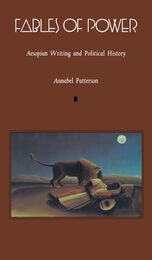
Fables of Power
Aesopian Writing and Political HistoryAnnabel Patterson
Duke University Press, 1991
Patterson begins with an analysis of the legendary Life of Aesop, its cultural history and philosophical implications, a topic that involves such widely separated figures as La Fontaine, Hegel, and Vygotsky. The myth’s origin is recovered here in the saving myth of Aesop the Ethiopian, black, ugly, who began as a slave but become both free and influential, a source of political wisdom. She then traces the early modern history of the fable from Caxton, Lydgate, and Henryson through the eighteenth century, focusing on such figures as Spenser, Sidney, Lyly, Shakespeare, and Milton, as well as the lesser-known John Ogilby, Sir Roger L’Estrange, and Samuel Croxall.
Patterson discusses the famous fable of The Belly and the Members, which, because it articulated in symbolic terms some of the most intransigent problems in political philosophy and practice, was still going strong as a symbolic text in the mid-nineteenth century, where it was focused on industrial relations by Karl Marx and by George Eliot against electoral reform.
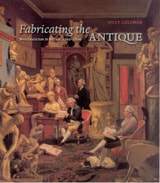
Fabricating the Antique
Neoclassicism in Britain, 1760-1800Viccy Coltman
University of Chicago Press, 2006
Looking at the theoretical foundations of neoclassicism, Coltman contends this reinvention of ancient material culture was more than a fabrication of style. Based in the strong emphasis on classical education during this time, neoclassicism, Coltman claims, could be more accurately described as a style of thought translated into material possessions. Fabricating the Antique is a new take on both well-known collections of ancient art and newly cataloged artifacts. This book also covers how these objects—once removed from their original context—were received, preserved, and displayed. Art historians, classicists, and archaeologists alike will benefit from this important examination of British eighteenth-century history.
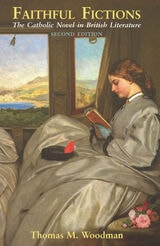
Faithful Fictions
The Catholic Novel in British LiteratureThomas M. Woodman
Catholic University of America Press, 2022
Faithful Translators
Authorship, Gender, and Religion in Early Modern EnglandJaime Goodrich
Northwestern University Press, 2014
Fallenness in Victorian Women's Writing
Marry, Stitch, Die, Or Do WorseDeborah Anna Logan
University of Missouri Press, 1998
The Angel-in-the-House is an ideal commonly used to define sexual standards of the Victorian Age. Although widely considered to be the cultural "norm," the Victorian Angel, revered for her morality, domestic virtue, and dedication to the family, is more frequently depicted in the literature of the time as an anomaly. In fact, a primary concern of Victorian literature appears to be the many exceptions to this unattainable ideal, which, according to the period's madonna-or-harlot polarity, casts these exceptions as fallen women. Deborah Anna Logan presents an unusual study of this image of fallenness in Victorian literature, focusing on the links among angelic ideology, sexuality, and, more important, social deviance.
Fallenness, according to Logan, does not refer simply to women who have sexually strayed from morality; besides prostitutes, the ranks of the fallen include unmarried mothers, needlewomen, alcoholics, the insane, the childless, the anorexic, slaves, and harem women. All of these women are presented as fallen because they fail to conform to sexual and social norms. In some cases, economic need was responsible for women's failure to uphold the ideals of domesticity and motherhood that were so revered in nineteenth- century society. But other examples illustrate the power of angelic ideology to construct deviancy even out of nonsexual behaviors.
Logan's study is distinguished by its exclusive focus on women writers, including Charlotte Brontë, George Eliot, Elizabeth Gaskell, Harriet Martineau, Elizabeth Barrett Browning, Florence Nightingale, Sarah Grand, and Mary Prince. Logan utilizes primary texts from these Victorian writers as well as contemporary critics such as Catherine Gallagher and Elaine Showalter to provide the background on social factors that contributed to the construction of fallen-woman discourse. Examining novels, short stories, poetry, and travel journals, Logan successfully demonstrates the rich links between these writers and their fallen characters--links in which, for women, even the act of writing becomes a type of fallenness.
Fallenness in Victorian Women's Writing is a significant and original contribution to the study of literature. Logan's thoroughly researched and attractively presented book will be of special interest to students of Victorian and women's studies, as well as to the general reader.

Familiar Stranger
A Life Between Two IslandsStuart Hall
Duke University Press, 2017
Growing up in a middle-class family in 1930s Kingston, Jamaica, still then a British colony, the young Stuart Hall found himself uncomfortable in his own home. He lived among Kingston's stiflingly respectable brown middle class, who, in their habits and ambitions, measured themselves against the white elite. As colonial rule was challenged, things began to change in Kingston and across the world. In 1951 a Rhodes scholarship took Hall across the Atlantic to Oxford University, where he met young Jamaicans from all walks of life, as well as writers and thinkers from across the Caribbean, including V. S. Naipaul and George Lamming. While at Oxford he met Raymond Williams, Charles Taylor, and other leading intellectuals, with whom he helped found the intellectual and political movement known as the New Left. With the emotional aftershock of colonialism still pulsing through him, Hall faced a new struggle: that of building a home, a life, and an identity in a postwar England so rife with racism that it could barely recognize his humanity.
With great insight, compassion, and wit, Hall tells the story of his early life, taking readers on a journey through the sights, smells, and streets of 1930s Kingston while reflecting on the thorny politics of 1950s and 1960s Britain. Full of passion and wisdom, Familiar Stranger is the intellectual memoir of one of our greatest minds.
Family Fortunes
Men and Women of the English Middle Class, 1780-1850Leonore Davidoff and Catherine Hall
University of Chicago Press, 1987
"The book explores how the middle class constructed its own institutions, material culture and values during the industrial revolution, looking at two settings—urban manufacturing Birmingham and rural Essex—both centers of active capitalist development. The use of sources is dazzling: family business records, architectural designs, diaries, wills and trusts, newspapers, prescriptive literature, sermons, manuscript census tracts, the papers of philanthropic societies, popular fiction, and poetry.
"Family Fortunes occupies a place beside Mary Ryan's The Cradle of the Middle Class and Suzanne Lebsock's Free Women of Petersburg. It provides scholars with a definitive study of the middle class in England, and facilitates a comparative perspective on the history of middle-class women, property, and the family."—Judith Walkowitz, Johns Hopkins University

Family Law Matters
Katherine O'Donovan
Pluto Press, 1993
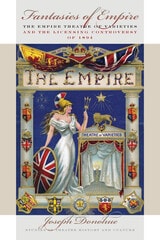
Fantasies of Empire
The Empire Theatre of Varieties and the Licensing Controversy of 1894Joseph Donohue
University of Iowa Press, 2005
Fantasies of Empire is the first book to recount in full the story of the Empire licensing controversy in all its captivating detail. Contemporaneous accounts are interwoven with Donohue’s identification and analysis of the larger issues raised: What the controversy reveals about contemporary sexual and social relations, what light it sheds on opposing views regarding the place of art and entertainment in modern society, and what it says about the pervasive effect of British imperialism on society’s behavior in the later years of Queen Victoria’s reign. Donohue connects the controversy to one of the most interesting developments in the history of modern theatre, the simultaneous emergence of a more sophisticated, varied, and moneyed audience and a municipal government insistent on its right to control and regulate that audience’s social and cultural character and even its moral behavior.
Rich in illustrations and entertainingly written, Fantasies of Empire will appeal to theatre, dance, and social historians and to students of popular entertainment, the Victorian period, urban studies, gender studies, leisure studies, and the social history of architecture.

Fantasy, Fashion, and Affection
Editions of Robert Herrick's Poetry for the Common Reader, 1810–1968Jay Gertzman
University of Wisconsin Press, 1986
Farm to Form
Modernist Literature and Ecologies of Food in the British EmpireJessica Martell
University of Nevada Press, 2020
Deeply informed by Martell’s extensive knowledge of modern British, Irish, American, and World Literatures, this progressive work positions modernism as central to the study of narratives of resistance against social and environmental degradation. Analyzed works include those of Thomas Hardy, E. M. Forster, Virginia Woolf, Joseph Conrad, George Russell, and James Joyce.
In light of climate change, fossil fuel supremacy, nutritional dearth, and other pressing food issues, modernist texts bring to life an era of crisis and anxiety similar to our own. In doing so, Martell summons the past as a way to employ the modernist term of “defamiliarizing” the present so that entrenched perceptions can be challenged. Our current food regime is both new and constantly evolving with the first industrial food trades. Studying earlier cultural responses to them invites us to return to persistent problems with new insights and renewed passion.
Fashioning Celebrity
Eighteenth-Century British Actresses and Strategies for Image MakingLaura Engel
The Ohio State University Press, 2011

Fasti Ecclesiae Anglicanae 1300-1541
II: Hereford DioceseEdited by Joyce M. Horn and revised by David Lepine
University of London Press, 2009
Fasti Ecclesiae Anglicanae 1541–1857
The Welsh Dioceses XIVCompiled by William H. Campbell
University of London Press, 2026
A detailed history of the Church of England’s Welsh dioceses, including the building of cathedrals and churches.
The volumes in this series trace the process of reorganization and reform that took place in the Church of England after the Norman conquest, with the building of new cathedrals, the establishment of new constitutions for their chapters, and the appointment of foreign clergy. In this period, when many documents are undated, the chronological framework is provided by the careers of bishops, dignitaries, canons, and cathedral priors.
This volume covers the years 1541 to 1857, with a focus on the Welsh dioceses. During this period, six new dioceses were created out of larger dioceses, with former abbey churches named as their cathedrals. These fourteen cathedrals were known as the New Foundation, as compared with the thirteen medieval secular cathedrals of the Old Foundation. Further substantial reorganization took place in the 1830s, and additional dioceses were created to meet the needs of the period. This volume offers a detailed and comprehensive account of the period, making it an essential research tool for historians.
Father and Son
Kingsley Amis, Martin Amis, and the British Novel since 1950Gavin Keulks
University of Wisconsin Press, 2004
Fault Lines and Controversies in the Study of Seventeenth-Century English Literature
Edited & Intro Claude J. Summers & Ted-Lary Pebworth
University of Missouri Press, 2002
Fear, Loathing, and Victorian Xenophobia
Edited by Marlene Tromp, Maria K. Bachman, and Heidi Kaufman
The Ohio State University Press, 2013
Feminist Narrative Ethics
Tacit Persuasion in Modernist FormKatherine Saunders Nash
The Ohio State University Press, 2014
Despite pronouncements by many theorists about the difficulty—even the impossibility—of doing justice in a single study to both history and form, Feminist Narrative Ethics proves that they can be mutually illuminating. Its approach is not only resolutely rhetorical, but resolutely historical as well. It strikes a felicitous balance between history and form that affords new understanding of the implied author concept.
Feminist Narrative Ethics makes a persuasive case for the necessity of locating authorial agency in the implied (rather than the actual) author and cogently explains why rhetorical theory insists on the concept of an implied (rather than an inferred) author. And it proposes a new facet of agency that rhetorical theorists have heretofore neglected: the ethics of progressive revisions to a project in manuscript.
Fetter'd or Free?
British Women Novelists, 1670-1815Mary Anne Schofield
Ohio University Press, 1986
Fictions of Affliction
Physical Disability in Victorian CultureMartha Stoddard Holmes
University of Michigan Press, 2010
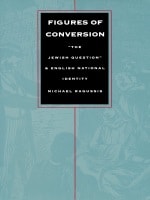
Figures of Conversion
“The Jewish Question” and English National IdentityMichael Ragussis
Duke University Press, 1995
—Daniel Defoe, The Farther Adventures of Robinson Crusoe (1719)
When the hero of Defoe’s novel listens skeptically to this anecdote related by a French Roman Catholic priest, he little suspects that in less than a century the conversion of the Jews would become nothing short of a national project—not in France but in England. In this book, Michael Ragussis explores the phenomenon of Jewish conversion—the subject of popular enthusiasm, public scandal, national debate, and dubbed "the English madness" by its critics—in Protestant England from the 1790s through the 1870s.
Moving beyond the familiar catalog of anti-Semitic stereotypes, Ragussis analyzes the rhetoric of conversion as it was reinvented by the English in sermons, stories for the young, histories of the Jews, memoirs by Jewish converts, and popular novels. Alongside these texts and the countertexts produced by English Jews, he situates such writers as Edgeworth, Scott, Disraeli, Arnold, Trollope, and Eliot within the debate over conversion and related issues of race, gender, and nation-formation. His work reveals how a powerful group of emergent cultural projects—including a revisionist tradition of the novel, the new science of ethnology, and the rewriting of European history—redefined English national identity in response to the ideology of conversion, the history of the Jews, and "the Jewish question."
Figures of Conversion offers an entirely new way of regarding Jewish identity in nineteenth-century British culture and will be of importance not only to literary scholars but also to scholars of Judaic and religious studies, history, and cultural studies.
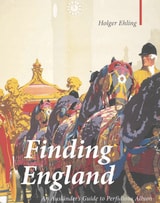
Finding England
An Auslander's Guide to Perfidious AlbionHolger Ehling
Haus Publishing, 2013
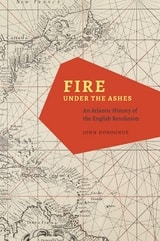
Fire under the Ashes
An Atlantic History of the English RevolutionJohn Donoghue
University of Chicago Press, 2013
Prominent merchant revolutionaries from Coleman Street led England’s imperial expansion by investing deeply in the slave trade and projects of colonial conquest. Opposing them were other Coleman Street puritans, who having crossed and re-crossed the ocean as colonists and revolutionaries, circulated new ideas about the liberty of body and soul that they defined against England’s emergent, political economy of empire. These transatlantic radicals promoted social justice as the cornerstone of a republican liberty opposed to both political tyranny and economic slavery—and their efforts, Donoghue argues, provided the ideological foundations for the abolitionist movement that swept the Atlantic more than a century later.

First Love
The Affections of Modern FictionMaria DiBattista
University of Chicago Press, 1991
DiBattista argues that modernity reinvented First Love as a myth of creative initiative, as its characteristic response to a pervasive sense of historical belatedness. Anxious that its own creations can never be more than diminished forms of mightier originals, modernity idolizes First Love as the beginning that can never be repeated. First Love hence epitomizes the dream of a new self-incarnation. From Turgenev's First Love to the formative works of Virginia Woolf, Gertrude Stein, E. M. Forster, and Vladimir Nabokov, First Love confirms the birth of an artistic vocation. For modern men and women intent on becoming the original authors of their own lives, First Love becomes paradigmatic of those life-altering moments that transform the undifferentiated sequence of days into a fateful narrative.
DiBattista focuses on the enunciation of First Love in the fiction of Thomas Hardy, D. H. Lawrence, James Joyce, and Samuel Beckett. In reading their works, DiBattista dramatically revises the accepted view of irony as the dominant tone of modernism. First Love constitutes, she shows, a new apprehension of the world characterized not by the frigid distances of irony but by a belief in the creative individual who may begin the world anew, as if for the first time.
Fishing by Obstinate Isles
Modern and Postmodern British Poetry and American ReadersKeith Tuma
Northwestern University Press, 1998
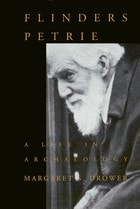
Flinders Petrie
A Life in ArchaeologyMargaret S. Drower
University of Wisconsin Press, 1995
Flinders Petrie has been called the “Father of Modern Egyptology”—and indeed he is one of the pioneers of modern archaeological methods. This fascinating biography of Petrie was first published to high acclaim in England in 1985. Margaret S. Drower, a student of Petrie’s in the early 1930s, traces his life from his boyhood, when he was already a budding scholar, through his stunning career in the deserts of Egypt to his death in Jerusalem at the age of eighty-nine. Drower combines her first-hand knowledge with Petrie’s own voluminous personal and professional diaries to forge a lively account of this influential and sometimes controversial figure.
Drower presents Petrie as he was: an enthusiastic eccentric, diligently plunging into the uncharted past of ancient Egypt. She tells not only of his spectacular finds, including the tombs of the first Pharaohs, the earliest alphabetic script, a Homer manuscript, and a collection of painted portraits on mummy cases, but also of Petrie’s important contributions to the science of modern archaeology, such as orderly record-keeping of the progress of a dig and the use of pottery sherds in historical dating. Petrie's careful academic methods often pitted him against such rival archaeologists as Amélineau, who boasted he had smashed the stone jars he could not carry away to be sold, and Maspero and Naville, who mangled a pyramid at El Kula they had vainly tried to break into.
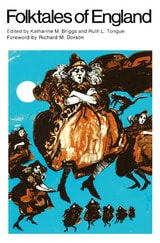
Folktales of England
Edited by Katharine M. Briggs and Ruth L. Tongue
University of Chicago Press, 1968
"This is a fine, homely feast, immediately intelligble. . . ."—Times Educational Supplement
". . . should be of special concern to Americans since many of the tales are parallel to or the source of our own folk stories."—Choice
"This is entertainment, to be sure, but is also part of man's attempts to comprehend his world."—Quartet
"Folktales of England is by all odds the most satisfactory general collection of folktales to come out of England since the advent of modern collection and classification techniques."—Ernest W. Baughman, Journal of American Folklore
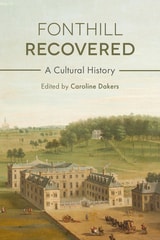
Fonthill Recovered
A Cultural HistoryEdited by Caroline Dakers
University College London, 2018
Fonthill Recovered draws on new research to explore the rich cultural history of this place where little remains today—a tower, a stable block, the ruins of what was once a kitchen, and an indentation in a field. The first half of the book traces the occupation of Fonthill from the Bronze Age to the twenty-first century. Some of the owners surpassed Beckford in terms of their wealth and political power—and even, in one case, their sexual proclivities. They include Charles I’s Chancellor of the Exchequer and the richest British commoner of the nineteenth century. The second half of the book consists of essays on specific topics, examining such crucial areas as the complex history of the designed landscape, the sources of the Beckfords’ wealth and their extensive art collection, and the recent appearance of the Abbey in a video game.

Footloose in Farm Service
Autobiographical Recollections of John DickieMarjory Harper
Aberdeen University Press, 2013
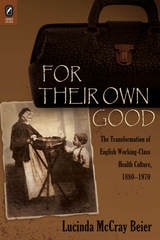
For Their Own Good
The Transformation of English Working-Class Health Culture, 1880–1970Lucinda Mccray Beier
The Ohio State University Press, 2008
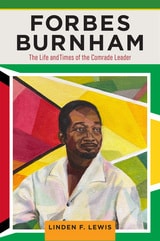
Forbes Burnham
The Life and Times of the Comrade LeaderLinden F. Lewis
Rutgers University Press, 2024
Forbes Burnham: The Life and Times of the Comrade Leader is the first political biography of this complex and influential figure. It charts how the political party he founded, the People’s National Congress, combined nationalist rhetoric, socialist policies, and Pan-Africanist philosophies. It also explores how, in a country already deeply divided between the descendants of African slaves and Indian indentured servants, Burnham consolidated political power by intensifying ethnic polarizations. Drawing from historical archives as well as new interviews with the people who knew Burnham best, sociologist Linden F. Lewis examines how his dictatorial tendencies coexisted with his progressive convictions. Forbes Burnham is a compelling study of the nature of postcolonial leadership and its pitfalls.
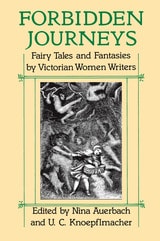
Forbidden Journeys
Fairy Tales and Fantasies by Victorian Women WritersEdited by Nina Auerbach and U. C. Knoepflmacher
University of Chicago Press, 1992
"Forbidden Journeys is not only a darkly entertaining book to read for the fantasies and anti-fantasies told, but also is a significant contribution to nineteenth-century cultural history, and especially feminist studies."—United Press International
"A service to feminists, to Victorian Studies, to children's literature and to children."—Beverly Lyon Clark, Women's Review of Books
"These are stories to laugh over, cheer at, celebrate, and wince at. . . . Forbidden Journeys is a welcome reminder that rebellion was still possible, and the editors' intelligent and fascinating commentary reveals ways in which these stories defied the Victorian patriarchy."—Allyson F. McGill, Belles Lettres
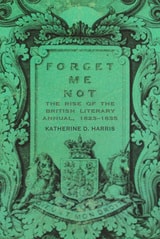
Forget Me Not
The Rise of the British Literary Annual, 1823–1835Katherine D. Harris
Ohio University Press, 2015
By November 1822, the British reading public had already voraciously consumed both Walter Scott’s expensive novels and Rudolf Ackermann’s exquisite lithographs. The next decade, referred to by some scholars as dormant and unproductive, is in fact bursting with Forget Me Nots, Friendship’s Offerings, Keepsakes, and Literary Souvenirs. By wrapping literature, poetry, and art into an alluring package, editors and publishers saturated the market with a new, popular, and best-selling genre, the literary annual. In Forget Me Not, Katherine D. Harris assesses the phenomenal rise of the annual and its origins in other English, German, and French literary forms as well as its social influence on women, its redefinition of the feminine, and its effects on late nineteenth- and early twentieth-century print culture. Harris adopts an interdisciplinary approach that uses textual and social contexts to explore a forum of subversive femininity, where warfare and the masculine hero were not celebrated.
Initially published in diminutive, decoratively bound volumes filled with engravings of popularly recognized artwork and “sentimental” poetry and prose, the annuals attracted a primarily middle-class female readership. The annuals were released each November, making them an ideal Christmas gift, lover’s present, or token of friendship. Selling more than 100,000 copies during each holiday season, the annuals were accused of causing an epidemic and inspiring an “unmasculine and unbawdy age” that lasted through 1860 and lingered in derivative forms until the early twentieth century in both the United States and Europe. The annual thrived in the 1820s and after despite—or perhaps because of—its “feminine” writing and beautiful form.
Forging Fraternity in Late Medieval Society
The Palmers' Guild of LudlowRachael Harkes
University of London Press, 2025
Forging Fraternity in Late Medieval Society is the first major study of a national guild and its far-reaching influence. Rachael Harkes outlines the intricate role of the Palmers’ Guild of Ludlow, showing how its membership extended beyond urban centers into rural life and shaped local and regional governance on the eve of the Reformation. Through meticulous analysis of guild records and non-guild sources, this book confronts preconceived notions about these understudied institutions, demonstrating how they functioned as social and political networks that connected villages, households, city officials, and even the Crown.
By shedding light on the complex intersections of faith and community, Forging Fraternity in Late Medieval Society sheds new light on the forces that shaped late medieval England and Wales at a moment when traditional structures of power and belief were on the brink of transformation.
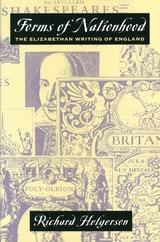
Forms of Nationhood
The Elizabethan Writing of EnglandRichard Helgerson
University of Chicago Press, 1992

Four Shakespearean Period Pieces
Margreta de Grazia
University of Chicago Press, 2021
Yet recent theoretical work has called for their reappraisal. Anachronisms, previously condemned as errors in the order of time, are being hailed as alternatives to that order. Conversely chronology and periods, its mainstays, are now charged with having distorted the past they have been entrusted to represent, and secularization, once considered the driving force of the modern era, no longer holds sway over the past or the present.
In light of this reappraisal, can Shakespeare studies continue unshaken? This is the question Four Shakespearean Period Pieces takes up, devoting a chapter to each term: on the rise of anachronism, the chronologizing of the canon, the staging of plays “in period,” and the use of Shakespeare in modernity’s secularizing project.
To read these chapters is to come away newly alert to how these fraught concepts have served to regulate the canon’s afterlife. Margreta de Grazia does not entirely abandon them but deftly works around and against them to offer fresh insights on the reading, editing, and staging of the author at the heart of our literary canon.
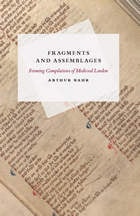
Fragments and Assemblages
Forming Compilations of Medieval LondonArthur Bahr
University of Chicago Press, 2013
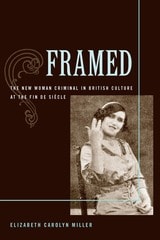
Framed
The New Woman Criminal in British Culture at the Fin de SiecleElizabeth Carolyn Miller
University of Michigan Press, 2008
Framed uses fin de siècle British crime narrative to pose a highly interesting question: why do female criminal characters tend to be alluring and appealing while fictional male criminals of the era are unsympathetic or even grotesque?
In this elegantly argued study, Elizabeth Carolyn Miller addresses this question, examining popular literary and cinematic culture from roughly 1880 to 1914 to shed light on an otherwise overlooked social and cultural type: the conspicuously glamorous New Woman criminal. In so doing, she breaks with the many Foucauldian studies of crime to emphasize the genuinely subversive aspects of these popular female figures. Drawing on a rich body of archival material, Miller argues that the New Woman Criminal exploited iconic elements of late nineteenth- and early twentieth-century commodity culture, including cosmetics and clothing, to fashion an illicit identity that enabled her to subvert legal authority in both the public and the private spheres.
"This is a truly extraordinary argument, one that will forever alter our view of turn-of-the-century literary culture, and Miller has demonstrated it with an enrapturing series of readings of fictional and filmic criminal figures. In the process, she has filled a gap between feminist studies of the New Woman of the 1890s and more gender-neutral studies of early twentieth-century literary and social change. Her book offers an extraordinarily important new way to think about the changing shape of political culture at the turn of the century."
---John Kucich, Professor of English, Rutgers University
"Given the intellectual adventurousness of these chapters, the rich material that the author has brought to bear, and its combination of archival depth and disciplinary range, any reader of this remarkable book will be amply rewarded."
---Jonathan Freedman, Professor of English and American Culture, University of Michigan
Elizabeth Carolyn Miller is Assistant Professor of English at the University of California, Davis.
digitalculturebooks is an imprint of the University of Michigan and the Scholarly Publishing Office of the University of Michigan Library dedicated to publishing innovative and accessible work exploring new media and their impact on society, culture, and scholarly communication. Visit the website at www.digitalculture.org.
Framing Abuse
Media Influence and Public Understanding of Sexual Violence Against ChildrenJenny Kitzinger
Pluto Press, 2004
Which stories attract attention and why? What strategies do journalists and campaigners use to persuade people and how do we respond? Answering these and other questions, Kitzinger demonstrates how media reporting can impact on people's knowledge of the 'facts', perceptions of risk, sense of appropriate policy responses and even how we interpret our own experiences.
Kitzinger examines feminist initiatives to challenge sexual violence, the emergence of incest as a social problem and the development of new survivor identities. She also explores stereotypes around sex offenders,interrogates protests against 'paedophiles-in-the-community' and presents a detailed analysis of the impact of scandals about disputed abuse accusations.
This book is essential reading for anyone interested in theories of media influence, identity and social change or who wishes to encourage responsible journalism. It is also a key resource for anyone concerned about sexual violence and the protection of children or who is attempting to design intervention strategies.
Free Women
Ethics and Aesthetics in Twentieth-Century Women's FictionKate Fullbrook
Temple University Press, 1990
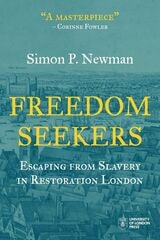
Freedom Seekers
Escaping from Slavery in Restoration LondonSimon P. Newman
University of London Press, 2021
This book brings the history of slavery in England to light, revealing the powerful untold stories of resistance by enslaved workers from Africa, South Asia, and First-Nations America forced to work in London as sailors and dockworkers, wet-nurses and washerwomen. Featuring a series of original case studies on those enslaved people who escaped captivity, this volume provides a rich source of information about slavery in eighteenth-century mainland Britain and the “freedom seekers” therein. Using maps, photographs, newspaper advertisements, and more, the book details escape routes, the networks of slaveholders, and the community of people of color across the London region.
Freedom Seekers demonstrates that not only were enslaved people present in Restoration London but that white Londoners were intimately involved in the construction of the system of racial slavery, a process traditionally regarded as happening in the colonies rather than the British Isles. Freedom Seekers is an utterly unmissable and important book that seeks to delve into Britain’s colonial past.
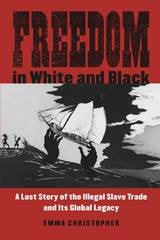
Freedom in White and Black
A Lost Story of the Illegal Slave Trade and Its Global LegacyEmma Christopher
University of Wisconsin Press, 2020
This story can be told because of an exceptional trove of court documents that provides unparalleled insight into one small link in the great, horrific chain of slavery. Emma Christopher follows a trail of evidence across four continents to examine the lives of this barracoon's owners, their workers, and their tragic human merchandise. She reveals how an American, Charles Mason, escaped justice, while British subjects Robert Bostock and John McQueen were arrested. In court five African men—Tamba, Tom Ball, Yarra, Noah, and Sessay—courageously testified against their former owners/captors. They, and 233 other liberated men, women, and children, were relocated to Freetown, Sierra Leone. There they endured harsh lives of "freedom," while the punishment of Bostock and McQueen was fleeting.
From the fragmented facts of these lives, Christopher sheds fascinating light on the early development of the nations of Sierra Leone, Liberia, and Australia (where Bostock and McQueen were banished) and the role of former slaves in combatting the illegal trade.
Freud's Couch, Scott's Buttocks, Brontë's Grave
Simon Goldhill
University of Chicago Press, 2011
The Victorian era was the high point of literary tourism. Writers such as Charles Dickens, George Eliot, and Sir Walter Scott became celebrities, and readers trekked far and wide for a glimpse of the places where their heroes wrote and thought, walked and talked. Even Shakespeare was roped in, as Victorian entrepreneurs transformed quiet Stratford-upon-Avon into a combination shrine and tourist trap.
Stratford continues to lure the tourists today, as do many other sites of literary pilgrimage throughout Britain. And our modern age could have no better guide to such places than Simon Goldhill. In Freud's Couch, Scott’s Buttocks, Brontë's Grave, Goldhill makes a pilgrimage to Sir Walter Scott's baronial mansion, Wordsworth's cottage in the Lake District, the Bront ë parsonage, Shakespeare's birthplace, and Freud's office in Hampstead. Traveling, as much as possible, by methods available to Victorians—and gamely negotiating distractions ranging from broken bicycles to a flock of giggling Japanese schoolgirls—he tries to discern what our forebears were looking for at these sites, as well as what they have to say to the modern mind. What does it matter that Emily Brontë’s hidden passions burned in this specific room? What does it mean, especially now that his fame has faded, that Scott self-consciously built an extravagant castle suitable for Ivanhoe—and star-struck tourists visited it while he was still living there? Or that Freud's meticulous recreation of his Vienna office is now a meticulously preserved museum of itself? Or that Shakespeare’s birthplace features student actors declaiming snippets of his plays . . . in the garden of a house where he almost certainly never wrote a single line?
Goldhill brings to these inquiries his trademark wry humor and a lifetime's engagement with literature. The result is a travel book like no other, a reminder that even today, the writing life still has the power to inspire.

Friend
The Story of George Fox and the QuakersJane Yolen
QuakerPress, 2006
Friends of Alice Wheeldon
Sheila Rowbotham
Pluto Press, 1986
From Counter-Reformation to Glorious Revolution
Hugh Trevor-Roper
University of Chicago Press, 1992
The pieces here range from an account of the Jesuit Matteo Ricci's mission in China in the sixteenth century to a discussion of the Anglo-Scottish Union. They include essays on medicine at the early Stuart Court, on the plunder of artistic treasures in Europe during the wars of the seventeenth century, on the plans of Hugo Grotius to create a new universal church on an Anglican base, on the Glorious Revolution of 1688 and religious toleration thereafter. There are also biographical studies of Archbishop Laud, Matthew Wren, the Earl of Clarendon, and Prince Rupert.
As Noel argument wrote in Our Age, Hugh Trevor-Roper has "perfected the historical essay as the most beguiling form of enlightening readers about the past. He is the most eloquent, sophisticated and assured historian of Our Age, and has never written an inelegant sentence or produced an incoherent arguement."
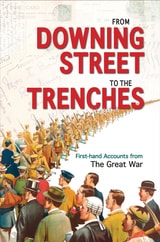
From Downing Street to the Trenches
First-hand Accounts from the Great War, 1914-1916Mike Webb
Bodleian Library Publishing, 2014
From Downing Street to the Trenches gathers eyewitness accounts and photographs that vividly convey this lived experience. The letters of Prime Minister H. H. Asquith show the strain of wartime leadership and shed light on his later downfall, while letters home from the young Harold Macmillan are suffused with his experiences in the trenches and mark the beginning of his road to Downing Street. Although it was forbidden to record cabinet discussions, Secretary of State Lewis Harcourt’s unauthorized diary provides a window into the government of the time, complete with character sketches of some of the leading figures, including Winston Churchill. In addition to political figures, the book draws on many local records, including the diary of an Essex rector, written to record the impact of the war on his community and parish.
Filled with fear and sorrow but also suffused with hope for the future, the accounts collected here paint a highly personal and immediate picture of the war as it was happening to real people of the time.
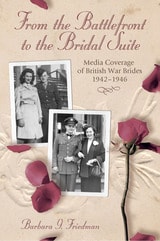
From the Battlefront to the Bridal Suite
Media Coverage of British War Brides, 1942-1946Barbara G. Friedman
University of Missouri Press, 2007
With their gregarious natures and casual styles, American GIs in wartime England were instantly attractive to British women—especially in the absence of their fighting men. As a result, some seventy thousand British war brides returned to the United States—with many on the home front at first suspecting that the GIs were somehow being exploited.
The war brides’ stories have been told in memoirs, romantic novels, and immigration history. Barbara Friedman sheds new light on their experiences by focusing on media representations of sexuality and marriage in wartime, showing how mass media interpretations turned from public suspicion of war brides to popular acceptance.
Friedman tells how British media first insisted that GIs had come to fight, not to woo the locals, and shrugged off the first brides as an “American problem.” Yet, as Friedman shows, the British media were complicit in encouraging the relationships in the first place: the British press promoted a hospitality program that deemed the entertainment of American troops “patriotic duty,” while women’s magazines hailed American men as ideal husbands and the United States as a promised land.
From the American perspective, Friedman reveals, despite rules against foreign marriages, the U.S. Army encouraged GI-civilian fraternization through armed service publications, attitudes toward GI sexuality, and participation in the hospitality program. Armed service publications went from depicting British women as “frowsy dames” to honoring them as models of domesticity, while newspapers back home eventually legitimized the marriages by casting the brides as welcome additions to American society. Meanwhile, American women’s magazines viewed them as more similar to than different from their American counterparts and called on readers to help British brides master American homemaking.
By combining letters and diaries of brides with published accounts, Friedman identifies accuracies and inaccuracies in the media record as well as gaps in coverage. She considers how the brides saw themselves compared to their media images and shows how the media co-opted brides as symbols of the Anglo-American “special friendship,” postwar power imbalance, and gendered ideals of marriage and domestication.
From the Battlefront to the Bridal Suite is the untold story of overlooked participants in the most celebrated drama of the twentieth century—women whose lives were shaped profoundly by a war that was more than just a male enterprise. It shows the power of the press in the most unlikely matters and suggests a broader definition of the wartime experience.
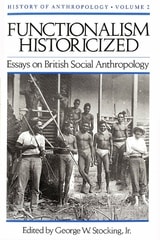
Functionalism Historicized
Essays on British Social AnthopologyEdited by George W. Stocking, Jr.
University of Wisconsin Press, 1988
" This volume is likely to prove indispensable to historians of anthropology in general and of British anthropology in particular. There are a wide range of historical skills on display, from traditional textual analysis to historical sociology of the most sophisticated sort, and there is a more or less thorough chronological coverage from the era of classical evolutionism virtually up to the present. One can only hope that historicizing anthropologists will sample some of these wares."—Journal of the History of the Behavioral Sciences