Results by title
5448 books match the query 'History and criticism' and 217 start with f
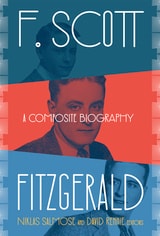
F. Scott Fitzgerald
A Composite BiographyNiklas Salmose
University of Minnesota Press, 2023
A comprehensive study of the life of F. Scott Fitzgerald, related in two-year chapters by twenty-three leading writers on the Jazz Age author
“There never was a good biography of a novelist,” F. Scott Fitzgerald wrote in The Crack-Up. “There couldn’t be. He is too many people, if he’s any good.” Fitzgerald, a good novelist by any measure, has tested this challenge to the biographer’s art. A new star illuminating the literary scene; a chronicler of the Jazz Age in all its brilliance and tarnish; a romantic symbol of the American century; an acute observer of society’s best and worst, and of his own star-crossed career; a midlife burnout at forty-four, leaving an unfinished masterpiece in his wake—he was a man of many aspects, a writer whose complexity and multitudes this composite biography finally aptly portrays.
Bringing together twenty-three leading writers and scholars on Fitzgerald, each focusing on two years of his life, this volume takes its cue from Henry James’s remark, cited by preeminent Fitzgerald biographer Scott Donaldson: “The whole of anything is never told; you can only take what groups together.” F. Scott Fitzgerald: A Composite Biography presents a new way of “grouping together” biographical material and perspectives, considering from various angles the author's best-known works as well as understudied writings, including neglected stories and forays into autobiography such as “What I Think and Feel at 25” and “How to Live on $36,000 a Year.” The glamor and fame that made F. Scott and Zelda mythic figures of their time appear here alongside the personal experiences that he occasionally included in his writing: the beginnings as well as the poignant end; the literary relationships that informed and framed his work, set against solitary effort, fame, and failures. This remarkable study of F. Scott Fitzgerald reflects the multifaceted whole of a “life in many parts” in new and revelatory ways.
Contributors: Jade Broughton Adams; Ronald Berman; William Blazek, Liverpool Hope U; Elisabeth Bouzonviller, Jean Monnet U; Jackson Bryer, U of Maryland; Kirk Curnutt, Troy U; Catherine Delesalle-Nancey, U Jean Moulin Lyon 3; Scott Donaldson; Kayla Forrest; Marie-Agnès Gay, U Jean Moulin Lyon 3; Joel Kabot, U of Maryland, Baltimore; Sara Kosiba; Arne Lunde, U of California, Los Angeles; Bryant Mangum, Virginia Commonwealth U; Martina Mastandrea; Philip McGowan, Queen’s U Belfast; David Page; Walter Raubicheck, Pace U; Ross Tangedal, U of Wisconsin–Stevens Point; Helen Turner, Linnaeus U; James L. W. West III, Pennsylvania State U.
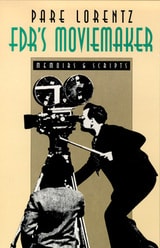
FDR's Moviemaker
Memoirs And ScriptsPare Lorentz
University of Nevada Press, 1992
"The films of Pare Lorentz are acknowledged masterpieces of world cinema. They are groundbreaking documentary records of our country in the hard years of the Depression." —William M. Drennen, Jr.
In the depths of the Great Depression, the U.S. Government produced a series of films about the pressing problems facing the nation—drought, flood, poverty, and slums. Starting with a minuscule initial budget of $6,000, Lorentz, a young film critic from New York who had never made a motion picture, was hired to head the project. The first fruit of his labor, The Plow That Broke the Plains, was a moving and dramatic account of the Dust Bowl that met with immediate and critical acclaim. Lorentz followed up his first film with The River, a history of the Mississippi River Basin and the effect of the Tennessee Valley Authority on the area. Both films demonstrated the potential of the documentary as a powerful impetus to social change, prompting widespread discussion not only of the problems they presented but also of the documentary form itself. This book combines the autobiographical history of a creative communicator and pioneer documentary filmmaker with the full scripts of The Plow That Broke the Plains, The River, Ecce Homo, and The Fight for Life.
FEMALE TRADITION IN SOUTHERN LITERATURE
Carol S. Manning
University of Illinois Press, 1993
essays reclaim women's traditions which have been neglected by critics who ought to have known
better." -- Kathryn Lee Seidel, author of The Southern Belle in the American Novel
FEMINIST REALISM AT THE FIN DE SIÈCLE
The Influence of the Late-Victorian Woman’s Press on the Development of the NovelMolly Youngkin
The Ohio State University Press, 2007

FRAMING ANNA KARENINA
TOLSTOY, WOMEN QUESTION, & VICTORIAN NOVAMY MANDELKER
The Ohio State University Press, 1994
FROM OLD WOMAN TO OLDER WOMEN
Contemporary Culture and Women’s NarrativesSally Chivers
The Ohio State University Press, 2003
Sally Chivers provides a fascinating look at and challenge to how North American popular culture has portrayed old age as a time of disease, decline, and death. Within contemporary Canadian literary and film production, a tradition of articulate central elderly female characters challenges what the aging body has come to signify in a broader cultural context. Rather than seek positive images of aging, which can do their own prescriptive damage, the author focuses on constructive depictions that provide a basis on which to create new stories and readings of growing old. This type of humanities approach to the study of aging promises neither to fixate on nor avoid consideration of the role of the body in the much broader process of getting older. The progression implied in the title from the solitary symbol of The Old Woman toward a community of older women, indicates not a move toward euphemism, but rather an increasing and necessary awareness of the social and cultural dimensions of aging.
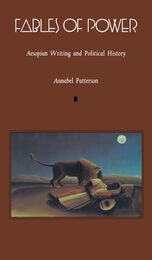
Fables of Power
Aesopian Writing and Political HistoryAnnabel Patterson
Duke University Press, 1991
Patterson begins with an analysis of the legendary Life of Aesop, its cultural history and philosophical implications, a topic that involves such widely separated figures as La Fontaine, Hegel, and Vygotsky. The myth’s origin is recovered here in the saving myth of Aesop the Ethiopian, black, ugly, who began as a slave but become both free and influential, a source of political wisdom. She then traces the early modern history of the fable from Caxton, Lydgate, and Henryson through the eighteenth century, focusing on such figures as Spenser, Sidney, Lyly, Shakespeare, and Milton, as well as the lesser-known John Ogilby, Sir Roger L’Estrange, and Samuel Croxall.
Patterson discusses the famous fable of The Belly and the Members, which, because it articulated in symbolic terms some of the most intransigent problems in political philosophy and practice, was still going strong as a symbolic text in the mid-nineteenth century, where it was focused on industrial relations by Karl Marx and by George Eliot against electoral reform.
Fables of Representation
EssaysPaul Hoover
University of Michigan Press, 2004
With its title essay, "Fables of Representation," one of the most cogent studies ever written of the New York School of poets (a group that includes the influential poet John Ashbery), this book is required reading for anyone who seeks to understand the poetry and culture of the postmodern period.
Author Paul Hoover's wide-ranging subjects include African-American interdisciplinary studies; the position of poetry in the electronic age; the notion of doubleness in the work of Harryette Mullen and others; the lyricism of the New York School poets; and the role of reality in American poetry. Hoover also introduces two provocative essays sure to generate attention and discussion: "The Postmodern Era: A Final Exam" and "The New Millennium: Fifty Statements on Literature and Culture."
Paul Hoover is the editor of the anthology Postmodern American Poetry and author of nine poetry collections, including Totem and Shadow: New and Selected Poems and Viridian. His poetry has appeared in American Poetry Review, The New Republic, and The Paris Review, among others. He is Poet-in-Residence at Columbia College, Chicago.
Facing Texts
Encounters Between Contemporary Writers and CriticsHeide Ziegler, ed.
Duke University Press, 1988
Fact, Fiction, and Form
Selected EssaysRalph W. Rader
The Ohio State University Press, 2011
Fado Resounding
Affective Politics and Urban LifeLila Ellen Gray
Duke University Press, 2013
Fairy Tales from Before Fairy Tales
The Medieval Latin Past of Wonderful LiesJan M. Ziolkowski
University of Michigan Press, 2009
When did fairy tales begin? What qualifies as a fairy tale? Is a true fairy tale oral or literary? Or is a fairy tale determined not by style but by content? To answer these and other questions, Jan M. Ziolkowski not only provides a comprehensive overview of the theoretical debates about fairy tale origins but includes an extensive discussion of the relationship of the fairy tale to both the written and oral sources. Ziolkowski offers interpretations of a sampling of the tales in order to sketch the complex connections that existed in the Middle Ages between oral folktales and their written equivalents, the variety of uses to which the writers applied the stories, and the diverse relationships between the medieval texts and the expressions of the same tales in the "classic" fairy tale collections of the nineteenth century. In so doing, Ziolkowski explores stories that survive in both versions associated with, on the one hand, such standards of the nineteenth-century fairy tale as the Brothers Grimm, Hans Christian Andersen, and Carlo Collodi and, on the other, medieval Latin, demonstrating that the literary fairy tale owes a great debt to the Latin literature of the medieval period.
Faithful Fictions
The Catholic Novel in British LiteratureThomas M. Woodman
Catholic University of America Press, 2022
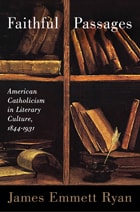
Faithful Passages
American Catholicism in Literary Culture, 1844–1931James Emmett Ryan
University of Wisconsin Press, 2013
Faithful Passages also reveals new dimensions in American religious literary culture by moving beyond the antebellum period to consider how the first important cohort of Catholic writers shaped their message for subsequent generations of readers in the late nineteenth and early twentieth centuries. Perhaps most strikingly, Ryan shows that by the early twentieth century, Roman Catholic themes and traditions in American literature would be advanced in complex ways by mainstream, non-Catholic modernist writers like Kate Chopin and Willa Cather.
Catholic literary culture in the United States took shape in a myriad of ways and at the hands of diverse participants. The process by which Roman Catholic ideas, themes, and moralities were shared and adapted by writers with highly differentiated beliefs, Ryan contends, illuminates a surprising fluidity of religious commitment and expression in early U.S. literary culture.
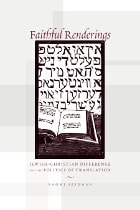
Faithful Renderings
Jewish-Christian Difference and the Politics of TranslationNaomi Seidman
University of Chicago Press, 2006
Bringing together central issues in translation studies with episodes in Jewish–Christian history, Naomi Seidman considers a range of texts, from the Bible to Elie Wiesel’s Night, delving into such controversies as the accuracy of various Bible translations, the medieval use of converts from Judaism to Christianity as translators, the censorship of anti-Christian references in Jewish texts, and the translation of Holocaust testimony. Faithful Renderings ultimately reveals that translation is not a marginal phenomenon but rather a crucial issue for understanding the relations between Jews and Christians and indeed the development of each religious community.
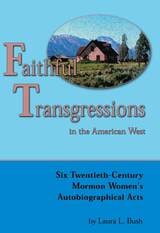
Faithful Transgressions In The American West
Six Twentieth-Century Mormon Women's Autobiographical ActsLaura L. Bush
Utah State University Press, 2004
The central issue Bush finds in these works is how their authors have dealt with the authority of Mormon Church leaders. As she puts it in her preface, "I use the phrase 'faithful transgression' to describe moments in the texts when each writer, explicitly or implicitly, commits herself in writing to trust her own ideas and authority over official religious authority while also conceiving of and depicting herself to be a 'faithful' member of the Church." Bush recognizes her book as her own act of faithful transgression. Writing it involved wrestling, she states, "with my own deeply ingrained religious beliefs and my equally compelling education in feminist theories that mean to liberate and empower women."
Faithful Transgressions examines a remarkable group of authors and their highly readable and entertaining books. In producing the first significant book-length study of Mormon women's autobiographical writing, Bush rides a wave of memoir publishing and academic interest in autobiography and other life narratives. As she elucidates these works in relation to the religious tradition that played a major role in shaping them, she not only positions them in relation to feminist theory and current work on women's life writings but ties them to the long literary tradition of spiritual autobiography.
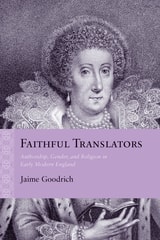
Faithful Translators
Authorship, Gender, and Religion in Early Modern EnglandJaime Goodrich
Northwestern University Press, 2014
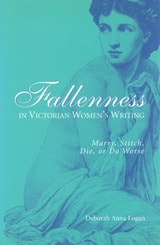
Fallenness in Victorian Women's Writing
Marry, Stitch, Die, Or Do WorseDeborah Anna Logan
University of Missouri Press, 1998
The Angel-in-the-House is an ideal commonly used to define sexual standards of the Victorian Age. Although widely considered to be the cultural "norm," the Victorian Angel, revered for her morality, domestic virtue, and dedication to the family, is more frequently depicted in the literature of the time as an anomaly. In fact, a primary concern of Victorian literature appears to be the many exceptions to this unattainable ideal, which, according to the period's madonna-or-harlot polarity, casts these exceptions as fallen women. Deborah Anna Logan presents an unusual study of this image of fallenness in Victorian literature, focusing on the links among angelic ideology, sexuality, and, more important, social deviance.
Fallenness, according to Logan, does not refer simply to women who have sexually strayed from morality; besides prostitutes, the ranks of the fallen include unmarried mothers, needlewomen, alcoholics, the insane, the childless, the anorexic, slaves, and harem women. All of these women are presented as fallen because they fail to conform to sexual and social norms. In some cases, economic need was responsible for women's failure to uphold the ideals of domesticity and motherhood that were so revered in nineteenth- century society. But other examples illustrate the power of angelic ideology to construct deviancy even out of nonsexual behaviors.
Logan's study is distinguished by its exclusive focus on women writers, including Charlotte Brontë, George Eliot, Elizabeth Gaskell, Harriet Martineau, Elizabeth Barrett Browning, Florence Nightingale, Sarah Grand, and Mary Prince. Logan utilizes primary texts from these Victorian writers as well as contemporary critics such as Catherine Gallagher and Elaine Showalter to provide the background on social factors that contributed to the construction of fallen-woman discourse. Examining novels, short stories, poetry, and travel journals, Logan successfully demonstrates the rich links between these writers and their fallen characters--links in which, for women, even the act of writing becomes a type of fallenness.
Fallenness in Victorian Women's Writing is a significant and original contribution to the study of literature. Logan's thoroughly researched and attractively presented book will be of special interest to students of Victorian and women's studies, as well as to the general reader.
False Documents
Inter-American Cultural History, Literature, and the Lost Decade (1975–1992)Frans Weiser
The Ohio State University Press, 2020
After deconstructing economic accounts of the “two Americas" model of the hemisphere, including the lost decade (1981–1992) and the “end of history” (1975–1992), Weiser considers six case studies during the same period that reach very different conclusions by drawing on cultural history, including works by Tomás Eloy Martínez, Laura Antillano, Ana Maria Machado, Silviano Santiago, John Updike, and Jay Cantor. In order to expose how governments controlled and misrepresented recent events, these writers created false documents, or fake historical texts, that presented themselves as legitimate eyewitness accounts or archival documents. Weiser establishes how this alternative to postmodern irony more effectively galvanized citizen responses. As the first book to contextualize the parallel, hemispheric evolutions of postwar literary criticism and cultural historiography, False Documents responds to the methodological impasse between Latin American and American studies as well as the antagonism between history and literature, arguing that collaboration and synthesis are particularly vital at a moment when the humanities is increasingly under attack.
False Starts
The Rhetoric of Failure and the Making of American ModernismDavid M. Ball
Northwestern University Press, 2014
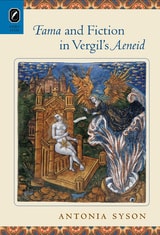
Fama and Fiction in Vergil's Aeneid
Antonia Syson
The Ohio State University Press, 2013
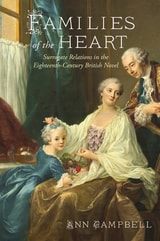
Families of the Heart
Surrogate Relations in the Eighteenth-Century British NovelAnn Campbell
Bucknell University Press, 2023
In this innovative analysis of canonical British novels, Campbell identifies a new literary device—the surrogate family—as a signal of cultural anxieties about young women’s changing relationship to matrimony across the long eighteenth century. By assembling chosen families rather than families of origin, Campbell convincingly argues, female protagonists in these works compensate for weak family ties, explore the world and themselves, prepare for idealized marriages, or sidestep marriage altogether. Tracing the evolution of this rich convention from the female characters in Defoe’s and Richardson’s fiction who are allowed some autonomy in choosing spouses, to the more explicitly feminist work of Haywood and Burney, in which connections between protagonists and their surrogate sisters and mothers can substitute for marriage itself, this book makes an ambitious intervention by upending a traditional trope—the model of the hierarchal family—ultimately offering a new lens through which to regard these familiar works.
Family Matters in the British and American Novel
Andrea O’Reilly Herrera
University of Wisconsin Press, 1997
Fangirls
Scenes from Modern Music CultureBy Hannah Ewens
University of Texas Press, 2020
"To be a fan is to scream alone together." This is the discovery Hannah Ewens makes in Fangirls: how music fandom is at once a journey of self-definition and a conduit for connection and camaraderie; how it is both complicated and empowering; and how now, more than ever, fandoms composed of girls and young queer people create cultures that shape and change an entire industry.
This book is about what it means to be a fangirl.
Speaking to hundreds of fans from the UK, US, Europe, and Japan, Ewens tells the story of music fandom using its own voices, recounting previously untold or glossed-over scenes from modern pop and rock music history. In doing so, she uncovers the importance of fan devotion: how Ariana Grande represents both tragedy and resilience to her followers, or what it means to meet an artist like Lady Gaga in person. From One Directioners, to members of the Beyhive, to the author's own fandom experiences, this book reclaims the "fangirl" label for its young members, celebrating their purpose, their power, and, most of all, their passion for the music they love.
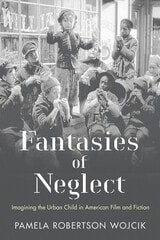
Fantasies of Neglect
Imagining the Urban Child in American Film and FictionPamela Robertson Wojcik
Rutgers University Press, 2016

Fantastic Planets, Forbidden Zones, and Lost Continents
The 100 Greatest Science-Fiction FilmsBy Douglas Brode
University of Texas Press, 2015
Whether you judge by box office receipts, industry awards, or critical accolades, science fiction films are the most popular movies now being produced and distributed around the world. Nor is this phenomenon new. Sci-fi filmmakers and audiences have been exploring fantastic planets, forbidden zones, and lost continents ever since George Méliès’ 1902 film A Trip to the Moon. In this highly entertaining and knowledgeable book, film historian and pop culture expert Douglas Brode picks the one hundred greatest sci-fi films of all time.
Brode’s list ranges from today’s blockbusters to forgotten gems, with surprises for even the most informed fans and scholars. He presents the movies in chronological order, which effectively makes this book a concise history of the sci-fi film genre. A striking (and in many cases rare) photograph accompanies each entry, for which Brode provides a numerical rating, key credits and cast members, brief plot summary, background on the film’s creation, elements of the moviemaking process, analysis of the major theme(s), and trivia. He also includes fun outtakes, including his top ten lists of Fifties sci-fi movies, cult sci-fi, least necessary movie remakes, and “so bad they’re great” classics—as well as the ten worst sci-fi movies (“those highly ambitious films that promised much and delivered nil”). So climb aboard spaceship Brode and journey to strange new worlds from Metropolis (1927) to Guardians of the Galaxy (2014).
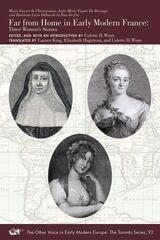
Far from Home in Early Modern France
Three Women’s StoriesMarie Guyart de l’Incarnation, Anne-Marie Fiquet du Boccage, and Henriette-Lucie Dillon de la Tour du Pin
Iter Press, 2022
This book showcases three Frenchwomen who ventured far from home at a time when such traveling was rare. In 1639, Marie de l’Incarnation embarked for New France where she founded the first Ursuline monastery in present-day Canada. In 1750, Madame du Boccage set out at the age of forty on her first “grand tour.” She visited England, the Netherlands, and Italy where she experienced firsthand the intellectual liberty offered there to educated women. As the Reign of Terror gripped France, the Marquise de la Tour du Pin fled to America with her husband and their two young children, where they ran a farm from 1794 to 1796. The writings these women left behind detailing their respective journeys abroad represent significant contributions to early modern travel literature. This book makes available to anglophone readers three texts that are rich in both historical and literary terms.
Faraway Women and the "Atlantic Monthly"
Cathryn Halverson
University of Massachusetts Press, 2019
Winner of the 2020 Thomas J. Lyon Award from the Western Literature Association
In the first decades of the twentieth century, famed Atlantic Monthly editor Ellery Sedgwick chose to publish a group of nontraditional writers he later referred to as “Faraway Women,” working-class authors living in the western United States far from his base in Boston. Cathryn Halverson surveys these enormously popular Atlantic contributors, among them a young woman raised in Oregon lumber camps, homesteaders in Wyoming, Idaho, and Alberta, and a world traveler who called Los Angeles and Honolulu home.
Faraway Women and the “Atlantic Monthly” examines gender and power as it charts an archival journey connecting the least remembered writers and readers of the time with one of its most renowned literary figures, Gertrude Stein. It shows how distant friends, patrons, publishers, and readers inspired, fostered, and consumed the innovative life narratives of these unlikely authors, and it also tracks their own strategies for seizing creative outlets and forging new protocols of public expression. Troubling binary categories of east and west, national and regional, and cosmopolitan and local, the book recasts the coordinates of early twentieth-century American literature.
Farm to Form
Modernist Literature and Ecologies of Food in the British EmpireJessica Martell
University of Nevada Press, 2020
Deeply informed by Martell’s extensive knowledge of modern British, Irish, American, and World Literatures, this progressive work positions modernism as central to the study of narratives of resistance against social and environmental degradation. Analyzed works include those of Thomas Hardy, E. M. Forster, Virginia Woolf, Joseph Conrad, George Russell, and James Joyce.
In light of climate change, fossil fuel supremacy, nutritional dearth, and other pressing food issues, modernist texts bring to life an era of crisis and anxiety similar to our own. In doing so, Martell summons the past as a way to employ the modernist term of “defamiliarizing” the present so that entrenched perceptions can be challenged. Our current food regime is both new and constantly evolving with the first industrial food trades. Studying earlier cultural responses to them invites us to return to persistent problems with new insights and renewed passion.
Fashioning Femininity and English Renaissance Drama
Karen Newman
University of Chicago Press, 1991
Through the critical lens of poststructuralism, Newman reads anatomies, conduct and domesticity handbooks, sermons, homilies, ballads, and court cases to delineate the ideologies of femininity they represented and produced. Arguing that drama, as spectacle, provides a peculiarly useful locus for analyzing the management of femininity, Newman considers the culture of early modern London to reveal how female subjectivity was fashioned and staged in the plays of Shakespeare, Jonson, and others.
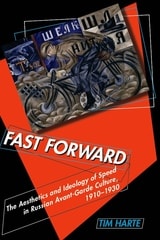
Fast Forward
The Aesthetics and Ideology of Speed in Russian Avant-Garde Culture, 1910–1930Tim Harte
University of Wisconsin Press, 2009
Although modernism arrived somewhat late in Russia, the increased tempo of life at the start of the twentieth century provided Russia’s avant-garde artists with an infusion of creative dynamism and crucial momentum for revolutionary experimentation. In Fast Forward Tim Harte presents a detailed examination of the images and concepts of speed that permeated Russian modernist poetry, visual arts, and cinema. His study illustrates how a wide variety of experimental artistic tendencies of the day—such as “rayism” in poetry and painting, the effort to create a “transrational” language (zaum’) in verse, and movements seemingly as divergent as neo-primitivism and constructivism—all relied on notions of speed or dynamism to create at least part of their effects.
Fast Forward reveals how the Russian avant-garde’s race to establish a new artistic and social reality over a twenty-year span reflected an ambitious metaphysical vision that corresponded closely to the nation’s rapidly changing social parameters. The embrace of speed after the 1917 Revolution, however, paradoxically hastened the movement’s demise. By the late 1920s, under a variety of historical pressures, avant-garde artistic forms morphed into those more compatible with the political agenda of the Russian state. Experimentation became politically suspect and abstractionism gave way to orthodox realism, ultimately ushering in the socialist realism and aesthetic conformism of the Stalin years.
Father and Son
Kingsley Amis, Martin Amis, and the British Novel since 1950Gavin Keulks
University of Wisconsin Press, 2004
Fault Lines and Controversies in the Study of Seventeenth-Century English Literature
Edited & Intro Claude J. Summers & Ted-Lary Pebworth
University of Missouri Press, 2002
Fear, Loathing, and Victorian Xenophobia
Edited by Marlene Tromp, Maria K. Bachman, and Heidi Kaufman
The Ohio State University Press, 2013
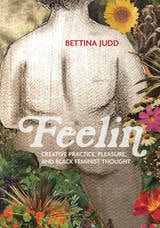
Feelin
Creative Practice, Pleasure, and Black Feminist ThoughtBettina Judd
Northwestern University Press, 2023
How creativity makes its way through feeling—and what we can know and feel through the artistic work of Black women
Feeling is not feelin. As the poet, artist, and scholar Bettina Judd argues, feelin, in African American Vernacular English, is how Black women artists approach and produce knowledge as sensation: internal and complex, entangled with pleasure, pain, anger, and joy, and manifesting artistic production itself as the meaning of the work. Through interviews, close readings, and archival research, Judd draws on the fields of affect studies and Black studies to analyze the creative processes and contributions of Black women—from poet Lucille Clifton and musician Avery*Sunshine to visual artists Betye Saar, Joyce J. Scott, and Deana Lawson.
Feelin: Creative Practice, Pleasure, and Black Feminist Thought makes a bold and vital intervention in critical theory’s trend toward disembodying feeling as knowledge. Instead, Judd revitalizes current debates in Black studies about the concept of the human and about Black life by considering how discourses on emotion as they are explored by Black women artists offer alternatives to the concept of the human. Judd expands the notions of Black women’s pleasure politics in Black feminist studies that include the erotic, the sexual, the painful, the joyful, the shameful, and the sensations and emotions that yet have no name. In its richly multidisciplinary approach, Feelin calls for the development of research methods that acknowledge creative and emotionally rigorous work as productive by incorporating visual art, narrative, and poetry.
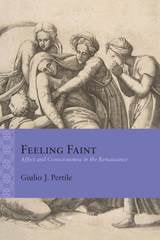
Feeling Faint
Affect and Consciousness in the RenaissanceGiulio J. Pertile
Northwestern University Press, 2019
Such a phenomenon, subsequently obscured by the Enlightenment identification of consciousness and personal identity, is what we discover in scenes of swooning from the Renaissance: consciousness without self, consciousness reconceived as what Fredric Jameson calls "a registering apparatus for transformed states of being." Where the early modern period has often been seen in terms of the rise of self-aware subjectivity, Feeling Faint argues that swoons, faints, and trances allow us to conceive of Renaissance subjectivity in a different guise: as the capacity of the senses and passions to experience, regulate, and respond to their own activity without the intervention of first-person awareness.
In readings of Renaissance authors ranging from Montaigne to Shakespeare, Pertile shows how self-loss affords embodied consciousness an experience of itself in a moment of intimate vitality which precedes awareness of specific objects or thoughts—an experience with which we are all familiar, and yet which is tantalizingly difficult to pin down.
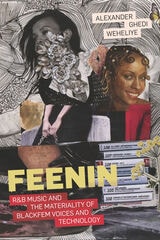
Feenin
R&B Music and the Materiality of BlackFem Voices and TechnologyAlexander Ghedi Weheliye
Duke University Press, 2023
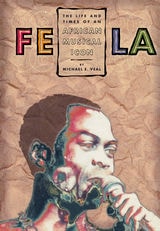
Fela
Life And Times Of An AfricanMichael Veal
Temple University Press, 2000
Although harassed, beaten, and jailed by Nigerian authorities, he continued his outspoken and derisive criticism of political corruption at home and economic exploitation from abroad. A volatile mixture of personal characteristics -- charisma, musical talent, maverick lifestyle, populist ideology, and persistence in the face of persecution -- made him a legend throughout Africa and the world. Celebrated during the 1970s as a musical innovator and spokesman for the continent's oppressed masses, he enjoyed worldwide celebrity during the 1980s and was recognized in the 1990s as a major pioneer and elder statesman of African music. By the time of his death in 1997 from AIDS-related complications, Fela had become something of a Nigerian institution.
In Africa, the idea of transnational alliance, once thought to be outmoded, has gained new currency. In African America, during a period of increasing social conservatism and ethnic polarization, Africa has re-emerged as a symbol of cultural affirmation. At such an historical moment, Fela's music offers a perspective on race, class, and nation on both sides of the Atlantic. As Professor Veal demonstrates, over three decades Fela synthesized a unique musical language while also clearing -- if only temporarily -- a space for popular political dissent and a type of counter-cultural expression rarely seen in West Africa. In the midst of political turmoil in Africa, as well as renewal of pro-African cultural nationalism throughout the diaspora, Fela's political music functions as a post-colonial art form that uses cross-cultural exchange to voice a unique and powerful African essentialism.
Feminism And Documentary
Diane Waldman
University of Minnesota Press, 1999
The first book of essays to explore the intersection of these two vital disciplines.
Documentary and feminist film studies have long been separate or parallel universes that need to converse or collide. The essays in this volume, written by prominent scholars and filmmakers, demonstrate the challenges that feminist perspectives pose for documentary theory, history, and practice. They also show how fuller attention to documentary enriches and complicates feminist theory, especially regarding the relationship between gender and sexuality, race and ethnicity, class and nation.
Feminism and Documentary begins with a substantial historical introduction that highlights several of the specific areas that contributors address: debates over realism, the relationship between filmmaker and subject, historical thinking about documentary and thinking about the historical documentary, biography and autobiography, and the use of psychoanalysis. Other essays, most of which appear here for the first time, range from broad overviews to close analyses of particular films and videos and from discussions of well-known works such as Roger and Me and Don’t Look Back to lesser known texts that might revise the canon. The collection includes an extensive filmography and videography with useful distribution information and a bibliography of work in this neglected area of scholarship. Lucid, sophisticated, and eye-opening, this book will galvanize documentary studies and demonstrate the need for women’s and cultural studies to grapple with visual media. Contributors: Michelle Citron, Northwestern U; Gloria J. Gibson, Indiana U; Chris Holmlund, U of Tennessee; Alexandra Juhasz, Pitzer College; Ann Kaneko; Anahid Kassabian, Fordham U; David Kazanjian, U of California, Berkeley; Susan Knobloch; Silvia Kratzer-Juilfs; Deborah Lefkowitz; Julia Lesage, U of Oregon; Laura U. Marks, Carleton U, Ottawa; Paula Rabinowitz, U of Minnesota; Michael Renov, USC; Patricia R. Zimmermann, Ithaca College.
Feminism and American Literary History
EssaysBaym, Nina
Rutgers University Press, 1992
Feminisms
An AnthologyWarhol-Down, Robyn
Rutgers University Press, 1991
Feminist Comedy
Women Playwrights of LondonWillow White
University of Delaware Press, 2024
Feminist Fabulation
Space/Postmodern FictionMarleen S. Barr
University of Iowa Press, 1992
Feminist Literacies, 1968-75
Kathryn Thoms Flannery
University of Illinois Press, 2010
In the late 1960s and early 1970s, ordinary women affiliated with the women's movement were responsible for a veritable explosion of periodicals, poetry, and manifestos, as well as performances designed to support "do-it-yourself" education and consciousness-raising. Kathryn Thoms Flannery discusses this outpouring and the group education, brainstorming, and creative activism it fostered as the manifestation of a feminist literacy quite separate from women's studies programs at universities or the large-scale political workings of second-wave feminism. Seeking to break down traditional barriers such as the dichotomies of writer/reader or student/teacher, these new works also forged polemical alternatives to the forms of argumentation traditionally used to silence women, creating a space for fresh voices. Feminist Literacies explores these truly radical feminist literary practices and pedagogies that flourished during a brief era of volatility and hope.
Feminist Narrative Ethics
Tacit Persuasion in Modernist FormKatherine Saunders Nash
The Ohio State University Press, 2014
Despite pronouncements by many theorists about the difficulty—even the impossibility—of doing justice in a single study to both history and form, Feminist Narrative Ethics proves that they can be mutually illuminating. Its approach is not only resolutely rhetorical, but resolutely historical as well. It strikes a felicitous balance between history and form that affords new understanding of the implied author concept.
Feminist Narrative Ethics makes a persuasive case for the necessity of locating authorial agency in the implied (rather than the actual) author and cogently explains why rhetorical theory insists on the concept of an implied (rather than an inferred) author. And it proposes a new facet of agency that rhetorical theorists have heretofore neglected: the ethics of progressive revisions to a project in manuscript.
Feminist Readings of Native American Literature
Coming to VoiceKathleen M. Donovan
University of Arizona Press, 1998
The author demonstrates how Canadian women of mixed-blood ancestry achieve a voice through autobiographies and autobiographical novels. Using a framework of feminist reader response theory, she considers an underlying misogyny in the writings of N. Scott Momaday. And in examining commonalities between specific cultures, she discusses how two women of color, Paula Gunn Allen and Toni Morrison, explore representations of femaleness in their respective cultures. By synthesizing a broad spectrum of critical writing that overlaps women's voices and Native American literature, Donovan expands on the frame of dialogue within feminist literary and cultural theory. Drawing on the related fields of ethnography, ethnopoetics, ecofeminism, and post-colonialism, Feminist Readings of Native American Literature offers the first systematic study of the intersection between two dynamic arenas in literary studies today.
Feminist Rehearsals
Gender at the Theatre in Early Twentieth-Century Argentina and MexicoMay Summer Farnsworth
University of Iowa Press, 2023
2023 George Freedley Memorial Award, Finalist
As feminism gained prominence in twentieth-century popular culture, dramatic conventions progressed accordingly, offering larger and more diverse roles for women characters. Feminist Rehearsals documents the early stages of feminist theatre in Argentina and Mexico, revealing how various aspects of performance culture—spectator formation, playwriting, professional acting and directing, and dramatic techniques—paralleled political activism and championed the goals of the women’s rights movement. Through performance and protest, feminists enacted new identities and pushed for myriad social and legislative reforms during a time when women were denied suffrage and full citizenship status. Together, feminist theatre and demonstrations politicized women spectators’ collective presence and promoted women’s rights in the public sphere.
Feminist Theories for Dramatic Criticism
Gayle Austin
University of Michigan Press, 1990
Feminist Theories for Dramatic Criticism provides a number of useful approaches for analyzing works for the stage from a feminist perspective. Each chapter outlines key feminist theories in a specific field, covering literary criticisms, anthropology, psychology, and film, and then applies these theories in a detailed criticism of one or two plays. Plays by Eugene O'Neill, Arthur Miller, Lillian Hellman, Jane Bowles, Sam Shepard, and Alice Childress—all produced after World War II—are reexamined through the lenses of feminist theorist Judith Fetterley, Gayle Rubin, Nancy Chodorow, and Laura Mulvey, each a key figure in her respective field.
The introduction provides a framework for the discussion of feminist dramatic criticism by presenting the multiple political perspectives within feminism. The contributions of black and lesbian feminists to the question of theory are explored, as are the evolutionary stages of feminist criticism as they have been occurring in other fields. Theater has been slower than most fields to move through these stages, and its trajectory thus far is briefly traced. For the sake of clarity, each of the central chapters treats theories from a particular discipline, but the conclusion reminds us that in practice the theories are most often combined.
The book will appeal to theater scholars and practitioners interested in finding their way into feminist theory for the first time, or in expanding their knowledge of its insights for use in teaching, research, and production. Those in women's studies and other fields will find it shows ways to include plays among the texts they analyze.

Feminist Theory and Literary Practice
Deborah L. Madsen
Pluto Press, 2000
Fernando Ortiz on Music
Selected Writing on Afro-Cuban CultureRobin D. Moore
Temple University Press, 2018
Fernando Ortiz (1881–1969) is recognized as one of the most influential Latin American authors of the twentieth century. Although he helped establish the field of Afro-diasporic studies, his writings are still relatively unknown to the English-speaking world. In Fernando Ortiz on Music, accomplished ethnomusicologist Robin Moore has collected and translated an essential selection of Ortiz’s publications. These essays on Afro-Cuban expressive culture, music and dance are now available for the first time in English.
Ortiz’s writings are accompanied by an extended introduction that contextualizes the author’s life, intellectual influences, and collaborators as well as his fieldwork and interviews. Fernando Ortiz on Music also charts the writer’s changing views of black heritage through the years. This comprehensive anthology, which includes examples of his early scholarship as well as publications from the 1940s and ’50s, extends the life and legacy of this important and under-known scholar of Latin American and Caribbean music.
Contributors include: David Garcia, Sarah Lahasky, Cary Peñate, Susan Thomas, and the editor