Results by title
238 books match the query 'Libraries' and 11 start with f
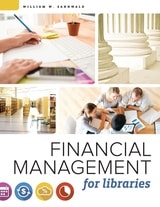
Financial Management for Libraries
William W. Sannwald
American Library Association, 2018
Presenting financial management principles and best practices applicable to both public and academic libraries, this comprehensive text elucidates a broad array of issues crucial for those entering a managerial position. Both thorough and straightforward, Sannwald's treatment
- gives readers a solid grounding in the basics of accounting and finance, with an emphasis on applicability to library management and operations;
- ties budgets and strategic planning to library vision, mission, goals, and objectives;
- discusses the roles of stakeholders such as boards, governmental/municipal bodies, the university, and the community;
- looks at a variety of funding sources, from tax revenue to gifts and donations, and presents sound strategies for including them when projecting income and expenses;
- articulates and discusses the pros and cons of various budget strategies;
- includes sample budgets and forms that can be customized as needed;
- offers expert guidance on modifying budgets for windfalls and shortfalls;
- explains operating ratios, fiscal benchmarking, and metrics, demonstrating how to use these to effectively create and manage a budget and assess the fiscal health of the library; and
- advises on how to effectively prepare and present a budget and annual financial statements to a library's governing agency.
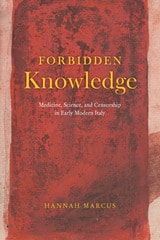
Forbidden Knowledge
Medicine, Science, and Censorship in Early Modern ItalyHannah Marcus
University of Chicago Press, 2020
Forbidden Knowledge explores the censorship of medical books from their proliferation in print through the prohibitions placed on them during the Counter-Reformation. How and why did books banned in Italy in the sixteenth century end up back on library shelves in the seventeenth? Historian Hannah Marcus uncovers how early modern physicians evaluated the utility of banned books and facilitated their continued circulation in conversation with Catholic authorities.
Through extensive archival research, Marcus highlights how talk of scientific utility, once thought to have begun during the Scientific Revolution, in fact, began earlier, emerging from ecclesiastical censorship and the desire to continue to use banned medical books. What’s more, this censorship in medicine, which preceded the Copernican debate in astronomy by sixty years, has had a lasting impact on how we talk about new and controversial developments in scientific knowledge. Beautiful illustrations accompany this masterful, timely book about the interplay between efforts at intellectual control and the utility of knowledge.

Forging the Future of Special Collections
Arnold Hirshon
American Library Association, 2016
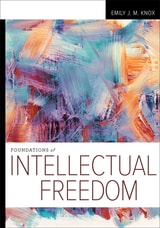
Foundations of Intellectual Freedom
Emily J. M. Knox
American Library Association, 2022
- the historical and legal roots of intellectual freedom, with an in-depth examination of John Stuart Mill’s “On Liberty” and Article 19 of the U.N Declaration of Human Rights, and its central concepts and principles;
- the intersection of intellectual freedom, freedom of expression, and social justice;
- professional values, codes of ethics, ALA’s Library Bill of Rights, and Freedom to Read/View Statements;
- pro- and anti- censorship arguments and their use in impeding and facilitating access to information;
- book banning and internet filtering;
- privacy and its relationship to information services;
- U.S. case law and precedents;
- the basics of U.S. copyright law, including fair use, and how it differs from international copyright law; and
- emerging global issues and their impact on future intellectual freedom.
From A to Zine
Building a Winning Zine Collection in Your LibraryJulie Bartel
American Library Association, 2004

From the Modernist Annex
American Women Writers in Museums and LibrariesKarin Roffman
University of Alabama Press, 2010
Fundamentals of Electronic Resources Management
Alana Verminski
American Library Association, 2022
Whether it's networking with vendor reps or poring over data, the continually evolving field of electronic resources management (ERM) is always throwing something new your way. Alana Verminski and Kelly Marie Blanchat were once new on the job themselves, crossing over from research instruction and the vendor side of scholarly publishing. They share what they've learned along the way in this hands-on guide. Cutting through the complexity of a role that's changing rapidly, inside you'll find to-the-point advice on methods and tools that will help you stay on top of things, including coverage of such key topics as
- the full range of purchasing options, from Big Deals to unbundling to pay-per-view;
- conversation starters that will help build productive relationships with vendor reps;
- questions to ask vendors about accessibility;
- common clauses of licensing agreements and what they mean;
- understanding the four types of authentication;
- using a triage approach to troubleshooting hitches in accessing articles;
- conducting an overlap analysis to evaluate new content;
- the basic principles of usage statistics, and four ways to use COUNTER reports when evaluating renewals;
- tips for activating targets in your knowledge base;
- five steps to developing an effective marketing plan; and
- how to master the lingo, with clear explanations of jargon, important terms, and acronyms.
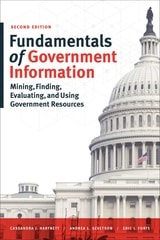
Fundamentals of Government Information
Mining, Finding, Evaluating, and Using Government ResourcesCassandra J. Hartnett
American Library Association, 2016
Fundamentals of Managing Reference Collections
Carol A. Singer
American Library Association, 2012
Fundamentals of Planning and Assessment for Libraries
Rachel A. Fleming-May and Regina Mays
American Library Association, 2021
The concepts of planning and assessment are intrinsically linked—and understanding them is essential for raising the library’s profile and strengthening its position among stakeholders and the community. Even if you're an LIS student or are new to the profession, or if planning or assessment are not your primary areas of responsibility, you still have a role to play in the success of organizational efforts. Fleming-May has more than a decade of experience in planning and assessment initiatives and instruction, and Mays was her institution’s first assessment librarian; their primer draws from theory, research, and their first-hand observations to illuminate such topics as
- characteristics of bad planning strategy that can help to illustrate a better approach;
- reasons why using economic models, like ROI, fall short;
- how to mix the three types of planning;
- guidelines to ensure that assessment is meaningful and actionable;
- tips for creating effective surveys;
- emphasizing users’ needs with a critical assessment framework;
- data analysis for surveys, interviews, focus groups, and observation;
- four questions to ask about audience level before you develop a report;
- a sample 3-year assessment plan that can be customized; and
- seven steps for developing a culture of ongoing assessment.
Future Libraries
Dreams, Madness and RealityAmerican Library Association, 1995