Results by title
8128 books match the query 'Literary Criticism' and 298 start with f
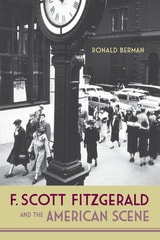
F. Scott Fitzgerald and the American Scene
Ronald Berman
University of Alabama Press, 2017
A study of the philosophical, intellectual, and political influences on the artistic creations of Fitzgerald and key early American modernist writers
F. Scott Fitzgerald and the American Scene continues Ronald Berman’s lifelong study of the philosophical, intellectual, and political influences on the artistic creations of key early American modernist writers. Each chapter in this volume elaborates on a crucial aspect of F. Scott Fitzgerald’s depiction of American society, specifically through the lens of the social sciences that most influenced his writing and thinking.
Berman addresses, among other subjects, Fitzgerald’s use of philosophy, cultural analyses, and sociology—all enriched by the insights of his own experience living an American life. He was especially interested in how life had changed from 1910 to 1920. Many Americans were unable to navigate between the 1920s and their own memories of a very different world before the Great War; especially Daisy Buchanan who evolves from girlhood (as typified in sentimental novels of the time) to wifehood (as actually experienced in the new decade). There is a profound similarity between what happens to Fitzgerald’s characters and what happened to the nation.
Berman revisits classics like The Great Gatsby but also looks carefully at Fitzgerald’s shorter fictions, analyzing a stimulating spectrum of scholars from more contemporary critics like Thomas Piketty to George Santayana, John Maynard Keynes, John Dewey, and Walter Lippmann. This fascinating addition to F. Scott Fitzgerald scholarship, although broad in its content, is accessible to a wide audience. Scholars and students of Fitzgerald and twentieth-century American literature, as well as dedicated Fitzgerald readers, will enjoy Berman’s take on a long-debated and celebrated author.
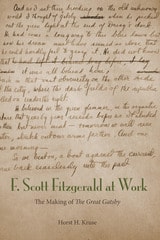
F. Scott Fitzgerald at Work
The Making of "The Great Gatsby"Horst H. Kruse
University of Alabama Press, 2014
The essays in F. Scott Fitzgerald at Work examine fresh facts that illuminate the experiences and source materials upon which Fitzgerald based this quintessentially American masterpiece. They confirm author Horst Kruse’s view that Fitzgerald’s flights of fancy, even at their most spectacular, are firmly grounded in biographical experience as well as in the social, literary, and philosophical circumstances of his era.
In the first essay, Kruse reconstructs the life story of the individual who allegedly inspired the character of Jay Gatsby: Max von Gerlach. Kruse recounts his journeys to various archives and libraries in the United States as well as in Germany to unearth new facts about the genesis of the Gatsby characters. In another journey, readers travel with Kruse to Long Island to explore its physical and moral geography in relation to Fitzgerald, specifically the role of certain elite Long Island families in the advancement of the “science of eugenics” movement. The final two essays take Kruse across the globe to various destinations to consider the broader place of The Great Gatsby in American and international intellectual history.
Replete with fascinating discoveries and insights, F. Scott Fitzgerald at Work both corrects previous assumptions about The Great Gatsby and deepens our appreciation and understanding of Fitzgerald‘s imagination.
F. Scott Fitzgerald in the Twenty-First Century
Jackson R. Bryer
University of Alabama Press, 2003
This thought-provoking collection explores significant new facets of an American author of lasting international stature.
“Edited by three eminent Fitzgerald scholars, this fine book comprises nineteen incisive and provocative essays (most written for this collection) by . . . well-known Fitzgerald critics. The content is as varied as the international origins of its authors.” —Choice
As the author of some of the most compelling short stories ever written, two of the central novels in American literature, and some of the most beautiful prose ever penned, F. Scott Fitzgerald is read and studied all over the world. Sixty-two years after his death, his works—protean, provocative, multilayered, and rich—continue to elicit spirited responses. This collection grew out of the F. Scott Fitzgerald Conference that convened in Princeton at the centennial of this author's birth. Bringing together dozens of the world's leading scholars and commentators, the conference and the book celebrate the ever-growing legacy of Fitzgerald's art.
The subjects of these 19 essays reflect the contributors' wish to shine new light on less-frequently discussed aspects of Fitzgerald's work. Topics include Fitzgerald's Princeton influences and his expression of Catholic romanticism; his treatments of youth culture, the devil, and waste; parallels in the work of Mencken, Cather, and Murakami; and the ways gender, pastoral mode, humor, and the Civil War are variously presented in his work. One illustrated summary examines Fitzgerald's effect on popular culture through his appearance in the comics. Two broad overviews—one on Fitzgerald's career and another on the final developments in the author's style—round out the collection.
The international scope of the contributors to this volume reflects Fitzgerald's worldwide reputation and appeal. With extensive treatments of This Side of Paradise, The Beautiful and Damned, The Last Tycoon, and the Pat Hobby stories, this collection makes an unusual and significant contribution to the field of Fitzgerald studies.
FEELING HISTORY
LUCAN, STOICISM, AND THE POETICS OF PASSIONFrancesca D’Alessandro Behr
The Ohio State University Press, 2007
FEMALE TRADITION IN SOUTHERN LITERATURE
Carol S. Manning
University of Illinois Press, 1993
essays reclaim women's traditions which have been neglected by critics who ought to have known
better." -- Kathryn Lee Seidel, author of The Southern Belle in the American Novel
FEMINIST REALISM AT THE FIN DE SIÈCLE
The Influence of the Late-Victorian Woman’s Press on the Development of the NovelMolly Youngkin
The Ohio State University Press, 2007
FROM OLD WOMAN TO OLDER WOMEN
Contemporary Culture and Women’s NarrativesSally Chivers
The Ohio State University Press, 2003
Sally Chivers provides a fascinating look at and challenge to how North American popular culture has portrayed old age as a time of disease, decline, and death. Within contemporary Canadian literary and film production, a tradition of articulate central elderly female characters challenges what the aging body has come to signify in a broader cultural context. Rather than seek positive images of aging, which can do their own prescriptive damage, the author focuses on constructive depictions that provide a basis on which to create new stories and readings of growing old. This type of humanities approach to the study of aging promises neither to fixate on nor avoid consideration of the role of the body in the much broader process of getting older. The progression implied in the title from the solitary symbol of The Old Woman toward a community of older women, indicates not a move toward euphemism, but rather an increasing and necessary awareness of the social and cultural dimensions of aging.
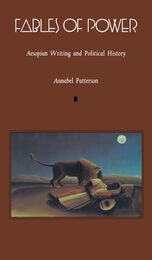
Fables of Power
Aesopian Writing and Political HistoryAnnabel Patterson
Duke University Press, 1991
Patterson begins with an analysis of the legendary Life of Aesop, its cultural history and philosophical implications, a topic that involves such widely separated figures as La Fontaine, Hegel, and Vygotsky. The myth’s origin is recovered here in the saving myth of Aesop the Ethiopian, black, ugly, who began as a slave but become both free and influential, a source of political wisdom. She then traces the early modern history of the fable from Caxton, Lydgate, and Henryson through the eighteenth century, focusing on such figures as Spenser, Sidney, Lyly, Shakespeare, and Milton, as well as the lesser-known John Ogilby, Sir Roger L’Estrange, and Samuel Croxall.
Patterson discusses the famous fable of The Belly and the Members, which, because it articulated in symbolic terms some of the most intransigent problems in political philosophy and practice, was still going strong as a symbolic text in the mid-nineteenth century, where it was focused on industrial relations by Karl Marx and by George Eliot against electoral reform.
Fables of Representation
EssaysPaul Hoover
University of Michigan Press, 2004
With its title essay, "Fables of Representation," one of the most cogent studies ever written of the New York School of poets (a group that includes the influential poet John Ashbery), this book is required reading for anyone who seeks to understand the poetry and culture of the postmodern period.
Author Paul Hoover's wide-ranging subjects include African-American interdisciplinary studies; the position of poetry in the electronic age; the notion of doubleness in the work of Harryette Mullen and others; the lyricism of the New York School poets; and the role of reality in American poetry. Hoover also introduces two provocative essays sure to generate attention and discussion: "The Postmodern Era: A Final Exam" and "The New Millennium: Fifty Statements on Literature and Culture."
Paul Hoover is the editor of the anthology Postmodern American Poetry and author of nine poetry collections, including Totem and Shadow: New and Selected Poems and Viridian. His poetry has appeared in American Poetry Review, The New Republic, and The Paris Review, among others. He is Poet-in-Residence at Columbia College, Chicago.

Fables, Foibles, and Foobles
Carl Sandburg
University of Illinois Press, 1988
Sandburg often incorporated proverbs, riddles, aphorisms, and vernacular wisdom in lectures, poetry, children’s stories, and in his novel Remembrance Rock. Believing that silliness and fun helped preserve sanity and balance, he put together a collection of fanciful anecdotes - alive with alliteration - for his own amusement. Now, more than twenty years after his death, the publication of Fables, Foibles, and Foobles truly reveals, for perhaps the first time, the playful spirit of this great American poet.
George Hendrick has compiled the best of these never-before-published nonsensical pieces, which include Flies, Fleas, Flinyons, Flicks, Flooches, Flacks, Flatches, and assorted F-friends deep in dialogue about books and reading; the fascinating worlds of the curious hoomadooms, hongdorshes, and onkadonks; fables to rival Thurber; jokes about every conceivable type of nut; and cameo appearances by Hank the Honk and Flitty the Wid, among others. Robert Harvey’s whimsical drawings, scattered throughout the book, illuminate this charming cast of characters.
Facing It
AIDS Diaries and the Death of the AuthorRoss Chambers
University of Michigan Press, 2001
"Groundbreaking in its approach and potentially wide in its appeal. . . . The rigor of the ideas, their dramatic nature, and the political drive of the rhetoric all should win Facing It a large readership that could extend far beyond students of narrative or queer theory." --David Bergman, Towson University, editor of Camp Grounds: Style and Homosexuality
Ross Chambers is Distinguished University Professor of French and Comparative Literature, University of Michigan, and author of Room for Maneuver: Reading (the) Oppositional (in) Narrative and Story and Situation: Narrative Seduction and the Power of Fiction.

Facing It
AIDS Diaries and the Death of the AuthorRoss Chambers
University of Michigan Press, 1999
"Groundbreaking in its approach and potentially wide in its appeal. . . . The rigor of the ideas, their dramatic nature, and the political drive of the rhetoric all should win Facing It a large readership that could extend far beyond students of narrative or queer theory." --David Bergman, Towson University, editor of Camp Grounds: Style and Homosexuality
Ross Chambers is Distinguished University Professor of French and Comparative Literature, University of Michigan, and author of Room for Maneuver: Reading (the) Oppositional (in) Narrative and Story and Situation: Narrative Seduction and the Power of Fiction.
Facing Texts
Encounters Between Contemporary Writers and CriticsHeide Ziegler, ed.
Duke University Press, 1988
Fact, Fiction, and Form
Selected EssaysRalph W. Rader
The Ohio State University Press, 2011
Facundo and the Construction of Argentine Culture
By Diana Sorensen Goodrich
University of Texas Press, 1996
Domingo F. Sarmiento's classic 1845 essay Facundo, Civilizacion y Barbarie opened an inquiry into the nature of Argentinian culture that continues to the present day. In this elegantly written study, Diana Sorensen Goodrich explores the varied, and often conflicting, readings that Facundo has received since its publication and shows how these readings have contributed to the making and remaking of the Argentine nation and its culture.
Goodrich's analysis sheds new light on the intersection between canon formation and nation-building. While much has been written about Facundo as a primary text in Latin American letters, this is the first study that locates it within the problematics of canon formation and the cultural, social, and political contexts in which conflicting interpretations are constructed.
This new approach to Facundo illuminates the interactions among institutions, cultural ideologies, and political life. This book will be important reading for everyone interested in questions of national identity and the institutionalization of a national tradition.
Faint Praise
The Plight of Book Reviewing in AmericaGail Pool
University of Missouri Press, 2007
For more than two hundred years, book reviewers have influenced American readers, setting our literary agenda by helping us determine not only what we read but also what we think about what we read. And for nearly as long, critics of these critics have lambasted book reviews for their overpraise, hostility, banality, and bias.
Faint Praise takes a hard and long-overdue look at the institution of book reviewing. Gail Pool, herself an accomplished reviewer and review editor, analyzes the inner workings of this troubled trade to show how it works—and why it so often fails to work well. She reveals why bad reviewing happens despite good intentions and how it is that so many intelligent people who love books can say so many unintelligent things on their behalf.
Reviewers have the power to award prestige to authors, give prominence to topics, and shape opinion and taste; yet most readers have little knowledge of why certain books are selected for review, why certain reviewers are selected to review them, and why they so often praise books that aren’t all that good. Pool takes readers behind the scenes to describe how editors choose books for review and assign them to reviewers, and she examines the additional roles played by publishers, authors, and readers. In describing the context of reviewing, she reveals a culture with little interest in literature, much antipathy to criticism, and a decided weakness for praise. In dissecting the language of reviews, Pool demonstrates how it often boils down to unbelievable hype.
Pool explores the multifaceted world of book reviewing today, contrasting traditional methods of reviewing with alternative book coverage, from Amazon.com to Oprah, and suggesting how the more established practices could be revised. She also explores the divide between service journalism practiced by reviewers versus the alleged high art served up by literary critics—and what this fuzzy boundary between reviewing and criticism really means.
This is the first book to analyze the field in depth, weighing the inherent difficulties of reviewing against the unacceptable practices that undermine the very reasons we read—and need—reviews. Faint Praise is a book not just for those who create and review books but also for everyone who loves books. By demystifying this hidden process, Pool helps everyone understand how to read reviews—and better decide what to read.
Fair Rosamond
A Study of the Development of a Literary ThemeVirgil B. Heltzel
Northwestern University Press, 1947
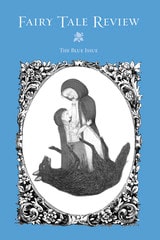
Fairy Tale Review, The Blue Issue
The Blue IssueKate Bernheimer
University of Alabama Press, 2006
Fairy Tale Review, The Green Issue
The Green IssueKate Bernheimer
University of Alabama Press, 2007
Faithful Passages
American Catholicism in Literary Culture, 1844–1931James Emmett Ryan
University of Wisconsin Press, 2013
Faithful Passages also reveals new dimensions in American religious literary culture by moving beyond the antebellum period to consider how the first important cohort of Catholic writers shaped their message for subsequent generations of readers in the late nineteenth and early twentieth centuries. Perhaps most strikingly, Ryan shows that by the early twentieth century, Roman Catholic themes and traditions in American literature would be advanced in complex ways by mainstream, non-Catholic modernist writers like Kate Chopin and Willa Cather.
Catholic literary culture in the United States took shape in a myriad of ways and at the hands of diverse participants. The process by which Roman Catholic ideas, themes, and moralities were shared and adapted by writers with highly differentiated beliefs, Ryan contends, illuminates a surprising fluidity of religious commitment and expression in early U.S. literary culture.
Faithful Renderings
Jewish-Christian Difference and the Politics of TranslationNaomi Seidman
University of Chicago Press, 2006
Bringing together central issues in translation studies with episodes in Jewish–Christian history, Naomi Seidman considers a range of texts, from the Bible to Elie Wiesel’s Night, delving into such controversies as the accuracy of various Bible translations, the medieval use of converts from Judaism to Christianity as translators, the censorship of anti-Christian references in Jewish texts, and the translation of Holocaust testimony. Faithful Renderings ultimately reveals that translation is not a marginal phenomenon but rather a crucial issue for understanding the relations between Jews and Christians and indeed the development of each religious community.
Faithful Translators
Authorship, Gender, and Religion in Early Modern EnglandJaime Goodrich
Northwestern University Press, 2014
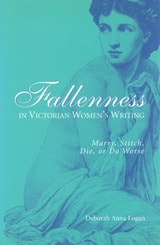
Fallenness in Victorian Women's Writing
Marry, Stitch, Die, Or Do WorseDeborah Anna Logan
University of Missouri Press, 1998
The Angel-in-the-House is an ideal commonly used to define sexual standards of the Victorian Age. Although widely considered to be the cultural "norm," the Victorian Angel, revered for her morality, domestic virtue, and dedication to the family, is more frequently depicted in the literature of the time as an anomaly. In fact, a primary concern of Victorian literature appears to be the many exceptions to this unattainable ideal, which, according to the period's madonna-or-harlot polarity, casts these exceptions as fallen women. Deborah Anna Logan presents an unusual study of this image of fallenness in Victorian literature, focusing on the links among angelic ideology, sexuality, and, more important, social deviance.
Fallenness, according to Logan, does not refer simply to women who have sexually strayed from morality; besides prostitutes, the ranks of the fallen include unmarried mothers, needlewomen, alcoholics, the insane, the childless, the anorexic, slaves, and harem women. All of these women are presented as fallen because they fail to conform to sexual and social norms. In some cases, economic need was responsible for women's failure to uphold the ideals of domesticity and motherhood that were so revered in nineteenth- century society. But other examples illustrate the power of angelic ideology to construct deviancy even out of nonsexual behaviors.
Logan's study is distinguished by its exclusive focus on women writers, including Charlotte Brontë, George Eliot, Elizabeth Gaskell, Harriet Martineau, Elizabeth Barrett Browning, Florence Nightingale, Sarah Grand, and Mary Prince. Logan utilizes primary texts from these Victorian writers as well as contemporary critics such as Catherine Gallagher and Elaine Showalter to provide the background on social factors that contributed to the construction of fallen-woman discourse. Examining novels, short stories, poetry, and travel journals, Logan successfully demonstrates the rich links between these writers and their fallen characters--links in which, for women, even the act of writing becomes a type of fallenness.
Fallenness in Victorian Women's Writing is a significant and original contribution to the study of literature. Logan's thoroughly researched and attractively presented book will be of special interest to students of Victorian and women's studies, as well as to the general reader.
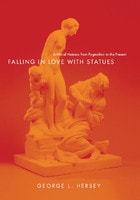
Falling in Love with Statues
Artificial Humans from Pygmalion to the PresentGeorge L. Hersey
University of Chicago Press, 2009
Hersey’s history of statue love begins in Cyprus, home of the legendary sculptor Pygmalion, who famously grew enamored of his own creation. Examining the island’s prehistoric images of Aphrodite—the love goddess who brought Pygmalion’s sculpture to life—Hersey traces the origins of statue love back to the Cypriot followers who adored her terra-cotta likenesses. He goes on to explore ideas about human replicas in the works of Empedocles, Aristotle, Lucretius, and Ovid, whose definitive account of the Pygmalion myth introduced the notion that statues have the potential to induce physical responses in their viewers. Finding avatars of Ovid’s living image in everything from pagan idols and early Christian statuary to eighteenth-century painting to modern action figures and marionettes, Hersey concludes by investigating the concern that these automata will eventually replace humans.
In the process, he narrates a powerful history of artificial life at a moment when—with the development of robot soldiers, ever more sophisticated genetic engineering, and a continually expanding digital universe—it seems more real than ever.
False Documents
Inter-American Cultural History, Literature, and the Lost Decade (1975–1992)Frans Weiser
The Ohio State University Press, 2020
After deconstructing economic accounts of the “two Americas" model of the hemisphere, including the lost decade (1981–1992) and the “end of history” (1975–1992), Weiser considers six case studies during the same period that reach very different conclusions by drawing on cultural history, including works by Tomás Eloy Martínez, Laura Antillano, Ana Maria Machado, Silviano Santiago, John Updike, and Jay Cantor. In order to expose how governments controlled and misrepresented recent events, these writers created false documents, or fake historical texts, that presented themselves as legitimate eyewitness accounts or archival documents. Weiser establishes how this alternative to postmodern irony more effectively galvanized citizen responses. As the first book to contextualize the parallel, hemispheric evolutions of postwar literary criticism and cultural historiography, False Documents responds to the methodological impasse between Latin American and American studies as well as the antagonism between history and literature, arguing that collaboration and synthesis are particularly vital at a moment when the humanities is increasingly under attack.
False Starts
The Rhetoric of Failure and the Making of American ModernismDavid M. Ball
Northwestern University Press, 2014
Fama and Fiction in Vergil's Aeneid
Antonia Syson
The Ohio State University Press, 2013
Familial Forms
Politics and Genealogy in Seventeenth-Century English LiteratureErin Murphy
University of Delaware Press, 2011
Familial Forms is the first full-length study to examine how literary writers engaged the politics of genealogy that helped define the “century of revolution.” By demonstrating how conflicts over the family-state analogy intersected with the period’s battles over succession, including: the ascent of James I, the execution of Charles I, disputes over the terms of the Interregnum government, the Restoration of Charles II, the Exclusion Crisis, the deposition of James II, the ascent of William and Mary, and Anne’s failure to produce a surviving heir, this study provides a new map of the seventeenth-century politics of family in England. Beginning with a reconsideration of Jacobean patriarchalism, Familial Forms focuses on the work of John Milton, Lucy Hutchinson, John Dryden, and Mary Astell. From their contrasting political and gendered positions, these authors contemplated and contested the relevance of marriage and kinship to government. Their writing illuminates two crucial elements of England’s conflicts. First, the formal qualities of poems and prose tracts reveal that not only was there a competition among different versions of the family-state analogy, but also a competition over its very status as an analogy. Second, through their negotiations of linear and nonlinear forms, Milton, Hutchinson, Dryden, and Astell demonstrate the centrality of temporality to the period’s political battles.
Through close textual analysis of poetry, political tracts, parliamentary records, and nonliterary genealogies, Familial Forms offers a fresh understanding of the seventeenth-century politics of genealogy. It also provides new answers to long-standing critical questions about the poetic form of canonical works, such as Paradise Lost and Absalom and Achitophel, and illuminates the political significance of newly-canonical works by women writers, including Aemilia Lanyer’s Salve Deus Rex Judaeoreum, Hutchinson’s Order and Disorder, and Astell’s A Serious Proposal to the Ladies.
Published by University of Delaware Press. Distributed worldwide by Rutgers University Press.
Families of the Heart
Surrogate Relations in the Eighteenth-Century British NovelAnn Campbell
Bucknell University Press, 2023
In this innovative analysis of canonical British novels, Campbell identifies a new literary device—the surrogate family—as a signal of cultural anxieties about young women’s changing relationship to matrimony across the long eighteenth century. By assembling chosen families rather than families of origin, Campbell convincingly argues, female protagonists in these works compensate for weak family ties, explore the world and themselves, prepare for idealized marriages, or sidestep marriage altogether. Tracing the evolution of this rich convention from the female characters in Defoe’s and Richardson’s fiction who are allowed some autonomy in choosing spouses, to the more explicitly feminist work of Haywood and Burney, in which connections between protagonists and their surrogate sisters and mothers can substitute for marriage itself, this book makes an ambitious intervention by upending a traditional trope—the model of the hierarchal family—ultimately offering a new lens through which to regard these familiar works.

Fan Phenomena
Game of ThronesEdited by Kavita Mudan Finn
Intellect Books, 2017
With the seventh season of the HBO series in production, Game of Thrones has been nominated for multiple awards, its cast has been catapulted to celebrity, and references to it proliferate throughout popular culture. Often positioned as the grittier antithesis to J. R. R. Tolkien’s Lord of the Rings, Martin’s narrative focuses on the darker side of chivalry and heroism, stripping away these higher ideals to reveal the greed, amorality, and lust for power underpinning them.
Fan Phenomena: Game of Thrones is an exciting new addition to the Intellect series, bringing together academics and fans of Martin’s universe to consider not just the content of the books and HBO series, but fan responses to both. From trivia nights dedicated to minutiae to forums speculating on plot twists to academics trying to make sense of the bizarre climate of Westeros, everyone is talking about Game of Thrones. Edited by Kavita Mudan Finn, the book focuses on the communities created by the books and television series and how these communities envision themselves as consumers, critics, and even creators of fanworks in a wide variety of media, including fiction, art, fancasting, and cosplay.
Fancy's Image
Contexts, Settings, and Perspectives in Shakespeare and His ContemporariesCharles R Forker
Southern Illinois University Press, 1990
In ten essays spanning more than three decades of scholarship, Charles R. Forker, the author of Skull Beneath the Skin: The Achievement of John Webster, explores the dramatic and poetic styles of Shakespeare and his contemporaries in relation to Elizabethan ideas of space and time, image patterns and aesthetic form in drama, cultural contexts (the family, the state, the individual), and political and religious values.
Forker has divided his essays into three sections. The essays in the first section, "The Stage," explore theatrical self-consciousness; those in "The Green World" examine the use of pastoral and natural settings as significant factors in dramatization; the essays in the final section, "The Family," discuss ideas of dramatic engagement and disengagement in major Elizabethan playwrights other than Shakespeare.
Fantasies of Neglect
Imagining the Urban Child in American Film and FictionPamela Robertson Wojcik
Rutgers University Press, 2016
Far Afield
French Anthropology between Science and LiteratureVincent Debaene
University of Chicago Press, 2014
The relationship between anthropology and literature in France is one of careful curiosity. Literary writers are wary about anthropologists’ scientific austerity but intrigued by the objects they collect and the issues they raise, while anthropologists claim to be scientists but at the same time are deeply concerned with writing and representational practices. Debaene elucidates the richness that this curiosity fosters and the diverse range of writings it has produced, from Proustian memoirs to proto-surrealist diaries. In the end he offers a fascinating intellectual history, one that is itself located precisely where science and literature meet.
Far from Mecca
Globalizing the Muslim CaribbeanAliyah Khan
Rutgers University Press, 2020
Far from Mecca: Globalizing the Muslim Caribbean is the first academic work on Muslims in the English-speaking Caribbean. Khan focuses on the fiction, poetry, and music of Islam in Guyana, Trinidad, and Jamaica. Combining archival research, ethnography, and literary analysis, Khan argues for a historical continuity of Afro- and Indo-Muslim presence and cultural production in the Caribbean. Case studies explored range from Arabic-language autobiographical and religious texts written by enslaved Sufi West Africans in nineteenth-century Jamaica, to early twentieth-century fictions of post-indenture South Asian Muslim indigeneity and El Dorado, to the attempted government coup in 1990 by the Jamaat al-Muslimeen in Trinidad, as well as the island’s calypso music, to contemporary judicial cases concerning Caribbean Muslims and global terrorism. Khan argues that the Caribbean Muslim subject, the “fullaman,” a performative identity that relies on gendering and racializing Islam, troubles discourses of creolization that are fundamental to postcolonial nationalisms in the Caribbean.
Faraway Women and the "Atlantic Monthly"
Cathryn Halverson
University of Massachusetts Press, 2019
Winner of the 2020 Thomas J. Lyon Award from the Western Literature Association
In the first decades of the twentieth century, famed Atlantic Monthly editor Ellery Sedgwick chose to publish a group of nontraditional writers he later referred to as “Faraway Women,” working-class authors living in the western United States far from his base in Boston. Cathryn Halverson surveys these enormously popular Atlantic contributors, among them a young woman raised in Oregon lumber camps, homesteaders in Wyoming, Idaho, and Alberta, and a world traveler who called Los Angeles and Honolulu home.
Faraway Women and the “Atlantic Monthly” examines gender and power as it charts an archival journey connecting the least remembered writers and readers of the time with one of its most renowned literary figures, Gertrude Stein. It shows how distant friends, patrons, publishers, and readers inspired, fostered, and consumed the innovative life narratives of these unlikely authors, and it also tracks their own strategies for seizing creative outlets and forging new protocols of public expression. Troubling binary categories of east and west, national and regional, and cosmopolitan and local, the book recasts the coordinates of early twentieth-century American literature.
Farm to Form
Modernist Literature and Ecologies of Food in the British EmpireJessica Martell
University of Nevada Press, 2020
Deeply informed by Martell’s extensive knowledge of modern British, Irish, American, and World Literatures, this progressive work positions modernism as central to the study of narratives of resistance against social and environmental degradation. Analyzed works include those of Thomas Hardy, E. M. Forster, Virginia Woolf, Joseph Conrad, George Russell, and James Joyce.
In light of climate change, fossil fuel supremacy, nutritional dearth, and other pressing food issues, modernist texts bring to life an era of crisis and anxiety similar to our own. In doing so, Martell summons the past as a way to employ the modernist term of “defamiliarizing” the present so that entrenched perceptions can be challenged. Our current food regime is both new and constantly evolving with the first industrial food trades. Studying earlier cultural responses to them invites us to return to persistent problems with new insights and renewed passion.

Fascist Fantasies?
Aesthetics and the Ambivalent Reception of Science Fiction and FantasyEdited by Tobias Hof and Jan Süselbeck
Lever Press, 2027
Why do right-wing extremists find science fiction and fantasy so appealing? This edited collection sets out to answer that question by examining ten influential genre texts, comics, and their filmic adaptations through an interdisciplinary lens. The wide historical scope reveals a recurring pattern: The far right has repeatedly attempted to claim interpretive authority over popular fiction as a means of establishing what Antonio Gramsci called “cultural hegemony.” By investigating how and why right-wing audiences gravitate toward these genres—and why those works may carry an inherent susceptibility to such readings—the collection offers timely insights into how core elements of fascist ideology can be transmitted both subtly through narrative and symbolism, and more deliberately through right-wing appropriation. The volume also explores how certain authors—whether intentionally or not—have lent themselves to this agenda through ambivalent storytelling choices.
Works examined include The Lord of the Rings, Star Wars, and The Matrix, and many more to enable a nuanced decoding of ambivalent texts, semiotics, and cinematic codes, while also assessing their potential real-world impact. Balancing scholarly rigor and an accessible style, the collection will be of interest to students and university instructors, as well as to engaged film enthusiasts and fantasy fans eager to think more critically about the genres they love.
Fashion Nation
Picturing the United States in the Long Nineteenth CenturySandra Tomc
University of Michigan Press, 2021
Fashioning Celebrity
Eighteenth-Century British Actresses and Strategies for Image MakingLaura Engel
The Ohio State University Press, 2011
Fashioning Change
The Trope of Clothing in High- and Late-Medieval EnglandAndrea Denny-Brown
The Ohio State University Press, 2012
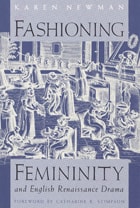
Fashioning Femininity and English Renaissance Drama
Karen Newman
University of Chicago Press, 1991
Through the critical lens of poststructuralism, Newman reads anatomies, conduct and domesticity handbooks, sermons, homilies, ballads, and court cases to delineate the ideologies of femininity they represented and produced. Arguing that drama, as spectacle, provides a peculiarly useful locus for analyzing the management of femininity, Newman considers the culture of early modern London to reveal how female subjectivity was fashioned and staged in the plays of Shakespeare, Jonson, and others.
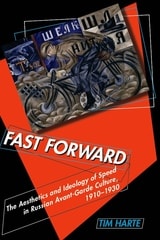
Fast Forward
The Aesthetics and Ideology of Speed in Russian Avant-Garde Culture, 1910–1930Tim Harte
University of Wisconsin Press, 2009
Although modernism arrived somewhat late in Russia, the increased tempo of life at the start of the twentieth century provided Russia’s avant-garde artists with an infusion of creative dynamism and crucial momentum for revolutionary experimentation. In Fast Forward Tim Harte presents a detailed examination of the images and concepts of speed that permeated Russian modernist poetry, visual arts, and cinema. His study illustrates how a wide variety of experimental artistic tendencies of the day—such as “rayism” in poetry and painting, the effort to create a “transrational” language (zaum’) in verse, and movements seemingly as divergent as neo-primitivism and constructivism—all relied on notions of speed or dynamism to create at least part of their effects.
Fast Forward reveals how the Russian avant-garde’s race to establish a new artistic and social reality over a twenty-year span reflected an ambitious metaphysical vision that corresponded closely to the nation’s rapidly changing social parameters. The embrace of speed after the 1917 Revolution, however, paradoxically hastened the movement’s demise. By the late 1920s, under a variety of historical pressures, avant-garde artistic forms morphed into those more compatible with the political agenda of the Russian state. Experimentation became politically suspect and abstractionism gave way to orthodox realism, ultimately ushering in the socialist realism and aesthetic conformism of the Stalin years.
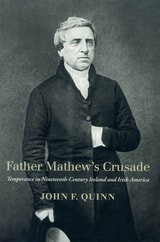
Father Mathew's Crusade
Temperance in Nineteenth-Century Ireland and Irish AmericaJohn F. Quinn
University of Massachusetts Press, 2002
For centuries, the Irish have been famed, and often derided, for their attachment to alcohol. Yet in the 1830s and 1840s, Ireland became a temperance stronghold. The man almost singlehandedly responsible for this surprising transformation was Father Theobald Mathew (1790–1856), a popular Franciscan friar. Over a ten-year period, five million Irish men, women, and children took the pledge at his hands, while hundreds of public houses were forced to shut their doors or switch to selling coffee and tea.
By the end of the 1840s, however, Mathew's “miracle” was already coming undone. The Great Famine was ravaging Ireland and Mathew's years of nonstop campaigning had left him sick, exhausted, and bankrupt. Undeterred, he traveled to the United States in 1849 to generate support and administer the pledge to as many new immigrants as he could find. Failing health forced him to return to Ireland where he died in 1856, leaving behind a weak and fragmented movement.
In the late nineteenth century, several Irish priests revived Mathew's crusade. In the United States, Irish American bishops supported the Catholic Total Abstinence Union (CTAU) and joined hands with the Women's Christian Temperance Union in their war against liquor. In Ireland, Father James Cullen formed the Pioneers, a total abstinence association for devout Catholics. While the CTAU languished after the United States Congress passed the Prohibition Amendment in 1919, the Pioneers continued to thrive in Ireland into the 1960s. Although the group's membership has declined in recent years, there are still today a large number of Irish teetotalers.

Father and Son
Kingsley Amis, Martin Amis, and the British Novel since 1950Gavin Keulks
University of Wisconsin Press, 2004
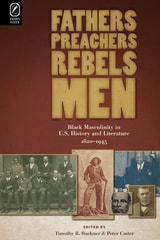
Fathers, Preachers, Rebels, Men
Black Masculinity in U.S. History and Literature, 1820–1945Timothy R. Buckner
The Ohio State University Press, 2011
Fathers, Preachers, Rebels, Men: Black Masculinity in U.S. History and Literature, 1820–1945,edited by Timothy R. Buckner and Peter Caster, brings together scholars of history and literature focused on the lives and writing of black men during the nineteenth and twentieth centuries in the United States. The interdisciplinary study demonstrates the masculine character of cultural practices developed from slavery through segregation. Black masculinity embodies a set of contradictions, including an often mistaken threat of violence, the belief in its legitimacy, and the rhetorical union of truth and fiction surrounding slavery, segregation, resistance, and self-determination. The attention to history and literature is necessary because so many historical depictions of black men are rooted in fiction. The essays of this collection balance historical and literary accounts, and they join new descriptions of familiar figures such as Charles W. Chesnutt and W. E. B. Du Bois with the less familiar but critically important William Johnson and Nat Love.

Faulkner and Hemingway
Biography of a Literary RivalryJoseph Fruscione
The Ohio State University Press, 2012
Faulkner the Storyteller
Blair Labatt
University of Alabama Press, 2006
A study exploring the role of event and plot in William Faulkner’s fiction.
Faulkner the Storyteller addresses the role of event and plot in Faulkner's fiction and the creation of an implied teller behind the tale. Novels like The Sound and the Fury and Absalom, Absalom! are often thought of as canonical modernist texts antagonistic to traditional notions of plot and storytelling. Blair Labatt, however, argues that Faulkner's fiction, regardless of its modernist gestures, is filled and driven by sophisticated manifestations of plot—willed challenges, structural targets, gambits, designs, engagements, and battles—a language of competition and conflict and a syntax of events.
Labatt examines Faulkner's short stories, such as "Mountain Victory," "That Evening Sun," and "Barn Burning," and the architecture of the Snopes Trilogy (The Hamlet, The Town, and The Mansion), and finds that Faulkner's deployment of cause and effect is central to his narratives. Labatt also explores how Faulkner's use of plot creates an implied voice that lends a humorous element to his story's twists and turns that often brackets and encloses the pathos of his characters.

Faulkner's Narrative Poetics
Style as VisionArthur F. Kinney
University of Massachusetts Press, 1978
Faulkner's Revision of Absalom, Absalom!
A Collation of the Manuscript and the Published BookBy Gerald Langford
University of Texas Press, 1971
Faulkner’s Revision of Absalom, Absalom! is a study of the creative process as exemplified in one of the major achievements in twentieth-century fiction. Portions of the original handwritten version of the story are collated, line by line, with corresponding sections of the published version. In an introductory discussion the major changes are analyzed and evaluated.
It is particularly interesting to observe Faulkner revising not only his choice of words and the construction of his sentences but also the central design of the story. Most notably, he changed his mind about having it known from the beginning that Charles Bon was Sutpen’s part-Negro son, and he developed Quentin Compson into the pivotal figure who finally supplies this missing piece of information.
In the process of revision Absalom, Absalom! became a kind of detective story, and the reader is forced to join the quest and participate in the undertaking which is the basic subject of the book—the human attempt to comprehend and deal with the past.
To trace the process of this revision is to experience a sharp focusing of theme and to witness a demonstration of how the meaning of a fictional work can shape its structure and, in turn, stand revealed by what has become the outward sign, or form, of that meaning.
Faulkner's Revision of Sanctuary
A Collation of the Unrevised Galleys and the Published BookBy Gerald Langford
University of Texas Press, 1972
Was Sanctuary really a “cheap idea,” as Faulkner himself called it, a book “deliberately conceived to make money”? The question has teased the reading public since its publication. Many readers have had their worst suspicions about Faulkner’s work confirmed by his statement, but most serious critics have discounted the disparagement, emphasizing instead Faulkner’s further statement that when the galley proofs arrived from his publisher, “I saw that it was so terrible that there were two things to do: tear it up or rewrite it. I thought again, ‘It might sell; maybe 10,000 of them will buy it.’ So I tore the galleys down and rewrote the book.”
Now that two sets of the original galleys are available for inspection, one can see just how Faulkner reworked the novel. In the collation provided here by Gerald Langford, using Faulkner’s own corrected galleys held by the University of Texas at Austin, the reader can reconstruct the first version for himself, noting the cancellations, the additions, and the rewritten passages. As Gerald Langford makes clear in his introductory analysis, neither of Faulkner’s statements is to be trusted. Through revision, Sanctuary became theatrically more effective but thematically less interesting than the original version. Particularly noteworthy is the experimental narrative method of the original version, which foreshadows the method of Absalom, Absalom! as opposed to the straightforward, easily accessible method to which Faulkner turned in the revised Sanctuary and Light in August.