Results by title
117 books match the query 'Philippines' and 6 start with f
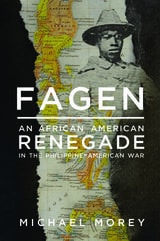
Fagen
An African American Renegade in the Philippine-American WarMichael Morey
University of Wisconsin Press, 2019
The outlines of Fagen's legend have been known for more than a century, but the details of his military achievements, his personal history, and his ultimate fate have remained a mystery—until now. Michael Morey tracks Fagen's life from his youth in Tampa as a laborer in a phosphate camp through his troubled sixteen months in the army, and, most importantly, over his long-obscured career as a guerrilla officer. Morey places this history in its larger military, political, and social context to tell the story of the young renegade whose courage and defiance challenged the supremacist assumptions of the time.
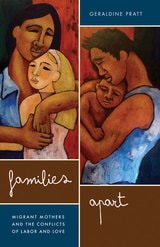
Families Apart
Migrant Mothers and the Conflicts of Labor and LoveGeraldine Pratt
University of Minnesota Press, 2012
In a developing nation like the Philippines, many mothers provide for their families by traveling to a foreign country to care for someone else’s. Families Apart focuses on Filipino overseas workers in Canada to reveal what such arrangements mean for families on both sides of the global divide.
The outcome of Geraldine Pratt’s collaboration with the Philippine Women Centre of British Columbia, this study documents the difficulties of family separation and the problems that children have when they reunite with their mothers in Vancouver. Aimed at those who have lived this experience, those who directly benefit from it, and those who simply stand by and watch, Families Apart shows how Filipino migrant domestic workers—often mothers themselves—are caught between competing neoliberal policies of sending and receiving countries and how, rather than paying rich returns, their ambitions as migrants often result in social and economic exclusion for themselves and for their children. This argument takes shape as an open-ended series of encounters, moving between a singular academic voice and the “we” of various research collaborations, between Vancouver and the Philippines, and between genres of “evidence-based” social scientific research, personal testimony, theatrical performance, and nonfictional narrative writing.
Through these experiments with different modes of storytelling, Pratt seeks to transform frameworks of perception, to create and collect sympathetic witnesses—in short, to promote a wide-ranging public discussion and debate about a massive worldwide shift in family (and nonfamily) relations of intimacy and care.
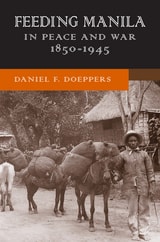
Feeding Manila in Peace and War, 1850–1945
Daniel F. Doeppers
University of Wisconsin Press, 2019
Doeppers follows key commodities for the city—rice, produce, fish, fowl, meat, milk, flour, coffee—and their complex interconnections. In the process he considers the changing ecology of the surrounding region as well as the social fabric that weaves together farmers, merchants, transporters, storekeepers, and door-to-door vendors.
Fighting from a Distance
How Filipino Exiles Helped Topple a DictatorJose V. Fuentecilla
University of Illinois Press, 2013

Filipino Crosscurrents
Oceanographies of Seafaring, Masculinities, and GlobalizationKale Bantigue Fajardo
University of Minnesota Press, 2011
Filipino seamen currently compose approximately twenty percent of the 1.2 million international maritime transportation workers. Ninety percent of the world’s goods and commodities are transported by ship. Taken together, these statistics attest to the critical role Filipino seamen play in worldwide maritime trade. In Filipino Crosscurrents, an interdisciplinary ethnography, Kale Bantigue Fajardo examines the cultural politics of seafaring, Filipino maritime masculinities, and globalization in the Philippines and the Filipino diaspora.
Drawing on fieldwork conducted on ships and in the ports of Manila and Oakland, as well as on an industrial container ship that traveled across the Pacific, Fajardo argues that Filipino seamen have become key figures through which the Philippine state and economic elites promote Filipino masculinity and neoliberal globalization. From government officials to working-class seamen and seafarers’ advocates, Fajardo’s wide-ranging analysis exposes the gaps in dominant narratives of Filipino seamen in national, regional, and global contexts.
Writing in a hybrid style that weaves together ethnographic description, cultural critique, travelogue, and autobiography, Fajardo invites readers to reconsider the meanings of masculinity and manhood.
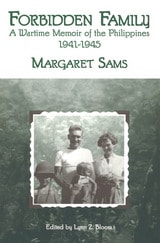
Forbidden Family
Wartime Memoir of the Philippines, 1941-1945Margaret Sams
University of Wisconsin Press, 1997
Written just five years after the end of World War II, this is Margaret Sams’s moving testimony of life in a Japanese internment camp—the can of Spam hoarded for Christmas dinner, the clandestine radio hidden in her sewing kit, the beheading of other prisoners for transgressions. With her husband held elsewhere as a prisoner of war and with a small son to protect, Margaret broke the rules both of society and of her captors to fall in love and bear a child with a kind and daring fellow internee, Jerry Sams.