Results by title
1201 books match the query 'Race relations' and 51 start with f
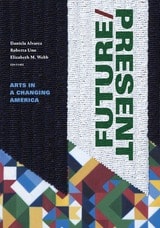
FUTURE/PRESENT
Arts in a Changing AmericaDaniela Alvarez, Roberta Uno, and Elizabeth M. Webb, editors
Duke University Press, 2024
Selected contributors. Dahlak Brathwaite, adrienne maree brown, Jeff Chang, Tameca Cole, Ofelia Esparza, Antoine Hunter, Nobuko Miyamoto, Wendy Red Star, Spel, Jose Antonio Vargas, Carrie Mae Weems, Hinaleimoana Kwai Kong Wong-Kalu
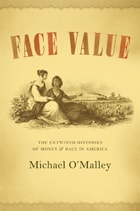
Face Value
The Entwined Histories of Money and Race in AmericaMichael O'Malley
University of Chicago Press, 2012
From colonial history to the present, Americans have passionately, even violently, debated the nature and the character of money. They have painted it and sung songs about it, organized political parties around it, and imprinted it with the name of God—all the while wondering: is money a symbol of the value of human work and creativity, or a symbol of some natural, intrinsic value?
In Face Value, Michael O’Malley provides a deep history and a penetrating analysis of American thinking about money and the ways that this ambivalence unexpectedly intertwines with race. Like race, money is bound up in questions of identity and worth, each a kind of shorthand for the different values of two similar things. O’Malley illuminates how these two socially constructed hierarchies are deeply rooted in American anxieties about authenticity and difference.
In this compelling work of cultural history, O’Malley interprets a stunning array of historical sources to evaluate the comingling of ideas about monetary value and social distinctions. More than just a history, Face Value offers us a new way of thinking about the present culture of coded racism, gold fetishism, and economic uncertainty.
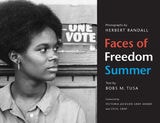
Faces of Freedom Summer
Herbert Randall and Bobs M. Tusa
University of Alabama Press, 2001
Witness the faces that defined a movement for freedom and equality
The old adage “One picture is worth ten thousand words” is definitely true for Faces of Freedom Summer. There are simply not enough words to describe the period in our history that is recorded by the pictures in this book.
As this book afirms, the resurgence of overt activities by hate groups—both the old traditional ones (e.g., the Ku Klux Klan) and the new ones (e.g., the Skin Heads)—however much the hard work and sacrifices of the modern civil rights movement humanized American society, much still remains to be done. The modern civil rights movement associated with the 1960s was not in vain, yet it did not eradicate from our society the evils of racism and sexism. While we activists made the United States more of an open society than it has ever been in its history, our vision and desire for the beloved community did not reach into all sectors of American society. “Freedom,” it has been said, “is a constant struggle, a work of eternal vigilance.”
Faces of Freedom Summer brings to life that there was such a time and there were such people and, if such a people were once, then they are still among us. Yet, they may only become aware of themselves when they are confronted with visible evidence, such as the evidence contained in the pictures of Herbert Randall.
False Black Power?
Jason L. Riley
Templeton Press, 2017
Black civil rights leaders have long supported ethnic identity politics and prioritized the integration of political institutions, and seldom has that strategy been questioned. In False Black Power?, Jason L. Riley takes an honest, factual look at why increased black political power has not paid off in the ways that civil rights leadership has promised.
Recent decades have witnessed a proliferation of black elected officials, culminating in the historic presidency of Barack Obama. However, racial gaps in employment, income, homeownership, academic achievement, and other measures not only continue but in some cases have even widened. While other racial and ethnic groups in America have made economic advancement a priority, the focus on political capital for blacks has been a disadvantage, blocking them from the fiscal capital that helped power upward mobility among other groups.
Riley explains why the political strategy of civil rights leaders has left so many blacks behind. The key to black economic advancement today is overcoming cultural handicaps, not attaining more political power. The book closes with thoughtful responses from key thought leaders Glenn Loury and John McWhorter.
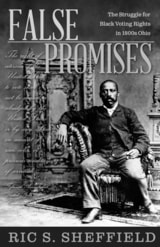
False Promises
The Struggle for Black Voting Rights in 1800s OhioRic S. Sheffield
Ohio University Press, 0
Brings to life the struggle for Black suffrage in nineteenth-century Ohio
In False Promises, the fight for Black voting rights in Ohio comes alive through narratives of men of color who defied the state’s nineteenth-century restrictions on suffrage. Though ratification of the Fifteenth Amendment ostensibly extended the franchise, state election laws still forced men of color into a perilous struggle for full citizenship. Ric S. Sheffield depicts their courage and determination, revealing their humanity through stories of sacrifice, resistance, and hope.
Drawing on Saidiya Hartman’s concept of critical fabulation, Sheffield weaves together historical records with imaginative reconstructions of dialogue, setting, and descriptive elements beyond the dusty courthouse pages. Grounded in archival evidence yet reimagined to fill in the silences, these stories recount the lived experiences of those who risked everything to exercise their right to vote.
False Promises also connects these historical battles to the present, illustrating how voter-suppression tactics in today’s Ohio have roots in the racial exclusions of the nineteenth century. By exposing the enduring legacy of white supremacist policies, the book challenges the widespread misconception that racial disenfranchisement was solely a southern problem. Ohio’s complex racial history—noted for its role in the Underground Railroad but also for its repressive Black Laws—also includes a fierce and ongoing struggle over the right to vote. Through compelling storytelling, historical analysis, and a reclamation of voices lost to history, False Promises urges readers to reconsider their understanding of democracy and the right to vote.
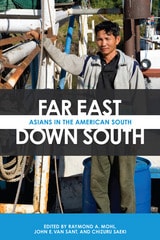
Far East, Down South
Asians in the American SouthEdited by Raymond A. Mohl, John E. Van Sant, and Chizuru Saeki
University of Alabama Press, 2016
Uncovering the overlooked histories of Asians in the American South.
In sharp contrast to the “melting pot” reputation of the United States, the American South—with its history of slavery, Jim Crow, and the civil rights movement—has been perceived in stark and simplistic demographic terms. In Far East, Down South, editors Raymond A. Mohl, John E. Van Sant, and Chizuru Saeki provide a collection of essential essays that restores and explores an overlooked part of the South’s story—that of Asian immigration to the region.
These essays form a comprehensive overview of key episodes and issues in the history of Asian immigrants to the South. During Reconstruction, southern entrepreneurs experimented with the replacement of slave labor with Chinese workers. As in the West, Chinese laborers played a role in the development of railroads. Japanese farmers also played a more widespread role than is usually believed. Filipino sailors recruited by the US Navy in the early decades of the twentieth century often settled with their families in the vicinity of naval ports such as Corpus Christi, Biloxi, and Pensacola. Internment camps brought Japanese Americans to Arkansas. Marriages between American servicemen and Japanese, Korean, Filipina, Vietnamese, and nationals in other theaters of war created many thousands of blended families in the South. In recent decades, the South is the destination of internal immigration as Asian Americans spread out from immigrant enclaves in West Coast and Northeast urban areas.
Taken together, the book’s essays document numerous fascinating themes: the historic presence of Asians in the South dating back to the mid-nineteenth century; the sources of numerous waves of contemporary Asian immigration to the South; and the steady spread of Asians out from the coastal port cities. Far East, Down South adds a vital new dimension to popular understanding of southern history.
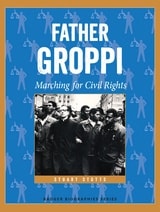
Father Groppi
Marching for Civil RightsStuart Stotts
Wisconsin Historical Society Press, 2013
Father Groppi Marched to Change Milwaukee
"Father Groppi: Marching for Civil Rights" tells the story of Father James Groppi, a Catholic priest from Milwaukee, Wis., who stood up for civil rights in the 1960s and 1970s.
This important new addition to the Badger Biographies series for young readers also tells about a turbulent time in Wisconsin history and sheds light on the civil rights movement and its place in the North.
Growing up on the south side of Milwaukee as the son of Italian immigrants, young James Groppi learned early on what it felt like to be made fun of just because of who you are, and he learned to respect people from other races and ethnic groups. Later, while studying to become a priest, he saw the discrimination African Americans faced. It made him angry, and he vowed to do whatever he could to fight racism.
Father Groppi marched with Dr. Martin Luther King Jr. and other leaders of the civil rights movement. But he knew there was work to be done in his own city. In Milwaukee, he teamed up with the NAACP and other organizations, protesting discrimination and segregation wherever they saw it. It wasn't always easy, and Father Groppi and the other civil rights workers faced great challenges.
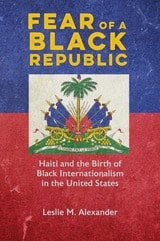
Fear of a Black Republic
Haiti and the Birth of Black Internationalism in the United StatesLeslie M. Alexander
University of Illinois Press, 2023
A bold exploration of Black internationalism’s origins, Fear of a Black Republic links the Haitian revolution to the global Black pursuit of liberation, justice, and social equality.
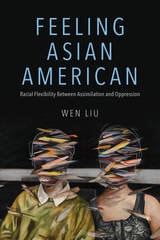
Feeling Asian American
Racial Flexibility Between Assimilation and OppressionWen Liu
University of Illinois Press, 2024
Asian Americans have become the love-hate subject of the American psyche: at times celebrated as the model minority, at other times hated as foreigners. Wen Liu examines contemporary Asian American identity formation while placing it within a historical and ongoing narrative of racial injury. The flexible racial status of Asian Americans oscillates between oppression by the white majority and offers to assimilate into its ranks. Identity emerges from the tensions produced between those two poles. Liu dismisses the idea of Asian Americans as a coherent racial population. Instead, she examines them as a raced, gendered, classed, and sexualized group producing varying physical and imaginary boundaries of nation, geography, and citizenship. Her analysis reveals repeated norms and acts that capture Asian Americanness as part of a racial imagination that buttresses capitalism, white supremacy, neoliberalism, and the US empire.
An innovative challenge to persistent myths, Feeling Asian American ranges from the wartime origins of Asian American psychology to anti-Asian attacks to present Asian Americanness as a complex political assemblage.
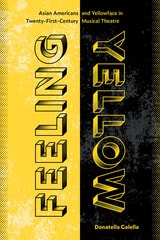
Feeling Yellow
Asian Americans and Yellowface in Twenty-First-Century Musical TheatreDonatella Galella
University of Michigan Press, 2026
Feeling Yellow examines how yellowface has persisted on the contemporary musical stage and how Asian Americans have contested yellowface, as they stake their own claim to the theatrical stage and nation state. Donatella Galella boldly argues that the pleasures of musical theatre and the disavowal of systemic anti-Asian racism enable the ongoing portrayal of Asian and Asian American characters by non-Asian actors. Galella offers two concepts to understand these phenomena: feeling yellow and yellowface without yellowed faces. Feeling yellow encapsulates the racialized anger, despair, and alienation of Asian American artists and audiences. Yellowface without yellowed faces denotes subtle ways of conveying Asianness, such as performing Asianness with exaggerated irony, using racialized costumes rather than yellow skin and slanted eye makeup, and setting musicals in fantasy Asian lands populated by multiracial casts.
Galella utilizes musicals such as Thoroughly Modern Millie, Anything Goes, The Mikado, and Soft Power, to understand how Asian and Asian American representation is connected to larger questions: How does racial identity shape emotional reactions to musical theatre? Why does yellowface and anti-Asian racism persist? What are the terms for Asian Americans belonging in the United States? Using a range of approaches from dramaturgy to auto-ethnography and materials from interviews to Reddit posts, Feeling Yellow spotlights Asian American affect, artistry, and activism.
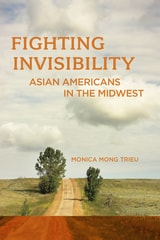
Fighting Invisibility
Asian Americans in the MidwestMonica Mong Trieu
Rutgers University Press, 2023
Drawing from in-depth interviews, census data, and cultural productions from Asian Americans in Ohio, Wisconsin, Nebraska, Minnesota, Illinois, Iowa, Indiana, and Michigan, this interdisciplinary research examines how post-1950s Midwest Asian Americans navigate identity and belonging, racism, educational settings, resources within co-ethnic communities, and pan-ethnic cultural community. Their experiences and life narratives are heavily framed by three pervasive themes of spatially defined isolation, invisibility, and racialized visibility.
Fighting Invisibility makes an important contribution to racialization literature, while also highlighting the necessity to further expand the scope of Asian American history-telling and knowledge production.
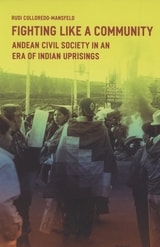
Fighting Like a Community
Andean Civil Society in an Era of Indian UprisingsRudi Colloredo-Mansfeld
University of Chicago Press, 2009
The indigenous population of the Ecuadorian Andes made substantial political gains during the 1990s in the wake of a dynamic wave of local activism. The movement renegotiated land development laws, elected indigenous candidates to national office, and successfully fought for the constitutional redefinition of Ecuador as a nation of many cultures. Fighting Like a Community argues that these remarkable achievements paradoxically grew out of the deep differences—in language, class, education, and location—that began to divide native society in the 1960s.
Drawing on fifteen years of fieldwork, Rudi Colloredo-Mansfeld explores these differences and the conflicts they engendered in a variety of communities. From protestors confronting the military during a national strike to a migrant family fighting to get a relative released from prison, Colloredo-Mansfeld recounts dramatic events and private struggles alike to demonstrate how indigenous power in Ecuador is energized by disagreements over values and priorities, eloquently contending that the plurality of Andean communities, not their unity, has been the key to their political success.
Fighting and Writing
The Rhodesian Army at War and PostwarLuise White
Duke University Press, 2021
Fighting for a Free Missouri
German Immigrants, African Americans, and the Issue of SlaverySydney J. Norton
University of Missouri Press, 2023

Filipinos Represent
DJs, Racial Authenticity, and the Hip-hop NationAntonio T. Tiongson Jr.
University of Minnesota Press, 2013
The “Hip-hop Nation” has been scouted, staked out, and settled by journalists and scholars alike. Antonio T. Tiongson Jr. steps into this well-mapped territory with questions aimed at interrogating how nation is conceptualized within the context of hip-hop. What happens, Tiongson asks, to notions of authenticity based on hip-hop’s apparent blackness when Filipino youth make hip-hop their own?
Tiongson draws on interviews with Bay Area–based Filipino American DJs to explore the authenticating strategies they rely on to carve out a niche within DJ culture. He shows how Filipino American youth involvement in DJing reconfigures the normal boundaries of Filipinoness predicated on nostalgia and cultural links with an idealized homeland. Filipinos Represent makes the case that while the engagement of Filipino youth with DJ culture speaks to the broadening racial scope of hip-hop—and of what it means to be Filipino—such involvement is also problematic in that it upholds deracialized accounts of hip-hop and renders difference benign.
Looking at the ways in which Filipino DJs legitimize their place in an expressive form historically associated with African Americans, Tiongson examines what these complex forms of identification reveal about the contours and trajectory of contemporary U.S. racial formations and discourses in the post–civil rights era.
Finding the Lost Year
What Happened When Little Rock Closed Its Public SchoolsSondra Gordy
University of Arkansas Press, 2009
Much has been written about the Little Rock School Crisis of 1957, but very little has been devoted to the following year—the Lost Year, 1958–59—when Little Rock schools were closed to all students, both black and white. Finding the Lost Year is the first book to look at the unresolved elements of the school desegregation crisis and how it turned into a community crisis, when policymakers thwarted desegregation and challenged the creation of a racially integrated community and when competing groups staked out agendas that set Arkansas’s capital on a path that has played out for the past fifty years.
In Little Rock in 1958, 3,665 students were locked out of a free public education. Teachers’ lives were disrupted, but students’ lives were even more confused. Some were able to attend schools outside the city, some left the state, some joined the military, some took correspondence courses, but fully 50 percent of the black students went without any schooling. Drawing on personal interviews with over sixty former teachers and students, black and white, Gordy details the long-term consequences for students affected by events and circumstances over which they had little control.
“Fifty years ago segregationists trying to keep black students out of Little Rock Central High inadvertently broke up one of the country’s greatest football dynasties. . . . Wait a minute. . . . Who said you can’t have a high school football team just because you don’t have a high school? Canceling football, Faubus decreed, would be ‘a cruel and unnecessary blow to the children.’ O.K. then, everyone agreed. Play ball!”
—“Blinded by History,” Sports Illustrated
Fire Dreams
Making Black Feminist Liberation in the SouthLaura McTighe, with Women With A Vision
Duke University Press, 2024
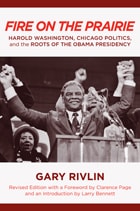
Fire on the Prairie
Harold Washington, Chicago Politics, and the Roots of the Obama PresidencyGary Rivlin
Temple University Press, 2012
Harold Washington’s historic and improbable victory over the vaunted Chicago political machine shook up American politics. The election of the enigmatic yet engaging Washington led to his serving five tumultuous years as the city’s first black mayor. He fashioned an uneasy but potent multiracial coalition that today still stands as a model for political change.
In this revised edition of Fire on the Prairie, acclaimed reporter Gary Rivlin chronicles Washington’s legacy—a tale rich in character and intrigue. He reveals the cronyism of Daley’s government and Washington’s rivalry with Jesse Jackson. Rivlin also shows how Washington’s success inspired a young community organizer named Barack Obama to turn to the electoral arena as a vehicle for change. While the story of a single city, , this political biography is anything but parochial.
First Freedom
The Responses of Alabama's Blacks to Emancipation and ReconstructionPeter Kolchin
University of Alabama Press, 2008
Firsting and Lasting
Writing Indians out of Existence in New EnglandJean M. O’Brien
University of Minnesota Press, 2010
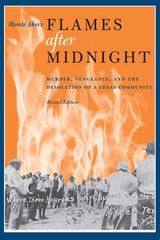
Flames after Midnight
Murder, Vengeance, and the Desolation of a Texas Community, Revised EditionBy Monte Akers
University of Texas Press, 2011
What happened in Kirven, Texas, in May 1922, has been forgotten by the outside world. It was a coworker's whispered words, "Kirven is where they burned the [Negroes]," that set Monte Akers to work at discovering the true story behind a young white woman's brutal murder and the burning alive of three black men who were almost certainly innocent of it. This was followed by a month-long reign of terror as white men killed blacks while local authorities concealed the real identity of the white probable murderers and allowed them to go free.
Writing nonfiction with the skill of a novelist, Akers paints a vivid portrait of a community desolated by race hatred and its own refusal to face hard truths. He sets this tragedy within the story of a region prospering from an oil boom but plagued by lawlessness, and traces the lynching's repercussions down the decades to the present day. In the new epilogue, Akers adds details that have come to light as a result of the book's publication, including an eyewitness account of the burnings from an elderly man who claimed to have castrated two of the men before they were lynched.
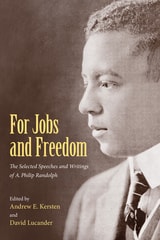
For Jobs and Freedom
Selected Speeches and Writings of A. Philip RandolphAndrew E. Kersten
University of Massachusetts Press, 2014
This volume documents Randolph's life and work through his own writings. The editors have combed through the files of libraries, manuscript collections, and newspapers, selecting more than seventy published and unpublished pieces that shed light on Randolph's most significant activities. The book is organized thematically around his major interests—dismantling workplace inequality, expanding civil rights, confronting racial segregation, and building international coalitions. The editors provide a detailed biographical essay that helps to situate the speeches and writings collected in the book. In the absence of an autobiography, this volume offers the best available presentation of Randolph's ideas and arguments in his own words.
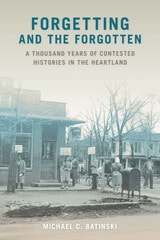
Forgetting and the Forgotten
A Thousand Years of Contested Histories in the HeartlandMichael C. Batinski
Southern Illinois University Press, 2022
Revealing the forgotten in community histories
Histories try to forget, as this evocative study of one community reveals. Forgetting and the Forgotten details the nature of how a community forged its story against outsiders. Historian Michael C. Batinski explores the habits of forgetting that enable communities to create an identity based on silencing competing narratives. The white settlers of Jackson County, Illinois, shouldered the hopes of a community and believed in the justice of their labor as it echoed the national story. The county’s pastkeepers, or keepers of the past, emphasizing the white settlers’ republican virtue, chose not to record violence against Kaskaskia people and African Americans and to disregard the numerous transient laborers. Instead of erasing the presence of outsiders, the pastkeepers could offer only silence, but it was a silence that could be broken.
Batinski’s historiography critically examines local historical thought in a way that illuminates national history. What transpired in Jackson County was repeated in countless places throughout the nation. At the same time, national history writing rarely turns to experiences that can be found in local archives such as court records, genealogical files, archaeological reports, coroner’s records, and veterans’ pension files. In this archive, juxtaposed with the familiar actors of Jackson County history—Benningsen Boon, John A. Logan, and Daniel Brush—appear the Sky People, Italian immigrant workers, black veterans of the Civil War and later champions of civil rights whose stories challenge the dominant narrative.
Forging Arizona
A History of the Peralta Land Grant and Racial Identity in the WestAnita Huizar-Hernández
Rutgers University Press, 2019

Fort Worth from World War II to 1960
Harold Rich
University of North Texas Press, 2025
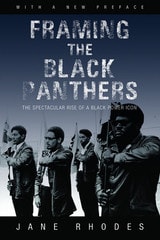
Framing the Black Panthers
The Spectacular Rise of a Black Power IconJane Rhodes
University of Illinois Press, 2017
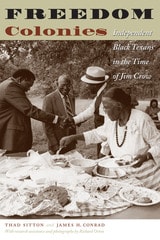
Freedom Colonies
Independent Black Texans in the Time of Jim CrowBy Thad Sitton and James H. Conrad
University of Texas Press, 2005
Friends of the Dallas Public Library Award, 2006
Best Book on East Texas, East Texas Historical Association, 2007
In the decades following the Civil War, nearly a quarter of African Americans achieved a remarkable victory—they got their own land. While other ex-slaves and many poor whites became trapped in the exploitative sharecropping system, these independence-seeking individuals settled on pockets of unclaimed land that had been deemed too poor for farming and turned them into successful family farms. In these self-sufficient rural communities, often known as "freedom colonies," African Americans created a refuge from the discrimination and violence that routinely limited the opportunities of blacks in the Jim Crow South.
Freedom Colonies is the first book to tell the story of these independent African American settlements. Thad Sitton and James Conrad focus on communities in Texas, where blacks achieved a higher percentage of land ownership than in any other state of the Deep South. The authors draw on a vast reservoir of ex-slave narratives, oral histories, written memoirs, and public records to describe how the freedom colonies formed and to recreate the lifeways of African Americans who made their living by farming or in skilled trades such as milling and blacksmithing. They also uncover the forces that led to the decline of the communities from the 1930s onward, including economic hard times and the greed of whites who found legal and illegal means of taking black-owned land. And they visit some of the remaining communities to discover how their independent way of life endures into the twenty-first century.
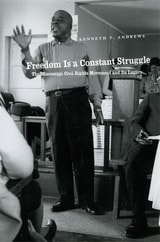
Freedom Is a Constant Struggle
The Mississippi Civil Rights Movement and Its LegacyKenneth T. Andrews
University of Chicago Press, 2004
Freedom Is a Constant Struggle is also the first book of its kind to detail the activities of white supremacists in Mississippi, revealing how white repression and intimidation sparked black activism and simultaneously undermined the movement's ability to achieve far-reaching goals. Andrews shows that the federal government's role was important but reactive as federal actors responded to the sustained struggles between local movements and their opponents. He tracks the mobilization of black activists by the NAACP, the creation of Freedom Summer, efforts to galvanize black voters, the momentous desegregation of public schools and the rise of all-white private academies, and struggles over the economic development of black communities. From this complex history, Andrews shows how the civil rights movement built innovative organizations and campaigns that empowered local leadership and had a lasting legacy in Mississippi and beyond.
Based on an original and creative research design that combines extensive archival research, interviews with activists, and quantitative historical data, Freedom Is a Constant Struggle provides many new insights into the civil rights struggle, and it presents a much broader theory to explain whether and how movements have enduring impacts on politics and society. What results is a work that will be invaluable to students of social movements, democratic politics, and the struggle for racial freedom in the U.S.

Freedom with Violence
Race, Sexuality, and the US StateChandan Reddy
Duke University Press, 2011
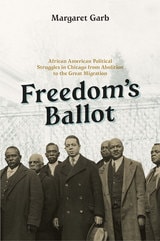
Freedom's Ballot
African American Political Struggles in Chicago from Abolition to the Great MigrationMargaret Garb
University of Chicago Press, 2014
Freedom’s Ballot is the history of three generations of African American activists—the ministers, professionals, labor leaders, clubwomen, and entrepreneurs—who transformed twentieth-century urban politics. This is a complex and important story of how black political power was institutionalized in Chicago in the half-century following the Civil War. Margaret Garb explores the social and political fabric of Chicago, revealing how the physical makeup of the city was shaped by both political corruption and racial empowerment—in ways that can still be seen and felt today.

Freedom's Port
The African American Community of Baltimore, 1790-1860Christopher Phillips
University of Illinois Press, 1997
He shows how it grew from a transient aggregate of individuals, many fresh from slavery, to a strong, overwhelmingly free community less wracked by class and intraracial divisions than were other cities. Almost from the start, Phillips states, Baltimore's African Americans forged their own freedom and actively defended it--in a state that maintained slavery and whose white leadership came to resent the liberties the city's black people had achieved.
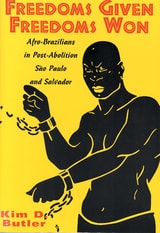
Freedoms Given, Freedoms Won
Afro-Brazilians in Post-Abolition São Paolo and SalvadorButler, Kim D
Rutgers University Press, 1998
Freedoms Given, Freedoms Won explores the ways Afro-Brazilians in two major cities adapted to the new conditions of life after the abolition of slavery and how they confronted limitations placed on their new freedom. The book sets forth new ways of understanding why the abolition of slavery did not yield equitable fruits of citizenship, not only in Brazil, but throughout the Americas and the Caribbean.
Afro-Brazilians in Sao Paulo and Salvador lived out their new freedom in ways that raise issues common to the entire Afro-Atlantic diaspora. In Sao Paulo, they initiated a vocal struggle for inclusion in the creation of the nation's first black civil rights organization and political party, and they appropriated a discriminatory identity that isolated blacks. In contrast, African identity prevaled over black identity in Salvador, where social protest was oriented toward protecting the right of cultural pluralism.
Of all the eras and issues studied in Afro-Brazilian history, post-abolition social and political action has been the most neglected. Butler provides many details of this period for the first time in English and supplements published sources with original oral histories, Afro-Brazilian newspapers, and new state archival documents currently being catalogued in Bahia. Freedoms Given, Freedoms Won sets the Afro-Brazilian experience in a national context as well as situating it within the Afro-Atlantic diaspora through a series of explicit parallels, particularly with Cuba and Jamaica.

Friends Disappear
The Battle for Racial Equality in EvanstonMary Barr
University of Chicago Press, 2014
In Friends Disappear Barr goes back to her old neighborhood and pieces together a history of Evanston with a particular emphasis on its neighborhoods, its schools, and its work life. She finds that there is a detrimental myth of integration surrounding Evanston despite bountiful evidence of actual segregation, both in the archives and from the life stories of her subjects. Curiously, the city’s own desegregation plan is partly to blame. The initiative called for the redistribution of students from an all-black elementary school to institutions situated in white neighborhoods. That, however, required busing, and between the tensions it generated and obvious markers of class difference, the racial divide, far from being closed, was widened. Friends Disappear highlights how racial divides limited the life chances of blacks while providing opportunities for whites, and offers an insider’s perspective on the social practices that doled out benefits and penalties based on race—despite attempts to integrate.
From Black Power to Hip Hop
Racism, Nationalism, and FeminismPatricia Hill Collins
Temple University Press, 2006

From Civilization To Segregation
Social Ideals and Social Control in Southern Rhodesia, 1890–1934Carol Summers
Ohio University Press, 1994
This study examines the social changes that took place in Southern Rhodesia after the arrival of the British South Africa Company in the 1890s. Summer’s work focuses on interactions among settlers, the officials of the British South America Company and the administration, missionaries, humanitarian groups in Britain, and the most vocal or noticeable groups of Africans. Through this period of military conquest and physical coercion, to the later attempts at segregationist social engineering, the ideals and justifications of Southern Rhodesians changed drastically. Native Policy, Native Education policies, and, eventually, segregationist Native Development policies changed and evolved as the white and black inhabitants of Southern Rhodesia (colonial Zimbabwe) struggled over the region’s social form and future.
Summers’s work complements a handful of other recent works reexamining the social history of colonial Zimbabwe and demonstrating how knowledge, perception, and ideologies interacted with the economic and political dimensions of the region’s past.
From Cotton Belt to Sunbelt
Federal Policy, Economic Development, and the Transformation of the South 1938–1980Bruce J. Schulman
Duke University Press, 1994
From Dessalines to Duvalier
Race, Colour and National Independence in HaitiNicholls, David
Rutgers University Press, 1996
From Dessalines to Duvalier
Race, Colour and National Independence in HaitiNicholls, David
Rutgers University Press, 1996
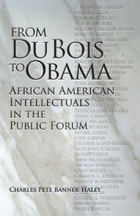
From Du Bois to Obama
African American Intellectuals in the Public ForumCharles Pete Banner-Haley
Southern Illinois University Press, 2014
In his groundbreaking new book Charles Pete Banner-Haley explores the history of African American intellectualism and reveals the efforts of black intellectuals in the ongoing struggle against racism, showing how they have responded to Jim Crow segregation, violence against black Americans, and the more subtle racism of the postintegration age. Banner-Haley asserts that African American intellectuals—including academicians, social critics, activists, and writers—serve to generate debate, policy, and change, acting as a moral force to persuade Americans to acknowledge their history of slavery and racism, become more inclusive and accepting of humanity, and take responsibility for social justice.
Other topics addressed in this insightful study include the disconnection over time between black intellectuals and the masses for which they speak; the ways African American intellectuals identify themselves in relation to the larger black community, America as a whole, and the rest of the world; how black intellectuals have gained legitimacy in American society and have accrued moral capital, especially in the area of civil rights; and how that moral capital has been expended. Among the influential figures covered in the book are W. E. B. Du Bois, Ralph Ellison, Richard Wright, James Weldon Johnson, E. Franklin Frazier, Ralph Bunche, Oliver C. Cox, George S. Schuyler, Zora Neale Hurston, Martin Luther King, Jr., Jesse Jackson, Cornel West, Toni Morrison, bell hooks, Charles Johnson, and Barack Obama.
African American intellectuals, as Banner-Haley makes clear, run the political gamut from liberal to conservative. He discusses the emergence of black conservatism, with its accompanying questions about affirmative action, government intervention on behalf of African Americans, and the notion of a color-blind society. He also looks at how popular music—particularly rap and hip-hop—television, movies, cartoons, and other media have functioned as arenas for investigating questions of identity, exploring whether African American intellectuals can also be authentically black.
A concluding discussion of the so-called browning of America, and the subsequent rise in visibility and influence of black intellectuals culminates with the historic election of President Barack Obama, an African American intellectual who has made significant contributions to American society through his books, articles, and speeches. Banner-Haley ponders what Obama’s election will mean for the future of race relations and black intellectualism in America.
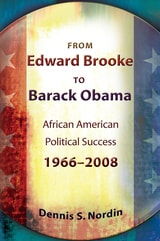
From Edward Brooke to Barack Obama
African American Political Success, 1966-2008Dennis S. Nordin
University of Missouri Press, 2012
In From Edward Brooke to Barack Obama, Dennis S. Nordin navigates the history of biracial elections by examining the experiences of a variety of African American politicians from across the country, revealing how voters, both black and white, respond to the issue of race in an election.
From Edward Brooke to Barack Obama investigates the implications of race in politics, a highly relevant topic in today’s American society. It offers readers a chronological overview of the progress made over the last several decades as well as shows where there is room for growth in the political arena. By taking a pertinent topic for the era and placing it in the context of history, Nordin successfully chronicles the roles of race and race relations in American politics.
From Hate to Hallows
Reframing Black Church ArsonTodne Thomas
Duke University Press, 2026
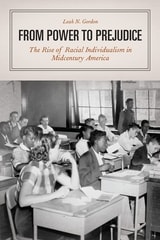
From Power to Prejudice
The Rise of Racial Individualism in Midcentury AmericaLeah N. Gordon
University of Chicago Press, 2015
To answer these questions, From Power to Prejudice examines American academia—both black and white—in the 1940s and ’50s. Gordon presents four competing visions of “the race problem” and documents how an individualistic paradigm, which presented white attitudes as the source of racial injustice, gained traction. A number of factors, Gordon shows, explain racial individualism’s postwar influence: individuals were easier to measure than social forces; psychology was well funded; studying political economy was difficult amid McCarthyism; and individualism was useful in legal attacks on segregation. Highlighting vigorous midcentury debate over the meanings of racial justice and equality, From Power to Prejudice reveals how one particular vision of social justice won out among many contenders.
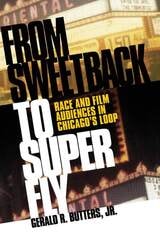
From SWEETBACK to SUPER FLY
Race and Film Audiences in Chicago's LoopGerald R. Butters, Jr.
University of Missouri Press, 2014
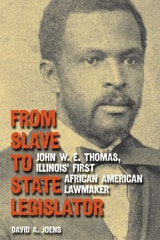
From Slave to State Legislator
John W. E. Thomas, Illinois' First African American LawmakerDavid A. Joens
Southern Illinois University Press, 2012
As the first African American elected to the Illinois General Assembly, John W. E. Thomas was the recognized leader of the state’s African American community for nearly twenty years and laid the groundwork for the success of future Black leaders in Chicago politics. Despite his key role in the passage of Illinois’ first civil rights act and his commitment to improving his community against steep personal and political barriers, Thomas’s life and career have been long forgotten by historians and the public alike. This fascinating full-length biography—the first to address the full influence of Thomas or any Black politician from Illinois during the Reconstruction Era—is also a pioneering effort to explain the dynamics of African American politics and divisions within the Black community in post–Civil War Chicago.
In From Slave to State Legislator, David A. Joens traces Thomas’s trajectory from a slave owned by a doctor’s family in Alabama to a prominent attorney believed to be the wealthiest African American man in Chicago at the time of his death in 1899. Providing one of the few comprehensive looks at African Americans in Chicago during this period, Joens reveals how Thomas’s career represents both the opportunities available to African Americans in the postwar period and the limits still placed on them. When Thomas moved to Chicago in 1869, he started a grocery store, invested in real estate, and founded the first private school for African Americans before becoming involved in politics.
From Slave to State Legislator provides detailed coverage of Thomas’s three terms in the legislature during the 1870s and 1880s, his multiple failures to be nominated for reelection, and his loyalty to the Republican Party at great political cost, calling attention to the political differences within a Black community often considered small and homogenous. Even after achieving his legislative legacy—the passage of the first state civil rights law—Thomas was plagued by patronage issues and an increasingly bitter split with the African American community frustrated with slow progress toward true equality. Drawing on newspapers and an array of government documents, Joens provides the most thorough review to date of the first civil rights legislation and the two controversial “colored conventions” chaired by Thomas.
Joens cements Thomas’s legacy as a committed and conscientious lawmaker amid political and personal struggles. In revealing the complicated rivalries and competing ambitions that shaped Black northern politics during the Reconstruction Era, Joens shows the long-term impact of Thomas’s friendship with other burgeoning African American political stars and his work to get more black representatives elected. The volume is enhanced by short biographies of other key Chicago African American politicians of the era.
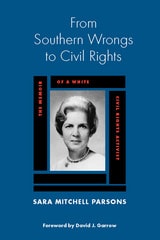
From Southern Wrongs to Civil Rights
The Memoir of a White Civil Rights ActivistSara Mitchell Parsons
University of Alabama Press, 2009
This first-hand account tells the story of turbulent civil rights era Atlanta through the eyes of a white upper-class woman who became an outspoken advocate for integration and racial equality
As a privileged white woman who grew up in segregated Atlanta, Sara Mitchell Parsons was an unlikely candidate to become a civil rights agitator. After all, her only contacts with blacks were with those who helped raise her and those who later helped raise her children. As a young woman, she followed the conventional path expected of her, becoming the dutiful wife of a conservative husband, going to the country club, and playing bridge. But unlike many of her peers, Parsons harbored an increasing uneasiness about racial segregation.In a memoir that includes candid diary excerpts, Parsons chronicles her moral awakening. With little support from her husband, she runs for the Atlanta Board of Education on a quietly integrationist platform and, once elected, becomes increasingly outspoken about inequitable school conditions and the slow pace of integration. Her activities bring her into contact with such civil rights leaders as Martin Luther King, Jr., and his wife, Coretta Scott King. For a time, she leads a dual existence, sometimes traveling the great psychic distance from an NAACP meeting on Auburn Avenue to an all-white party in upscale Buckhead. She eventually drops her ladies' clubs, and her deepening involvement in the civil rights movement costs Parsons many friends as well as her first marriage.
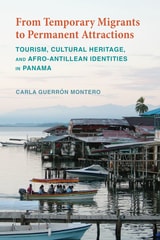
From Temporary Migrants to Permanent Attractions
Tourism, Cultural Heritage, and Afro-Antillean Identities in PanamaCarla Guerrón Montero
University of Alabama Press, 2020
A new reading of Panama’s nation-building process, interpreted through a lens of transnational tourism
Based on long-term ethnographic and archival research, From Temporary Migrants to Permanent Attractions: Tourism, Cultural Heritage, and Afro-Antillean Identities in Panama considers the intersection of tourism, multiculturalism, and nation building. Carla Guerrón Montero analyzes the ways in which tourism becomes a vehicle for the development of specific kinds of institutional multiculturalism and nation-building projects in a country that prides itself on being multiethnic and racially democratic.
The narrative centers on Panamanian Afro-Antilleans who arrived in Panama in the nineteenth century from the Greater and Leeward Antilles as a labor force for infrastructural projects and settled in Panama City, Colón, and the Bocas del Toro Archipelago. The volume discusses how Afro-Antilleans, particularly in Bocas del Toro, have struggled since their arrival to become part of Panama’s narrative of nationhood and traces their evolution from plantation workers for the United Fruit Company to tourism workers. Guerrón Montero notes that in the current climate of official tolerance, they have seized the moment to improve their status within Panamanian society, while also continuing to identify with their Caribbean heritage in ways that conflict with their national identity.
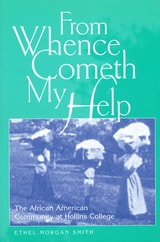
From Whence Cometh My Help
The African American Community at Hollins CollegeEthel Morgan Smith
University of Missouri Press, 2000
In 1842 Charles Lewis Cocke arrived in Roanoke, Virginia, with sixteen slaves; there, he founded Hollins College, an elite woman's school. Many of the early students also brought their slaves to the college with them. Upon Emancipation some of the African Americans of the community "mostly women" stayed on as servants, forming what is now called the Hollins Community. Although the servants played an integral part in the college's success, students were strongly discouraged from acknowledging them as people. Rules forbidding any "familiarity" with the servants perpetuated a prejudicial attitude toward the African American community that would persist well into the 1940s.
Determined to give voice to the African American community that served as the silent workforce for Hollins College, Ethel Morgan Smith succeeded in finding individuals to step forward and tell their stories. From Whence Cometh My Help examines the dynamics of an institution built on the foundations of slavery and so steeped in tradition that it managed to perpetuate servitude for generations. Interviewing senior community members, Smith gives recognition to the invisible population that provided and continues to provide the labor support for Hollins College for more than 150 years.
Although African American students have been admitted to the college for roughly thirty years, to date only one person from the Hollins Community has graduated from the college. From Whence Cometh My Help explores the subtle and complex relationship between the affluent white world of Hollins College and the proud African American community that has served it since its inception. Interweaving personal observations, historical documents, and poetry throughout a revealing oral history, Smith shares her fascinating discoveries and the challenges involved in telling a story silenced for so long.
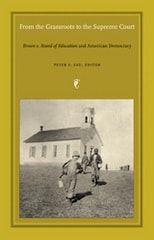
From the Grassroots to the Supreme Court
Brown v. Board of Education and American DemocracyPeter F. Lau, ed.
Duke University Press, 2004
The contributors illuminate the breadth of developments that led to Brown, from the parallel struggles for social justice among African Americans in the South and Mexican, Asian, and Native Americans in the West during the late nineteenth century to the political and legal strategies implemented by the National Association for the Advancement of Colored People (naacp) in the twentieth century. Describing the decision’s impact on local communities, essayists explore the conflict among African Americans over the implementation of Brown in Atlanta’s public schools as well as understandings of the ruling and its relevance among Puerto Rican migrants in New York City. Assessing the legacy of Brown today, contributors analyze its influence on contemporary law, African American thought, and educational opportunities for minority children.
Contributors
Tomiko Brown-Nagin
Davison M. Douglas
Raymond Gavins
Laurie B. Green
Christina Greene
Blair L. M. Kelley
Michael J. Klarman
Peter F. Lau
Madeleine E. Lopez
Waldo E. Martin Jr.
Vicki L. Ruiz
Christopher Schmidt
Larissa M. Smith
Patricia Sullivan
Kara Miles Turner
Mark V. Tushnet
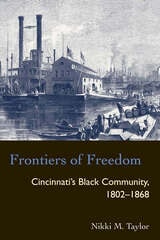
Frontiers of Freedom
Cincinnati’s Black Community 1802–1868Nikki M. Taylor
Ohio University Press, 2004
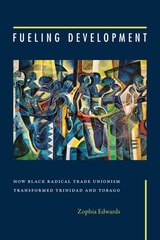
Fueling Development
How Black Radical Trade Unionism Transformed Trinidad and TobagoZophia Edwards
Duke University Press, 2025