Results by title
238 books match the query 'Religion, Politics & State' and 9 start with f

Failing Peace
Gaza and the Palestinian-Israeli ConflictSara Roy
Pluto Press, 2006
The book focuses on the Gaza Strip, an area that remains consistently neglected and misunderstood despite its political centrality. Drawing on more than two thousand interviews and extensive firsthand experience, Sara Roy chronicles the impact of Israeli occupation in Palestine over nearly a generation.
Exploring the devastating consequences of socio-economic and political decline, this is a unique and powerful account of the reality of life in the West Bank and Gaza. Written by one of the world's foremost scholars of the region, it offers an unrivalled breadth of scholarship and insight.
Faith and Community
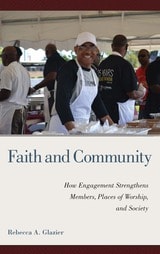
How Engagement Strengthens Members, Places of Worship, and SocietyRebecca A. Glazier
Temple University Press, 2024
Faith and Community shows the benefits of religious people taking action in their communities. Through more than a decade of multi-method data collection, Rebecca Glazier surveyed over 4,000 congregants and nearly 500 clergy in Little Rock, Arkansas to gather opinions from members and leaders on community issues and engagement. Together with interviews and case studies, her findings indicate that active congregants are happier and more civically involved.
Faith and Community provides valuable insights into the relationship between religion and community engagement. The data illustrates how community engagement benefits individuals, congregations, and democracy and offers one solution to what ails religion in America today.
Faith and the Fragility of Justice
Responses to Gender-Based Violence in South AfricaMeredith Whitnah
Rutgers University Press, 2025
Faking Liberties
Religious Freedom in American-Occupied JapanJolyon Baraka Thomas
University of Chicago Press, 2019
Through a fresh analysis of pre-war Japanese law, Jolyon Baraka Thomas demonstrates that the occupiers’ triumphant narrative obscured salient Japanese political debates about religious freedom. Indeed, Thomas reveals that American occupiers also vehemently disagreed about the topic. By reconstructing these vibrant debates, Faking Liberties unsettles any notion of American authorship and imposition of religious freedom. Instead, Thomas shows that, during the Occupation, a dialogue about freedom of religion ensued that constructed a new global set of political norms that continue to form policies today.
Forever Suspect
Racialized Surveillance of Muslim Americans in the War on TerrorSelod, Saher
Rutgers University Press, 2018

Fraternal Critique
The Politics of Muslim Community in FranceKirsten Wesselhoeft
University of Chicago Press, 2025
The conversation about Islam in France is framed by the presumption that Muslim communities are a threat to secular solidarity or fraternité. In the face of state repression, French Muslims have not closed ranks around a narrow range of voices; instead, Kirsten Wesselhoeft finds that young Muslim activists have continued to purposefully spark debate about the values that anchor community life. Wesselhoeft argues that such disagreements, far from dividing communities, actually constitute a form of belonging. Some activists call this ethic “fraternal critique,” and Wesselhoeft finds in it profound insights about the place for critique in civic life. The French state has reacted to Muslim solidarity with repression, but Wesselhoeft argues that unity need not come at the expense of dissent. Instead, fraternal critique can teach us how to build communities that are worth fighting over and fighting for.
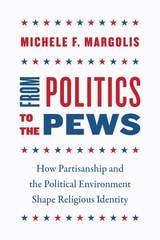
From Politics to the Pews
How Partisanship and the Political Environment Shape Religious IdentityMichele F. Margolis
University of Chicago Press, 2018
Michele F. Margolis offers a bold challenge to the conventional wisdom, arguing that the relationship between religion and politics is far from a one-way street that starts in the church and ends at the ballot box. Margolis contends that political identity has a profound effect on social identity, including religion. Whether a person chooses to identify as religious and the extent of their involvement in a religious community are, in part, a response to political surroundings. In today’s climate of political polarization, partisan actors also help reinforce the relationship between religion and politics, as Democratic and Republican elites stake out divergent positions on moral issues and use religious faith to varying degrees when reaching out to voters.

From Popular to Insurgent Intellectuals
Peasant Catechists in the Salvadoran RevolutionLeigh Binford
Rutgers University Press, 2023
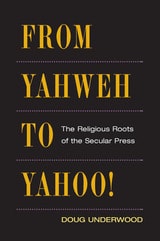
From Yahweh to Yahoo!
The Religious Roots of the Secular PressDoug Underwood
University of Illinois Press, 2001
Presenting religion as journalism's silent partner, From Yahweh to Yahoo!provides a fresh and surprising view of the religious impulses at work in contemporary newsrooms. Focusing on how the history of religion in the United States entwines with the growth of the media, Doug Underwood argues that American journalists draw from the nation's moral and religious heritage and operate, in important ways, as personifications of the old religious virtues.
Underwood traces religion's influence on mass communication from the biblical prophets to the Protestant Reformation, from the muckraker and Social Gospel campaigns of the late nineteenth and early twentieth centuries to the modern age of mass media. While forces have pushed journalists away from identifying themselves with religion, they still approach such secular topics as science, technology, and psychology in reverential ways. Underwood thoughtful analysis covers the press's formulaic coverage of spiritual experience, its failure to cover new and non-Christian religions in America, and the complicity of the mainstream media in launching the religious broadcasting movement.