Results by title
862 books match the query 'Social History' and 30 start with f

Faith, Family, and Flag
Branson Entertainment and the Idea of AmericaJoanna Dee Das
University of Chicago Press, 2025
Branson, Missouri, the Ozark Mountain mecca of wholesome entertainment, has been home to countless stage shows espousing patriotism and Christianity, welcoming over ten million visitors a year. Some consider it “God’s Country” and others “as close to Hell as anything on Earth.” For Joanna Dee Das, Branson is a political, religious, and cultural harbinger of a certain enduring dream of what America is. She takes Branson more seriously than the light-hearted fun it advertises—and maybe we should too.
For Das, Branson’s performers offer visions of the American Dream that embody a set of values known as the three Fs: faith, family, and flag. Branson boosters insist that these are universal values that welcome all people; the city aims to capture as many tourists as possible. But over the past several decades, faith, family, and flag have become markers of contemporary conservatism. The shows and culture of Branson, for all their fun and laughter, have been a galvanizing political force for white, working-and-middle class, Christian Americans. For social and economic conservatives alike, Branson is practically proof-of-concept for America as they want it to be.
Faith, Family, and Flag is a comprehensive history of the Branson entertainment industry, within the context of America’s long culture wars. Das reveals how and why a town known for popular entertainment, a domain associated most often with the political left (“Hollywood liberals”), came to be so important to the political right and its vision for America.

Faith, Family, and Flag
Branson Entertainment and the Idea of AmericaJoanna Dee Das
University of Chicago Press, 2025
Sons of Britches. The Great American Chuckwagon Dinner Show. The Haygoods. The Grand Jubilee. These are just a couple of the many shows performed in Branson, MO, a popular tourist destination that has played a role in the nation’s culture wars for over one hundred years.
Branson, Missouri, the Ozark Mountain mecca of wholesome entertainment, has been home to countless stage shows espousing patriotism and Christianity, welcoming over ten million visitors a year. Some consider it “God’s Country” and others “as close to Hell as anything on Earth.” For Joanna Dee Das, Branson is a political, religious, and cultural harbinger of a certain enduring dream of what America is. She takes Branson more seriously than the light-hearted fun it advertises—and maybe we should too.
For Das, Branson’s performers offer visions of the American Dream that embody a set of values known as the three Fs: faith, family, and flag. Branson boosters insist that these are universal values that welcome all people; the city aims to capture as many tourists as possible. But over the past several decades, faith, family, and flag have become markers of contemporary conservatism. The shows and culture of Branson, for all their fun and laughter, have been a galvanizing political force for white, working-and-middle class, Christian Americans. For social and economic conservatives alike, Branson is practically proof-of-concept for America as they want it to be.
Faith, Family, and Flag is a comprehensive history of the Branson entertainment industry, within the context of America’s long culture wars. Das reveals how and why a town known for popular entertainment, a domain associated most often with the political left (“Hollywood liberals”), came to be so important to the political right and its vision for America.
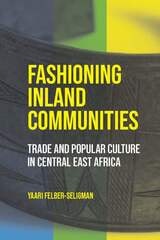
Fashioning Inland Communities
Trade and Popular Culture in Central East AfricaYaari Felber-Seligman
University of Wisconsin Press, 2025
Ruvuma used fashion to build varied communities, from local to pan-regional, reflecting the dynamic relationships among inland groups. Examples of Ruvuma popular fashions reveal processes of meaning making and community building that call for us to expand our attention to the ways in which East African peoples interacted alongside, as well as beyond, trade networks that sourced prestige and commercial goods. Popular culture here emerges as a heterarchical force that shaped lasting multidirectional connections across and between Ruvuma and their neighbors. As both a subject and a strategy for analysis, the history of popular fashion shifts how we view histories of small, decentralized societies as they encounter larger economies. Felber-Seligman demonstrates that this has implications for our understanding not only of trade but of material culture, community, gender, and family.

Feminism as Life's Work
Four Modern American Women through Two World WarsTrigg, Mary K
Rutgers University Press, 2014
Through these women’s intertwined stories, Mary Trigg traces the changing nature of the women’s movement across turbulent decades rent by world war, revolution, global depression, and the rise of fascism. Criticizing the standard division of feminist activism as a series of historical waves, Trigg exposes how Irwin, Beard, Stevens, and Pruette helped push the U.S. feminist movement to victory and continued to propel it forward from the 1920s to the 1960s, decades not included in the “wave” model. At a time widely viewed as the “doldrums” of feminism, the women in this book were in fact taking the cause to new sites: the National Women’s Party; sexuality and relations with men; marriage; and work and financial independence. In their utopian efforts to reshape work, sexual relations, and marriage, modern feminists ran headlong into the harsh realities of male power, the sexual double standard, the demands of motherhood, and gendered social structures.
In Feminism as Life’s Work, Irwin, Beard, Stevens, and Pruette emerge as the heirs of the suffrage movement, guardians of a long feminist tradition, and catalysts of the belief in equality and difference. Theirs is a story of courage, application, and perseverance—a story that revisits the “bleak and lonely years” of the U.S. women’s movement and emerges with a fresh perspective of the history of this pivotal era.

Feminists Who Changed America, 1963-1975
Edited by Barbara J. Love: Foreword by Nancy F. Cott
University of Illinois Press, 2006
Documenting key feminists who ignited the second wave women's movement
Barbara J. Love’s Feminists Who Changed America, 1963-1975 will be the first comprehensive directory to document many of the founders and leaders (including both well-known and grassroots organizers) of the second wave women's movement. It tells the stories of more than two thousand individual women and a few notable men who together reignited the women's movement and made permanent changes to entrenched customs and laws.
The biographical entries on these pioneering feminists represent their many factions, all parts of the country, all races and ethnic groups, and all political ideologies. Nancy Cott's foreword discusses the movement in relation to the earlier first wave and presents a brief overview of the second wave in the context of other contemporaneous social movements.

Fictive Kinship
Family Reunification and the Meaning of Race and Nation in American ImmigrationCatherine Lee
Russell Sage Foundation, 2013
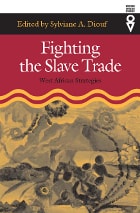
Fighting the Slave Trade
West African StrategiesSylviane A. Diouf
Ohio University Press, 2003
While most studies of the slave trade focus on the volume of captives and on their ethnic origins, the question of how the Africans organized their familial and communal lives to resist and assail it has not received adequate attention. But our picture of the slave trade is incomplete without an examination of the ways in which men and women responded to the threat and reality of enslavement and deportation.
Fighting the Slave Trade is the first book to explore in a systematic manner the strategies Africans used to protect and defend themselves and their communities from the onslaught of the Atlantic slave trade and how they assaulted it.
It challenges widely held myths of African passivity and general complicity in the trade and shows that resistance to enslavement and to involvement in the slave trade was much more pervasive than has been acknowledged by the orthodox interpretation of historical literature.
Focused on West Africa, the essays collected here examine in detail the defensive, protective, and offensive strategies of individuals, families, communities, and states. In chapters discussing the manipulation of the environment, resettlement, the redemption of captives, the transformation of social relations, political centralization, marronage, violent assaults on ships and entrepôts, shipboard revolts, and controlled participation in the slave trade as a way to procure the means to attack it, Fighting the Slave Trade presents a much more complete picture of the West African slave trade than has previously been available.

Film and the American Moral Vision of Nature
Theodore Roosevelt to Walt DisneyRonald B. Tobias
Michigan State University Press, 2011

Finns in the United States
A History of Settlement, Dissent, and IntegrationAuvo Kostiainen
Michigan State University Press, 2014
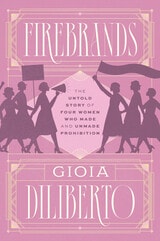
Firebrands
The Untold Story of Four Women Who Made and Unmade ProhibitionGioia Diliberto
University of Chicago Press, 2024
In the popular imagination, the story of Prohibition in America is a story of men and male violence, one full of federal agents fighting gangsters over the sale of moonshine. In contrast, Firebrands is the story of four Jazz Age dynamos—all women –who were forces behind the passage, the enforcement, the defiance, and, ultimately, the repeal of the Eighteenth Amendment. They battled each other directly, and they learned to marshal clout with cowed and hypocritical legislators, almost all of them men. Their clash over Prohibition stands as the first significant exercise of women’s political power since women gained the right to vote, and their influence on the American political scene wouldn’t be equaled for decades.
In Gioia Diliberto’s fresh and timely take on this period of history, we meet Ella Boole, the stern and ambitious leader of the Woman’s Christian Temperance Union, who campaigned fiercely to introduce Prohibition and fought desperately to keep it alive. We also meet Mabel Walker Willebrandt, the most powerful woman in America at the time, who served as the top federal prosecutor charged with enforcing Prohibition. Diliberto tells the story, too, of silent film star Texas Guinan, who ran New York speakeasies backed by the mob and showed that Prohibition was not only absurd but unenforceable. And, she follows Pauline Morton Sabin, a glamorous Manhattan aristocrat who belatedly recognized the cascading evil in Prohibition and mobilized the movement to kill it.
These women led their opposing forces of “Wets” and “Drys” across a teeming landscape of bootleggers, gangsters, federal agents, temperance fanatics, and cowardly politicians, many of them secret drunks. Building on the momentum of suffrage, they forged a path for the activists who followed during the great civil rights battles of the mid-twentieth century. Yet, they have been largely lost to history. In Firebrands, Diliberto finally gives these dynamic figures their due, creating a varied and dramatic portrait of women wielding power, in politics, society, and popular culture.

Flickering Light
A History of NeonChristoph Ribbat
Reaktion Books, 2013

Flowering of the Cumberland
Harriette Simpson Arnow
Michigan State University Press, 2013

Football and Colonialism
Body and Popular Culture in Urban MozambiqueNuno Domingos
Ohio University Press, 2017
In articles for the newspaper O Brado Africano in the mid-1950s, poet and journalist José Craveirinha described the ways in which the Mozambican football players in the suburbs of Lourenço Marques (now Maputo) adapted the European sport to their own expressive ends. Through gesture, footwork, and patois, they used what Craveirinha termed “malice”—or cunning—to negotiate their places in the colonial state. “These manifestations demand a vast study,” Craveirinha wrote, “which would lead to a greater knowledge of the black man, of his problems, of his clashes with European civilization, in short, to a thorough treatise of useful and instructive ethnography.”
In Football and Colonialism, Nuno Domingos accomplishes that study. Ambitious and meticulously researched, the work draws upon an array of primary sources, including newspapers, national archives, poetry and songs, and interviews with former footballers. Domingos shows how local performances and popular culture practices became sites of an embodied history of Mozambique. The work will break new ground for scholars of African history and politics, urban studies, popular culture, and gendered forms of domination and resistance.

For Customers Only
Public Bathrooms and the Making of American InequalityBryant Simon
University of Chicago Press, 2026
Public toilets determine who gets everyday dignity, freedom of movement, and civic belonging—and who doesn’t.
Americans have nowhere to go. Nationwide, countless public spaces lack one crucial thing: bathrooms, never mind ones that are safe and functional. Yet in the past, political leaders celebrated the opening of public bathrooms with boisterous press conferences and showy ribbon-cutting ceremonies.
For Customers Only is the first book to tell the larger history of public bathrooms in the United States, a fascinating story characterized by persistent discrimination, squeamishness about unknown bodies, and disinvestment in public amenities. Acclaimed writer and historian Bryant Simon argues that restrooms aren’t only an architectural feature, but an emblem of control and inequality. In the late nineteenth century, cities vied for the newest and biggest comfort stations to meet the demands of their bustling economies and accommodate a broad and growing public. They built restrooms with gold-domed entrances and ornamented stall doors to inspire cleanliness and order.
But officials soon grew anxious about who might take advantage of this privacy: gay men, the unhoused, and eventually drug users. And as the civil rights movement challenged segregation, officials in the north and south closed public toilets rather than integrate them. By the end of the twentieth century, only people with means could use private bathrooms while out and about—provided they made a purchase at a business. Today, as the fights over trans rights reveal, bathroom access remains a flash point across the country. Meanwhile, some municipalities are again calling for widely available public toilets, but as a tool for economic revitalization, not a public necessity.
The political and cultural history of a squirm-inducing subject, For Customers Only reveals the real and symbolic power of the most ordinary of things. Bathrooms, Simon shows, have always reflected our fragmented national values. Whether these spaces will ever become more accessible and inclusive is ultimately up to us.
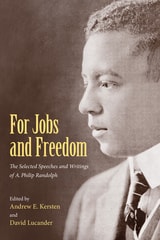
For Jobs and Freedom
Selected Speeches and Writings of A. Philip RandolphAndrew E. Kersten
University of Massachusetts Press, 2014
This volume documents Randolph's life and work through his own writings. The editors have combed through the files of libraries, manuscript collections, and newspapers, selecting more than seventy published and unpublished pieces that shed light on Randolph's most significant activities. The book is organized thematically around his major interests—dismantling workplace inequality, expanding civil rights, confronting racial segregation, and building international coalitions. The editors provide a detailed biographical essay that helps to situate the speeches and writings collected in the book. In the absence of an autobiography, this volume offers the best available presentation of Randolph's ideas and arguments in his own words.

For the Prevention of Cruelty
The History and Legacy of Animal Rights Activism in the United StatesDiane L. Beers
Ohio University Press, 2006

Forging Deaf Education in Nineteenth-Century France
Biographical Sketches of Bébian, Sicard, Massieu, and ClercFerdinand Berthier
Gallaudet University Press, 2009
In 1811, deaf student Ferdinand Berthier commenced his education at the National Institute for the Deaf in Paris under its director Abbé Sicard and his teachers Auguste Bébian, Jean Massieu, and Laurent Clerc. Their tutelage eventually led Berthier to join the faculty at the Institute and become a life-long proponent of sign language and Deaf culture. Berthier earned fame for instituting the famous silent banquets in Paris in 1834. He also learned to advance his agenda by writing biographies of important figures who advocated sign over oralism to educate deaf French students. Forging Deaf Education in Nineteenth-Century France offers the first translation of Berthier’s biographical sketches of the four men above who influenced him most.
Berthier wrote first about Bébian in 1839, timed to advocate sign language for teaching deaf students after the death of the pro-oralism Institute Director Désiré Ordinaire. Berthier extolled Bébian’s linguistic acumen and his educational philosophy. In later sketches, however, he described Sicard and Massieu in positive terms, but also criticized them for supporting “methodical” signing that conformed to spoken language conventions. In contrast, he lauded Clerc in his portrayal for using “natural” signing to teach deaf students. The clarity of these translations will introduce a brand new audience to Berthier’s biographies shaped by his unswerving beliefs about Deaf French education.

Fractured
Race, Class, Gender and the Hatred of Identity PoliticsMichael
Pluto Press, 2022
Identity politics has smeared political discourse for over a decade. The right uses it to lament the loss of free speech, while many on the left bemoan that it will be the end of class politics. It has been used to dismiss movements such as Black Lives Matter and brought seemingly progressive people into the path of fascism. It has armed the march of the transphobes.
In Fractured, the authors move away from the identity politics debate. Instead of crudely categorizing race, gender, and sexuality as 'identities', or forcing them under the heading of 'diversity', they argue that the interconnectedness of these groupings has always been inseparable from the history of class struggle under British and American capitalism.
Through an appraisal of pivotal historical moments in Britain and the US, and a sharp look at contemporary debates, the authors tame the frenzied culture war, offering a refreshing and reasoned way to understand how class struggle is formed and creating the possibilities for new forms of solidarity in an increasingly fractured world.

Framing the Sixties
The Use and Abuse of a Decade from Ronald Reagan to George W. BushBernard von Bothmer
University of Massachusetts Press, 2010
Over the past quarter century, American liberals and conservatives alike have invoked memories of the 1960s to define their respective ideological positions and to influence voters. Liberals recall the positive associations of what might be called the “good Sixties”—the “Camelot” years of JFK, the early civil rights movement, and the dreams of the Great Society—while conservatives conjure images of the “bad Sixties”—a time of urban riots, antiwar protests, and countercultural revolt.
In Framing the Sixties, Bernard von Bothmer examines this battle over the collective memory of the decade primarily through the lens of presidential politics. He shows how four presidents—Ronald Reagan, George H. W. Bush, Bill Clinton, and George W. Bush—each sought to advance his political agenda by consciously shaping public understanding of the meaning of “the Sixties.” He compares not only the way that each depicted the decade as a whole, but also their commentary on a set of specific topics: the presidency of John F. Kennedy, Lyndon Johnson's “Great Society” initiatives, the civil rights movement, and the Vietnam War.
In addition to analyzing the pronouncements of the presidents themselves, von Bothmer draws on interviews he conducted with more than one hundred and twenty cabinet members, speechwriters, advisers, strategists, historians, journalists, and activists from across the political spectrum—from Julian Bond, Daniel Ellsberg, Todd Gitlin, and Arthur Schlesinger to James Baker, Robert Bork, Phyllis Schlafly, and Paul Weyrich.
It is no secret that the upheavals of the 1960s opened fissures within American society that have continued to affect the nation's politics and to intensify its so-called culture wars. What this book documents is the extent to which political leaders, left and right, consciously exploited those divisions by “framing” the memory of that turbulent decade to serve their own partisan interests.

Franklin's Thrift
The Lost History of an American VirtueDavid Blankenhorn
Templeton Press, 2009
Americans today often think of thrift as a negative value—a miserly hoarding of resources and a denial of pleasure. Even more telling, many Americans don’t even think of thrift at all anymore. Franklin’s Thrift challenges this state of mind by recovering the rich history of thrift as a quintessentially American virtue.
The contributors to this volume trace how the idea and practice of thrift have been a vital part of the American vision of economic freedom and social abundance. For Benjamin Franklin, who personified and promoted the idea, thrift meant working productively, consuming wisely, saving proportionally, and giving generously. Franklin’s thrift became the cornerstone of a new kind of secular faith in the ordinary person’s capacity to shape his lot and fortune in life. Later chapters document how thrift moved into new domains in the nineteenth and twentieth centuries. It became the animating idea behind social movements to promote children’s school savings, create mutual savings banks and credit unions for working men and women, establish a federal savings bond program, and galvanize the nation to conserve resources during two world wars.
Historians, enthusiasts of Americana or traditional American virtues, and anyone interested in resolving our society’s current financial woes will find much to treasure in this diverse collection, with topics ranging from the inspirational lessons we can learn from the film It’s a Wonderful Life to a history of the roles played by mutual savings banks, credit unions, and thrift stores in America’s national thrift movement. It also includes actual policy recommendations for our present situation.

Free Spirits
Spiritualism, Republicanism, and Radicalism in the Civil War EraMark A. Lause
University of Illinois Press, 2016

Freedom, Inc. and Black Political Empowerment
Micah W. Kubic
University of Missouri Press, 2016
Much has been written about black urban empowerment and about the candidates—particularly the winning candidates—who are the public face of such shifts in power. Authors invariably mention the important role played by black political organizations in electing black officials or organizing communities, but Micah W. Kubic goes further, making, for the first time, one such organization the focus of a book-length study. Kubic tells the story of black political empowerment in Kansas City through the prism of Freedom, Inc., the nation’s oldest existing black political organization.
Using interviews and observation of participants as well as archival research, Kubic offers historical and political analysis of Freedom, Inc. from its founding in 1962 through its role in municipal elections of 2007. Kubic asserts that strong local organizations are living, dynamic organisms and that they, rather than charismatic candidates or interracial alliances, are the crucial players in both determining political outcomes and advancing black interests in urban areas.

Friendship and Love, Ethics and Politics
Studies in Mediaeval and Early Modern HistoryEva Österberg
Central European University Press, 2010

From Curlers to Chainsaws
Women and Their MachinesJoyce Dyer
Michigan State University Press, 2016
From Curlers to Chainsaws is a groundbreaking collection of lyrical and illuminating essays about the serious, silly, seductive, and sometimes sorrowful relationships between women and their machines. This collection explores in depth objects we sometimes take for granted, focusing not only on their functions but also on their powers to inform identity.
For each writer, the device moves beyond the functional to become a symbolic extension of the writer’s own mind—altering and deepening each woman’s concept of herself.

From Gluttony to Enlightenment
The World of Taste in Early Modern EuropeViktoria von Hoffmann
University of Illinois Press, 2016
Viktoria von Hoffmann explores four kinds of early modern texts--culinary, medical, religious, and philosophical--to follow taste's ascent from the sinful to the beautiful. Combining food studies and sensory history, she takes readers on an odyssey that redefined a fundamental human experience. Scholars and cooks rediscovered a vast array of ways to prepare and present foods. Far-sailing fleets returned to Europe bursting with new vegetables, exotic fruits, and pungent spices. Hosts refined notions of hospitality in the home while philosophers pondered the body and its perceptions. As von Hoffmann shows, these labors produced a sea change in perception and thought, one that moved taste from the base realm of the tongue to the ethereal heights of aesthetics.
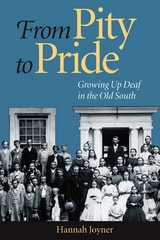
From Pity to Pride
Growing Up Deaf in the Old SouthHannah Joyner
Gallaudet University Press, 2004
The antebellum South’s economic dependence on slavery engendered a rigid social order in which a small number of privileged white men dominated African Americans, poor whites, women, and many people with disabilities. From Pity to Pride examines the experiences of a group of wealthy young men raised in the old South who also would have ruled over this closely regimented world had they not been deaf. Instead, the promise of status was gone, replaced by pity, as described by one deaf scion, “I sometimes fancy some people to treat me as they would a child to whom they were kind.”
In this unique and fascinating history, Hannah Joyner depicts in striking detail the circumstances of these so-called victims of a terrible “misfortune.” Joyner makes clear that Deaf people in the North also endured prejudice. She also explains how the cultural rhetoric of paternalism and dependency in the South codified a stringent system of oppression and hierarchy that left little room for self-determination for Deaf southerners. From Pity to Pride reveals how some of these elite Deaf people rejected their family’s and society’s belief that being deaf was a permanent liability. Rather, they viewed themselves as competent and complete. As they came to adulthood, they joined together with other Deaf Americans, both southern and northern, to form communities of understanding, self-worth, and independence.
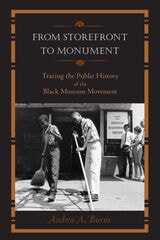
From Storefront to Monument
Tracing the Public History of the Black Museum MovementAndrea A. Burns
University of Massachusetts Press, 2013
Winner of the 2015 National Council on Public History Book Award
Today well over two hundred museums focusing on African American history and culture can be found throughout the United States and Canada. Many of these institutions trace their roots to the 1960s and 1970s, when the struggle for racial equality inspired a movement within the black community to make the history and culture of African America more “public.”
This book tells the story of four of these groundbreaking museums: the DuSable Museum of African American History in Chicago (founded in 1961); the International Afro-American Museum in Detroit (1965); the Anacostia Neighborhood Museum in Washington, D.C. (1967); and the African American Museum of Philadelphia (1976). Andrea A. Burns shows how the founders of these institutions, many of whom had ties to the Black Power movement, sought to provide African Americans with a meaningful alternative to the misrepresentation or utter neglect of black history found in standard textbooks and most public history sites. Through the recovery and interpretation of artifacts, documents, and stories drawn from African American experience, they encouraged the embrace of a distinctly black identity and promoted new methods of interaction between the museum and the local community.
Over time, the black museum movement induced mainstream institutions to integrate African American history and culture into their own exhibits and educational programs. This often controversial process has culminated in the creation of a National Museum of African American History and Culture, now scheduled to open in the nation's capital in 2015.
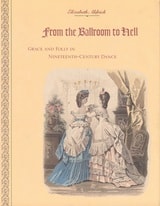
From the Ballroom to Hell
Grace and Folly in Nineteenth-Century DanceElizabeth Aldrich
Northwestern University Press, 1991
From the Ballroom to Hell collects over 100 little-known excerpts from dance, etiquette, beauty, and fashion manuals from the nineteenth century. Included are instructions for performing various dances, as well as musical scores, costume patterns, and the proper way to hold one's posture, fork, gloves, and fan. While of particular interest to dancers, dance historians, and choreographers, anyone fascinated by the ways and mores of the period will find From the Ballroom to Hell an endearing and informative glimpse of America's past.

From the Lookout
Memories of Peninsula State Park’s Summer Camp for GirlsKathleen Harris
Wisconsin Historical Society Press, 2020
With big ideas, little money, and no experience, Alice Orr Clark and Frances Louise “Kidy” Mabley founded Meenahga as a place for young women to refine their manners, enjoy outdoor leisure activities, and learn woodcraft. From the Lookout is an account of these experiences, a history of Camp Meenahga informed by what campers, counselors, and others left behind, including letters home, notes from Clark and Mabley, and many pages from the camp yearbook and newsletter Pack and Paddle.
Brimming with nostalgia, From the Lookout brings to life the sights, sounds, and smells of an idyllic summer retreat, one that long after it closed lived on as a place of respite in the memories of those who knew and loved it best.

From the Margins
Historical Anthropology and Its FuturesBrian Keith Axel, ed.
Duke University Press, 2002
In original articles encompassing a wide range of geographic and temporal locations, eminent scholars contest some of the primary preconceptions of their fields. The contributors tackle such topics as the paradoxical nature of American Civil War monuments, the figure of the “New Christian” in early seventeenth-century Peru, the implications of statistics for ethnography, and contemporary South Africa's “occult economies.” That anthropology and history have their provenance in—and have been complicit with—colonial formations is perhaps commonplace knowledge. But what is rarely examined is the specific manner in which colonial processes imbue and threaten the celebratory ideals of postcolonial reason or the enlightenment of today’s liberal practices in the social sciences and humanities.
By elaborating this critique, From the Margins offers diverse and powerful models that explore the intersections of historically specific local practices with processes of a world historical order. As such, the collection will not only prove valuable reading for anthropologists and historians, but also for scholars in colonial, postcolonial, and globalization studies.
Contributors. Talal Asad, Brian Keith Axel, Bernard S. Cohn, Jean Comaroff, John L. Comaroff, Nicholas B. Dirks, Irene Silverblatt, Paul A. Silverstein, Teri Silvio, Ann Laura Stoler, Michel-Rolph Trouillot