Results by title
139 books match the query 'Social archaeology' and 5 start with f

Food Provisioning in Complex Societies
Zooarchaeological PerspectivesLevent Atici
University Press of Colorado, 2022
Through creative combinations of ethnohistoric evidence, iconography, and contextual analysis of faunal remains, this work offers new insight into the mechanisms involved in food provisioning for complex societies. Contributors combine zooarchaeological and historical data from global case studies to analyze patterns in centralization and bureaucratic control, asymmetrical access and inequalities, and production-distribution-consumption dynamics of urban food provisioning and animal management.
Taking a global perspective and including both prehistoric and historic case studies, the chapters in the volume reflect some of the current best practices in the zooarchaeology of complex societies. Embedding faunal evidence within a broader anthropological explanatory framework and integrating archaeological contexts, historic texts, iconography, and ethnohistorical sources, the book discerns myriad ways that animals are key contributors to, and cocreators of, complex societies in all periods and all places. Chapters cover the diverse sociopolitical and economic roles wild animals played in Bronze Age Turkey; the production and consumption of animal products in medieval Ireland; the importance of belief systems, politics, and cosmologies in Shang Dynasty animal provisioning in the Yellow River Valley; the significance of external trade routes in the kingdom of Aksum (modern Sudan); hunting and animal husbandry at El Zotz; animal economies from two Mississippian period sites; and more.
Food Provisioning in Complex Societies provides an optimistic roadmap and heuristic tools to explore the diverse, resilient, and contingent processes involved in food provisioning. The book represents a novel and productive way forward for understanding the unique, yet predictably structured, provisioning systems that emerged in the context of complex societies in all parts of the world. It will be of interest to zooarchaeologists and archaeologists alike.
Contributors: Joaquin Arroyo-Cabrales, Fiona Beglane, Roderick Campbell, Kathryn Grossman, Patricia Martinez-Lira, Jacqueline S. Meier, Sarah E. Newman, Terry O'Connor, Tanya M. Peres, Gypsy C. Price, Elizabeth J. Reitz, Kim Shelton, Marcus Winter, Helina S. Woldekiros
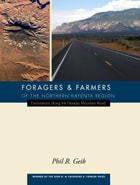
Foragers and Farmers of the Northern Kayenta Region
Excavations along the Navajo Mountain RoadPhil Geib
University of Utah Press, 2011
Foragers and Farmers of the Northern Kayenta Region presents the results of a major archaeological excavation project on Navajo tribal land in the Four Corners area and integrates this new information with existing knowledge of the archaeology of the northern Kayenta region. The excavation of thirty-three sites provides a cross section of prehistory from which Navajo Nation archaeologists retrieved a wealth of information about subsistence, settlement, architecture, and other aspects of past lifeways. The project’s most important contributions involve the Basketmaker and Archaic periods, and include a large number of radiocarbon dates on high-quality samples. Dating back to the early Archaic period (ca. 7000 BC) and ranging forward through the Basketmaker components to the Puebloan period, this volume is a powerful record of ancient peoples and their cultures. Detailed supplementary data will be available on the University of Utah Press Web site upon publication of this summary volume.
Volume 2: Archaic Site Descriptions
Volume 3: Basketmaker Site Descriptions
Volume 4: Puebloan Site Descriptions
Volume 5: Analyses and Interpretation
Appendix Volume
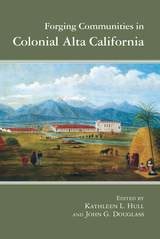
Forging Communities in Colonial Alta California
Edited by Kathleen L. Hull and John G. Douglass
University of Arizona Press, 2018
Forging Communities in Colonial Alta California reorients understandings of this dynamic period, which challenged both Native and non-Native people to reimagine communities not only in different places and spaces but also in novel forms and practices. The contributors draw on archaeological and historical archival sources to analyze the generative processes and nature of communities of belonging in the face of rapid demographic change and perceived or enforced difference.
Contributors provide important historical background on the effects that colonialism, missions, and lives lived beyond mission walls had on Indigenous settlement, marriage patterns, trade, and interactions. They also show the agency with which Indigenous peoples make their own decisions as they construct and reconstruct their communities. With nine different case studies and an insightful epilogue, this book offers analyses that can be applied broadly across the Americas, deepening our understanding of colonialism and community.
Contributors:
Julienne Bernard
James F. Brooks
John Dietler
Stella D’Oro
John G. Douglass
John Ellison
Glenn Farris
Heather Gibson
Kathleen L. Hull
Linda Hylkema
John R. Johnson
Kent G. Lightfoot
Lee M. Panich
Sarah Peelo
Seetha N. Reddy
David W. Robinson
Tsim D. Schneider
Christina Spellman
Benjamin Vargas
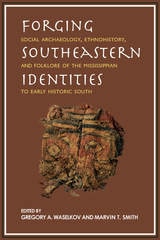
Forging Southeastern Identities
Social Archaeology, Ethnohistory, and Folklore of the Mississippian to Early Historic SouthGregory A. Waselkov
University of Alabama Press, 2017
Forging Southeastern Identities explores the many ways archaeologists and ethnohistorians define and trace the origins of Native Americans’ collective social identity.
Forging Southeastern Identities: Social Archaeology and Ethnohistory of the Mississippian to Early Historic South, a groundbreaking collection of ten essays, covers a broad expanse of time—from the ninth to the nineteenth centuries—and focuses on a common theme of identity. These essays represent the various methods used by esteemed scholars today to study how Native Americans in the distant past created new social identities when old ideas of the self were challenged by changes in circumstance or by historical contingencies.
Archaeologists, anthropologists, and folklorists working in the Southeast have always recognized the region’s social diversity; indeed, the central purpose of these disciplines is to study peoples overlooked by the mainstream. Yet the ability to define and trace the origins of a collective social identity—the means by which individuals or groups align themselves, always in contrast to others—has proven to be an elusive goal. Here, editors Gregory A. Waselkov and Marvin T. Smith champion the relational identification and categorical identification processes, taken from sociological theory, as effective analytical tools.
Taking up the challenge, the contributors have deployed an eclectic range of approaches to establish and inform an overarching theme of identity. Some investigate shell gorgets, textiles, shell trade, infrastructure, specific sites, or plant usage. Others focus on the edges of the Mississippian world or examine colonial encounters between Europeans and native peoples. A final chapter considers the adaptive malleability of historical legend in the telling and hearing of slave narratives.
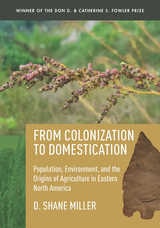
From Colonization to Domestication
Population, Environment, and the Origins of Agriculture in Eastern North AmericaD. Shane Miller
University of Utah Press, 2018
Eastern North America is one of only a handful of places in the world where people first discovered how to domesticate plants. In this book, anthropologist Shane Miller uses two common, although unconventional, sources of archaeological data—stone tools and the distribution of archaeological sites—to trace subsistence decisions from the initial colonization of the American Southeast at the end of the last Ice Age to the appearance of indigenous domesticated plants roughly 5,000 years ago.
Miller argues that the origins of plant domestication lie within the context of a boom/bust cycle that culminated in the mid-Holocene, when hunter-gatherers were able to intensively exploit shellfish, deer, oak, and hickory. After this resource “boom” ended, some groups shifted to other plants in place of oak and hickory, which included the suite of plants that were later domesticated. Accompanying these subsistence trends is evidence for increasing population pressure and declining returns from hunting. Miller contends, however, that the appearance of domesticated plants in eastern North America, rather than simply being an example of necessity as the mother of invention, is the result of individuals adjusting to periods of both abundance and shortfall driven by climate change.