Results by title
1861 books match the query 'Social life and customs' and 83 start with f
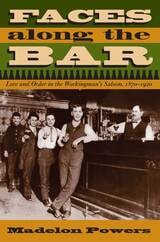
Faces along the Bar
Lore and Order in the Workingman's Saloon, 1870-1920Madelon Powers
University of Chicago Press, 1998
"A free-pouring blend of astonishing facts, folklore and firsthand period observations. . . . It's the rich details that'll inspire the casual reader to drink deep from this tap of knowledge."—Don Waller, USA Today recommended reading
"A surprise on every page."—Publishers Weekly
"Here we get social history that appreciates the bar talk even while dissecting its marvelous rituals."—Library Journal, starred review
"Careful scholarship with an anecdotal flair to please even the most sober of readers."—Nina C. Ayoub, Chronicle of Higher Education
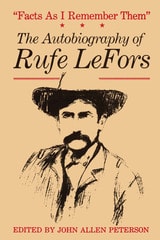
Facts as I Remember Them
The Autobiography of Rufe LeForsEdited by John Allen Peterson
University of Texas Press, 1986
The rivers of the Texas Panhandle, the Canadian, and the forks of the Red break through the Cap Rock at the eastern edge of the Staked Plains. It’s rough, bleak country, with few trees and a great expanse of sky. Storms that form on the Great Plains and in the Rocky Mountains sweep through with nothing much to slow them down. And the small dusty towns that serve this vast ranchland cling to the waterways as they have for over a hundred years, since their early settlement. Their names aren’t well known now, but they were once focal points in a rugged country where buffalo hunters, trail drivers, outlaws, and ordinary folks alike passed through.
Rufe LeFors was one such "ordinary" man. With his father and older brothers, he was among the first to settle this country, drawn to West Texas by tales of open land and good grass. His life story, set down near the end of his long and adventurous life, is the best sort of insider's history, the chronicle of a life lived fully amid the exciting events and rough landscape of the frontier's final years.
Rufe LeFors recorded his story over the course of a decade, finishing up in 1941 in his eighty-first year. His memoirs span the period from the War between the States to the early twentieth century, when the Panhandle was still scarcely settled, a true frontier. In his time LeFors was trail driver, pony express rider, and rancher. He traveled for a year with Arrington's Texas Rangers, and he wore the badge of deputy sheriff in the wild west town of Old Mobeetie. He rode a fast horse after claims in the Cherokee Strip, spent time as a horse trader, and finally settled in Lawton, Oklahoma, where, after some twenty years as a deputy, he was elected to the office of sheriff.
LeFors knew how to tell a story. Whether it is an account of an outlaw's capture or the rescue of a white girl from prairie fire by a Comanche brave, he weaves into his narrative all the color, drama, and character of the event. His version of the death of Billy the Kid adds another perspective to that much celebrated episode in western history. His encounters with Temple Houston, the governor's flamboyant son, rancher Charles Goodnight, and Ranger Captain Arrington add to our fund of knowledge about those legendary frontier figures. LeFors wanted to get the facts—as he remembered them—straight. With his sharp eye for texture and detail and keen ear for language and timing, he created a narrative that wonderfully captures the flavor of his life and exciting times.

Fada
Boredom and Belonging in NigerAdeline Masquelier
University of Chicago Press, 2019

Family Bible
Melissa J. Delbridge
University of Iowa Press, 2008
"Swimming and sex seemed a lot alike to me when I was growing up. You took off most of your clothes to do them and you only did them with people who were the same color as you. As your daddy got richer, you got to do them in fancier places." Starting with her father, who never met a whitetail buck he couldn't shoot, a whiskey bottle he couldn't empty, or a woman he couldn't charm, and her mother, who "invented road rage before 1960," Melissa Delbridge introduces us to the people in her own family bible. Readers will find elements of Southern Gothic and familiar vernacular characters, but Delbridge endows each with her startling and original interpretation. In this disarmingly unguarded and unapologetic memoir, she shows us what really happened in the "stew of religion and sex" that was 1960s Tuscaloosa.

Family Ties
By Clarice Lispector
University of Texas Press, 1972
The silent rage that seizes a matriarch whose family is feting her eighty-ninth year.The tangle of emotions felt by a sophisticated young woman toward her elderly mother. An adolescent girl's obsessive fear of being looked at. The "giddying sense of compassion" that a blind man introduces into a young housewife's settled existence. Of such is made the world of Clarice Lispector, the Brazilian writer whose finest work is acknowledged to be her exquisitely crafted short stories. Here, in these thirteen of Lispector's most brilliantly conceived stories, mysterious and unexpected moments of crisis propel characters to self-discovery or keenly felt intuitions about the human condition. Her characters mirror states of mind. Alienated by their unsettling sense of life's absurdity, they seem at times absorbed in their interior lives and in the passions that dominate and usually defeat them.
Giovanni Pontiero's translation has been lauded by Gregory Rabassa as "magnificent."

Fangs Of Malice
Hypocrisy Sincerity And ActingMatthew H Wikander
University of Iowa Press, 2002
The idea that actors are hypocrites and fakes and therefore dangerous to society was widespread in the seventeenth and eighteenth centuries. Fangs of Malice examines the equation between the vice of hypocrisy and the craft of acting as it appears in antitheatrical tracts, in popular and high culture, and especially in plays of the period. Rousseau and others argue that actors, expert at seeming other than they are, pose a threat to society; yet dissembling seems also to be an inevitable consequence of human social intercourse. The “antitheatrical prejudice” offers a unique perspective on the high value that modern western culture places on sincerity, on being true to one's own self.
Taking a cue from the antitheatrical critics themselves, Matthew Wikander structures his book in acts and scenes, each based on a particular slander against actors. A prologue introduces his main issues. Act One deals with the proposition “They Dress Up”: foppish slavery to fashion, cross-dressing, and dressing as clergy. Act Two treats the proposition “They Lie” by focusing on social dissembling and the phenomenon of the self-deceiving hypocrite and the public, princely hypocrite. Act Three, “They Drink,” examines a wide range of antisocial behavior ascribed to actors, such as drinking, gambling, and whoring. An epilogue ties the ancient ideas of possession and the panic that actors inspire to contemporary anxieties about representation not only in theatre but also in the visual and literary arts.
Fangs of Malice will be of great interest to scholars and students of drama as well as to theatre professionals and buffs.

Fanti Kinship and the Analysis of Kinship Terminologies
David B. Kronenfeld
University of Illinois Press, 2008
This book examines Fanti kinship terminology from a variety of analytic and formal perspectives. Based on work with a broad number of informants, David B. Kronenfeld details and analyzes internal variation in usage within the Fanti community, shows the relationship between terminology and social groups and communicative usage, and relates these findings to major theoretical work on kinship and on the intersections of language, thought, and culture.
The terminological analysis in this study employs a great variety of formal approaches, assesses the strengths and weaknesses of each approach, and covers a wide range of types of usage. This work also performs a systematic, formal analysis of behavior patterns among kin, joining this approach with the analysis of a kinship terminological system. Rather than treating kinship terminology as a special, isolated piece of culture, this study also ties its analysis to more general semantic and cultural theoretical issues. Including computational and comparative studies of kinship terminologies, this volume represents the fullest analysis of any kinship terminological system in the ethnographic record.
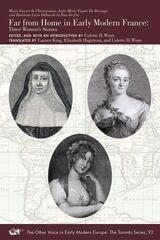
Far from Home in Early Modern France
Three Women’s StoriesMarie Guyart de l’Incarnation, Anne-Marie Fiquet du Boccage, and Henriette-Lucie Dillon de la Tour du Pin
Iter Press, 2022
This book showcases three Frenchwomen who ventured far from home at a time when such traveling was rare. In 1639, Marie de l’Incarnation embarked for New France where she founded the first Ursuline monastery in present-day Canada. In 1750, Madame du Boccage set out at the age of forty on her first “grand tour.” She visited England, the Netherlands, and Italy where she experienced firsthand the intellectual liberty offered there to educated women. As the Reign of Terror gripped France, the Marquise de la Tour du Pin fled to America with her husband and their two young children, where they ran a farm from 1794 to 1796. The writings these women left behind detailing their respective journeys abroad represent significant contributions to early modern travel literature. This book makes available to anglophone readers three texts that are rich in both historical and literary terms.
Fashioning Inland Communities
Trade and Popular Culture in Central East AfricaYaari Felber-Seligman
University of Wisconsin Press, 2025
Ruvuma used fashion to build varied communities, from local to pan-regional, reflecting the dynamic relationships among inland groups. Examples of Ruvuma popular fashions reveal processes of meaning making and community building that call for us to expand our attention to the ways in which East African peoples interacted alongside, as well as beyond, trade networks that sourced prestige and commercial goods. Popular culture here emerges as a heterarchical force that shaped lasting multidirectional connections across and between Ruvuma and their neighbors. As both a subject and a strategy for analysis, the history of popular fashion shifts how we view histories of small, decentralized societies as they encounter larger economies. Felber-Seligman demonstrates that this has implications for our understanding not only of trade but of material culture, community, gender, and family.
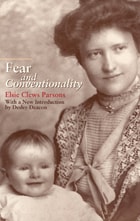
Fear and Conventionality
Elsie Clews Parsons
University of Chicago Press, 1997
A modern mind at the turn of the century, Parsons challenged social conventions at a time when it was less than popular to do so. Witty, graceful, and impassioned, this book will be of interest to social and cultural historians and anyone interested in early twentieth-century America.
Elsie Clews Parsons (1874-1941) is the author of many books, including The Family, The Old-Fashioned Woman, Pueblo Indian Religion, and Mitla. Available from the University of Chicago Press is Elsie Clews Parsons: Constructing Sex and Culture in Modernist America, a biography by Desley Deacon.
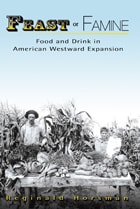
Feast or Famine
Food and Drink in American Westward ExpansionReginald Horsman
University of Missouri Press, 2008
Feast or Famine is the first comprehensive account of food and drink in the winning of the West, describing the sustenance of successive generations of western pioneers. Drawing on journals of settlers and travelers—as well as a lifetime of research on the American West—Reginald Horsman examines more than one hundred years of history, from the first advance of explorers into the Mississippi valley to the movement of ranchers and farmers onto the Great Plains, recording not only the components of their diets but food preparation techniques as well.
Most settlers were able to obtain food beyond the dreams of ordinary Europeans, for whom meat was a luxury. Not only were buffalo, deer, and wild turkey there for the taking, pioneers also gathered greens such as purslane, dandelion, and pigweed—as well as wild fruits, berries, and nuts. They replaced sugar with wild honey or maple syrup, and when they had no tea, they made drinks out of sage, sassafras, and mint. Horsman also reveals the willingness of Indians to convey their knowledge of food to newcomers, sharing salmon in the Pacific Northwest, agricultural crops in the arid Southwest.
Horsman tells how agricultural expansion and transportation opened a veritable cornucopia and how the development of canning soon made it possible for meals to transcend simple frontier foods, with canned oysters and crystallized eggs in airtight cans on merchants’ shelves. He covers food on different regional frontiers, as well as the cuisines of particular groups such as fur traders, soldiers, miners, and Mormons. He also discusses food shortages that resulted from poor preparation, temporary scarcity of game, marginal soil, or simply bad luck. At times, as with the ill-fated Donner Party, pioneers starved.
Engagingly written and meticulously researched, Feast or Famine is a one-of-a-kind look at a subject too long ignored in histories of the West. By revealing the spectrum of frontier fare across years and regions, it shows us that the land of opportunity was often a land of plenty.

Field Observations
StoriesStories by Rob Davidson
University of Missouri Press, 2001
Field Observations, the debut fiction collection from Rob Davidson, contains stories about people who find themselves at difficult turning points in their lives—times when they are faced with hard choices, broken promises, and the fear of self-destruction. Davidson's characters are diverse: a retired math teacher, an auto repair worker, a technical writer, a nurse living overseas. What connects them is the way Davidson renders each character with essential human dignity, regardless of his or her flaws. This collection addresses such contemporary concerns as love relationships, cultural interaction, divorce, aging, and alcoholism in a lively, sometimes offbeat way.
In "Inventory"—winner of a 1997 AWP Intro Journals Award—the young narrator, fresh out of the army, struggles to take stock of his civilian life and assume responsibility for himself. An estranged wife, in "You Have to Say Something," competes for attention with her husband's manic approach to work, finding both solace and frustration in a new friend, a compulsive gift-giver. "A Private Life" renders a young Peace Corps volunteer grappling with her loneliness in a foreign country, with a sense of exposure and violation. In "What We Leave Behind," a college dropout and onetime golf prodigy finds himself dissatisfied with his current career as a vacuum cleaner salesman; after a quirky encounter with a client, he finds hope for a new beginning.
A recurrent motif in the stories is the presentation of characters who either tend to observe, even spy on, others, or who have the sense that they themselves are being watched. The notion of a passive observer extends to several characters who seem to treat their own lives as subject for observation rather than action, frequently persisting in patterns of behavior that are clearly destructive.
Rendered in clean, smooth prose with sharply observed details and driven by Davidson's fine ear for dialogue, these stories poignantly capture the difficult in-between states that trouble people every day. Fully defined and evocatively written, this collection addresses important real-life issues and concerns.

Fierce and Indomitable
The Protohistoric Non-Pueblo World in the American SouthwestEdited by Deni J. Seymour
University of Utah Press, 2016
Trending upward as an archaeological field of study, protohistoric mobile groups provide fascinating new directions for cutting-edge research in the American Southwest and beyond. These mobile residents represent the ancient and ancestral roots of many modern indigenous peoples, including the Apaches, Jumano, Yavapai, and Ute. These important protohistoric and historic mobile people have tended to be ignored because their archaeological sites were deemed too difficult to identify, too scant to be worthy of study, and too different to incorporate. This book brings together information from a diverse collection of authors working throughout the American Southwest and its fringes to make the bold statement that these groups can be identified in the archaeological record and their sites have much to contribute to the study of cultural process, method and theory, and past lifeways. Mobile groups are integral for assessing the grand reorganizational events of the Late Prehistoric period and are key to understanding colonial contact and transformations. Now, the only analyses, overviews, and class lectures that will be considered comprehensive will be those that address the presence of these many widespread mobile peoples.

Fiestas in Laredo
Matachines, Quinceañeras, and George Washington’s BirthdayNorma E. Cantú
University of North Texas Press, 2024

Fighting Horse Of Stanislaus
Stories Essays Dan De QuilleLAWRENCE I. BERKOVE
University of Iowa Press, 1990

Filth
Dirt, Digust, and Modern LifeWilliam A. Cohen
University of Minnesota Press, 2004
Finding God in All the Black Places
Sacred Imaginings in Black Popular CultureBeretta E. Smith-Shomade
Rutgers University Press, 2025
https://manifold.ecds.emory.edu/projects/finding-god-in-all-the-black-places
(https://dhjhkxawhe8q4.cloudfront.net/rup-wp-v2/wp-content/uploads/2025/01/28132142/9781978839809.pdf)
In Finding God in All the Black Places, Beretta E. Smith-Shomade contends that Black spirituality and Black church religiosity are the critical crux of Black popular culture. She argues that cultural, community, and social support live within the Black church and that spirit, art, and progress are deeply entwined and seal this connection. Including the work of artists such as Mary J. Blige, D’Angelo, Erykah Badu, Prince, Spike Lee, and Oprah Winfrey, the book examines contemporary Black television, film, music and digital culture to demonstrate the role, impact, and dominance of spirituality and religion in Black popular culture. Smith-Shomade believes that acknowledging and comprehending the foundations of Black spirituality and Black church religiosity within Black popular culture provide a way for viewers, listeners, and users not only to endure but also to revitalize.

Finding Mars
Ned Rozell
University of Alaska Press, 2011
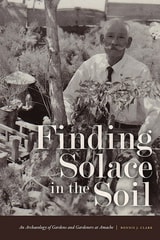
Finding Solace in the Soil
An Archaeology of Gardens and Gardeners at AmacheBonnie J. Clark
University Press of Colorado, 2022
Before incarceration, many at Amache had been farmers, gardeners, or nursery workers. Between 1942 and 1945, they applied their horticultural expertise to the difficult high plains landscape of southeastern Colorado. At Amache they worked to form microclimates, reduce blowing sand, grow better food, and achieve stability and preserve community at a time of dehumanizing dispossession. In this book archaeologist Bonnie J. Clark examines botanical data like seeds, garden-related artifacts, and other material evidence found at Amache, as well as oral histories from survivors and archival data including personal letters and government records, to recount how the prisoners of Amache transformed the harsh military setting of the camp into something resembling a town. She discusses the varieties of gardens found at the site, their place within Japanese and Japanese American horticultural traditions, and innovations brought about by the creative use of limited camp resources.
The gardens were regarded by the incarcerees as a gift to themselves and to each other. And they were also, it turns out, a gift to the future as repositories of generational knowledge where a philosophical stance toward nature was made manifest through innovation and horticultural skill. Framing the gardens and gardeners of Amache within the larger context of the incarceration of Japanese Americans and of recent scholarship on displacement and confinement, Finding Solace in the Soil will be of interest to gardeners, historical archaeologists, landscape archaeologists, cultural anthropologists, and scholars of Japanese American history and horticultural history.

Finding the Arctic
History and Culture Along a 2,500-Mile Snowmobile Journey from Alaska to Hudson’s BayMatthew Sturm
University of Alaska Press, 2012

Fire Road
Donald Anderson
University of Iowa Press, 2001

Fire in the Water, Earth in the Air
Legends of West Texas MusicBy Christopher J. Oglesby
University of Texas Press, 2006
From Buddy Holly and the Crickets to the Flatlanders, Terry Allen, and Natalie Maines, Lubbock, Texas, has produced songwriters, musicians, and artists as prolifically as cotton, conservatives, and windstorms. While nobody questions where the conservatives come from in a city that a recent nonpartisan study ranked as America's second most conservative, many people wonder why Lubbock is such fertile ground for creative spirits who want to expand the boundaries of thought in music and art. Is it just that "there's nothing else to do," as some have suggested, or is there something in the character of Lubbock that encourages creativity as much as conservatism?
In this book, Christopher Oglesby interviews twenty-five musicians and artists with ties to Lubbock to discover what it is about this community and West Texas in general that feeds the creative spirit. Their answers are revealing. Some speak of the need to rebel against conventional attitudes that threaten to limit their horizons. Others, such as Joe Ely, praise the freedom of mind they find on the wide open plains. "There is this empty desolation that I could fill if I picked up a pen and wrote, or picked up a guitar and played," he says. Still others express skepticism about how much Lubbock as a place contributes to the success of its musicians. Jimmie Dale Gilmore says, "I think there is a large measure of this Lubbock phenomenon that is just luck, and that is the part that you cannot explain."
As a whole, the interviews create a portrait not only of Lubbock's musicians and artists, but also of the musical community that has sustained them, including venues such as the legendary Cotton Club and the original Stubb's Barbecue. This kaleidoscopic portrait of the West Texas music scene gets to the heart of what it takes to create art in an isolated, often inhospitable environment. As Oglesby says, "Necessity is the mother of creation. Lubbock needed beauty, poetry, humor, and it needed to get up and shake its communal ass a bit or go mad from loneliness and boredom; so Lubbock created the amazing likes of Jimmie Dale Gilmore, Butch Hancock, Terry Allen, and Joe Ely."
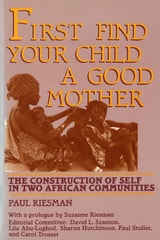
First Find Your Child a Good Mother
The Construction of Self in Two African CommunitiesRiesman, Paul
Rutgers University Press, 1992
Through a systematic comparison of the life circumstances, child-rearing practices, and personalities of the FulBe and their former slaves, the RiimaayBe, this book develops an alternative theory of the way personality is formed in the Fulani society of West Africa. Riesman discusses the different characters, economies, and life plans of adult men and women of both groups, focusing on their ideas about the value of relatives. He further presents detailed observations of child-rearing practices, and concludes that the FulBe and RiimaayBe do not differ in these practices. Contrasting Fulani and Western notions of parenting, he suggests that child-rearing practices are themselves irrelevant to the formation of adult personality, but that a people's ideas about the meaning of life, social relations, and the development of character are very important. Finally, Riesman outlines a sociocultural theory of personality and its formation, and uses this theory to make sense of the differences between FulBe and RiimaayBe.
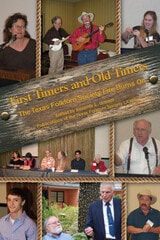
First Timers and Old Timers
Kenneth L. Untiedt
University of North Texas Press, 2012

Flavor and Soul
Italian America at Its African American EdgeJohn Gennari
University of Chicago Press, 2017
In Flavor and Soul, John Gennari spotlights this affinity, calling it “the edge”—now smooth, sometimes serrated—between Italian American and African American culture. He argues that the edge is a space of mutual emulation and suspicion, a joyous cultural meeting sometimes darkened by violent collision. Through studies of music and sound, film and media, sports and foodways, Gennari shows how an Afro-Italian sensibility has nourished and vitalized American culture writ large, even as Italian Americans and African Americans have fought each other for urban space, recognition of overlapping histories of suffering and exclusion, and political and personal rispetto.
Thus, Flavor and Soul is a cultural contact zone—a piazza where people express deep feelings of joy and pleasure, wariness and distrust, amity and enmity. And it is only at such cultural edges, Gennari argues, that America can come to truly understand its racial and ethnic dynamics.
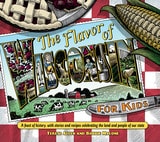
Flavor of Wisconsin for Kids
A Feast of History, with Stories and Recipes Celebrating the Land and People of Our StateTerese Allen
Wisconsin Historical Society Press, 2012
What are some food favorites in Wisconsin, and why are they special to us? How have our landscape and the people who have inhabited it contributed to our food heritage? This unique blend of history book and cookbook gives kids a real taste for hands-on history by showing them how to create and sample foods that link us to the resources found in our state and the heritage of those who produce them.
Designed for kids and adults to use together, The Flavor of Wisconsin for Kids draws upon the same source material that makes The Flavor of Wisconsin by Harva Hachten and Terese Allen a fascinating and authoritative document of the history and traditions of food in our state, and presents it in a colorful, kid-friendly format that’s both instructional and fun. Mindful of the importance of teaching kids about where the foods they eat come from, each chapter examines a different food source—forests; waters; vegetable, meat, and dairy farms; gardens; and communities. The authors explore our state’s foodways, from their origins to how they have changed over the years, and then offer a selection of related recipes. The recipes are written for modern kitchens but use many traditional ingredients and techniques. Level of difficulty is clearly noted, as well as whether a recipe requires a heat source to prepare.

Flow
The Life and Times of Philadelphia's Schuylkill RiverBeth Kephart
Temple University Press, 2014

Flowering of the Cumberland
Harriette Simpson Arnow
Michigan State University Press, 2013

Flowers in the Dustbin
Culture, Anarchy, and Postwar EnglandNeil Nehring
University of Michigan Press, 1993
Flowers in the Dustbin looks at the volatile relations between literature, rock music, and youth subcultures in postwar England. Neil Nehring traces the continuities between the original avant-garde of the twenties and thirties and the postwar youth culture, arguing that anarchism never really disappeared from the world. The author shows that British youth groups like the Mods, the Rockers, Punks, and Teddy Boys and the music that inspired them appear increasingly more acute than their literary counterparts, belying conventional assumptions about the relative powers of "high" and "low" culture. By examining literary texts as part of a larger sampling of cultural forms and their uses in everyday life, Flowers in the Dustbin provides a striking illustration of the significance the field of cultural studies holds for studies in English.

Folk Groups And Folklore Genres Reader
A Readeredited by Elliott Oring
Utah State University Press, 1989

Folklore and Culture on the Texas-Mexican Border
By Américo Paredes
University of Texas Press, 1995
In an illustrious career spanning over forty years, Américo Paredes has often set the standard for scholarship and writing in folklore and Chicano studies. In folklore, he has been in the vanguard of important theoretical and methodological movements. In Chicano studies, he stands as one of the premier exponents.
Paredes's books are widely known and easily available, but his scholarly articles are not so familiar or accessible. To bring them to a wider readership, Richard Bauman has selected eleven essays that eloquently represent the range and excellence of Paredes's work. The hardcover edition of Folklore and Culture was published in 1993. This paperback edition will make the book more accessible to the general public and more practical for classroom use.

Folklore by the Fireside
Text and Context of the Tuscan VegliaBy Alessandro Falassi
University of Texas Press, 1980
For centuries, social life in rural Tuscany has centered around the veglia, an evening gathering of family and friends at the hearth. Folklore by the Fireside is a thorough and insightful study of this custom—from the tales, riddles, lullabies, and folk prayers performed as the small children are put to bed to the courtship songs and dances later in the evening to the anti-veglia male gossip, card games, and protest songs originating in the tavern.
Alessandro Falassi skillfully correlates the veglia to the rites of passage and family values of an agrarian society. Although the impact of mass media and other factors has tended to weaken the tradition, even today Tuscan children are taught to behave and adolescents are guided along the conventional path to adulthood, courtship, and marriage through veglia folklore.
This is the first work to deal systematically with Tuscan folklore from a semiotic and structural viewpoint and to examine the veglia as a means of handing down traditional values. It is important not only for its careful, detailed description but also for its rigorous methodology and theoretical richness.

Folklore in Motion
Texas Travel LoreKenneth L. Untiedt
University of North Texas Press, 2007

Folklore in Utah
A History and Guide to ResourcesDavid Stanley
Utah State University Press, 2004
Over thirty scholars examine the development of folklore studies through the lens of over one hundred years of significant activity in a state that has provided grist for the mills of many prominent folklorists. In the past the Folklore Society of Utah has examined the work of such scholars in biographical and other essays published in its newsletters. This book incorporates those essays and goes well beyond them to include many other topices, offering a thorough history of folklore studies and a guide to resources for those pursuing research in Utah now and in the future.
The essays survey the development and contributions of folklore studies in Utah from 1892 to 2004 but also represent developments in both academic and public-sector folklore throughout the United States. Following a thorough historical introduction, part I profiles the first folklorists working in the state, including Hector Lee, Thomas Cheney, Austin and Alta Fife, Wayland Hand, and Lester Hubbard. Part II looks at the careers of prominent Utah folklorists Jan Harold Brunvand, Barre Toelken, and William B. Wilson, as well as the works of the next, current generation of folklorists. Part III covers studies in major folklore genres, with essays on the study of material culture, vernacular architecture, and Mormon, ethnic, Native American, and Latino folklore. Part IV examines public folklore programs including organizations, conferences, and tourism. Back matter describes academic programs at Utah institutions of higher education, summarizes the holdings of the various folklore archives in the state, and provides a complete cross-indexed bibliography of articles, books, and recordings of Utah folklore.
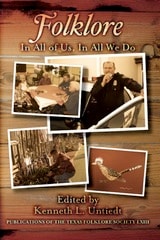
Folklore
In All of Us, In All We DoKenneth L. Untiedt
University of North Texas Press, 2006

Folktales from the Helotes Settlement
John Igo
University of North Texas Press, 2014
Following Tradition
Folklore in the Discourse of American CultureSimon J. Bronner
Utah State University Press, 1998
Following Tradition is an expansive examination of the history of tradition—"one of the most common as well as most contested terms in English language usage"—in Americans' thinking and discourse about culture. Tradition in use becomes problematic because of "its multiple meanings and its conceptual softness." As a term and a concept, it has been important in the development of all scholarly fields that study American culture. Folklore, history, American studies, anthropology, cultural studies, and others assign different value and meaning to tradition. It is a frequent point of reference in popular discourse concerning everything from politics to lifestyles to sports and entertainment. Politicians and social advocates appeal to it as prima facie evidence of the worth of their causes. Entertainment and other media mass produce it, or at least a facsimile of it. In a society that frequently seeks to reinvent itself, tradition as a cultural anchor to be reverenced or rejected is an essential, if elusive, concept. Simon Bronner's wide net captures the historical, rhetorical, philosophical, and psychological dimensions of tradition. As he notes, he has written a book "about an American tradition—arguing about it." His elucidation of those arguments makes fascinating and thoughtful reading. An essential text for folklorists, Following Tradition will be a valuable reference as well for historians and anthropologists; students of American studies, popular culture, and cultural studies; and anyone interested in the continuing place of tradition in American culture.

Foods of Association
Biocultural Perspectives on Foods and Beverages that Mediate SociabilityNina L. Etkin
University of Arizona Press, 2009
This fascinating book examines the biology and culture of foods and beverages that are consumed in communal settings, with special attention to their health implications. Nina Etkin covers a wealth of topics, exploring human evolutionary history, the Slow Food movement, ritual and ceremonial foods, caffeinated beverages, spices, the street foods of Hawaii and northern Nigeria, and even bottled water. Her work is framed by a biocultural perspective that considers both the physiological implications of consumption and the cultural construction and circulation of foods. For Etkin, the foods and beverages we consume are simultaneously “biodynamic substances and cultural objects.”
The book begins with a look at the social eating habits of our primate relatives and discusses our evolutionary adaptations. It then offers a history of social foods in the era of European expansion, with a focus on spices and “caffeinated cordials.” (Of course, there were some powerful physiological consequences of eating foods brought home by returning explorers, and those are considered too—along with consequences for native peoples.) From there, the book describes “street food,” which is always served in communal settings. Etkin then scrutinizes ceremonial foods and beverages, and considers their pharmacological effects as well. Her extensive examination concludes by assessing the biological and cultural implications of bottled water.
While intended primarily for scholars, this enticing book serves up a tantalizing smorgasbord of food for thought.
Foodways in Roman Republican Italy
Laura M. Banducci
University of Michigan Press, 2021
Foodways in Roman Republican Italy explores the production, preparation, and consumption of food and drink in Republican Italy to illuminate the nature of cultural change during this period. Traditionally, studies of the cultural effects of Roman contact and conquest have focused on observing changes in the public realm: that is, changing urban organization and landscape, and monumental construction. Foodways studies reach into the domestic realm: How do the daily behaviors of individuals express their personal identity, and How does this relate to changes and expressions of identity in broader society? Laura M. Banducci tracks through time the foodways of three sites in Etruria from about the third century BCE to the first century CE: Populonia, Musarna, and Cetamura del Chianti. All were established Etruscan sites that came under Roman political control over the course of the third and second centuries BCE. The book examines the morphology and use wear of ceramics used for cooking, preparing, and serving food in order to deduce cooking methods and the types of foods being prepared and consumed. Change in domestic behaviors was gradual and regionally varied, depending on local social and environmental conditions, shaping rather than responding to an explicitly “Roman” presence.

Football and Colonialism
Body and Popular Culture in Urban MozambiqueNuno Domingos
Ohio University Press, 2017
In articles for the newspaper O Brado Africano in the mid-1950s, poet and journalist José Craveirinha described the ways in which the Mozambican football players in the suburbs of Lourenço Marques (now Maputo) adapted the European sport to their own expressive ends. Through gesture, footwork, and patois, they used what Craveirinha termed “malice”—or cunning—to negotiate their places in the colonial state. “These manifestations demand a vast study,” Craveirinha wrote, “which would lead to a greater knowledge of the black man, of his problems, of his clashes with European civilization, in short, to a thorough treatise of useful and instructive ethnography.”
In Football and Colonialism, Nuno Domingos accomplishes that study. Ambitious and meticulously researched, the work draws upon an array of primary sources, including newspapers, national archives, poetry and songs, and interviews with former footballers. Domingos shows how local performances and popular culture practices became sites of an embodied history of Mozambique. The work will break new ground for scholars of African history and politics, urban studies, popular culture, and gendered forms of domination and resistance.
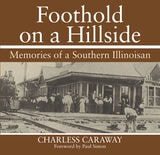
Foothold on a Hillside
Memories of a Southern IllinoisanCharless Caraway. Foreword by Paul Simon
Southern Illinois University Press, 1986
In a style reminiscent of the master storytellers of yore, Charless Caraway recounts the story of his life, as a man and a boy, on small farms in Saline and Jackson counties, particularly around Eldorado, Makanda, and Etherton Switch. He makes no bones about the hardships of those "old days," first helping his father eke out a living from the land, then scrambling for a living as a sharecropper and fruit picker, as he scrimped and saved for the day when he and his young wife, Bessie Mae Rowan Caraway, could buy a piece of land of their own.
The one-room school, the general store, the trips by wagon over roads that choked you in summer and swallowed you in winter, the home that burned: all are described in a matter-of-fact yet moving way. Many of the locations, buildings, and people are represented in equally unromanticized photographs from the family’s collection. Some of the stories and photos recall the common disasters of the frontier: drought, flood, and the tornado of 1925.
It is clear from these stories that each aspect of life exacted a price, but the Caraways paid that price without regret and rallied to go on their way. Charless and his family and friends fill this book with courage, strength, and an unshakable faith in the value of human endeavor.

For the Love of Cod
A Father and Son's Search for Norwegian HappinessEric Dregni
University of Minnesota Press, 2021
A journey to find Norway’s supposed bliss makes for a comic travelogue that asks, seriously, what makes Norwegians so damn happy—and does it translate?
Norway is usually near or at the top of the World Happiness Report. But is it really one of the happiest countries on Earth? Eric Dregni had his doubts. Years ago he and his wife had lived in this country his great-great-grandfather once fled. When their son Eilif was born there, the Norwegian government paid for the birth, gave them $5,000, and deposited $150 into their bank account every month, but surely happiness was more than a generous health care system. What about all those grim months without sun? When Eilif turned fifteen, father and son decided to go back together and investigate. For the Love of Cod is their droll report on the state of purported Norwegian bliss.
Arriving in May, a month of festivals and eternal sun, the Dregnis are thrust into Norway at its merriest—and into the reality of the astronomical cost of living, which forces them to find lodging with friends and relatives. But this gives them an inside look at the secrets to a better life. It’s not the massive amounts of money flowing from the North Sea oil fields but how these funds are distributed that fuels the Norwegian version of democratic socialism—resulting in miniscule differences between rich and poor. Locals introduce them to the principles underlying their avowed contentment, from an active environmentalism that translates into flyskam (flight shame), which keeps Norwegians in the family cabin for the long vacations prescribed by law and charges a 150 percent tax on gas guzzlers (which, Eilif observes, means more Teslas seen in one hour than in a year in Minnesota!).
From a passion for dugnad or community volunteerism and sakte or “slow,” a rejection of the mad pace of modernity, to the commodification of Viking history and the dark side of Black Metal music that turns the idea of quaint, traditional Norway upside down, this idiosyncratic father and son tour lets readers, free of flyskam, see how, or whether, Norwegian happiness translates.

For the Love of Mike
More of the Best of Mike RoykoMike Royko
University of Chicago Press, 2001
Royko, a nationally syndicated Pulitzer Prize winner, wrote for three major Chicago newspapers in the course of his 34 years as a daily columnist. Chosen from more than 7,000 columns, For the Love of Mike brings back more than a hundred vintage Royko pieces-most of which have not appeared since their initial publication-for readers across the country to enjoy. This second collection includes Royko's riffs on the consequences of accepting a White House dinner invitation (not surprisingly, he turned it down); his explanation of the notorious Ex-Cub Factor in World Series play; and his befuddlement at a private screening of Beyond the Valley of the Dolls, to which he was invited by his pal Ebert, the screenplay's author. The new collection also illuminates Royko's favorite themes, topics he returned to again and again: his skewering of cultural trends, his love of Chicago, and his rage against injustice. By turns acerbic, hilarious, and deeply moving, Royko remains a writer of wit and passion who represents the best of urban journalism.
"To read these columns again is to have Mike back again, nudging, chuckling, wincing, deflating pomposity, sticking up for the little guy, defending good ideas against small-minded people," writes Roger Ebert in his foreword to the book. For the Love of Mike does indeed bring Mike back again, and until a Chicago newspaper takes up Ebert's suggestion that it begin reprinting each of Royko's columns, one a day, this collection will more than satisfy Royko's loyal readers.

Forbidden Relatives
THE AMERICAN MYTH OF COUSIN MARRIAGEMartin Ottenheimer
University of Illinois Press, 1996
A social anthropologist, Martin Ottenheimer questioned U.S. laws against cousin marriage because his international research into marriage patterns showed no European countries prohibit such unions. He examines the historical development of U.S. laws governing marriage, contrasts them with European laws, and analyzes the genetic implications of first cousin marriage. Modern genetic evidence, Ottenheimer says, doesn't support the concept that children of these unions are at any special risk.
Ottenheimer's book, the only volume available that deals with kinship in this way, will challenge readers and give them much to consider and discuss.
Forging Southeastern Identities
Social Archaeology, Ethnohistory, and Folklore of the Mississippian to Early Historic SouthGregory A. Waselkov
University of Alabama Press, 2017
Forging Southeastern Identities explores the many ways archaeologists and ethnohistorians define and trace the origins of Native Americans’ collective social identity.
Forging Southeastern Identities: Social Archaeology and Ethnohistory of the Mississippian to Early Historic South, a groundbreaking collection of ten essays, covers a broad expanse of time—from the ninth to the nineteenth centuries—and focuses on a common theme of identity. These essays represent the various methods used by esteemed scholars today to study how Native Americans in the distant past created new social identities when old ideas of the self were challenged by changes in circumstance or by historical contingencies.
Archaeologists, anthropologists, and folklorists working in the Southeast have always recognized the region’s social diversity; indeed, the central purpose of these disciplines is to study peoples overlooked by the mainstream. Yet the ability to define and trace the origins of a collective social identity—the means by which individuals or groups align themselves, always in contrast to others—has proven to be an elusive goal. Here, editors Gregory A. Waselkov and Marvin T. Smith champion the relational identification and categorical identification processes, taken from sociological theory, as effective analytical tools.
Taking up the challenge, the contributors have deployed an eclectic range of approaches to establish and inform an overarching theme of identity. Some investigate shell gorgets, textiles, shell trade, infrastructure, specific sites, or plant usage. Others focus on the edges of the Mississippian world or examine colonial encounters between Europeans and native peoples. A final chapter considers the adaptive malleability of historical legend in the telling and hearing of slave narratives.
Forgotten Bodies
Imperialism, Chuukese Migration, and Stratified Reproduction in GuamSarah A. Smith
Rutgers University Press, 2024

Forgotten Towns of Southern New Jersey
Beck, Henry
Rutgers University Press, 1983

Four Classic Mormon Village Studies
Howard M. Bahr
University of Utah Press, 2014

Four Germanys
A Chronicle of the Schorcht FamilyDonald S. Pitkin
Temple University Press, 2016
In this last book by the late Donald Pitkin, author of The House that Giacomo Built, comes a story of the Schorcht family, through whose fortunes and struggles one can see the transformations of Germany through the long twentieth century.
Each chapter of Four Germanys is reflective of generational rather than historical time. In 1922, Edwin Schorcht inherited his family farm, and in Part One, Pitkin traces the derivation of this farmstead. Part Two focuses on Schorcht’s children who came of age in Hitler’s Germany. Part Three has the Schorchts growing up in the Ulbricht years (1950–73) of the German Democratic Republic. The book concludes with the great-granddaughter, Maria, looking back to the past in relation to the new Germany that history had bequeathed her.
Ultimately, Four Germanys reflects the impact of critical historical events on ordinary East Germans while it also reveals how one particular family managed its own historical adaptation to these events.

Fragments of Culture
The Everyday of Modern TurkeyKandiyoti, Deniz
Rutgers University Press, 2002
In this volume, some of the most innovative scholars of post 1980s Turkey address the complex ways that suburbanization and the growth of a globalized middle class have altered gender and class relations, and how Turkish society is being shaped and redefined through consumption. They also explore the increasingly polarized cultural politics between secularists and Islamists, and the ways that previously repressed Islamic elements have reemerged to complicate the idea of an "authentic" Turkish identity. Contributors examine a range of issues from the adjustments to religious identity as the Islamic veil becomes marketed as a fashion item, to the media's increased attention in Turkish transsexual lifestyle, to the role of folk dance as a ritualized part of public life. Fragments of Culture shows how attention to the minutiae of daily life can successfully unravel the complexities of a shifting society. This book makes a significant contribution to both modern Turkish studies and the scholarship on cross-cultural perspectives in Middle Eastern studies.