Results by title
418 books match the query 'Southern States' and 19 start with f
FEMALE TRADITION IN SOUTHERN LITERATURE
Carol S. Manning
University of Illinois Press, 1993
essays reclaim women's traditions which have been neglected by critics who ought to have known
better." -- Kathryn Lee Seidel, author of The Southern Belle in the American Novel

Family Bible
Melissa J. Delbridge
University of Iowa Press, 2008
"Swimming and sex seemed a lot alike to me when I was growing up. You took off most of your clothes to do them and you only did them with people who were the same color as you. As your daddy got richer, you got to do them in fancier places." Starting with her father, who never met a whitetail buck he couldn't shoot, a whiskey bottle he couldn't empty, or a woman he couldn't charm, and her mother, who "invented road rage before 1960," Melissa Delbridge introduces us to the people in her own family bible. Readers will find elements of Southern Gothic and familiar vernacular characters, but Delbridge endows each with her startling and original interpretation. In this disarmingly unguarded and unapologetic memoir, she shows us what really happened in the "stew of religion and sex" that was 1960s Tuscaloosa.

Far East, Down South
Asians in the American SouthEdited by Raymond A. Mohl, John E. Van Sant, and Chizuru Saeki
University of Alabama Press, 2016
Uncovering the overlooked histories of Asians in the American South.
In sharp contrast to the “melting pot” reputation of the United States, the American South—with its history of slavery, Jim Crow, and the civil rights movement—has been perceived in stark and simplistic demographic terms. In Far East, Down South, editors Raymond A. Mohl, John E. Van Sant, and Chizuru Saeki provide a collection of essential essays that restores and explores an overlooked part of the South’s story—that of Asian immigration to the region.
These essays form a comprehensive overview of key episodes and issues in the history of Asian immigrants to the South. During Reconstruction, southern entrepreneurs experimented with the replacement of slave labor with Chinese workers. As in the West, Chinese laborers played a role in the development of railroads. Japanese farmers also played a more widespread role than is usually believed. Filipino sailors recruited by the US Navy in the early decades of the twentieth century often settled with their families in the vicinity of naval ports such as Corpus Christi, Biloxi, and Pensacola. Internment camps brought Japanese Americans to Arkansas. Marriages between American servicemen and Japanese, Korean, Filipina, Vietnamese, and nationals in other theaters of war created many thousands of blended families in the South. In recent decades, the South is the destination of internal immigration as Asian Americans spread out from immigrant enclaves in West Coast and Northeast urban areas.
Taken together, the book’s essays document numerous fascinating themes: the historic presence of Asians in the South dating back to the mid-nineteenth century; the sources of numerous waves of contemporary Asian immigration to the South; and the steady spread of Asians out from the coastal port cities. Far East, Down South adds a vital new dimension to popular understanding of southern history.

Fascinating Foods from the Deep South
Favorite Recipes from the University Club of Tuscaloosa, AlabamaAlline P. Van Duzor
University of Alabama Press, 2010
250 Recipes from the University of Alabama’s famed University Club in Tuscaloosa
The historic mansion at the corner of University Boulevard and Queen City Avenue in Tuscaloosa, Alabama has been home to the University of Alabama University Club since 1944. In its early years, the Club took shape around the vision and culinary expertise of the formidable Atlantan Alline P. Van Duzor, still remembered in Tuscaloosa for her impeccable and exacting standards. This book reveals her most beloved recipes.
Commissioned in the early 1960s by a New York publisher, this collection of her gastronomic creations sold through more than eight printings, further spreading her reputation.
The more than 250 favorite Southern recipes in this now-classic cookbook are written in Van Duzor’s straight-forward style, using common fresh and store-bought ingredients. This new edition has been augmented by a guide to portions and food brand names, an index to the recipes, and an appendix of past presidents of the University Club Board.
Cookbook collectors, local history buffs, the university community, and happy cooks everywhere will welcome this reissue of a popular cookbook that has won decades of fans.

Faulkner the Storyteller
Blair Labatt
University of Alabama Press, 2006
A study exploring the role of event and plot in William Faulkner’s fiction.
Faulkner the Storyteller addresses the role of event and plot in Faulkner's fiction and the creation of an implied teller behind the tale. Novels like The Sound and the Fury and Absalom, Absalom! are often thought of as canonical modernist texts antagonistic to traditional notions of plot and storytelling. Blair Labatt, however, argues that Faulkner's fiction, regardless of its modernist gestures, is filled and driven by sophisticated manifestations of plot—willed challenges, structural targets, gambits, designs, engagements, and battles—a language of competition and conflict and a syntax of events.
Labatt examines Faulkner's short stories, such as "Mountain Victory," "That Evening Sun," and "Barn Burning," and the architecture of the Snopes Trilogy (The Hamlet, The Town, and The Mansion), and finds that Faulkner's deployment of cause and effect is central to his narratives. Labatt also explores how Faulkner's use of plot creates an implied voice that lends a humorous element to his story's twists and turns that often brackets and encloses the pathos of his characters.
Fields of Vision
Essays on the Travels of William BartramEdited by Kathryn E. Holland Braund and Charlotte M. Porter
University of Alabama Press, 2010
A classic work of history, ethnography, and botany, and an examination of the life and environs of the 18th-century south
William Bartram was a naturalist, artist, and author of Travels through North and South Carolina, Georgia, East and West Florida, the Cherokee Country, the ExtensiveTerritories of the Muscogulees, or Creek Confederacy, and the Country of the Choctaws. The book, based on his journey across the South, reflects a remarkable coming of age. In 1773, Bartram departed his family home near Philadelphia, Pennsylvania, as a British colonist; in 1777, he returned as a citizen of an emerging nation of the United States. The account of his journey, published in 1791, established a national benchmark for nature writing and remains a classic of American literature, scientific writing, and history. Brought up as a Quaker, Bartram portrayed nature through a poetic lens of experience as well as scientific observation, and his work provides a window on 18th-century southern landscapes. Particularly enlightening and appealing are Bartram’s detailed accounts of Seminole, Creek, and Cherokee peoples.The Bartram Trail Conference fosters Bartram scholarship through biennial conferences held along the route of his travels. This richly illustrated volume of essays, a selection from recent conferences, brings together scholarly contributions from history, archaeology, and botany. The authors discuss the political and personal context of his travels; species of interest to Bartram; Creek architecture; foodways in the 18th-century south, particularly those of Indian groups that Bartram encountered; rediscovery of a lost Bartram manuscript; new techniques for charting Bartram’s trail and imaging his collections; and a fine analysis of Bartram’s place in contemporary environmental issues.

Fifty-Eight Lonely Men
Southern Federal Judges and School DesegregationJ. W. Peltason
University of Illinois Press, 1971
Fire Dreams
Making Black Feminist Liberation in the SouthLaura McTighe, with Women With A Vision
Duke University Press, 2024

Flannery O'Connor, Walker Percy, and the Aesthetic of Revelation
John D. Sykes, Jr.
University of Missouri Press, 2007
With his mastery of modernist technique and his depictions of characters obsessed with the past, Nobel laureate William Faulkner raised the bar for southern fiction writers. But the work of two later authors shows that the aesthetic of memory is not enough: Confederate thunder fades as they turn to an explicitly religious source of meaning.
According to John Sykes, the fiction of Flannery O’Connor and Walker Percy provides occasions for divine revelation. He traces their work from its common roots in midcentury southern and Catholic intellectual life to show how the two adopted different theological emphases and rhetorical strategies—O’Connor building to climactic images, Percy striving for dialogue with the reader—as a means of uncovering the sacramental foundation of the created order.
Sykes sets O’Connor and Percy against the background of the Southern Renaissance from which they emerged, showing not only how they shared a distinctly Christian notion of art that led them to see fiction as revelatory but also how their methods of revelation took them in different directions. Yet, despite their differences in strategy and emphasis, he argues that the two are united in their conception of the artist as “God’s sharp-eyed witness,” and he connects them with the philosophers and critics, both Christian and non-Christian, who had a meaningful influence on their work.
Through sustained readings of key texts—particularly such O’Connor stories as “The Artificial Nigger” and “The Geranium” and Percy’s novels Love in the Ruins and The Second Coming—Sykes focuses on the intertwined themes of revelation, sacrament, and community. He views their work in relation to the theological difficulties that they were not able to overcome concerning community. For both writers, the question of community is further complicated by the changing nature of the South as the Lost Cause and segregation lose their holds and a new form of prosperity arises.
By disclosing how O’Connor and Percy made aesthetic choices based on their Catholicism and their belief that fiction by its very nature is revelatory, Sykes demonstrates that their work cannot be seen as merely a continuation of the historical aesthetic that dominated southern literature for so long. Flannery O’Connor, Walker Percy, and the Aesthetic of Revelation is theoretically sophisticated without being esoteric and is accessible to any reader with a serious interest in these writers, brimming with fresh insights about both that clarify their approaches to art and enrich our understanding of their work.
Folk-Songs of the South
Collected Under the Auspices of the West Virginia Folk-Lore SocietyJohn Harrington Cox
West Virginia University Press, 2016
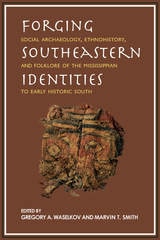
Forging Southeastern Identities
Social Archaeology, Ethnohistory, and Folklore of the Mississippian to Early Historic SouthGregory A. Waselkov
University of Alabama Press, 2017
Forging Southeastern Identities explores the many ways archaeologists and ethnohistorians define and trace the origins of Native Americans’ collective social identity.
Forging Southeastern Identities: Social Archaeology and Ethnohistory of the Mississippian to Early Historic South, a groundbreaking collection of ten essays, covers a broad expanse of time—from the ninth to the nineteenth centuries—and focuses on a common theme of identity. These essays represent the various methods used by esteemed scholars today to study how Native Americans in the distant past created new social identities when old ideas of the self were challenged by changes in circumstance or by historical contingencies.
Archaeologists, anthropologists, and folklorists working in the Southeast have always recognized the region’s social diversity; indeed, the central purpose of these disciplines is to study peoples overlooked by the mainstream. Yet the ability to define and trace the origins of a collective social identity—the means by which individuals or groups align themselves, always in contrast to others—has proven to be an elusive goal. Here, editors Gregory A. Waselkov and Marvin T. Smith champion the relational identification and categorical identification processes, taken from sociological theory, as effective analytical tools.
Taking up the challenge, the contributors have deployed an eclectic range of approaches to establish and inform an overarching theme of identity. Some investigate shell gorgets, textiles, shell trade, infrastructure, specific sites, or plant usage. Others focus on the edges of the Mississippian world or examine colonial encounters between Europeans and native peoples. A final chapter considers the adaptive malleability of historical legend in the telling and hearing of slave narratives.

Frances Newman
Southern Satirist and Literary RebelBarbara Ann Wade
University of Alabama Press, 1998
This first biographical and literary assessment of Frances Newman highlights one of the most experimental writers of the Southern Renaissance
Frances Newman was born into a prominent Atlanta family and was educated at private schools in the South and the Northeast. Her first novel, The Hard-Boiled Virgin, was hailed by James Branch Cabell as “the most brilliant, the most candid, the most civilized, and the most profound yet written by any American woman.” Cabell and H. L. Mencken became Newman’s literary mentors and loyally supported her satire of southern culture, which revealed the racism, class prejudice, and religious intolerance that reinforced the idealized image of the white southern lady. Writing within a nearly forgotten feminist tradition of southern women’s fiction, Newman portrayed the widely acclaimed social change in the early part of the century in the South as superficial rather than substantial, with its continued restrictive roles for women in courtship and marriage and limited educational and career opportunities.
Barbara Wade explores Newman’s place in the feminist literary tradition by comparing her novels with those of her contemporaries Ellen Glasgow, Mary Johnston, and Isa Glenn. Wade draws from Newman’s personal correspondence and newspaper articles to reveal a vibrant, independent woman who simultaneously defied and was influenced by the traditional southern society she satirized in her writing.

Freebooters and Smugglers
The Foreign Slave Trade in the United States after 1808Ernest Obadele-Starks
University of Arkansas Press, 2007

From Azaleas to Zydeco
My 4,600-Mile Journey through the SouthMark W. Nichols
Butler Center for Arkansas Studies, 2013
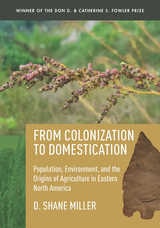
From Colonization to Domestication
Population, Environment, and the Origins of Agriculture in Eastern North AmericaD. Shane Miller
University of Utah Press, 2018
Eastern North America is one of only a handful of places in the world where people first discovered how to domesticate plants. In this book, anthropologist Shane Miller uses two common, although unconventional, sources of archaeological data—stone tools and the distribution of archaeological sites—to trace subsistence decisions from the initial colonization of the American Southeast at the end of the last Ice Age to the appearance of indigenous domesticated plants roughly 5,000 years ago.
Miller argues that the origins of plant domestication lie within the context of a boom/bust cycle that culminated in the mid-Holocene, when hunter-gatherers were able to intensively exploit shellfish, deer, oak, and hickory. After this resource “boom” ended, some groups shifted to other plants in place of oak and hickory, which included the suite of plants that were later domesticated. Accompanying these subsistence trends is evidence for increasing population pressure and declining returns from hunting. Miller contends, however, that the appearance of domesticated plants in eastern North America, rather than simply being an example of necessity as the mother of invention, is the result of individuals adjusting to periods of both abundance and shortfall driven by climate change.
From Cotton Belt to Sunbelt
Federal Policy, Economic Development, and the Transformation of the South 1938–1980Bruce J. Schulman
Duke University Press, 1994

From Dixie to Rocky Top
Music and Meaning in Southeastern Conference FootballCarrie Tipton
Vanderbilt University Press, 2023
The first book to explore the history of college fight songs as a culturally important phenomenon, From Dixie to Rocky Top zeroes in on the US South, where college football has forged a powerful, quasi-religious sense of meaning and identity throughout the region.
Tracing the story of Southeastern Conference (SEC) fight songs from the late nineteenth to the early twenty-first century, author Carrie Tipton places this popular repertory within the broader commercial music industry and uses fight songs to explore themes of authorship and copyright; the commodification of school spirit; and the construction of race, gender, and regional identity in Southern football culture.
This book unearths the history embedded in SEC football’s music traditions, drawing from the archives of the seventeen universities currently or formerly in the conference. Alongside rich primary sources, Tipton incorporates approaches and literature from sports history, Southern and American history, Southern and American studies, and musicology.
Chronicling iconic Southern fight songs’ origins, dissemination, meanings, and cultural reception over a turbulent century, From Dixie to Rocky Top weaves a compelling narrative around a virtually unstudied body of popular music.
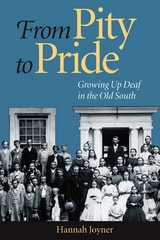
From Pity to Pride
Growing Up Deaf in the Old SouthHannah Joyner
Gallaudet University Press, 2004
The antebellum South’s economic dependence on slavery engendered a rigid social order in which a small number of privileged white men dominated African Americans, poor whites, women, and many people with disabilities. From Pity to Pride examines the experiences of a group of wealthy young men raised in the old South who also would have ruled over this closely regimented world had they not been deaf. Instead, the promise of status was gone, replaced by pity, as described by one deaf scion, “I sometimes fancy some people to treat me as they would a child to whom they were kind.”
In this unique and fascinating history, Hannah Joyner depicts in striking detail the circumstances of these so-called victims of a terrible “misfortune.” Joyner makes clear that Deaf people in the North also endured prejudice. She also explains how the cultural rhetoric of paternalism and dependency in the South codified a stringent system of oppression and hierarchy that left little room for self-determination for Deaf southerners. From Pity to Pride reveals how some of these elite Deaf people rejected their family’s and society’s belief that being deaf was a permanent liability. Rather, they viewed themselves as competent and complete. As they came to adulthood, they joined together with other Deaf Americans, both southern and northern, to form communities of understanding, self-worth, and independence.
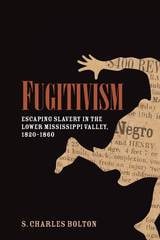
Fugitivism
Escaping Slavery in the Lower Mississippi Valley, 1820-1860S. Charles Bolton
University of Arkansas Press, 2019
Winner, 2020 Booker Worthen Literary Prize
During the antebellum years, over 750,000 enslaved people were taken to the Lower Mississippi Valley, where two-thirds of them were sold in the slave markets of New Orleans, Natchez, and Memphis. Those who ended up in Louisiana found themselves in an environment of swamplands, sugar plantations, French-speaking creoles, and the exotic metropolis of New Orleans. Those sold to planters in the newly-opened Mississippi Delta cleared land and cultivated cotton for owners who had moved west to get rich as quickly as possible, driving this labor force to harsh extremes.
Like enslaved people all over the South, those in the Lower Mississippi Valley left home at night for clandestine parties or religious meetings, sometimes “laying out” nearby for a few days or weeks. Some of them fled to New Orleans and other southern cities where they could find refuge in the subculture of slaves and free blacks living there, and a few attempted to live permanently free in the swamps and forests of the surrounding area. Fugitives also tried to returnto eastern slave states to rejoin families from whom they had been separated. Some sought freedom on the northern side of the Ohio River; othersfled to Mexico for the same purpose.
Fugitivism provides a wealth of new information taken from advertisements, newspaper accounts, and court records. It explains how escapees made use of steamboat transportation, how urban runaways differed from their rural counterparts, how enslaved people were victimized by slave stealers, how conflicts between black fugitives and the white people who tried to capture them encouraged a culture of violence in the South, and how runaway slaves from the Lower Mississippi Valley influenced the abolitionist movement in the North.
Readers will discover that along with an end to oppression, freedom-seeking slaves wanted the same opportunities afforded to most Americans.