Results by title
88 books match the query 'Translation' and 2 start with f
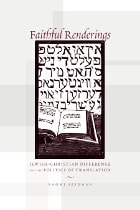
Faithful Renderings
Jewish-Christian Difference and the Politics of TranslationNaomi Seidman
University of Chicago Press, 2006
Faithful Renderings reads translation history through the lens of Jewish–Christian difference and, conversely, views Jewish–Christian difference as an effect of translation. Subjecting translation to a theological-political analysis, Seidman asks how the charged Jewish–Christian relationship—and more particularly the dependence of Christianity on the texts and translations of a rival religion—has haunted the theory and practice of translation in the West.
Bringing together central issues in translation studies with episodes in Jewish–Christian history, Naomi Seidman considers a range of texts, from the Bible to Elie Wiesel’s Night, delving into such controversies as the accuracy of various Bible translations, the medieval use of converts from Judaism to Christianity as translators, the censorship of anti-Christian references in Jewish texts, and the translation of Holocaust testimony. Faithful Renderings ultimately reveals that translation is not a marginal phenomenon but rather a crucial issue for understanding the relations between Jews and Christians and indeed the development of each religious community.
Bringing together central issues in translation studies with episodes in Jewish–Christian history, Naomi Seidman considers a range of texts, from the Bible to Elie Wiesel’s Night, delving into such controversies as the accuracy of various Bible translations, the medieval use of converts from Judaism to Christianity as translators, the censorship of anti-Christian references in Jewish texts, and the translation of Holocaust testimony. Faithful Renderings ultimately reveals that translation is not a marginal phenomenon but rather a crucial issue for understanding the relations between Jews and Christians and indeed the development of each religious community.
[more]
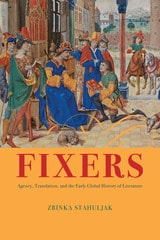
Fixers
Agency, Translation, and the Early Global History of LiteratureZrinka Stahuljak
University of Chicago Press, 2024
A new history of early global literature that treats translators as active agents mediating cultures.
In this book, Zrinka Stahuljak challenges scholars in both medieval and translation studies to rethink how ideas and texts circulated in the medieval world. Whereas many view translators as mere conduits of authorial intention, Stahuljak proposes a new perspective rooted in a term from journalism: the fixer. With this language, Stahuljak captures the diverse, active roles medieval translators and interpreters played as mediators of entire cultures—insider informants, local guides, knowledge brokers, art distributors, and political players. Fixers offers nothing less than a new history of literature, art, translation, and social exchange from the perspective not of the author or state but of the fixer.
In this book, Zrinka Stahuljak challenges scholars in both medieval and translation studies to rethink how ideas and texts circulated in the medieval world. Whereas many view translators as mere conduits of authorial intention, Stahuljak proposes a new perspective rooted in a term from journalism: the fixer. With this language, Stahuljak captures the diverse, active roles medieval translators and interpreters played as mediators of entire cultures—insider informants, local guides, knowledge brokers, art distributors, and political players. Fixers offers nothing less than a new history of literature, art, translation, and social exchange from the perspective not of the author or state but of the fixer.
[more]