Results by title
1296 books match the query 'Women authors' and 55 start with f
FEMALE TRADITION IN SOUTHERN LITERATURE
Carol S. Manning
University of Illinois Press, 1993
essays reclaim women's traditions which have been neglected by critics who ought to have known
better." -- Kathryn Lee Seidel, author of The Southern Belle in the American Novel
FROM OLD WOMAN TO OLDER WOMEN
Contemporary Culture and Women’s NarrativesSally Chivers
The Ohio State University Press, 2003
Sally Chivers provides a fascinating look at and challenge to how North American popular culture has portrayed old age as a time of disease, decline, and death. Within contemporary Canadian literary and film production, a tradition of articulate central elderly female characters challenges what the aging body has come to signify in a broader cultural context. Rather than seek positive images of aging, which can do their own prescriptive damage, the author focuses on constructive depictions that provide a basis on which to create new stories and readings of growing old. This type of humanities approach to the study of aging promises neither to fixate on nor avoid consideration of the role of the body in the much broader process of getting older. The progression implied in the title from the solitary symbol of The Old Woman toward a community of older women, indicates not a move toward euphemism, but rather an increasing and necessary awareness of the social and cultural dimensions of aging.
Faithful Error
Sarah Louise Garrido
University Press of Colorado, 2026
Exploring the tension between freedom and fidelity, Faithful Error meditates on life’s most sacred and often difficult loves—romantic, parental, familial, and spiritual—against a backdrop of environmental unease. These poems, rich in natural imagery, trace an emotional journey from intimate contemplation to transcendent questioning, grappling with the value of devotion in a world seemingly designed to extinguish hope. A palpable emotional intensity simmers beneath the restrained language, mirroring the manuscript's central dynamic: a yearning to err, yet ultimately finding freedom in a return—however complicated—to faith.
Faithful Transgressions In The American West
Six Twentieth-Century Mormon Women's Autobiographical ActsLaura L. Bush
Utah State University Press, 2004
The central issue Bush finds in these works is how their authors have dealt with the authority of Mormon Church leaders. As she puts it in her preface, "I use the phrase 'faithful transgression' to describe moments in the texts when each writer, explicitly or implicitly, commits herself in writing to trust her own ideas and authority over official religious authority while also conceiving of and depicting herself to be a 'faithful' member of the Church." Bush recognizes her book as her own act of faithful transgression. Writing it involved wrestling, she states, "with my own deeply ingrained religious beliefs and my equally compelling education in feminist theories that mean to liberate and empower women."
Faithful Transgressions examines a remarkable group of authors and their highly readable and entertaining books. In producing the first significant book-length study of Mormon women's autobiographical writing, Bush rides a wave of memoir publishing and academic interest in autobiography and other life narratives. As she elucidates these works in relation to the religious tradition that played a major role in shaping them, she not only positions them in relation to feminist theory and current work on women's life writings but ties them to the long literary tradition of spiritual autobiography.

Faithful Translators
Authorship, Gender, and Religion in Early Modern EnglandJaime Goodrich
Northwestern University Press, 2014
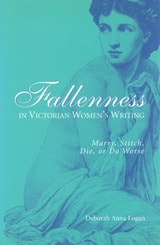
Fallenness in Victorian Women's Writing
Marry, Stitch, Die, Or Do WorseDeborah Anna Logan
University of Missouri Press, 1998
The Angel-in-the-House is an ideal commonly used to define sexual standards of the Victorian Age. Although widely considered to be the cultural "norm," the Victorian Angel, revered for her morality, domestic virtue, and dedication to the family, is more frequently depicted in the literature of the time as an anomaly. In fact, a primary concern of Victorian literature appears to be the many exceptions to this unattainable ideal, which, according to the period's madonna-or-harlot polarity, casts these exceptions as fallen women. Deborah Anna Logan presents an unusual study of this image of fallenness in Victorian literature, focusing on the links among angelic ideology, sexuality, and, more important, social deviance.
Fallenness, according to Logan, does not refer simply to women who have sexually strayed from morality; besides prostitutes, the ranks of the fallen include unmarried mothers, needlewomen, alcoholics, the insane, the childless, the anorexic, slaves, and harem women. All of these women are presented as fallen because they fail to conform to sexual and social norms. In some cases, economic need was responsible for women's failure to uphold the ideals of domesticity and motherhood that were so revered in nineteenth- century society. But other examples illustrate the power of angelic ideology to construct deviancy even out of nonsexual behaviors.
Logan's study is distinguished by its exclusive focus on women writers, including Charlotte Brontë, George Eliot, Elizabeth Gaskell, Harriet Martineau, Elizabeth Barrett Browning, Florence Nightingale, Sarah Grand, and Mary Prince. Logan utilizes primary texts from these Victorian writers as well as contemporary critics such as Catherine Gallagher and Elaine Showalter to provide the background on social factors that contributed to the construction of fallen-woman discourse. Examining novels, short stories, poetry, and travel journals, Logan successfully demonstrates the rich links between these writers and their fallen characters--links in which, for women, even the act of writing becomes a type of fallenness.
Fallenness in Victorian Women's Writing is a significant and original contribution to the study of literature. Logan's thoroughly researched and attractively presented book will be of special interest to students of Victorian and women's studies, as well as to the general reader.
Far Country
PoemsKyce Bello
University of Nevada Press, 2025
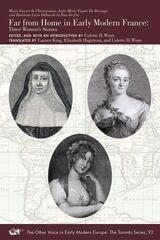
Far from Home in Early Modern France
Three Women’s StoriesMarie Guyart de l’Incarnation, Anne-Marie Fiquet du Boccage, and Henriette-Lucie Dillon de la Tour du Pin
Iter Press, 2022
This book showcases three Frenchwomen who ventured far from home at a time when such traveling was rare. In 1639, Marie de l’Incarnation embarked for New France where she founded the first Ursuline monastery in present-day Canada. In 1750, Madame du Boccage set out at the age of forty on her first “grand tour.” She visited England, the Netherlands, and Italy where she experienced firsthand the intellectual liberty offered there to educated women. As the Reign of Terror gripped France, the Marquise de la Tour du Pin fled to America with her husband and their two young children, where they ran a farm from 1794 to 1796. The writings these women left behind detailing their respective journeys abroad represent significant contributions to early modern travel literature. This book makes available to anglophone readers three texts that are rich in both historical and literary terms.
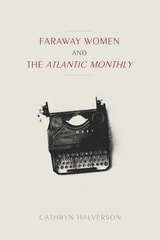
Faraway Women and the "Atlantic Monthly"
Cathryn Halverson
University of Massachusetts Press, 2019
Winner of the 2020 Thomas J. Lyon Award from the Western Literature Association
In the first decades of the twentieth century, famed Atlantic Monthly editor Ellery Sedgwick chose to publish a group of nontraditional writers he later referred to as “Faraway Women,” working-class authors living in the western United States far from his base in Boston. Cathryn Halverson surveys these enormously popular Atlantic contributors, among them a young woman raised in Oregon lumber camps, homesteaders in Wyoming, Idaho, and Alberta, and a world traveler who called Los Angeles and Honolulu home.
Faraway Women and the “Atlantic Monthly” examines gender and power as it charts an archival journey connecting the least remembered writers and readers of the time with one of its most renowned literary figures, Gertrude Stein. It shows how distant friends, patrons, publishers, and readers inspired, fostered, and consumed the innovative life narratives of these unlikely authors, and it also tracks their own strategies for seizing creative outlets and forging new protocols of public expression. Troubling binary categories of east and west, national and regional, and cosmopolitan and local, the book recasts the coordinates of early twentieth-century American literature.
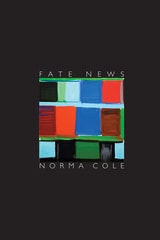
Fate News
Norma Cole
Omnidawn, 2018

Fear Icons
EssaysKisha Lewellyn Schlegel
The Ohio State University Press, 2018
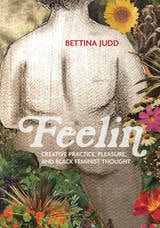
Feelin
Creative Practice, Pleasure, and Black Feminist ThoughtBettina Judd
Northwestern University Press, 2023
How creativity makes its way through feeling—and what we can know and feel through the artistic work of Black women
Feeling is not feelin. As the poet, artist, and scholar Bettina Judd argues, feelin, in African American Vernacular English, is how Black women artists approach and produce knowledge as sensation: internal and complex, entangled with pleasure, pain, anger, and joy, and manifesting artistic production itself as the meaning of the work. Through interviews, close readings, and archival research, Judd draws on the fields of affect studies and Black studies to analyze the creative processes and contributions of Black women—from poet Lucille Clifton and musician Avery*Sunshine to visual artists Betye Saar, Joyce J. Scott, and Deana Lawson.
Feelin: Creative Practice, Pleasure, and Black Feminist Thought makes a bold and vital intervention in critical theory’s trend toward disembodying feeling as knowledge. Instead, Judd revitalizes current debates in Black studies about the concept of the human and about Black life by considering how discourses on emotion as they are explored by Black women artists offer alternatives to the concept of the human. Judd expands the notions of Black women’s pleasure politics in Black feminist studies that include the erotic, the sexual, the painful, the joyful, the shameful, and the sensations and emotions that yet have no name. In its richly multidisciplinary approach, Feelin calls for the development of research methods that acknowledge creative and emotionally rigorous work as productive by incorporating visual art, narrative, and poetry.
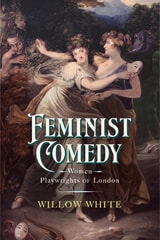
Feminist Comedy
Women Playwrights of LondonWillow White
University of Delaware Press, 2024
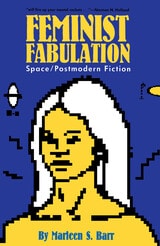
Feminist Fabulation
Space/Postmodern FictionMarleen S. Barr
University of Iowa Press, 1992
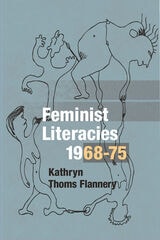
Feminist Literacies, 1968-75
Kathryn Thoms Flannery
University of Illinois Press, 2010
In the late 1960s and early 1970s, ordinary women affiliated with the women's movement were responsible for a veritable explosion of periodicals, poetry, and manifestos, as well as performances designed to support "do-it-yourself" education and consciousness-raising. Kathryn Thoms Flannery discusses this outpouring and the group education, brainstorming, and creative activism it fostered as the manifestation of a feminist literacy quite separate from women's studies programs at universities or the large-scale political workings of second-wave feminism. Seeking to break down traditional barriers such as the dichotomies of writer/reader or student/teacher, these new works also forged polemical alternatives to the forms of argumentation traditionally used to silence women, creating a space for fresh voices. Feminist Literacies explores these truly radical feminist literary practices and pedagogies that flourished during a brief era of volatility and hope.

Feminist Theory and Literary Practice
Deborah L. Madsen
Pluto Press, 2000
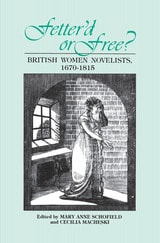
Fetter'd or Free?
British Women Novelists, 1670-1815Mary Anne Schofield
Ohio University Press, 1986
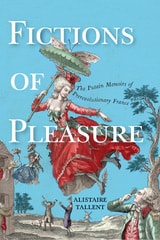
Fictions of Pleasure
The Putain Memoirs of Prerevolutionary FranceAlistaire Tallent
University of Delaware Press, 2024
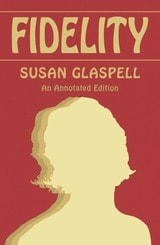
Fidelity
An Annotated EditionSusan Glaspell, edited by Kevin McMullen
Southern Illinois University Press, 2025
Recovering a lost feminist story of scandal and strength for a new generation
Out of print in the United States since its original publication in 1915, Susan Glaspell’s largely forgotten novel Fidelity tells the story of Ruth Holland, a young woman who returns to her small Midwestern hometown after eleven years’ absence. Forced home by the death of her father, Ruth must face a family and community that have largely turned against her following her affair with a married man.
Glaspell, mostly known as a playwright and for her founding of the Provincetown Players, was also an accomplished novelist. Inspired by events in Glaspell’s own life, Fidelity portrays Ruth’s struggle to find fulfillment, love, and purpose in a society that imposes rigid expectations and limitations on how a woman should live. Ruth is a woman torn between love and commitment to her family—and between love and commitment to herself. Glaspell’s narrative shifts between characters, offering glimpses through the community’s eyes of the ways that Ruth’s return forces residents to confront their beliefs and the impact that they have. In the vein of Chopin’s The Awakening and Flaubert’s Madame Bovary, Glaspell’s Fidelity holds an important place in the history of early twentieth-century feminist literature and is long overdue to be back in print.
Students at the University of Nebraska–Lincoln, under the guidance of Kevin McMullen, project manager of the Walt Whitman Archive, have resurrected this neglected novel. The text includes contemporary photographs of Susan Glaspell, a new introduction, and annotations throughout, which provide useful commentary for students and general readers alike.
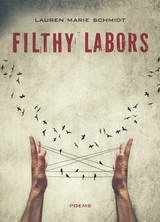
Filthy Labors
PoemsLauren Marie Schmidt
Northwestern University Press, 2017
Finding the Middle Ground
Krestovskii, Tur, and the Power of Ambivalence in Nineteenth-Century Russian Women's ProseJehanne Gheith
Northwestern University Press, 2004
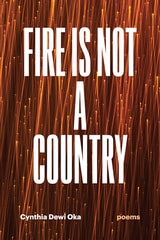
Fire Is Not a Country
PoemsCynthia Dewi Oka
Northwestern University Press, 2022
As she builds a lyric portrait of her own family, Oka interrogates how migration, economic exploitation, patriarchal violence, and a legacy of political repression shape the beauties and limitations of familial love and obligation. Woven throughout are speculative experiments that intervene in the popular apocalyptic narratives of our time with the wit of an unassimilable other.
Oka’s speakers mourn, labor, argue, digress, avenge, and fail, but they do not retreat. Born of conflicts public and private, this collection is for anyone interested in what it means to engage the multitudes within ourselves.
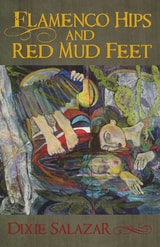
Flamenco Hips and Red Mud Feet
Dixie Salazar
University of Arizona Press, 2010
In the two sections of the book—“Inside” and “Outside”—parallelism and symmetry interact with themes both public and private. Flamenco Hips and Red Mud Feet presents thirty-nine poems in free verse and traditional poetic forms, especially the sonnet and adaptations of the sonnet. The sonnet—usually consisting of the octet (eight lines) that sets up the main idea of the poem and the sestet (six lines) that resolves, answers or completes the poem—is a natural form for a poet whose identity is divided. Double sonnets and “double-linked sonnets doubled” reflect the duality the poet feels inside her skin. And the poems written to and for a “lost sister” reinforce the theme.
Throughout this provocative book, Salazar navigates the alienation of her cultural in-between-ness. By the end, she appears to become more comfortable with her status of “outsider,” deciding that she doesn’t need to give in to pressures to pick a side or to accept others’ ideas of where her own “borders” begin or end.
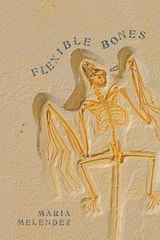
Flexible Bones
Maria Melendez
University of Arizona Press, 2010
The most modern of roller coasters ride on soft rubber tires and slithery smooth tracks. Gone are the days of jouncing along on steel wheels, smacking over hard metal joints. So it is with this book. Although readers are hurtled through time, space, and a universe of emotions, the ride is seductively smooth—and the transitions surprisingly seamless.
In the prologue, our attention bends to bridges, free-tail bats, soldiers, and peacemakers. These poems prepare us to watch for hopeful signs in the work ahead. In the first section, the spiritual seems to flow into the geopolitical—not in a hammer-you-over-the-head kind of way but in a blood-through-the-heart sort of way. In the second section, the spiritual mingles with the organic in a more personal way. By the end of the ride, we are aware that we have taken a trip with an intellectually fearless bushwhacker leading the way.
Anyone who has ever contemplated The Simpsons, sex-offender registries, desert internment camps, bats in flight, wars that never end, “la virgen,” grasshoppers, Google, or the cosmos will find a kindred spirit in Maria Melendez and a warm welcome in her work.

Folk Physics
New and Selected PoemsMolly Brodak
University of Iowa Press, 2027
Footpaths and Bridges
Voices from the Native American Women Playwrights ArchiveEdited by Shirley A. Huston-Findley and Rebecca Howard
University of Michigan Press, 2011
Footpaths and Bridges celebrates the vitality and diversity of Native American women, collecting plays ranging from ETHNOSTRESS—a humorous take on art and identity politics—to the biographical musical Te Ata to a retelling of the Thanksgiving story from the Wampanoag perspective. The dramatic works are accompanied by critical commentary that illuminates Native American women’s theater practices and perspectives, highlighting the issues of heritage, identity, and changing lifestyles that the plays imaginatively tackle.
Featuring work from a wide array of tribes and geographic regions, the collection affords the artist, scholar, and general reader access to previously unheard voices that communicate the complexity and the diversity of the Native American experience. The far-ranging genres and content of the plays suggest the many possibilities for communicating the past and the present, the personal and the political, and the stunning kaleidoscope of Native American life and art.
“Often thoughtful provocateurs, Native American playwrights are frequently overlooked . . . eminently readable, and possibly performable, the plays [in this collection] examine colonization, generational differences, ‘ethnostress,’ and cultural identity.”
—Choice
For Single Mothers Working as Train Conductors
Laura Esther Wolfson
University of Iowa Press, 2018
Laura Esther Wolfson’s literary debut draws on years of immersion in the Russian and French languages; struggles to gain a basic understanding of Judaism, its history, and her place in it; and her search for a form to hold the stories that emerge from what she has lived, observed, overheard, and misremembered.
In “Proust at Rush Hour,” when her lungs begin to collapse and fail, forcing her to give up an exciting and precarious existence as a globetrotting simultaneous interpreter, she seeks consolation by reading Proust in the original while commuting by subway to a desk job that requires no more than a minimal knowledge of French. In “For Single Mothers Working as Train Conductors” she gives away her diaphragm and tubes of spermicidal jelly to a woman in the Soviet Union who, with two unwanted pregnancies behind her, needs them more than she does. “The Husband Method” has her translating a book on Russian obscenities and gulag slang during the dissolution of her marriage to the Russian-speaker who taught her much of what she knows about that language.
In prose spangled with pathos and dusted with humor, Wolfson transports us to Paris, the Republic of Georgia, upstate New York, the Upper West Side, and the corridors of the United Nations, telling stories that skewer, transform, and inspire.
Forbidden Journeys
Fairy Tales and Fantasies by Victorian Women WritersEdited by Nina Auerbach and U. C. Knoepflmacher
University of Chicago Press, 1992
"Forbidden Journeys is not only a darkly entertaining book to read for the fantasies and anti-fantasies told, but also is a significant contribution to nineteenth-century cultural history, and especially feminist studies."—United Press International
"A service to feminists, to Victorian Studies, to children's literature and to children."—Beverly Lyon Clark, Women's Review of Books
"These are stories to laugh over, cheer at, celebrate, and wince at. . . . Forbidden Journeys is a welcome reminder that rebellion was still possible, and the editors' intelligent and fascinating commentary reveals ways in which these stories defied the Victorian patriarchy."—Allyson F. McGill, Belles Lettres
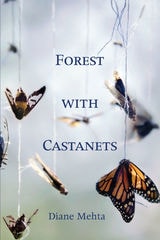
Forest with Castanets
Diane Mehta
Four Way Books, 2019
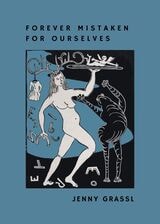
Forever Mistaken for Ourselves
Jenny Grassl
Tupelo Press, 2026
A collection of poems envisioned as a magic wardrobe of mirrors, vast with ocean and meadow, revealing reflections of the muses, a deer woman, and a sea-monster lover.
Forever Mistaken for Ourselves tells a story of transformations. Iron dresses, veils nailed to an hourglass, and a sex-changing flower/human defy or define a woman and her place in daily life and history. Queen Anne's black lace leaves holes open for a ghost. Never just coy, these characters and artifacts get up and do battle with complacency, in an all too often misogynistic world. Beasts come and go through the mirrors, a fish-man breaking through to deliver a whole-body kiss to a woman. Forests rise, and lawns “lean lethargies” to hold the reflected images of the speakers. Is there a confirmation of existence? “If she is—a silver say-so.”
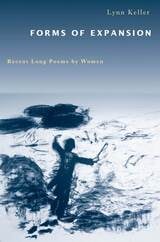
Forms of Expansion
Recent Long Poems by WomenLynn Keller
University of Chicago Press, 1997
Arguing that women poets no longer feel intimidated by the traditional associations of long poems with the heroic, public realm or with great artistic ambition, Keller shows how the long poem's openness to sociological, anthropological, and historical material makes it an ideal mode for exploring women's roles in history and culture. In addition, the varied forms of long poems—from sprawling free verse epics to regular sonnet sequences to highly disjunctive experimental collages—make this hybrid genre easily adaptable to diverse visions of feminism and of contemporary poetics.
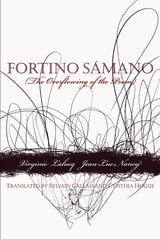
Fortino Sámano
The Overflowing of the PoemVirginie Lalucq and Jean-Luc Nancy
Omnidawn, 2012
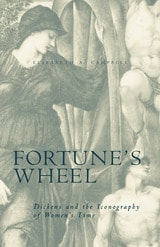
Fortune’s Wheel
Dickens and the Iconography of Women’s TimeElizabeth A. Campbell
Ohio University Press, 2003
In the first half of the nineteenth century, England became quite literally a world on wheels. The sweeping technological changes wrought by the railways, steam-powered factory engines, and progressively more sophisticated wheeled conveyances of all types produced a corresponding revolution in Victorian iconography: the image of the wheel emerged as a dominant trope for power, modernity, and progress.
In Fortune’s Wheel, an original and illuminating study, Elizabeth Campbell explores the ways in which Charles Dickens appropriated and made central to his novels the dominant symbol of his age. Between 1840 and 1860, a transformation took place in Dickens’ thinking about gender and time, and this revolution is recorded in iconographic representations of the goddess Fortune and wheel imagery that appear in his work.
Drawing on a rich history of both literary and visual representations of Fortune, Professor Campbell argues that Dickens’ contribution to both the iconographic and narrative traditions was to fuse the classical image of the wheel with the industrial one. As the wheel was increasingly identified as the official Victorian symbol for British industrial and economic progress, Dickens reacted by employing this icon to figure a more pessimistic historical vision—as the tragic symbol for human fate in the nineteenth century.
Fortune’s Wheel ably portrays the concept that, in both text and illustrations, images of fortune and the wheel in Dickens’ work record his abandonment of a linear, progressive, and arguably masculine view of history to embrace a cyclical model that has been identified with “women’s time.”
Foxes for Everybody
Twenty-Four Hours of Early MotherhoodCatherine Pierce
Northwestern University Press, 2026
Like a newborn’s patterns of sleeping and waking, the revelations of motherhood don’t follow a reasonable schedule, and there’s no clocking out. Organized around the hours of the day, Foxes for Everybody gives voice to the marvels, fears, absurdities, and astonishments of parenthood. These essays offer twenty-four glimpses into how we experience time, our families, our planet, and all of those small moments that aren’t small at all. In memories and reflections that weave through tornadoes and jellyfish, cemeteries and carousels, mortality, mental health, and the exquisite gift of a perfect sentence, acclaimed writer Catherine Pierce reminds us that fear and joy can and do live side by side, and urges us to stay awake—even when, especially when, we’re at the brink of exhaustion—to the possibility of wonder.

Fractured Borders
Reading Women's Cancer LiteratureMary K. DeShazer
University of Michigan Press, 2010
Fractured Borders: Reading Women's Cancer Literature surveys a wide range of contemporary writing about breast, uterine, and ovarian cancer, including works by Marilyn Hacker, Margaret Edson, Carole Maso, Audre Lorde, Eve Sedgwick, Mahasweta Devi, Lucille Clifton, Alicia Ostriker, Jayne Anne Phillips, Terry Tempest Williams, and Jeanette Winterson, among many others. DeShazer's readings bring insights from body theory, performance theory, feminist literary criticism, French feminisms, and disability studies to bear on these works, shining new light on a literary subject that is engaging more and more writers.
"An important and useful book that will appeal to people in a variety of fields and walks of life, including scholars, teachers, and anyone interested in this subject."
--Suzanne Poirier, University of Illinois at Chicago
"A book on a timely and important topic, wisely written beyond scholarly boundaries and crossing many theoretical and disciplinary lines."
--Patricia Moran, University of California, Davis
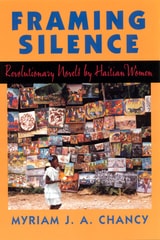
Framing Silence
Revolutionary Novels by Haitian WomenChancy, Myriam J
Rutgers University Press, 1992
Raped and colonized, coerced and silenced--this has been the position of Haitian women within their own society, as well as how they have been seen by foreign occupiers. Romanticized symbols of nationhood, they have served, however unwillingly, as a politicized site of contestation between opposing forces.
In this first book-length study in English devoted exclusively to Haitian women's literature, Myriam Chancy finds that Haitian women have their own history, traditions, and stories to tell, tales that they are unwilling to suppress or subordinate to narratives of national autonomy. Issues of race, class, color, caste, nationality, and sexuality are all central to their fiction--as is an urgent sense of the historical place of women between the two U.S. occupations of the country. Their novels interrogate women's social and political stance in Haiti from an explicitly female point of view, forcefully responding to overt sexual and political violence within the nation's ambivalent political climate. Through daring and sensitive readings, simultaneously historical, fictional and autobiographical, Chancy explores this literature, seeking to uncover answers to the current crisis facing these women today, both within their country and in exile.The writers surveyed include Anne-christine d'Adesky, Ghislaine Rey Charlier, Marie Chauvet, Jan J. Dominique, Nadine Magloire, and Edwidge Danticat, whose work has recently achieved such high acclaim.
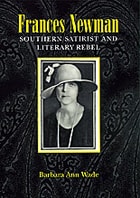
Frances Newman
Southern Satirist and Literary RebelBarbara Ann Wade
University of Alabama Press, 1998
This first biographical and literary assessment of Frances Newman highlights one of the most experimental writers of the Southern Renaissance
Frances Newman was born into a prominent Atlanta family and was educated at private schools in the South and the Northeast. Her first novel, The Hard-Boiled Virgin, was hailed by James Branch Cabell as “the most brilliant, the most candid, the most civilized, and the most profound yet written by any American woman.” Cabell and H. L. Mencken became Newman’s literary mentors and loyally supported her satire of southern culture, which revealed the racism, class prejudice, and religious intolerance that reinforced the idealized image of the white southern lady. Writing within a nearly forgotten feminist tradition of southern women’s fiction, Newman portrayed the widely acclaimed social change in the early part of the century in the South as superficial rather than substantial, with its continued restrictive roles for women in courtship and marriage and limited educational and career opportunities.
Barbara Wade explores Newman’s place in the feminist literary tradition by comparing her novels with those of her contemporaries Ellen Glasgow, Mary Johnston, and Isa Glenn. Wade draws from Newman’s personal correspondence and newspaper articles to reveal a vibrant, independent woman who simultaneously defied and was influenced by the traditional southern society she satirized in her writing.
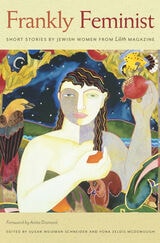
Frankly Feminist
Short Stories by Jewish Women from Lilith MagazineEdited by Susan Weidman Schneider and Yona Zeldis McDonough
Brandeis University Press, 2022
Short story collections focusing on Jewish writers have—no surprise—typically given women authors short shrift. This new volume represents the best Jewish feminist fiction published in Lilith magazine, and does what no other collection has done before in its geographic scope, its inclusion of twenty-first-century stories, and its Jewish feminist focus.
This collection showcases a wide range of stories offering variegated cultures and contexts and points of view: Persian Jews; a Biblical matriarch; an Ethiopian mother in modern Israel; suburban American teens; Eastern European academics; a sexual questioner; a Jew by choice; a new immigrant escaping her Lower East Side sweatshop; a Black Jewish marcher for justice; in Vichy France, a toddler’s mother hiding out; and more.
Organized by theme, the stories in this book emphasize a breadth of content, and our hope is that in reading you’ll appreciate the liveliness of the burgeoning self-awareness brought to life in each tale, and the occasional funny, call-your-friend-and-tell-her-about-it moment. Skip around, encounter an author whose other work you may know, be enticed by a title, or an opening line. We hope you’ll find both pleasure and enlightenment—and sometimes revelation—within these pages.
Free Women
Ethics and Aesthetics in Twentieth-Century Women's FictionKate Fullbrook
Temple University Press, 1990
Freedom's Empire
Race and the Rise of the Novel in Atlantic Modernity, 1640-1940Laura Doyle
Duke University Press, 2007
Doyle brings together authors often separated by nation, race, and period, including Aphra Behn, Eliza Haywood, Olaudah Equiano, Nathaniel Hawthorne, Harriet Wilson, Pauline Hopkins, George Eliot, and Nella Larsen. In so doing, she reassesses the strategies of early women novelists, reinterprets the significance of rape and incest in the novel, and measures the power of race in the modern English-language imagination.
French Women Authors
The Significance of the Spiritual, 1400–2000Kelsey L. Haskett
University of Delaware Press, 2013
Published by University of Delaware Press. Distributed worldwide by Rutgers University Press.
Fresh Courage Take
New Directions by Mormon WomenJamie Zvirzdin
Signature Books, 2015
The twelve essays in this anthology provide a refreshing array of female perspectives, personalities, and circumstances. Along with an introduction by Jamie Zvirzdin, the essays invite readers to recognize and own their personal struggles, gifts, faults, and desires and to accept where they stand on the spectrum of humanity. Fresh Courage Take demonstrates that the road to heaven is not a conveyor belt powered by a checklist of religious obligations, cooked casseroles, and a collection of children. If anything, it is a complex network of interchanges and decisions … including long, often solitary paths.
The authors span a wide range of views and situations in life: politically conservative to progressive, single to married with many children, highly educated to working-class, stay-at-home moms to the professionally successful, of European or African heritage, religiously orthodox to heterodox. In short, they define, from their diversity, what being a Mormon woman means and what type of path they feel they must take to be true to themselves and their beliefs.
Authors include Carli Anderson, Rachael Decker Bailey, Erika Ball, Rachel Brown, Karen Critchfield, Ashley Mae Hoiland, Sylvia Lankford, Marcee Ludlow, Brooke Stoneman, Camille Strate Fairbanks, Colleen Whitley, and Jamie Zvirzdin.
From Arcadia to Revolution
The Neapolitan Monitor and Other WritingsEleonora Fonseca Pimentel
Iter Press, 2019
The Other Voice in Early Modern Europe: The Toronto Series, Volume 67
From Mammies to Militants
Domestics in Black American Literature from Charles Chesnutt to Toni MorrisonTrudier Harris
University of Alabama Press, 2023
Unmasking stereotypes and reclaiming identity of Black Womanhood in American Culture.
Welfare queen, hot momma, unwed mother: these stereotypes of Black women share their historical conception in the image of the Black woman as domestic. Focusing on the issue of stereotypes, the new edition of Trudier Harris’s classic 1982 study From Mammies to Militants examines the position of the domestic in Black American literature with a new afterword bringing her analysis into the present.
From Charles Chesnutt’s The Marrow of Tradition to Toni Morrison’s The Bluest Eye, Black writers, some of whom worked as maids themselves, have manipulated the stereotype in a strategic way as a figure to comment on Black-white relations or to dramatize the conflicts of the Black protagonists. In fact, the characters themselves, like real-life maids, often use the stereotype to their advantage or to trick their oppressors.
Harris combines folkloristic, sociological, historical, and psychological analyses with literary ones, drawing on her own interviews with Black women who worked as domestics. She explores the differences between Northern and Southern maids and between “mammy” and “militant.” Her invaluable book provides a sweeping exploration of Black American writers of the twentieth century, with extended discussion of works by Charles Chesnutt, Kristin Hunter, Toni Morrison, Richard Wright, Ann Petry, William Melvin Kelley, Alice Childress, John A. Williams, Douglas Turner Ward, Barbara Woods, Ted Shine, and Ed Bullins. Often privileging political statements over realistic characterization in the design of their texts, the authors in Harris’s study urged Black Americans to take action to change their powerless conditions, politely if possible, violently if necessary. Through their commitment to improving the conditions of Black people in America, these writers demonstrate the connectedness of art and politics.
In her new afterword, “From Militants to Movie Stars,” Harris looks at domestic workers in African American literature after the original publication of her book in 1982. Exploring five subsequent literary treatments of Black domestic workers from Ernest J. Gaines’s A Lesson Before Dying to Lynn Nottage’s By the Way, Meet Vera Stark, Harris tracks how the landscape of representation of domestic workers has broken with tradition and continues to transform into something entirely new.
From Slave Cabins to the White House
Homemade Citizenship in African American CultureKoritha Mitchell
University of Illinois Press, 2021
Koritha Mitchell analyzes canonical texts by and about African American women to lay bare the hostility these women face as they invest in traditional domesticity. Instead of the respectability and safety granted white homemakers, black women endure pejorative labels, racist governmental policies, attacks on their citizenship, and aggression meant to keep them in "their place."
Tracing how African Americans define and redefine success in a nation determined to deprive them of it, Mitchell plumbs the works of Frances Harper, Zora Neale Hurston, Lorraine Hansberry, Toni Morrison, Michelle Obama, and others. These artists honor black homes from slavery and post-emancipation through the Civil Rights era to "post-racial" America. Mitchell follows black families asserting their citizenship in domestic settings while the larger society and culture marginalize and attack them, not because they are deviants or failures but because they meet American standards.
Powerful and provocative, From Slave Cabins to the White House illuminates the links between African American women's homemaking and citizenship in history and across literature.
From Sleep Unbound
Andrée Chedid
Ohio University Press, 1983
From the Belly of My Beauty
Esther G. Belin
University of Arizona Press, 1999
In this bold new collection of poems, Belin presents a startling vision of urban California—particularly Los Angeles—contrasted with Navajo life in the Four Corners region. She presents aspects of Diné life and history not normally seen by readers accustomed to accounts written by Navajos brought up on the reservation.
Her work reveals a difference in experience but a similarity in outlook. Belin's poems put familiar cultural forms in a new context, as Coyote "struts down east 14th / feeling good / looking good / feeling the brown." Her character Ruby dramatizes the gritty reality of a Native woman's life ("I laugh / sit / smoke a Virginia Slim / and talk to the spirits"). Her use of Diné language and poignant descriptions of family life will remind some of Joy Harjo's work, but with every turn of the page, readers will know that Belin is making her own mark on Native American literature.
From the Belly of My Beauty is also a ceremony of affirmation and renewal for those Native Americans affected by the Federal Indian Relocation Program of the 1950s and '60s, with its attempts to "assimilate" them into the American mainstream. They have survived by remembering who they were and where they came from. And they have survived so that they might bear witness, as Esther Belin so powerfully does. Belin holds American culture accountable for failing to treat its indigenous peoples with respect, but speaks for the ability of Native culture to survive and provide hope, even for mixed-blood or urban Indians. She is living proof that Native culture thrives wherever its people are found.
From the Center of Tradition
Critical Perspective on Linda HoganBarbara J. Cook
University Press of Colorado, 2003
From the Diary of Madame Mao
María Teresa Ogliastri
Carnegie Mellon University Press, 2026
Fictionalized poems that embody the reality of life in twentieth-century China through the voice of Jiang Qing, the wife of Mao Zedong.
From the Diary of Madame Mao is a poetry collection of fictionalized diary entries in the voice of Jiang Qing, wife of Mao Zedong and a vilified leader of the “Gang of Four," a Maoist political faction which wielded unchecked and violent suppression of dissent during China’s Cultural Revolution (1966–76). The haunting voice in this collection recounts the events of twentieth-century China through the imagined inner thoughts of Jiang, a liberated woman in a male-dominated society who struggled to fend for herself but then, upon gaining totalitarian power, became “mentally ill.” Maria Teresa Ogliastri—who has lived under authoritarian regimes in Venezuela for more than two decades— “opts for compassion” in her portrayal of this infamous public figure, conveying the full complexity of human emotion and experience in her singular lyric voice.
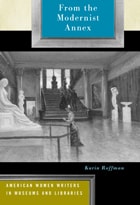
From the Modernist Annex
American Women Writers in Museums and LibrariesKarin Roffman
University of Alabama Press, 2010