Results by title
991 books match the query 'Writing' and 25 start with f
Facing the Center
Toward an Identity Politics of One-to-One MentoringHarry C. Denny
Utah State University Press, 2010
The face of the writing center, be it mainstream or marginal, majority or miority, orthodox or subversive, always has implications for teaching and learning. Facing the Center will extend current research in writing center theory to bring it in touch with theories now common in cultural studies curricula. Denny takes up issues of power, agency, language, and meaning, and pushes his readers to ask how they themselves, or the centers in which they work, might be perpetuating cultures that undermine inclusive, progressive education.
Faculty Writing Support
Emerging Research from Rhetoric and Composition StudiesJaclyn Wells
University Press of Colorado, 2025
Failing Sideways
Queer Possibilities for Writing AssessmentStephanie West-Puckett
Utah State University Press, 2023
A failure-oriented assessment model unsettles some of the most common practices, like rubrics and portfolios, and challenges many deeply held assumptions about validity and reliability in order to ask what could happen if assessment was oriented toward possibility and potential. Working to engage a more capacious writing construct, the authors propose queer validity inquiry (QVI) as a model for assessment that values failure, affect, identity, and materiality. These overlapping lenses help teachers honor parts of writing and learning that writing studies faculty have struggled to hold onto in a world overly focused on quickness and efficiency in schools.
Through programmatic and classroom examples, Failing Sideways privileges what is valued in the classroom but traditionally ignored in assessments. Reimagining what matters in the teaching and learning of writing and using assessment data differently, this book demonstrates what writing can be and could do in a more diverse and just world.
Feedback Loops
How to Give and Receive High-Quality FeedbackPatrick Barry
Michigan Publishing Services, 2023
Learning how to give and receive feedback is fundamental to the development of every student and professional. Yet few of us are ever taught anything like “feedback skills.”
This book, which is the first in the Feedback Loops series, is designed to change that. Here is what students who have taken the University of Michigan Law School course on which the series is based have said about it:
-
“One of the most memorable and useful classes I have taken in law school!”
-
“Excellent, full stop.”
-
“This class was always a fun highlight of my week.”
Feminist Rhetorical Resilience
Elizabeth A. Flynn, Patricia Sotirin, and Ann Brady
Utah State University Press, 2012
Although it is well known in other fields, the concept of “resilience” has not been addressed explicitly by feminist rhetoricians. This collection develops it in readings of rhetorical situations across a range of social contexts and national cultures. Contributors demonstrate that resilience offers an important new conceptual frame for feminist rhetoric, with emphasis on agency, change, and hope in the daily lives of individuals or groups of individuals disempowered by social or material forces. Collectively, these chapters create a robust conception of resilience as a complex rhetorical process, redeeming it from its popular association with individual heroism through an important focus on relationality, community, and an ethics of connection. Resilience, in this volume, is a specifically rhetorical response to complicated forces in individual lives. Through it, Feminist Rhetorical Resilience widens the interpretive space within which rhetoricians can work.
Feminist Technical Communication
Apparent Feminisms, Slow Crisis, and the Deepwater Horizon DisasterErin A. Clark
Utah State University Press, 2023
The first book to situate feminisms and technical communication in relationship as the focal point, Feminist Technical Communication traces the thread of feminisms through technical communication’s connection to social justice studies. Clark theorizes “slow crisis,” a concept made readable to technical communicators by apparent feminisms that can help technical communicators readily recognize and address social justice problems. Clark then applies this framework to the Deepwater Horizon Disaster, an extended crisis that has been publicly framed by a traditional view of efficiency that privileges economic impact. Through rich description of apparent feminist information-gathering techniques and a layered analysis this study offers application far beyond this single disaster, making available new crisis-response possibilities that consider the economy without eliding ecological and human health concerns.
Feminist Technical Communication offers a methodological approach to the systematic interrogation of power structures that operate on hidden misogynies. This book is useful to technical communicators, scholars of technical communication and rhetoric, and readers interested in gender studies and public health and is an ideal text for graduate-level seminars focused on feminisms, social justice, and cultural studies.
Field Of Dreams
edited by Peggy O'Neill, Angela Crow, and Larry Burton
Utah State University Press, 2002
One of the first collections to focus on independent writing programs, A Field of Dreams offers a complex picture of the experience of the stand-alone. Included here are narratives of individual programs from a wide range of institutions, exploring such issues as what institutional issues led to their independence, how independence solved or created administrative problems, how it changed the culture of the writing program and faculty sense of purpose, success, or failure.
Further chapters build larger ideas about the advantages and disadvantages of stand-alone status, covering labor issues, promotion/tenure issues, institutional politics, and others. A retrospective on the famous controversy at Minnesota is included, along with a look at the long-established independent programs at Harvard and Syracuse.
Finally, the book considers disciplinary questions raised by the growth of stand-alone programs. Authors here respond with critique and reflection to ideas raised by other chapters—do current independent models inadvertently diminish the influence of rhetoric and composition scholarship? Do they tend to ignore the outward movement of literacy toward technology? Can they be structured to enhance interdisciplinary or writing-across-the-curriculum efforts? Can independent programs play a more influential role in the university than they do from the English department?
Fighting and Writing
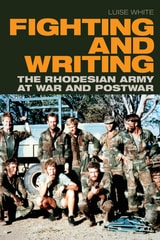
The Rhodesian Army at War and PostwarLuise White
Duke University Press, 2021
Find Your Story, Write Your Memoir
Lynn C. Miller and Lisa Lenard-Cook
University of Wisconsin Press, 2013
Bronze winner, Foreword Book of the Year, Writing Guides
Finding True North
First-Hand Stories of the Booms that Built Modern AlaskaMolly Rettig
University of Alaska Press, 2021
Melting sea ice and rumbling volcanoes. Sled dogs racing through unnamed valleys.
These were the images that came to mind when Molly Rettig moved to Fairbanks, Alaska to work as a reporter at the local newspaper. An avid environmentalist, she couldn’t wait to explore the vast, untamed spaces that had largely been paved over on the east coast. But when her 72-year-old neighbor, Clutch, invites her on a tour of his gold mine—an 800-foot tunnel blasted into the side of his house–she begins to question many of her ideas about Alaska, and about herself.
In Finding True North, Rettig takes us on a gripping journey through Alaska's past that brings alive the state's magnificent country and its quirky, larger-than-life characters. She meets a trapper who harvests all she needs from the land, a bush pilot who taught himself how to fly, and an archaeologist who helped build an oil pipeline through pristine wilderness. While she learns how airplanes, mines, and oil fields have paved the way for newcomers like herself, she also stumbles upon a bigger question: what has this quest for Alaska’s natural resources actually cost, and how much more is at stake?
This is a book about all the ways wild places teach us about ourselves. Rettig writes both playfully and honestly about how one place can be many things to many people—and how all of it can be true.
First Encounters with AI
Writers on WritingEdited by Nina Beguš
University of Michigan Press, 2026
First Encounters with AI gathers some of today’s most original literary minds to explore one of the central artistic and cultural questions of our era: What happens to writing when language is no longer used only by humans? As large language models enter the public imagination and everyday creative practice, writers across genres—novelists, poets, screenwriters, essayists, translators, scholars, technologists, language artists—are grappling with profound shifts in how stories are conceived, crafted, and shared.
Allison Parrish, Ted Chiang, Annelyse Gelman, Sasha Stiles, James Yu, Hannes Bajohr, Ken Liu, Qiufan Chen, Joseph Dumit, Gerardo Con Diaz, Iain S. Thomas, Sheila Heti, Nicholas Nardini, Jasmin B. Frelih, Katy Ilonka Gero, and Alex Saum-Pascual reflect on their early, intimate encounters with generative text at a moment when artificial intelligence feels at once thrilling, unsettling, and unavoidable. Their essays portray AI not as a monolith, but as a dynamic field of possibility and tension between creativity and computation, where longstanding human questions about intention, desire, authorship, labor, and value gain new urgency. Ranging from deeply personal meditations to critical provocations, from philosophical investigations to playful experiments, these writers reveal how writing tools shape writing itself—and what is at stake when those tools begin to imitate us. Curated and introduced by editor Nina Beguš, First Encounters with AI offers readers an essential guide to navigating this new literary landscape. Together, these essays map the terrain of our first contact zone with AI, offering clarity, insight, and imaginative depth at a moment of radical change.
First Person Squared
A Study of Co-Authoring in the AcademyKami Day & Michele Eodice
Utah State University Press, 2001
In (First Person)2, Day and Eodice offer one of the few book-length studies of co-authoring in academic fields since Lunsford and Ede published theirs over a decade ago. The central research here involves in-depth interviews with ten successful academic collaborators from a range of disciplines and settings. The interviews explore the narratives of these informants' experience—what brought them to collaborate, what cognitive and logistical processes were involved as they worked together, what is the status of collaborated work in their field, and so on—and situate these informants within the broader discussion of collaboration theory and research as it has been articulated over the last ten years.
As the study develops, Day and Eodice become most interested in the affective domain of co-authorship, and they find the most promising explorations of that domain in the work of feminist theorists in composition.
First Semester
Graduate Students, Teaching Writing, and the Challenge of Middle GroundJessica Restaino
Southern Illinois University Press, 2012
Jessica Restaino offers a snapshot of the first semester experiences of graduate student writing teachers as they navigate predetermined course syllabi and materials, the pressures of grading, the influences of foundational scholarship, and their own classroom authority. With rich qualitative data gathered from course observations, interviews, and correspondence, Restaino traces four graduate students’ first experiences as teachers at a large, public university. Yet the circumstances and situations she relates will ring familiar at widely varying institutions.
First Semester: Graduate Students, Teaching Writing, and the Challenge of Middle Ground presents a fresh and challenging theoretical approach to understanding and improving the preparation of graduate students for the writing classroom. Restaino uses a three-part theoretical construct—labor, action, and work, as defined in Hannah Arendt’s work of political philosophy, The Human Condition—as a lens for reading graduate students’ struggles to balance their new responsibilities as teachers with their concurrent roles as students. Arendt’s concepts serve as access points for analysis, raising important questions about graduate student writing teachers’ first classrooms and uncovering opportunities for improved support and preparation by university writing programs.
Firsthand
How I Solved a Literary Mystery and Learned to Play Kickass Tennis while Coming to Grips with the Disorder of ThingsKeith Gandal
University of Michigan Press, 2024
Keith Gandal combines this scholarly detective story with a comic personal narrative about how a midlife crisis accidentally sent him on a journey to write a research monograph that many in his profession—including at times himself—were dubious about. While researching how Hemingway, Fitzgerald, and Faulkner faced their forgotten crises of masculinity, Gandal discovers that his own crisis is instrumental to his creative process. Incorporating stories from Gandal’s comic romp through the hyper-competitive world of middle-aged men’s tennis, adopting pitbulls, and discussing Michel Foucault, Firsthand gives readers an inside look at how to acquire accurate knowledge—about the world, about history, and about oneself.
Folklore in New World Black Fiction
Writing and the Oral Traditional AestheticsChiji Akoma
The Ohio State University Press, 2007
Forgotten Tribe
Scientists as WritersLisa Emerson
University Press of Colorado, 2017
In The Forgotten Tribe: Scientists as Writers, Lisa Emerson offers an important corrective to the view that scientists are "poor writers, unnecessarily opaque, not interested in writing, and in need of remediation." She argues that scientists are among "the most sophisticated and flexible writers in the academy, often writing for a wider range of audiences (their immediate disciplinary peers, peers in adjacent fields, a broad scientific audience, industry, and a range of public audiences including social media) than most other faculty." Moreover, she notes, the often collaborative and multidisciplinary nature of their work results in writing practices that "may be more socially complex, and require more articulation, mediation, and interpersonal communication, and more use of advanced media and technology than those of faculty in other disciplines."
Drawing on extensive interviews with scientists, Emerson argues that writing scholars have "engaged in a form of cultural appropriation" that has worked against a deeper understanding of the contexts in which scientists work and the considerations they bring to their writing. Emerson grounds her analysis in the voices of scientists in a way that allows us to understand not only how they approach writing but also how we might usefully teach writing in the sciences. The Forgotten Tribe offers a valuable contribution to our understanding of scientific writing, allowing us to hear voices that are seldom included in our discussions of this critical area.
Freudian Slips
Woman, Writing, the Foreign TongueMary S. Gossy
University of Michigan Press, 1995
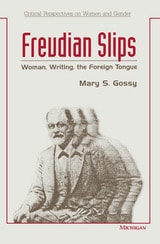
Gossy believes that Freud's most popular statement of a theory of the unconscious is written over foreign and feminized texts, bodies, and places, by way of anecdotes that range from the Dora case to menstruation to travel phobias. Freudian Slips: Woman, Writing, the Foreign Tongue does a feminist psychoanalytic reading of Freud's book and shows how slippery- textually, erotically, and historically- the writing of theory can be, and also how much we can learn from our slips when we are willing to admit that we have made them.
Bringing together autobiography, psychoanalysis, close readings, pedagogy, and politics in provocative and innovative ways, Gossy discusses Freud's work from both textual and theoretical perspectives and asks what his writing can teach us about authority, theory, home, and the foreign. Arguing that the dominant metaphor in the Psychopathology is that of the female body as foreign text, and that this body, writing, and the foreign tongue are identified with a feminized unconscious that threatens authoritative discourse, Freudian Slips moves toward fashioning a feminist theory that is both "slippery and (para)practical" and constantly searches for ways of writing theory that free, rather than sacrifice, the bodies of women.
"The readings of individual slips are often highly productive; the argument is both hardworking and playful. Freudian Slips is a book that people will enjoy reading and from which they will learn a great deal."-- Helena Michie, Rice University
Mary S. Gossy is Associate Professor of Spanish and Comparative Literature, Rutgers University. She is the author of The Untold Story: Women and Theory in Golden Age Texts.

Freudian Slips
Woman, Writing, the Foreign TongueMary S. Gossy
University of Michigan Press, 1995
From Chariots of Fire to The King's Speech
Writing Biopics and DocudramasAlan Rosenthal
Southern Illinois University Press, 2014
Over the past decade, movie audiences have become hungry for films based on real people and historical events. Never was this more evident than during the best-picture showdown between The King’s Speech and The Social Network during the 2011 Academy Awards, a scene then repeated, with Argo, Lincoln and Zero Dark Thirty in the 2013 awards.. While Hollywood moguls have come to recognize the box-office revenue and critical acclaim that accompany such films and are now fast-tracking many docudramas into theaters, there remains a need for more reality-based film scripts.
In From “Chariots of Fire” to “The King’s Speech,” writer, director, and producer Alan Rosenthal presents a manual for screenwriters to develop their bio-pic or docudrama from concept to completion. This comprehensive guide begins with an overview of the genre before providing screenwriters with all the techniques and insights needed to navigate the often intimidating landscape of screenwriting for reality-based scripts. Included within the volume are tips for such challenges as inception and research, developing dialogue and narration, and capably addressing any legal and rights issues that may arise. Also included are appendixes containing useful marketing tips and broadcast guidelines.
A practical, down-to-earth manual for experienced and novice screenwriters alike, From “Chariots of Fire” to “The King’s Speech” is the only manual dedicated explicitly to writing the bio-pic and docudrama. Rosenthal shares his decades of experience in the film industry, along with hands-on tools and maps, to help screenwriters completely master this popular film genre.
From Dissertation to Book, Second Edition
William Germano
University of Chicago Press, 2013
Since its publication in 2005, From Dissertation to Book has helped thousands of young academic authors get their books beyond the thesis committee and into the hands of interested publishers and general readers. Now revised and updated to reflect the evolution of scholarly publishing, this edition includes a new chapter arguing that the future of academic writing is in the hands of young scholars who must create work that meets the broader expectations of readers rather than the narrow requirements of academic committees.
At the heart of From Dissertation to Book is the idea that revising the dissertation is fundamentally a process of shifting its focus from the concerns of a narrow audience—a committee or advisors—to those of a broader scholarly audience that wants writing to be both informative and engaging. William Germano offers clear guidance on how to do this, with advice on such topics as rethinking the table of contents, taming runaway footnotes, shaping chapter length, and confronting the limitations of jargon, alongside helpful timetables for light or heavy revision.
Germano draws on his years of experience in both academia and publishing to show writers how to turn a dissertation into a book that an audience will actually enjoy, whether reading on a page or a screen. Germano also acknowledges that not all dissertations can or even should become books and explores other, often overlooked, options, such as turning them into journal articles or chapters in an edited work.
With clear directions, engaging examples, and an eye for the idiosyncrasies of academic writing, From Dissertation to Book reveals to recent PhDs the secrets of careful and thoughtful revision—a skill that will be truly invaluable as they add “author” to their curriculum vitae.
From Liberation to Remediation
The Rhetoric of General EducationKelly Ritter
Utah State University Press, 2026
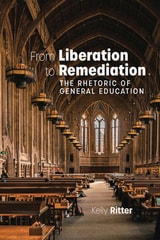
Kelly Ritter addresses how lawmakers, for-profit testing companies, and even universities fuel public misconceptions of what Gen Ed can provide for our democracy and the role that a broad-based college education plays in social uplift. Tracing the history of the public rhetoric that persuades parents and students to see these courses as a set of interchangeable precollege credits to gain (or game) by any means necessary, she examines how positive and negative public responses to the curricula affected the position of core subjects in US universities, focusing on first-year writing. She also explores the role local, state, and organizational politics played in Gen Ed’s positioning, including decisions related to race, social class, and educational attainment; the impact credit-by-exemption and seamless transfer had on the quality and import of Gen Ed programming in both high schools and colleges; and the perceived use-value of the courses themselves in the face of rising college costs. Finally, she considers which student populations have benefited from the denigration of Gen Ed’s value and which have been left behind.
Drawing on archival research and case studies, From Liberation to Remediation raises important questions about equity, access, and the role of General Education in US higher education’s future and demonstrates that recovering the original post-war democratizing principles and practices of Gen Ed is critical to the continuance of a literate, empathetic, and civic-minded democracy for the twenty-first century.
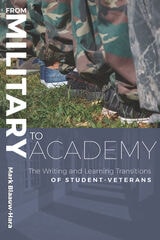
From Military to Academy
The Writing and Learning Transitions of Student-VeteransMark Blaauw-Hara
Utah State University Press, 2021
From Military to Academy is a detailed picture of how student-veterans may experience the shift to the college experience and academic writing. Grounding his research in the experiences of student-veterans at a community college, Blaauw-Hara integrates adult learning theory, threshold concepts, genre analysis, and student-veteran scholarship to help readers understand the challenges student-veterans experience and the strengths they bring as they enter the academic writing environment. Each chapter takes a different theoretical approach to frame student-veterans’ experiences, and Blaauw-Hara ends each chapter with specific, actionable pedagogical suggestions.
Composition studies scholars especially have demonstrated an ongoing interest in and commitment to understanding the experiences of student-veterans from military service to postsecondary education. From Military to Academy helps college writing faculty and writing program administrators understand and support the growing numbers of student-veterans who are making the transition to higher education.
From Notes to Narrative
Writing Ethnographies That Everyone Can ReadKristen Ghodsee
University of Chicago Press, 2016
From Notes to Narrative picks up where methodological training leaves off. Kristen Ghodsee, an award-winning ethnographer, addresses common issues that arise in ethnographic writing. Ghodsee works through sentence-level details, such as word choice and structure. She also tackles bigger-picture elements, such as how to incorporate theory and ethnographic details, how to effectively deploy dialogue, and how to avoid distracting elements such as long block quotations and in-text citations. She includes excerpts and examples from model ethnographies. The book concludes with a bibliography of other useful writing guides and nearly one hundred examples of eminently readable ethnographic books.
From Plot to Narrative
Ellis, Elizabeth
Parkhurst Brothers, Inc., 2012
Each of the twelve chapters represents a rung on the ladder of dynamic narrative development. Beginning with the most basic plot outline, Ellis leads readers through exercises and discussions of elements that build a story into a memorable reading or listening experience. The chapters include many topics of interest to all writers, regardless of medium, but some will speak most potently to those writing either fiction or personal narrative. Chapters include Characterization, Point of View, Emotion, Context, Imagery, and Connection [with the reader]. Herself a leading professional storyteller, Ellis also includes a chapter especially for those who plan to craft stories for oral performance.
Funnier
A New Theory for the Practice of ComedyAnne Libera
Northwestern University Press, 2026
A roadmap for understanding and creating comedy from the visionary Second City comedy director
Great comedy can feel ineffable—and unlearnable. Debunking the myth that “either you are funny, or you aren’t,” Libera breaks the magic of comedy down into an innovative theory and practical toolkit. Developed over the course of thirty years as a director for The Second City and professor of comedy studies in their training center, Libera’s approach is effective across stand-up, sketch, film, and television comedy, as evidenced by her powerhouse students: Amy Poehler, Kristen Schaal, Steven Yeun, and many more of your favorites.
This book starts with a way to think about comedy and then guides you through concrete strategies for making your work smarter, richer, funnier. Libera covers everything from generating material to revising and performing to fostering social connection through comedy. In the book’s final section, Libera draws from her personal life to make a profound case for why future comedy writers should consider the ethics of their art and their responsibility to their fellow human beings in the audience. Readers won’t just be funnier because of this book—they’ll be better people.