Results by title
18284 books match the query 'United States' and 783 start with f
Forming the Public
A Critical History of Journalism in the United StatesFrank D. Durham and Thomas P. Oates
University of Illinois Press, 2024
Weaving eyewitness history through US history, Forming the Public reveals what understanding the journalism landscape can teach us about the nature of journalism’s own interests in race, gender, and class while tracing the factors that shaped the contours of dominant American culture.
Forms of Expansion
Recent Long Poems by WomenLynn Keller
University of Chicago Press, 1997
Arguing that women poets no longer feel intimidated by the traditional associations of long poems with the heroic, public realm or with great artistic ambition, Keller shows how the long poem's openness to sociological, anthropological, and historical material makes it an ideal mode for exploring women's roles in history and culture. In addition, the varied forms of long poems—from sprawling free verse epics to regular sonnet sequences to highly disjunctive experimental collages—make this hybrid genre easily adaptable to diverse visions of feminism and of contemporary poetics.

Fornes
Theater in the Present TenseDiane Lynn Moroff
University of Michigan Press, 1996
Diane Lynn Moroff focuses on Fornes's major plays, providing illuminating readings of her unique and irreverent body of work. The book traces the career of this influential playwright, director, and teacher, including the reception of her plays, the range of critical responses (particularly those of feminist critics), and an introduction to Fornes's theatrical philosophies. It looks at such critical issues in Fornes's work as the representation of female subjectivity, theater as metaphor and context, art as ritual, and the role of the spectator. In a final chapter, Fornes's plays including Abingdon Square and her most recent work, What of the Night? are examined in the context of the sexualization of character, an ongoing theme for Fornes.
Fornes: Theater in the Present Tense will appeal to scholars and students in theater studies and women's studies and to anyone interested or engaged in contemporary theater.
Diane Lynn Moroff is Assistant Professor of English, Oglethorpe University.
Fort Limhi
The Mormon Adventure in Oregon Territory, 1855-1858David L. Bigler
Utah State University Press, 2004
In May 1855 twenty-seven men set out from the young Mormon settlements in Utah to establish the northernmost colony of the Kingdom of God, "the Northern Mission to the Remnants of the House of Jacob"-American Indians. More colonists, including families, would join them later. Building a fort in the Limhi Valley, four hundred miles to the north and at the foot of the pass by which Lewis and Clark had crossed the Continental Divide, they began to proselyte among Sacagawea's Shoshone relatives as well as members of the Bannock, Nez Percé, and other tribes. Three years later, some of their expected and actual Indian converts violently drove the colonists out and destroyed Fort Limhi.
In Fort Limhi: The Mormon Adventure in Oregon Territory, 1855-1858, David Bigler shows that the colony, known as the Salmon River Mission, played a pivotal role in the Utah War of 1857-1858 and that the catastrophic end of the mission was critical in keeping that conflict from becoming an all out war between Mormon Utah and the United States. In the process, he uses a multitude of primary sources, many newly uncovered or previously overlooked, to reconstruct a dramatic and compelling story involving stalwart Mormon frontiersmen, Brigham Young, a variety of Native American individuals and groups, the U. S. Army, and "mountaineers," as the surviving fur trade veterans now commonly known as "mountain men" called themselves.
Fort Meade, 1849–1900
Canter Brown
University of Alabama Press, 1995
The oldest town in interior south Florida, Fort Meade lies about 50 miles east of Tampa and 10 miles south of Polk County's seat of Bartow. In this volume, Polk County native Canter Brown recounts the intriguing story of the founding and evolution of Fort Meade during the last half of the 19th century, when it was first established as a military outpost to separate Seminoles from white pioneer families desirous of cattle-grazing lands. A civilian community coalesced at Fort Meade under the pressures of the Billy Bowlegs War of 1855-58. Quickly the village developed as a cattle-industry center, which was important to the Confederacy until its destruction in 1864 by home-grown Union forces.
In the postwar era the cattle industry revived, and the community prospered. The railroads arrived in the 1880s, bringing new settlers, and the village grew into a town. Opportunities expanded as well with the growth of citrus, phosphate mining, truck farming, and tobacco industries. A boom-and-bust economy alternately bolstered and rocked the town, and the disastrous freezes of 1894Ð95 almost delivered a fatal blow.
Little has been written about town development on the Florida frontier. This book portrays the extremely complicated and often exciting processes and influences at play in interior south Florida, and the very precarious hold that town life possessed on that frontier.Local history the way it should be written. Canter Brown has managed to score several significant accomplishments in Fort Meade, 1849-1900. The book contributes to the growing body of good, solid monographs dealing with Florida state and local history and represents the building blocks necessary for a state and regional synthesis. The cumulative research compiled for this volume is impressive and daunting. Canter Brown proves that good local history requires considerable detective work and far-ranging inquiries.
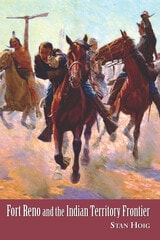
Fort Reno and the Indian Territory Frontier
Stan Hoig
University of Arkansas Press, 2005
The story of Fort Reno, as detailed here by Stan Hoig, touches on several of the most important topics of nineteenth-century Western history: the great cattle drives, Indian pacification and the Plains Wars, railroads, white settlement, and the Oklahoma land rushes. Hoig deals not only with Fort Reno, but also with Darlington agency, the Chisolm Trail, and the trading activities in Indian Territory from 1874 to approximately 1900. The author includes maps, photographs, and illustrations to enhance the narrative and guide the reader, like a scout, through a time of treacherous but fascinating events in the Old West.
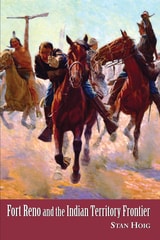
Fort Reno and the Indian Territory Frontier
Stan Hoig
University of Arkansas Press, 2005
The story of Fort Reno, as detailed here by Stan Hoig, touches on several of the most important topics of nineteenth-century Western history: the great cattle drives, Indian pacification and the Plains Wars, railroads, white settlement, and the Oklahoma land rushes. Hoig deals not only with Fort Reno, but also with Darlington agency, the Chisolm Trail, and the trading activities in Indian Territory from 1874 to approximately 1900. The author includes maps, photographs, and illustrations to enhance the narrative and guide the reader, like a scout, through a time of treacherous but fascinating events in the Old West.
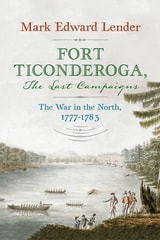
Fort Ticonderoga, The Last Campaigns
The War in the North, 1777–1783Mark Edward Lender
Westholme Publishing, 2027
During the War for Independence, Fort Ticonderoga’s guns, sited critically between Lakes Champlain and George, dominated north-south communications in upstate New York that were vital to both the British and American war efforts. In the public mind Ticonderoga was the “American Gibraltar” or the “Key to the Continent,” and patriots considered holding the fort essential to the success of the Revolutionary cause. Ticonderoga was a primary target in British Lieutenant General John Burgoyne’s 1777 campaign to crush American resistance in the north and end the rebellion in a decisive stroke. American efforts to defend the fort in June against overwhelming odds entailed political and military intrigue, bungling, heroism, and ultimately a narrow escape for the Continental and provincial forces under Major General Arthur St. Clair. The loss of Ticonderoga stunned patriot morale and ignited one of the greatest political firestorms of the war. But the fortunes of war turned. Two months later, the rebels mounted a sensational—if little known—counter-attack on Ticonderoga that had major implications for Burgoyne’s eventual defeat at Saratoga in October. Yet Saratoga brought no peace, and Ticonderoga would be central to additional military and political maneuverings—many of them known only to specialist historians—that would keep the region on edge until the end of the war in 1783.
Based on new archival research and taking advantage of the latest scholarship, Fort Ticonderoga, The Last Campaigns: The War in the North, 1777-1783 by distinguished historian Mark Edward Lender highlights the strategic importance of the fort as British, American, and regional forces (including those of an independent Vermont Republic) fought for control of the northern front at a critical point in the war. The book tells the Ticonderoga story in all of its complexity and drama, correcting misconceptions embedded in many previous accounts, and sheds vital new light on this key chapter in America’s struggle for independence.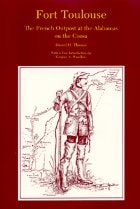
Fort Toulouse
The French Outpost at the Alabamas on the CoosaDaniel H Thomas, with an introduciton by Gregory A. Waselkov
University of Alabama Press, 1989
Situated at the head of the Alabama River system—at the juncture of the Coosa and Tallapoosa rivers—Fort Toulouse in 1717 was planned to keep the local Indians neutral, if not loyal, to the French and contain the British in their southernmost Atlantic colonies. Unlike the usual frontier settlements, Fort Toulouse was both a diplomatic post, since its officers acted as resident ministers, and a military post. Because it was located in a friendly territory adjoining an area under a rival (British) influence, the post participated in psychological warfare rather than in blood-letting. It used trade and aid, and was familiar with spies and double-agents—welcoming and debriefing British defectors; no cannon was discharged in anger at Toulouse.
The most eminent figure to have been connected directly with Fort Toulouse was General Andrew Jackson, who established a military post there during the War of 1812 after his victory over the Indians at Horseshoe Bend. The outpost was named Fort Jackson in his honor and played a key role in the treaty negotiations and eventual settlement of the Indian land by Americans.
In addition to discussing geopolitical and military affairs and diplomatic relations with Indian chiefs, Thomas describes daily life at the post and the variety of interactions between residents and visitors. Waselkov's introduction places the original 1960 book within the context of the existing scholarship of that time and adds an extensive and enlightening review of the most recent archaeological and historical research to Thomas' pioneering work.

Forth to the Mighty Conflict
Alabama and World War IIAllen Cronenberg
University of Alabama Press, 1995
From the home front to the front lines—Alabama’s pivotal role in shaping victory in World War II.
Alabama and its people played a conspicuous role in World War II. Not only were thousands of servicemen trained at military facilities in the state—at Fort McClellan, Camp Rucker, Camp Sibert, Maxwell Air Field, and Tuskegee Army Air Field—but Axis prisoners of war were interned in camps on Alabama soil. The state of Alabama held a significant number of these prisoners, over seventeen thousand in four camps across the state: Camp Aliceville, Camp Opelika, Fort McClellan, and Fort Rucker. This study focuses on Camp Aliceville and Camp Opelika which provide a sample that frames and highlights the national prisoner of war program. Through this example, one can see the lasting legacy of the prisoner of war program and its role in transforming the United States and forever changing the lives of thousands of prisoners, guards, and local citizens. An analysis of the Alabama camps also reveals how memory is constructed and how one narrative can ultimately emerge as the dominant story. In addition, a survey of the landscape reveals the importance of place and its role in the process of remembering and forgetting.
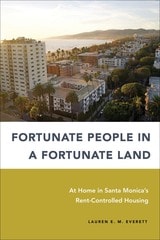
Fortunate People in a Fortunate Land
At Home in Santa Monica's Rent-Controlled HousingLauren E. M. Everett
Temple University Press, 2025
Everett seeks to understand the extent to which individuals feel at home or not at home and what factors contribute to those experiences. She also explores the nexus of Santa Monica’s tenant protection policies, infrastructure, and resources and the extent to which they inform stability—both perceived and actual—and life decisions.
The first scholarly book to take a tenant-centered approach to examining the benefits and problems of rent control, Fortunate People in a Fortunate Land examines the residential experience in this specific local context and explains how it relates to policy and other externalities in cities where homeownership is not financially viable for most renters.
In the series Urban Life, Landscape, and Policy

Fortune and Faith in Old Chicago
A Dual Biography of Mayor Augustus Garrett and Seminary Founder Eliza Clark GarrettCharles H. Cosgrove
Southern Illinois University Press, 2020
This engaging biography of Augustus Garrett and Eliza Clark Garrett tells two equally compelling stories: an ambitious man’s struggle to succeed and the remarkable spiritual journey of a woman attempting to overcome tragedy. By contextualizing the couple’s lives within the rich social, political, business, and religious milieu of Chicago’s early urbanization, author Charles H. Cosgrove fills a gap in the history of the city in the mid-nineteenth century.
The Garretts moved from the Hudson River Valley to a nascent Chicago, where Augustus made his fortune in the land boom as an auctioneer and speculator. A mayor during the city’s formative period, Augustus was at the center of the first mayoral election scandal in Chicago. To save his honor, he resigned dramatically and found vindication in his reelection the following year. His story reveals much about the inner workings of Chicago politics and business in the antebellum era.
The couple had lost three young children to disease, and Eliza arrived in Chicago with deep emotional scars. Her journey exemplifies the struggles of sincere, pious women to come to terms with tragedy in an age when most people attributed unhappy events to divine punishment. Following Augustus’s premature death, Eliza developed plans to devote her estate to founding a women’s college and a school for ministerial training, and in 1853 she endowed a Methodist theological school, the Garrett Biblical Institute (now the Garrett-Evangelical Theological Seminary), thereby becoming the first woman in North America to found an institution of higher learning.
In addition to illuminating our understanding of Chicago from the 1830s to the 1850s, Fortune and Faith in Old Chicago explores American religious history, particularly Presbyterianism and Methodism, and its attention to gender shows how men and women experienced the same era in vastly different ways. The result is a rare, fascinating glimpse into old Chicago through the eyes of two of its important early residents.
Forty Years In The Wilderness
Impressions Of Nevada, 1940-1980James W. Hulse
University of Nevada Press, 1986
A view of Nevada history by native Nevadan and historian Hulse that suggests prosperity be based on diverse businesses rather than on a gaming-financed economy.
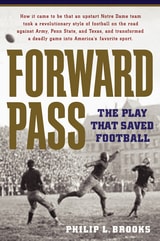
Forward Pass
The Play That Saved FootballPhilip L. Brooks
Westholme Publishing, 2007
In 1913, a small, up-and-coming school came to West Point to challenge the great Army football team. The opposing quarterback dropped back, raised the football, and threw a perfect spiral to his wide open teammate. Again and again the quarterback and his receiver completed passes, resulting in a stunning 35-13 defeat of Army. That school was Notre Dame and the receiver was Knute Rockne: the game of football was transformed. The story of Notre Dame’s passing attack goes back seven years, when the forward pass was first legalized as a means of opening the game up to avoid the fatalities that plagued early football and nearly saw the game banned. A student of the legendary Amos Alonzo Stagg, Jesse Harper, envisioned a mixture of precision passing and running throughout the game, and after arriving at Notre Dame, he schooled his team in his new-fangled approach.
In Forward Pass: The Play That Saved Football, Philip L. Brooks introduces the reader to the dirt, spectacle, and emotion of the great teams of the early twentieth century, including Jim Thorpe and the Carlisle Indians, Stagg’s University of Chicago Maroons, Fielding Yost’s Michigan Wolverines, Johnny Heisman’s Georgia Tech Yellow Jackets, and Gil Dobie’s Washington Huskies. While most teams experimented with passing, it was Jesse Harper and Knute Rockne who showed how the forward pass could be used as the ultimate offensive strategy and key to the brilliant future of football.
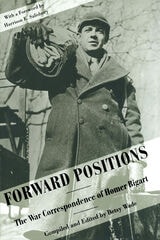
Forward Positions
The War Correspondence of Homer BigartHomer Bigart
University of Arkansas Press, 1992
Among journalists—and particularly war correspondents—Homer Bigart was both legend and example. In a career of four decades, first with the New York Herald Tribuneand then, through 1972, with The New York Times, Bigart distinguished himself as a superb writer and tireless digger for the realities that could be learned only in the field and not at headquarters. In 1943 Bigart sailed for England to cover the air war and was soon on mule-back in Sicily, and hanging on at Anzio. He then went to the Pacific, where his dispatches won him his first Pulitzer Prize for foreign correspondence. When hostilities erupted in Korea he was again on the front lines in the front lines in the Orient, and again recipient of a Pulitzer. By the time of the American involvement in Vietnam, he was an old-timer, a seasoned correspondent admired and celebrated for his wit but regarded with awe for his masterly stories, in which straightforward prose, informed by tenacious reporting, cut to the heart of the issues.
Previously available only n crumbling library copies of the Tribune and the Times, or in microfilm repositories, his dispatches, with their rare insights into warefar and he minds of those who wage war, are now collected in Forward Positions: The War Correspondence of Home Bigart, edited by Betsy Wade and introduced by Harrison E. Salisbury, himself the winner of a Pulitzer Prize for journalism.
Forward Positions does honor to a breed of journalist that had passed into history by the time of Bigart’s death. It includes one of the first accounts of the atomic annihilation of Hiroshima, a report on the war-crimes trial of Adolf Eichmann, a number of dispatches on “hot” battles of the Cold War, and a probing dispatch on Lieutenant William Calley’s testimony on the Mỹ Lai Massacre. With this representative selection of more than fifty of Bigart’s accounts of war on the ground, in the air, and in the courtroom, Wade provides a wealth of background material about his career, as well as glimpses of his impact on journalism. The book promises hours of captivating and informative reading for journalists, historians, veterans, and anyone who likes a good story tautly told.
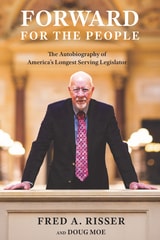
Forward for the People
The Autobiography of America's Longest Serving LegislatorFred A. Risser and Doug Moe
Wisconsin Historical Society Press, 2025
When Fred Risser retired from the Wisconsin Senate in 2021, his sixty-four years in state government made him the longest serving legislator in US history. Now, in this candid and illuminating autobiography, Risser shares his singular perspective on events that transformed the state and the nation over the course of his remarkable career. From his role in the “Joe Must Go” drive to recall US Senator Joseph McCarthy in the 1950s to his position as the senior senator among the “Fab Fourteen” Wisconsin Democrats who opposed Governor Scott Walker’s Act 10 legislation against collective bargaining in 2011, Risser was a leader in state politics for decades, always maintaining an unwavering belief that political action can change people’s lives for the better.
Forward for the People provides a unique peek behind the political curtain from the viewpoint of someone who saw it all. Risser worked with thirteen governors and authored more than 240 bills that became law, championing public health and safety, environmental protection, women’s and reproductive rights, organized labor, civil rights, and social justice, among many other causes. Risser also recounts interactions with prominent national politicians, including Robert La Follette Jr., Hubert Humphrey, Jimmy Carter, and Bill Clinton. More than forty photographs from Risser’s personal collection and the Wisconsin Senate paint a vivid picture of his six-decade journey through Wisconsin politics.
Forward for the People details Risser’s experiences out of state, from a stint in the Panama Canal Zone as a navy hospital corpsman to his undergraduate debate-team days at Minnesota’s Carleton College to his years studying law at the University of Oregon and his travels to all seven continents. The book also depicts the quirky habits that made Risser a memorable and beloved politician: biking his age in miles every birthday and never taking the elevator in his sixty-four years at the Wisconsin State Capitol. Enhanced with details sourced from correspondence, personal notes, newspaper accounts, and recollections from friends and former colleagues, Risser and coauthor Doug Moe have crafted an engaging account of an extraordinary life in public service.
Forward for the People
The Autobiography of America's Longest Serving LegislatorFred A. Risser and Doug Moe
Wisconsin Historical Society Press, 2026
When Fred Risser retired from the Wisconsin Senate in 2021, his sixty-four years in state government made him the longest serving legislator in US history. Now, in this candid and illuminating autobiography, Risser shares his singular perspective on events that transformed the state and the nation over the course of his remarkable career. From his role in the “Joe Must Go” drive to recall US Senator Joseph McCarthy in the 1950s to his position as the senior senator among the “Fab Fourteen” Wisconsin Democrats who opposed Governor Scott Walker’s Act 10 legislation against collective bargaining in 2011, Risser was a leader in state politics for decades, always maintaining an unwavering belief that political action can change people’s lives for the better.
Forward for the People provides a unique peek behind the political curtain from the viewpoint of someone who saw it all. Risser worked with thirteen governors and authored more than 240 bills that became law, championing public health and safety, environmental protection, women’s and reproductive rights, organized labor, civil rights, and social justice, among many other causes. Risser also recounts interactions with prominent national politicians, including Robert La Follette Jr., Hubert Humphrey, Jimmy Carter, and Bill Clinton.
Forward for the People details Risser’s experiences out of state, from a stint in the Panama Canal Zone as a navy hospital corpsman to his undergraduate debate-team days at Minnesota’s Carleton College to his years studying law at the University of Oregon and his travels to all seven continents. The book also depicts the quirky habits that made Risser a memorable and beloved politician: biking his age in miles every birthday and never taking the elevator in his sixty-four years at the Wisconsin State Capitol. Enhanced with details sourced from correspondence, personal notes, newspaper accounts, and recollections from friends and former colleagues, Risser and coauthor Doug Moe have crafted an engaging account of an extraordinary life in public service.
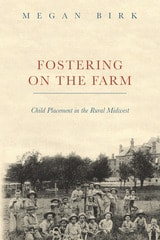
Fostering on the Farm
Child Placement in the Rural MidwestMegan Birk
University of Illinois Press, 2019
Drawing on institution records, correspondence from children and placement families, and state reports, Megan Birk scrutinizes how the farm system developed--and how the children involved may have become some of America's last indentured laborers. Between 1850 and 1900, up to one-third of farm homes contained children from outside the family. Birk reveals how the nostalgia attached to misplaced perceptions about healthy, family-based labor masked the realities of abuse, overwork, and loveless upbringings endemic in the system. She also considers how rural people cared for their own children while being bombarded with dependents from elsewhere. Finally, Birk traces how the ills associated with rural placement eventually forced reformers to transition to a system of paid foster care, adoptions, and family preservation.
Foundations of Intellectual Freedom
Emily J. M. Knox
American Library Association, 2022
- the historical and legal roots of intellectual freedom, with an in-depth examination of John Stuart Mill’s “On Liberty” and Article 19 of the U.N Declaration of Human Rights, and its central concepts and principles;
- the intersection of intellectual freedom, freedom of expression, and social justice;
- professional values, codes of ethics, ALA’s Library Bill of Rights, and Freedom to Read/View Statements;
- pro- and anti- censorship arguments and their use in impeding and facilitating access to information;
- book banning and internet filtering;
- privacy and its relationship to information services;
- U.S. case law and precedents;
- the basics of U.S. copyright law, including fair use, and how it differs from international copyright law; and
- emerging global issues and their impact on future intellectual freedom.

Foundations of Library and Information Science
Richard E. Rubin
American Library Association, 2020
Richard E. Rubin’s book has served as the authoritative introductory text for generations of library and information science practitioners, with each new edition taking in its stride the myriad societal, technological, political, and economic changes affecting our users and institutions and transforming our discipline. Rubin teams up with his daughter, Rachel G. Rubin, a rising star in the library field in her own right, for the fifth edition. Spanning all types of libraries, from public to academic, school, and special, it illuminates the major facets of LIS for students as well as current professionals. Continuing its tradition of excellence, this text addresses
- the history and mission of libraries from past to present, including the history of service to African Americans;
- critical contemporary social issues such as services to marginalized communities, tribal libraries, and immigrants;
- the rise of e-government and the crucial role of political advocacy;
- digital devices, social networking, digital publishing, e-books, virtual reality, and other technology;
- forces shaping the future of libraries, including Future Ready libraries, and sustainability as a core value of librarianship;
- the values and ethics of the profession, with new coverage of civic engagement, combatting fake news, the importance of social justice, and the role of critical librarianship;
- knowledge infrastructure and organization, including Resource Description and Access (RDA), linked data, and the Library Research Model;
- the significance of the digital divide and policy issues related to broadband access and net neutrality;
- intellectual freedom, legal issues, and copyright-related topics;
- contemporary issues in LIS education such as the ongoing tensions between information science and library science; and
- the changing character of collections and services including the role of digital libraries, preservation, and the digital humanities.
In its newest edition, Foundations of Library and Information Science remains the field’s essential resource.

Foundations of Library and Information Science
Richard E. Rubin
American Library Association, 2016

Foundations of World Order
The Legalist Approach to International Relations, 1898–1922Francis Anthony Boyle
Duke University Press, 1999
Although both the League of Nations and the Permanent Court of International Justice were rejected by the U.S. Senate, Boyle shows how the early governance of these institutions—precursors, respectively, to the United Nations and the International Court of Justice—informed later efforts to reduce and regulate transnational threats and the use of military force. Delving into such topics as the United States and its initial stance of neutrality in World War I and its imperial policy toward Latin America and the Caribbean, Boyle offers detailed readings of the relevant treaties, tribunals, and conferences, and assesses the political actors involved. Taking up the legalist point of view, he discusses the codification of customary international law, the obligatory arbitration of international disputes, and the creation of a new regime for the settlement of such disputes.
Boyle has provided in Foundations of World Order a compelling portrait of the relationship between political power and law, and of the impact of these forces on U.S. diplomacy. This volume will serve as a valuable resource to students, scholars, and practitioners of international law; it will also be of great interest to historians and political scientists engaged with issues of U.S. foreign policy and diplomatic history.
Founding Choices
American Economic Policy in the 1790sEdited by Douglas A. Irwin and Richard Sylla
University of Chicago Press, 2010
The political decisions made by the founding fathers were crucial to the success of the early republic. But the economic decisions they made were just as pivotal, ensuring the general welfare and common defense of the United States for decades to come. Founding Choices explores these economic choices and their profound influence on American life, westward expansion, and influence abroad. Among the topics covered are finance, trade, and monetary and banking policy, with a focus on the factors guiding those policies and their end result.
This book redresses the relative neglect of the economic achievements of the founders. It will be essential reading for historians and economists alike.
Founding Factions
How Majorities Shifted and Aligned to Shape the U.S. ConstitutionJeremy C. Pope and Shawn Treier
University of Michigan Press, 2020
Founding Farms
Portraits of Five Massachusetts Family FarmsStanley E. Sherer
University of Massachusetts Press, 1993
With each passing year, the number of family farms in the United States diminishes. Fewer people have the persistence and ingenuity to wrest a livelihood from the land in an era of corporate ownership and mass production. Yet some family farms survive.
Through words and photographs, this book documents the long lives of five of the oldest farms in Massachusetts. Each has remained in the same family for more than two, sometimes three, centuries and each has a distinctive history. The devotion to the land and family heritage is palpable in the stories these five families tell.
Stan Sherer’s remarkable photographs depict the activities of the family members as they go about their daily labors, planting crops, feeding animals, applying new technologies to ancient tasks, and coping with the vagaries of weather and state regulations. Michael E. C. Gery’s narrative traces how the farms began, what has sustained them through the generations, and how the families who run them today feel about their past, present, and future. These stories are told largely through the words of the people themselves.
The result is a complex portrait that moves beyond traditional stereotypes to reveal the realities of family farm life in an increasingly urbanized society.
Founding Fictions
Jennifer R. Mercieca
University of Alabama Press, 2010
Founding Fictions develops the concept of a “political fiction,” or a narrative that people tell about their own political theories, and analyzes how republican and democratic fictions positioned American citizens as either romantic heroes, tragic victims, or ironic partisans. By re-telling the stories that Americans have told themselves about citizenship, Mercieca highlights an important contradiction in American political theory and practice: that national stability and active citizen participation are perceived as fundamentally at odds.
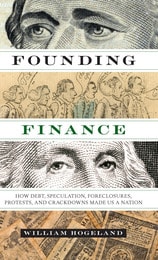
Founding Finance
How Debt, Speculation, Foreclosures, Protests, and Crackdowns Made Us a NationBy William Hogeland
University of Texas Press, 2014
Recent movements such as the Tea Party and anti-tax “constitutional conservatism” lay claim to the finance and taxation ideas of America’s founders, but how much do we really know about the dramatic clashes over finance and economics that marked the founding of America? Dissenting from both right-wing claims and certain liberal preconceptions, Founding Finance brings to life the violent conflicts over economics, class, and finance that played directly, and in many ways ironically, into the hardball politics of forming the nation and ratifying the Constitution—conflicts that still continue to affect our politics, legislation, and debate today.
Mixing lively narrative with fresh views of America’s founders, William Hogeland offers a new perspective on America’s economic infancy: foreclosure crises that make our current one look mild; investment bubbles in land and securities that drove rich men to high-risk borrowing and mad displays of ostentation before dropping them into debtors’ prisons; depressions longer and deeper than the great one of the twentieth century; crony mercantilism, war profiteering, and government corruption that undermine any nostalgia for a virtuous early republic; and predatory lending of scarce cash at exorbitant, unregulated rates, which forced people into bankruptcy, landlessness, and working in the factories and on the commercial farms of their creditors. This story exposes and corrects a perpetual historical denial—by movements across the political spectrum—of America’s all-important founding economic clashes, a denial that weakens and cheapens public discourse on American finance just when we need it most.
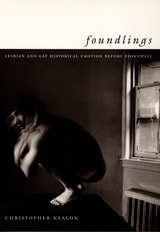
Foundlings
Lesbian and Gay Historical Emotion before StonewallChristopher Nealon
Duke University Press, 2001
The young runaways in Cather’s novels, the way critics conflated Crane’s homosexual body with his verse, the suggestive poses and utopian captions of muscle magazines, and Beebo Brinker, the aging butch heroine from Ann Bannon’s pulp novels—all embody for Nealon the uncertain space between two models of lesbian and gay sexuality. The “inversion” model dominant in the first half of the century held that homosexuals are souls of one gender trapped in the body of another, while the more contemporary “ethnic” model refers to the existence of a distinct and collective culture among gay men and lesbians. Nealon’s unique readings, however, reveal a constant movement between these two discursive poles, and not, as is widely theorized, a linear progress from one to the other.
This startlingly original study will interest those working on gay and lesbian studies, American literature and culture, and twentieth-century history.
Four Classic Mormon Village Studies
Howard M. Bahr
University of Utah Press, 2014
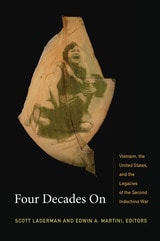
Four Decades On
Vietnam, the United States, and the Legacies of the Second Indochina WarScott Laderman and Edwin A. Martini, eds.
Duke University Press, 2013
Contributors. Alex Bloom, Diane Niblack Fox, H. Bruce Franklin, Walter Hixson, Heonik Kwon, Scott Laderman, Mariam B. Lam, Ngo Vinh Long, Edwin A. Martini, Viet Thanh Nguyen, Christina Schwenkel, Charles Waugh
Four of the Three Musketeers
The Marx Brothers on StageRobert S. Bader
Northwestern University Press, 2022
An updated paperback version of the book heralded as “a new benchmark in Marx scholarship” by the Los Angeles Times
Before film made them international comedy legends, the Marx Brothers developed their comic skills on stage for twenty-five years. In Four of the Three Musketeers: The Marx Brothers on Stage, Robert S. Bader offers the first comprehensive history of the foursome’s hardscrabble early years honing their act in front of live audiences.
From Groucho’s debut in 1905 to their final live performances of scenes from A Night in Casablanca in 1945, the brothers’ stage career shows how their characters and routines evolved before their arrival in Hollywood. Four of the Three Musketeers draws on an unmatched array of sources, many not referenced elsewhere. Bader’s detailed portrait of the struggling young actors both brings to vivid life a typical night on the road for the Marx Brothers and illuminates the inner workings of the vaudeville business, especially during its peak in the 1920s.
As Bader traces the origins of the characters that would later come to be beloved by filmgoers, he also skillfully scrapes away the accretion of rumors and mythology perpetuated not only by fans and writers but by the Marx Brothers themselves. Revealing, vital, and entertaining, Four of the Three Musketeers has taken its place as an essential reference for this legendary American act. Now, the updated edition adds newly discovered performances—some submitted by readers—and additional information provided by descendants of long-departed vaudevillians mentioned in the book.
Fourth City
Essays from the Prison in AmericaEdited by Doran Larson
Michigan State University Press, 2014
Fourth of July, Asbury Park
A History of the Promised LandDaniel Wolff
Rutgers University Press, 2022
Fourth of July, Asbury Park tells the tale of the city’s first 150 years, guiding us through the development of its lavish amusement parks and bandstands, as well as the decay of its working-class neighborhoods and spread of its racially-segregated ghettos. Featuring exclusive interviews with Springsteen and other prominent Asbury Park residents, Daniel Wolff uncovers the history of how this Jersey shore resort town came to epitomize both the promises of the American dream and the tragic consequences when those promises are broken.
Hailed by The New York Times as a “wonderfully evocative…grand, sad story” when first published in 2006, this revised and expanded edition considers how Asbury Park has changed in the twenty-first century, experiencing both gentrification and new forms of segregation.
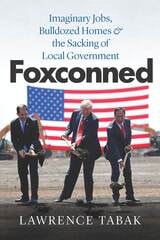
Foxconned
Imaginary Jobs, Bulldozed Homes, and the Sacking of Local GovernmentLawrence Tabak
University of Chicago Press, 2021
When Wisconsin governor Scott Walker stood shoulder to shoulder with President Trump and Speaker of the House Paul Ryan at the White House in July 2017, they painted a glorious picture of his state’s future. Foxconn, the enormous China-based electronics firm, was promising to bring TV manufacturing back to the United States with a $10 billion investment and 13,000 well-paying jobs. They actually were making America great again, they crowed.
Two years later, the project was in shambles. Ten thousand construction workers were supposed to have been building what Trump had promised would be “the eighth wonder of the world.” Instead, land had been seized, homes had been destroyed, and hundreds of millions of municipal dollars had been committed for just a few hundred jobs—nowhere near enough for Foxconn to earn the incentives Walker had shoveled at them. In Foxconned, journalist Lawrence Tabak details the full story of this utter collapse, which was disturbingly inevitable.
As Tabak shows, everything about Foxconn was a disaster. But worse, he reveals how the economic incentive infrastructure across the country is broken, leading to waste, cronyism, and the steady transfer of tax revenue to corporations. Tabak details every kind of financial chicanery, from eminent domain abuse to good old-fashioned looting—all to benefit a coterie of consultants, politicians, and contractors. With compassion and care, he also reports the distressing stories of the many individuals whose lives were upended by Foxconn.

Fractured Borders
Reading Women's Cancer LiteratureMary K. DeShazer
University of Michigan Press, 2010
Fractured Borders: Reading Women's Cancer Literature surveys a wide range of contemporary writing about breast, uterine, and ovarian cancer, including works by Marilyn Hacker, Margaret Edson, Carole Maso, Audre Lorde, Eve Sedgwick, Mahasweta Devi, Lucille Clifton, Alicia Ostriker, Jayne Anne Phillips, Terry Tempest Williams, and Jeanette Winterson, among many others. DeShazer's readings bring insights from body theory, performance theory, feminist literary criticism, French feminisms, and disability studies to bear on these works, shining new light on a literary subject that is engaging more and more writers.
"An important and useful book that will appeal to people in a variety of fields and walks of life, including scholars, teachers, and anyone interested in this subject."
--Suzanne Poirier, University of Illinois at Chicago
"A book on a timely and important topic, wisely written beyond scholarly boundaries and crossing many theoretical and disciplinary lines."
--Patricia Moran, University of California, Davis

Fractured Communities
Risk, Impacts, and Protest Against Hydraulic Fracking in U.S. Shale RegionsLadd, Anthony E.
Rutgers University Press, 2017

Fragmenting Globalization
The Politics of Preferential Trade Liberalization in China and the United StatesKa Zeng and Xiaojun Li
University of Michigan Press, 2021
Fragmenting Globalization uses multiple methods, including time series, cross-sectional analysis of the pattern of Preferential Trade Alliance formation by existing World Trade Organization members, a firm-level survey, and case studies of the pattern of corporate support for regional trade liberalization in both China and the United States. Zeng and Li show that the growing fragmentation of global production, trade, and investment is altering trade policy away from the traditional divide between export-oriented and import-competing industries.

Frames of Evil
The Holocaust as Horror in American FilmCaroline J. S. Picart, and David A. Frank. Foreword by Dominick LaCapra. Introduction by Edward J. Ingebretsen
Southern Illinois University Press, 2006
Challenging the classic horror frame in American film
American filmmakers appropriate the “look” of horror in Holocaust films and often use Nazis and Holocaust imagery to explain evil in the world, say authors Caroline Joan (Kay) S. Picart and David A. Frank. In Frames of Evil: The Holocaust as Horror in American Film, Picart and Frank challenge this classic horror frame—the narrative and visual borders used to demarcate monsters and the monstrous. After examining the way in which directors and producers of the most influential American Holocaust movies default to this Gothic frame, they propose that multiple frames are needed to account for evil and genocide.
Using Schindler’s List, The Silence of the Lambs, and Apt Pupil as case studies, the authors provide substantive and critical analyses of these films that transcend the classic horror interpretation. For example, Schindler’s List, say Picart and Frank, has the appearance of a historical docudrama but actually employs the visual rhetoric and narrative devices of the Hollywood horror film. The authors argue that evil has a face: Nazism, which is configured as quintessentially innate, and supernaturally crafty.
Frames of Evil, which is augmented by thirty-six film and publicity stills, also explores the commercial exploitation of suffering in film and offers constructive ways of critically evaluating this exploitation. The authors suggest that audiences will recognize their participation in much larger narrative formulas that place a premium on monstrosity and elide the role of modernity in depriving millions of their lives and dignity, often framing the suffering of others in a manner that allows for merely “documentary” enjoyment.
Framing Fat
Competing Constructions in Contemporary CultureKwan, Samantha
Rutgers University Press, 2013
Alongside public health officials at the Centers for Disease Control and Prevention are advertisers of the fashion-beauty complex, food industry advocates at the Center for Consumer Freedom, and activists at the National Association to Advance Fat Acceptance.
Framing Fat takes a bird’s-eye view of how these multiple actors construct the fat body by identifying the messages these groups put forth, particularly where issues of beauty, health, choice and responsibility, and social justice are concerned. Samantha Kwan and Jennifer Graves examine how laypersons respond to these conflicting messages and illustrate the gendered, raced, and classed implications within them. In doing so, they shed light on how dominant ideas about body fat have led to the moral indictment of body nonconformists, essentially “framing” them for their fat bodies.
Framing History
The Rosenberg Story and the Cold WarVirginia Carmichael
University of Minnesota Press, 1993
Framing Identities
Autobiography and the Politics of PedagogyWendy S. Hesford
University of Minnesota Press, 1999
A trenchant examination of the political dynamics of autobiography in education.
How do historically marginalized groups expose the partiality and presumptions of educational institutions through autobiographical acts? How are the stories we tell used to justify resistance to change or institutional complacency? These are the questions Wendy S. Hesford asks as she considers the uses of autobiography in educational settings. This book demonstrates how autobiographical acts-oral, written, performative, and visual-play out in vexed and contradictory ways and how in the academy they can become sites of cultural struggle over multicultural education, sexual harassment, institutional racism, hate speech, student activism, and commemorative practices.
Within the context of Oberlin, a small liberal arts college in Ohio, and beginning with a speak-out organized by Asian American students in 1995, this book looks at the uses of autobiographical practices in empowering groups traditionally marginalized in academic settings. Investigating the process of self-representation and the social, spatial, and discursive frames within which academic bodies and identities are constituted, Framing Identities explores the use of autobiographical acts in terms of power, influence, risks involved, and effectiveness. Hesford does not endorse autobiography as an unequivocal source of empowerment, however. Instead, she illustrates how autobiographical practices in the academy can mobilize competing and often irreconcilable interests. Hesford argues that by integrating self-reflection into cultural, rhetorical, and material analyses-and encouraging students to do the same-teachers not only will largely justify attention to the personal in the classroom, they will help their communities move beyond a naive identity politics. Framing Identities provides a model for teacher-researchers across the disciplines (education, English, composition, cultural studies, women’s studies, to name a few) to investigate the contradictory uses and consequences of autobiography at their own institutions, and to carve out new pedagogical spaces from which they and their students can emerge as social, political, and intellectual subjects.
Framing Public Memory
Edited by Kendall R. Phillips
University of Alabama Press, 2007
A collection of essays by prominent scholars from many disciplines on the construction of public memories
The study of public memory has grown rapidly across numerous disciplines in recent years, among them American studies, history, philosophy, sociology, architecture, and communications. As scholars probe acts of collective remembrance, they have shed light on the cultural processes of memory. Essays contained in this volume address issues such as the scope of public memory, the ways we forget, the relationship between politics and memory, and the material practices of memory.Stephen Browne’s contribution studies the alternative to memory erasure, silence, and forgetting as posited by Hannah Arendt in her classic Eichmann in Jerusalem. Rosa Eberly writes about the Texas tower shootings of 1966, memories of which have been minimized by local officials. Charles Morris examines public reactions to Larry Kramer’s declaration that Abraham Lincoln was homosexual, horrifying the guardians of Lincoln’s public memory. And Barbie Zelizer considers the impact on public memory of visual images, specifically still photographs of individuals about to perish (e.g., people falling from the World Trade Center) and the sense of communal loss they manifest.
Whether addressing the transitory and mutable nature of collective memories over time or the ways various groups maintain, engender, or resist those memories, this work constitutes a major contribution to our understanding of how public memory has been and might continue to be framed.
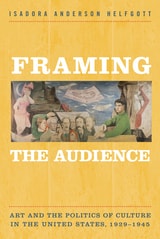
Framing the Audience
Art and the Politics of Culture in the United States, 1929-1945Isadora Helfgott
Temple University Press, 2015
Framing the Audience explores the cultural politics of the Great Depression and World War II through the prism of art appreciation. Isadora Helfgott interrogates the ideological and political motivations for breaking down barriers between fine art and popular culture. She charts the impact that changes in art appreciation had on the broader political, social, cultural, and artistic landscape.
Framing the Audience argues that efforts to expand the social basis of art became intertwined with—and helped shape—broader debates about national identity and the future of American political economy. Helfgott chronicles artists’ efforts toinfluence the conditions of artistic production and display. She highlights the influence of the Federal Art Project, the impact of the Museum of Modern Art as an institutional home for modernism in America and as an organizer of traveling exhibitions, and the efforts by LIFE and Fortune magazines to integrate art education into their visual record of modern life. In doing so, Helfgott makes critical observations about the changing relationship between art and the American public.
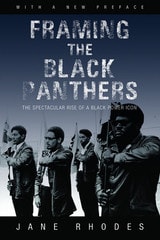
Framing the Black Panthers
The Spectacular Rise of a Black Power IconJane Rhodes
University of Illinois Press, 2017
Framing the Rape Victim
Gender and Agency ReconsideredMardorossian, Carine M
Rutgers University Press, 2014
In recent years, members of legal, law enforcement, media and academic circles have portrayed rape as a special kind of crime distinct from other forms of violence. In Framing the Rape Victim, Carine M. Mardorossian argues that this differential treatment of rape has exacerbated the ghettoizing of sexual violence along gendered lines and has repeatedly led to women’s being accused of triggering, if not causing, rape through immodest behavior, comportment, passivity, or weakness.
Contesting the notion that rape is the result of deviant behaviors of victims or perpetrators, Mardorossian argues that rape saturates our culture and defines masculinity’s relation to femininity, both of which are structural positions rather than biologically derived ones. Using diverse examples throughout, Mardorossian draws from Hollywood film and popular culture to contemporary women’s fiction and hospitalized birth emphasizing that the position of dominant masculinity can be occupied by men, women, or institutions, while structural femininity is a position that may define and subordinate men, minorities, and other marginalized groups just as effectively as it does women. Highlighting the legacies of the politically correct debates of the 1990s and the terrorist attacks of 9/11, the book illustrates how the framing of the term “victim” has played a fundamental role in constructing notions of agency that valorize autonomy and support exclusionary, especially masculine, models of American selfhood.
The gendering of rape, including by well-meaning, sometimes feminist, voices that claim to have victims’ best interests at heart, ultimately obscures its true role in our culture. Both a critical analysis and a call to action, Framing the Rape Victim shows that rape is not a special interest issue that pertains just to women but a pervasive one that affects our society as a whole.
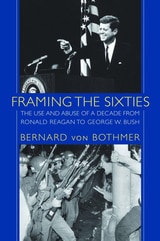
Framing the Sixties
The Use and Abuse of a Decade from Ronald Reagan to George W. BushBernard von Bothmer
University of Massachusetts Press, 2010
Over the past quarter century, American liberals and conservatives alike have invoked memories of the 1960s to define their respective ideological positions and to influence voters. Liberals recall the positive associations of what might be called the “good Sixties”—the “Camelot” years of JFK, the early civil rights movement, and the dreams of the Great Society—while conservatives conjure images of the “bad Sixties”—a time of urban riots, antiwar protests, and countercultural revolt.
In Framing the Sixties, Bernard von Bothmer examines this battle over the collective memory of the decade primarily through the lens of presidential politics. He shows how four presidents—Ronald Reagan, George H. W. Bush, Bill Clinton, and George W. Bush—each sought to advance his political agenda by consciously shaping public understanding of the meaning of “the Sixties.” He compares not only the way that each depicted the decade as a whole, but also their commentary on a set of specific topics: the presidency of John F. Kennedy, Lyndon Johnson's “Great Society” initiatives, the civil rights movement, and the Vietnam War.
In addition to analyzing the pronouncements of the presidents themselves, von Bothmer draws on interviews he conducted with more than one hundred and twenty cabinet members, speechwriters, advisers, strategists, historians, journalists, and activists from across the political spectrum—from Julian Bond, Daniel Ellsberg, Todd Gitlin, and Arthur Schlesinger to James Baker, Robert Bork, Phyllis Schlafly, and Paul Weyrich.
It is no secret that the upheavals of the 1960s opened fissures within American society that have continued to affect the nation's politics and to intensify its so-called culture wars. What this book documents is the extent to which political leaders, left and right, consciously exploited those divisions by “framing” the memory of that turbulent decade to serve their own partisan interests.

Franchising Dreams
The Lure of Entrepreneurship in AmericaPeter M. Birkeland
University of Chicago Press, 2002
Peter M. Birkeland worked for three years in the front-line operations of franchise units for three companies, met with CEOs and executives, and attended countless trade shows, seminars, and expositions. All this firsthand experience gave him unprecedented access to the hopes and aspirations of franchisees. His book closely traces different franchisees and follows them as their dreams of wealth and independence buckle beneath the weight of frustrating logistics and contractual technicalities. Through extensive interviews and research, Birkeland not only discovers what makes franchisees succeed or fail, he uncovers the difficulties in running a business according to someone else's system and values. Bearing witness to a market flooded with fierce competitors and dependent on the inscrutable whims of consumers, he uncovers the numerous challenges that franchisees face in making their businesses succeed.
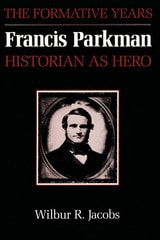
Francis Parkman, Historian as Hero
The Formative YearsBy Wilbur R. Jacobs
University of Texas Press, 1991
A historian who lived the kind of history he wrote, Francis Parkman is a major—and controversial—figure in American historiography. His narrative style, while popular with readers wanting a "good story," has raised many questions with professional historians. Was Parkman writing history or historical fiction? Did he color historical figures with his own heroic self-image? Was his objectivity compromised by his "unbending, conservative, Brahmin" values? These are some of the many issues that Wilbur Jacobs treats in this thought-provoking study.
Jacobs carefully considers the "apprenticeship" of Francis Parkman, first spent in facing the rigors of the Oregon Trail and later in struggling to write his histories despite a mysterious, frequently incapacitating illness. He shows how these events allowed Parkman to create a heroic self-image, which impelled his desire for fame as a historian and influenced his treatment of both the "noble" and the "savage" characters of his histories.
In addition to assessing the influence of Parkman's development and personality on his histories, Jacobs comments on Parkman's relationship to basic social and cultural issues of the nineteenth century. These include the slavery question, Native American issues, expansion of the suffrage to new groups, including women, and anti-Catholicism.
Francis Warrington Dawson and the Politics of Restoration
South Carolina, 1874-1889E. Culpepper Clark
University of Alabama Press, 1980
A revealing biography of a powerful Southern editor at the center of South Carolina’s post‑Reconstruction political transformation.
In the decades following the Civil War, South Carolina—like much of the South—struggled to redefine its political identity amid the collapse of Reconstruction and the rise of conservative “Redeemer” governments. In Francis Warrington Dawson and the Politics of Restoration, historian E. Culpepper Clark offers a deeply researched and incisive study of this transformation through the life and work of Francis Warrington Dawson, one of the state’s most influential newspaper editors.
Dawson was far more than a chronicler of events. As a powerful voice in South Carolina’s political press, he helped shape public opinion, broker alliances among conservative factions, and articulate the ideological foundations of post‑Reconstruction governance. Clark situates Dawson at the center of the struggles among Redeemers, Straight‑Out Democrats, agrarian reformers, and emerging political leaders such as Ben Tillman, revealing a political landscape marked by rivalry, class conflict, and competing visions of the New South.
Drawing on extensive manuscript collections, newspapers, and political correspondence, Clark explores the close relationship between journalism and power in the late nineteenth century and demonstrates how newspapers functioned as active political actors rather than neutral observers. The result is both a compelling political biography and a broader analysis of how restoration politics operated at the state level.
Francis Warrington Dawson and the Politics of Restoration is an essential work for readers interested in Southern history, Reconstruction and its aftermath, the history of American journalism, and the forces that shaped the political culture of the modern South.

Francois Vallé and His World
Upper Louisiana before Lewis and ClarkCarl J. Ekberg
University of Missouri Press, 2002
Winner of the Kemper & Leila Williams Prize in Louisiana History for excellence in historical scholarship for the year 2002, awarded by The Historic New Orleans Collection, The Louisiana Historical Association.