Results by title
18284 books match the query 'United States' and 783 start with f

From Black to Schwarz
Cultural Crossovers Between African America and GermanyMaria I. Diedrich
Michigan State University Press, 2011
From Blackjacks to Briefcases
A History of Commercialized Strikebreaking and Unionbusting in the United StatesRobert Michael Smith
Ohio University Press, 2003
From the beginning of the Industrial Age and continuing into the twenty-first century, companies faced with militant workers and organizers have often turned to agencies that specialized in ending strikes and breaking unions. Although their secretive nature has made it difficult to fully explore the history of this industry, From Blackjacks to Briefcases does just that.
By digging through subpoenaed documents of strike-bound companies, their mercenaries, and the testimony of executive officers and rank-and-file strikebreakers, Robert Smith examines the inner workings of the antiunion industry. In a clear and lively style, he brings to life the violent armed guards employed on the picket line or in the coal camps; the ruffians who filled the armies marshaled by the “King of the Strikebreakers,” Pearl Bergoff; the labor spies who wrecked countless unions; and, after the Wagner Act, those who manipulated national labor law to serve their clients.
In From Blackjacks to Briefcases, Smith follows the history of this ongoing struggle and tells a compelling story that parallels the history of the United States over the last century and a half.
From Bloodshed to Hope in Burundi
Our Embassy Years during GenocideBy Ambassador Robert Krueger and Kathleen Tobin Krueger
University of Texas Press, 2007
In 1994, while nations everywhere stood idly by, 800,000 people were slaughtered in eight weeks in Rwanda. Arriving as U.S. Ambassador to neighboring Burundi a few weeks later, Bob Krueger began drawing international attention to the genocide also proceeding in Burundi, where he sought to minimize the killing and to preserve its fledgling democratic government from destruction by its own army. From Bloodshed to Hope in Burundi is a compelling eyewitness account of both a horrific and persistent genocide and of the ongoing efforts of many courageous individuals to build a more just society.
Krueger and his wife Kathleen graphically document the slaughter occurring all around them, as well as their repeated efforts to get the U.S. government and the international community to take notice and take action. Bob Krueger reconstructs the events of the military coup that precipitated the Burundi genocide and describes his efforts to uncover the truth by digging up graves and interviewing survivors. In straightforward and powerful language, Kathleen Krueger recounts her family's experience living amid civil war, including when she faced down a dozen AK-47-wielding African soldiers to save the life of a household worker.
From Bloodshed to Hope in Burundi shines a piercing light on a genocide that has gone largely unreported, and identifies those responsible for it. It also offers hope that as the truth emerges and the perpetrators are brought to account, the people of Burundi will at last achieve peace and reconciliation.
From Blue Mills to Columbia
Cedar Falls and the Civil WarRobert K. Martin
University of Iowa Press, 1992
From Blue Mills to Columbia
Cedar Falls and the Civil WarKenneth L. Lyftogt
University of Iowa Press, 1993
From Blue to Red
The Rise of the GOP in ArkansasJohn C. Davis
University of Arkansas Press, 2024
John C. Davis’s From Blue to Red: The Rise of the GOP in Arkansas provides a rigorous yet accessible study of this partisan shift, tracking changes in voter preference at the top of the ticket in the 1960s, generational replacement in Arkansas’ political power structure in the 1990s, and the emergence of a more nationalized and polarized electorate in the 2000s, among other developments. From Blue to Red is a fascinating look at how Arkansas went from being one of the country’s most solidly Democratic states to one of its most ardently Republican in just a few years.
From Bondage to Belonging
The Worcester Slave NarrativesB. Eugene McCarthy
University of Massachusetts Press, 2007
First published between 1842 and 1895, the autobiographical narratives gathered in this volume document the experiences of eight former slaves who eventually took up residence in Worcester, Massachusetts. Each narrative tells a gripping individual story, its author clearly visible in the dress of his or her own words. Together they illuminate not only the inhumanity of slavery but also the dreams and dilemmas of emancipation, tracing the personal journeys of seven men and one woman from bondage to freedom.
In their well-researched introduction, B. Eugene McCarthy and Thomas L. Doughton situate the Worcester slave narratives within a broader historical framework and analyze their meaning and significance. Drawing on a wide range of sources, they reconstruct the black community of Worcester and compare it with other New England black communities of the time, describing how the town evolved from a society with slaves in the colonial era to a hub for free blacks by the eve of the Civil War. They explain why these writings must be understood as part of a long-established tradition of African American self-representation, and show how the four narratives published before 1865 focus on the experience of slavery, while the four written after the war offer the fresh perspective of living in freedom. Headnotes describe the distinctive literary features of each narrative and provide additional information about the lives of the authors. The editors discuss why these ex-slaves came to Worcester, the circumstances in which each wrote his or her narrative, and the audiences they had in mind. No other collection of slave narratives offers such a diverse range of testimony within a specific historical and literary context, or a more compelling account of the transition from bondage to belonging.

From Broadway to The Bronx
New York City’s History through SongVeronika Keller and Sabrina Mittermeier
Intellect Books, 2026
From Broadway to the Bronx tells the history of New York City in song across a variety of different genres that the city has been home to and instrumental in developing, covering everything from early twentieth-century sheet music to Broadway’s musical theater, hip-hop, disco, punk, dancehall, but also contemporary metal, rock, and pop. It features an analysis of the work of artists with intimate connections to the city, like Billy Joel, Lin-Manuel Miranda, Debbie Harry, Shinehead, and the Wu-Tang Clan, as well as an exclusive interview with RENT original cast member Anthony Rapp. The collection includes essays from authors across the disciplines of cultural studies, media studies, cultural history, and musicology, resulting in a far-ranging treatment of the interconnection of the city space and its musical history.
From California's Gold Fields to the Mendocino Coast
A Settlement History Across Time and PlaceSamuel M. Otterstrom
University of Nevada Press, 2017
The development of San Francisco’s outlying region from a wilderness into a prosperous village and farming mecca shows how quickly in-migration coupled with economic diversification can establish a stable settlement structure upon the landscape. Otterstrom describes an intricately woven tapestry of interrelated people who were contributing creators of a wide variety of prosperous northern California environs. He uncovers the processes that converted this sleepy post-Mexican outpost into a focal point of nearly hyperactive youthful growth. The narrative follows this crucial story of settlement development until the dawn of the twentieth century, through the interconnected framework of individual and family ingenuity, migration trajectories, and diverse geographical scales.
Multiplying individualistic experiences from across far-flung appendages of the Northern California system into larger and larger scales, Otterstrom has achieved a matchless historical and sociological study that will form the basis for any future studies of the area.
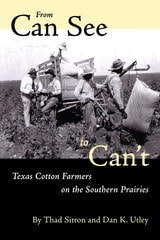
From Can See to Can’t
Texas Cotton Farmers on the Southern PrairiesBy Thad Sitton and Dan K. Utley
University of Texas Press, 1997
Cotton farming was the only way of life that many Texans knew from the days of Austin's Colony up until World War II. For those who worked the land, it was a dawn-till-dark, "can see to can't," process that required not only a wide range of specialized skills but also a willingness to gamble on forces often beyond a farmer's control—weather, insects, plant diseases, and the cotton market.
This unique book offers an insider's view of Texas cotton farming in the late 1920s. Drawing on the memories of farmers and their descendants, many of whom are quoted here, the authors trace a year in the life of south central Texas cotton farms. From breaking ground to planting, cultivating, and harvesting, they describe the typical tasks of farm families—as well as their houses, food, and clothing; the farm animals they depended on; their communities; and the holidays, activities, and observances that offered the farmers respite from hard work.
Although cotton farming still goes on in Texas, the lifeways described here have nearly vanished as the state has become highly urbanized. Thus, this book preserves a fascinating record of an important part of Texas' rural heritage.

From Canton Restaurant to Panda Express
A History of Chinese Food in the United StatesLiu, Haiming
Rutgers University Press, 2015
Finalist in the Culinary History category of the 2016 Gourmand World Cookbook Awards
From Canton Restaurant to Panda Express takes readers on a compelling journey from the California Gold Rush to the present, letting readers witness both the profusion of Chinese restaurants across the United States and the evolution of many distinct American-Chinese iconic dishes from chop suey to General Tso’s chicken. Along the way, historian Haiming Liu explains how the immigrants adapted their traditional food to suit local palates, and gives readers a taste of Chinese cuisine embedded in the bittersweet story of Chinese Americans.
Treating food as a social history, Liu explores why Chinese food changed and how it has influenced American culinary culture, and how Chinese restaurants have become places where shared ethnic identity is affirmed—not only for Chinese immigrants but also for American Jews. The book also includes a look at national chains like P. F. Chang’s and a consideration of how Chinese food culture continues to spread around the globe.
Drawing from hundreds of historical and contemporary newspaper reports, journal articles, and writings on food in both English and Chinese, From Canton Restaurant to Panda Express represents a groundbreaking piece of scholarly research. It can be enjoyed equally as a fascinating set of stories about Chinese migration, cultural negotiation, race and ethnicity, diverse flavored Chinese cuisine and its share in American food market today.
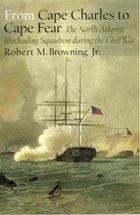
From Cape Charles to Cape Fear
The North Atlantic Blockading Squadron during the Civil WarRobert M. Browning
University of Alabama Press, 2003
A definitive study of Union naval power and the blockade that reshaped the Civil War.
In From Cape Charles to Cape Fear, acclaimed historian Robert M. Browning, Jr. offers a vivid and authoritative account of the Union Navy’s North Atlantic Blockading Squadron, a critical force in the American Civil War. Charged with enforcing the blockade along the Atlantic coastline from Virginia to North Carolina, the squadron played a decisive role in crippling the Confederacy’s economy and restricting its access to vital supplies.
Browning reveals the blockade as far more than a passive defensive strategy. Through detailed analysis of naval operations, coastal engagements, and strategic planning, he demonstrates how Union forces exerted control over key waterways and ports, including Norfolk and Wilmington. These contested hubs became focal points in a high-stakes struggle involving daring blockade runners, shifting naval tactics, and constant pressure on Southern trade networks.
Blending operational history with compelling narrative, Browning also captures the human dimension of naval warfare. Sailors and officers faced unpredictable weather, dangerous missions, and the relentless demands of maintaining control over an expansive coastline. Their experiences illuminate the challenges and complexities of maritime warfare during one of America’s defining conflicts.
Accessible yet richly researched, this book highlights the central importance of naval power in shaping Civil War outcomes. From Cape Charles to Cape Fear stands as an essential work for readers interested in Civil War history, naval strategy, and the enduring impact of maritime operations on the American past.
From Charity to Enterprise
The Development of American Social Work in a Market EconomyStanley Wenocur and Michael Reisch
University of Illinois Press, 1989
Now in paperback for the first time, From Charity to Enterprise sets the professionalization of social work into a dynamic social context. The explicit political and economic framework of Wenocur and Reisch's model enables the authors to examine how various subgroups within social work lost or gained control of the professional enterprise at various points.
From Charity to Social Work
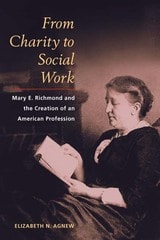
Mary E. Richmond and the Creation of an American ProfessionElizabeth N. Agnew
University of Illinois Press, 2003
Orphaned at a young age and largely self-educated, Richmond initially entered charity work as a means of self-support, but came to play a vital role in transforming philanthropy--previously seen as a voluntary expression of individual altruism--into a valid, organized profession. Her career took her from charity organization leadership in Baltimore and Philadelphia to an executive position with the prestigious Russell Sage Foundation in New York City.
Richmond's progressive civic philosophy of social work was largely informed by the social gospel movement. She strove to find practical applications of the teachings of Christianity in response to the social problems that accompanied rapid industrialization, urbanization, and poverty. At the same time, her tireless efforts and personal example as a woman created an appealing, if ambiguous, path for other professional women. A century later her legacy continues to echo in social work and welfare reform.

From Chinese Exclusion to Guantánamo Bay
Plenary Power and the Prerogative StateNatsu Taylor Saito
University Press of Colorado, 2007
From Chinese Exclusion to Guantánamo Bay also provides a larger context for understanding problems resulting from the exercise of plenary power. Saito explains how the rights of individuals and groups deemed Other by virtue of race or national origin have been violated under both the Constitution and international law. The differing treatment of José Padilla and John Walker Lindh - both Americans accused of terrorism - provides an example of such disparate approaches. Such executive actions and their sanction by Congress and the judiciary, Saito argues, undermine not just individual rights but the very foundations of our national security - democracy and the rule of law.
From Chinese Exclusion to Guantánamo Bay will interest readers concerned with the historical background of constitutional protection in times of war and peace and will provide fascinating new material for scholars, teachers, and students of law, history, and ethnic studies
From Civil War to Civil Rights, Alabama 1860–1960
An Anthology from The Alabama ReviewSarah Woolfolk Wiggins
University of Alabama Press, 1987
To understand Alabama history one must appreciate the impact of the failure of secession of the state in the subsequent half century as well as the causes for the success of the Civil Rights Movement in the state in the mid-twentieth century. The prophet of the first revolution was William Lowndes Yancey and the prophet of the second was Martin Luther King, Jr., two Southerners who set in motion forces that shaped American history beyond the borders of the state and region. In the years between their two lives Alabama changed dramatically.
In the new century, progressives had a distinct sense that they could take on outside forces larger than themselves. National currents swept Alabama into movements for the regulation of railroads, women’s suffrage, child labor reform, and welfare capitalism. Still, progressive reform coexisted with the most frightening political and social movement of early twentieth-century Alabama, the Ku Klux Klan, whose blessing or curse made or broke the careers of powerful politicians.
From Collective Bargaining to Collective Begging
How Public Employees Win and Lose the Right to BargainDominic D. Wells
Temple University Press, 2021
How do public employees win and lose their collective bargaining rights? And how can public sector labor unions protect those rights? These are the questions answered in From Collective Bargaining to Collective Begging. Dominic Wells takes a mixed-methods approach and uses more than five decades of state-level data to analyze the expansion and restriction of rights.
Wells identifies the factors that led states to expand collective bargaining rights to public employees, and the conditions under which public employee labor unions can defend against unfavorable state legislation. He presents case studies and coalition strategies from Ohio and Wisconsin to demonstrate how labor unions failed to protect their rights in one state and succeeded in another.
From Collective Bargaining to Collective Begging also provides a comprehensive quantitative analysis of the economic, political, and cultural factors that both led states to adopt policies that reduced the obstacles to unionization and also led other states to adopt policies that increased the difficulty to form and maintain a labor union. In his conclusion, Wells suggests the path forward for public sector labor unions and what policies need to be implemented to improve employee labor relations.
From Concentration Camp to Campus
Japanese American Students and World War IIAllan W. Austin
University of Illinois Press, 2003
Austin argues that the resettled students transformed the attempts at assimilation to create their own meanings and suit their own purposes, and succeeded in reintegrating themselves into the wider American society without sacrificing their connections to community and their Japanese cultural heritage.
From Conciliation to Conquest
The Sack of Athens and the Court-Martial of Colonel John B. TurchinGeorge C. Bradley and Richard L. Dahlen
University of Alabama Press, 2006
In the summer of 1862, the U.S. Army court martialed Colonel John B. Turchin, a Russian-born Union officer, for "outrages" committed by his troops in Athens, Alabama
In the summer of 1862, the U.S. Army court martialed Colonel John B. Turchin, a Russian-born Union officer, for offenses committed by his troops in Athens, Alabama, including looting, safe cracking, the vandalization of homes, and the rape of young black women. The pillage of Athens violated a government policy of conciliation; it was hoped that if Southern civilians were treated gently as citizens of the United States, they would soon return their allegiance to the federal government.
By examining the volunteers who made up Turchin’s force, the colonel's trial, his subsequent promotion, the policy debate surrounding the incident and the public reaction to the outcome, the authors further illuminate one of the most provocative questions in Civil War studies: how did the policy set forth by President Lincoln evolve from one of conciliation to one far more modern in nature, placing the burden of war on the civilian population of the South?
From Confinement to Containment
Japanese/American Arts during the Early Cold WarEdward Tang
Temple University Press, 2019
During the early part of the Cold War, Japan emerged as a model ally, and Japanese Americans were seen as a model minority. From Confinement to Containment examines the work of four Japanese and Japanese/American artists and writers during this period: the novelist Hanama Tasaki, the actor Yamaguchi Yoshiko, the painter Henry Sugimoto, and the children’s author Yoshiko Uchida. The backgrounds of the four figures reveal a mixing of nationalities, a borrowing of cultures, and a combination of domestic and overseas interests.
Edward Tang shows how the film, art, and literature made by these artists revealed to the American public the linked processes of U.S. actions at home and abroad. Their work played into—but also challenged—the postwar rehabilitated images of Japan and Japanese Americans as it focused on the history of transpacific relations such as Japanese immigration to the United States, the Asia-Pacific War, U.S. and Japanese imperialism, and the wartime confinement of Japanese Americans. From Confinement to Containment shows the relationships between larger global forces as well as how the artists and writers responded to them in both critical and compromised ways.
From Cotton Belt to Sunbelt
Federal Policy, Economic Development, and the Transformation of the South 1938–1980Bruce J. Schulman
Duke University Press, 1994
From Counterculture to Cyberculture
Stewart Brand, the Whole Earth Network, and the Rise of Digital UtopianismFred Turner
University of Chicago Press, 2006
In the early 1960s, computers haunted the American popular imagination. Bleak tools of the cold war, they embodied the rigid organization and mechanical conformity that made the military-industrial complex possible. But by the 1990s—and the dawn of the Internet—computers started to represent a very different kind of world: a collaborative and digital utopia modeled on the communal ideals of the hippies who so vehemently rebelled against the cold war establishment in the first place.
From Counterculture to Cyberculture is the first book to explore this extraordinary and ironic transformation. Fred Turner here traces the previously untold story of a highly influential group of San Francisco Bay–area entrepreneurs: Stewart Brand and the Whole Earth network. Between 1968 and 1998, via such familiar venues as the National Book Award–winning Whole Earth Catalog, the computer conferencing system known as WELL, and, ultimately, the launch of the wildly successful Wired magazine, Brand and his colleagues brokered a long-running collaboration between San Francisco flower power and the emerging technological hub of Silicon Valley. Thanks to their vision, counterculturalists and technologists alike joined together to reimagine computers as tools for personal liberation, the building of virtual and decidedly alternative communities, and the exploration of bold new social frontiers.
Shedding new light on how our networked culture came to be, this fascinating book reminds us that the distance between the Grateful Dead and Google, between Ken Kesey and the computer itself, is not as great as we might think.
From Cuenca to Queens
An Anthropological Story of Transnational MigrationBy Ann Miles
University of Texas Press, 2004
Transnational migration is a controversial and much-discussed issue in both the popular media and the social sciences, but at its heart migration is about individual people making the difficult choice to leave their families and communities in hopes of achieving greater economic prosperity. Vicente Quitasaca is one of these people. In 1995 he left his home in the Ecuadorian city of Cuenca to live and work in New York City. This anthropological story of Vicente's migration and its effects on his life and the lives of his parents and siblings adds a crucial human dimension to statistics about immigration and the macro impact of transnational migration on the global economy.
Anthropologist Ann Miles has known the Quitasacas since 1989. Her long acquaintance with the family allows her to delve deeply into the factors that eventually impelled the oldest son to make the difficult and dangerous journey to the United States as an undocumented migrant. Focusing on each family member in turn, Miles explores their varying perceptions of social inequality and racism in Ecuador and their reactions to Vicente's migration. As family members speak about Vicente's new, hard-to-imagine life in America, they reveal how transnational migration becomes a symbol of failure, hope, resignation, and promise for poor people in struggling economies. Miles frames this fascinating family biography with an analysis of the historical and structural conditions that encourage transnational migration, so that the Quitasacas' story becomes a vivid firsthand illustration of this growing global phenomenon.
From Darkness to Dynasty
The First 40 Years of the New England PatriotsJerry Thornton
University Press of New England, 2016

From Dead Ends to Cold Warriors
Constructing American Boyhood in Postwar Hollywood FilmsPeter W.Y. Lee
Rutgers University Press, 2021
From Dickinson to Dylan
Visions of Transcendence in Modernist LiteratureGlenn Hughes
University of Missouri Press, 2020
This work is unique in its extended focus, in a comparative study spanning a century, on the persistence and centrality in modernist literature of the struggle to understand and articulate the dependence of human meaning on the mystery of transcendent meaning. Hughes shows us that each of these authors is a mystic in his or her way, and that none are tempted by the modern inclination to suppose that meaning originates with human beings. Together, they address one of the most difficult and important challenges of modern literature: how to be a mystic in modernity.
From Disarmament to Rearmament
The Reversal of US Policy toward West Germany, 1946–1955Sheldon A. Goldberg
Ohio University Press, 2017
At the end of World War II, the Allies were unanimous in their determination to disarm the former aggressor Germany. As the Cold War intensified, however, the decision whether to reverse that policy and to rearm West Germany as a bulwark against the Soviet threat led to disagreements both within the US government and among members of the nascent NATO alliance. The US military took the practical view that a substantial number of German troops would be required to deter any potential Soviet assault. The State Department, on the other hand, initially advocated an alternative strategy of strengthening European institutions but eventually came around to the military’s position that an armed West Germany was preferable to a weak state on the dividing line between the Western democracies and the Soviet satellite states.
Sheldon A. Goldberg traces the military, diplomatic, and political threads of postwar policy toward West Germany and provides insights into the inner workings of alliance building and the roles of bureaucrats and military officers as well as those of diplomats and statesmen. He draws on previously unexamined primary sources to construct a cogent account of the political and diplomatic negotiations that led to West Germany’s accession to NATO and the shaping of European order for the next forty years.

From Dixie to Rocky Top
Music and Meaning in Southeastern Conference FootballCarrie Tipton
Vanderbilt University Press, 2023
The first book to explore the history of college fight songs as a culturally important phenomenon, From Dixie to Rocky Top zeroes in on the US South, where college football has forged a powerful, quasi-religious sense of meaning and identity throughout the region.
Tracing the story of Southeastern Conference (SEC) fight songs from the late nineteenth to the early twenty-first century, author Carrie Tipton places this popular repertory within the broader commercial music industry and uses fight songs to explore themes of authorship and copyright; the commodification of school spirit; and the construction of race, gender, and regional identity in Southern football culture.
This book unearths the history embedded in SEC football’s music traditions, drawing from the archives of the seventeen universities currently or formerly in the conference. Alongside rich primary sources, Tipton incorporates approaches and literature from sports history, Southern and American history, Southern and American studies, and musicology.
Chronicling iconic Southern fight songs’ origins, dissemination, meanings, and cultural reception over a turbulent century, From Dixie to Rocky Top weaves a compelling narrative around a virtually unstudied body of popular music.
From Du Bois to Obama
African American Intellectuals in the Public ForumCharles Pete Banner-Haley
Southern Illinois University Press, 2014
In his groundbreaking new book Charles Pete Banner-Haley explores the history of African American intellectualism and reveals the efforts of black intellectuals in the ongoing struggle against racism, showing how they have responded to Jim Crow segregation, violence against black Americans, and the more subtle racism of the postintegration age. Banner-Haley asserts that African American intellectuals—including academicians, social critics, activists, and writers—serve to generate debate, policy, and change, acting as a moral force to persuade Americans to acknowledge their history of slavery and racism, become more inclusive and accepting of humanity, and take responsibility for social justice.
Other topics addressed in this insightful study include the disconnection over time between black intellectuals and the masses for which they speak; the ways African American intellectuals identify themselves in relation to the larger black community, America as a whole, and the rest of the world; how black intellectuals have gained legitimacy in American society and have accrued moral capital, especially in the area of civil rights; and how that moral capital has been expended. Among the influential figures covered in the book are W. E. B. Du Bois, Ralph Ellison, Richard Wright, James Weldon Johnson, E. Franklin Frazier, Ralph Bunche, Oliver C. Cox, George S. Schuyler, Zora Neale Hurston, Martin Luther King, Jr., Jesse Jackson, Cornel West, Toni Morrison, bell hooks, Charles Johnson, and Barack Obama.
African American intellectuals, as Banner-Haley makes clear, run the political gamut from liberal to conservative. He discusses the emergence of black conservatism, with its accompanying questions about affirmative action, government intervention on behalf of African Americans, and the notion of a color-blind society. He also looks at how popular music—particularly rap and hip-hop—television, movies, cartoons, and other media have functioned as arenas for investigating questions of identity, exploring whether African American intellectuals can also be authentically black.
A concluding discussion of the so-called browning of America, and the subsequent rise in visibility and influence of black intellectuals culminates with the historic election of President Barack Obama, an African American intellectual who has made significant contributions to American society through his books, articles, and speeches. Banner-Haley ponders what Obama’s election will mean for the future of race relations and black intellectualism in America.
From Edward Brooke to Barack Obama
African American Political Success, 1966-2008Dennis S. Nordin
University of Missouri Press, 2012
In From Edward Brooke to Barack Obama, Dennis S. Nordin navigates the history of biracial elections by examining the experiences of a variety of African American politicians from across the country, revealing how voters, both black and white, respond to the issue of race in an election.
From Edward Brooke to Barack Obama investigates the implications of race in politics, a highly relevant topic in today’s American society. It offers readers a chronological overview of the progress made over the last several decades as well as shows where there is room for growth in the political arena. By taking a pertinent topic for the era and placing it in the context of history, Nordin successfully chronicles the roles of race and race relations in American politics.
From Eve to Evolution
Darwin, Science, and Women's Rights in Gilded Age AmericaKimberly A. Hamlin
University of Chicago Press, 2014
Hamlin chronicles the lives and writings of the women who combined their enthusiasm for evolutionary science with their commitment to women’s rights, including Antoinette Brown Blackwell, Eliza Burt Gamble, Helen Hamilton Gardener, Charlotte Perkins Gilman, and Elizabeth Cady Stanton. These Darwinian feminists believed evolutionary science proved that women were not inferior to men, that it was natural for mothers to work outside the home, and that women should control reproduction. The practical applications of this evolutionary feminism came to fruition, Hamlin shows, in the early thinking and writing of the American birth control pioneer Margaret Sanger.
Much scholarship has been dedicated to analyzing what Darwin and other male evolutionists had to say about women, but very little has been written regarding what women themselves had to say about evolution. From Eve to Evolution adds much-needed female voices to the vast literature on Darwin in America.
From Expectation to Experience
Essays on Law and Legal EducationJames Boyd White
University of Michigan Press, 2000
The essays here are united by two basic themes. First, the essays suggest that law can usefully be regarded not only as a set of rules designed to produce results in the material world, as it usually is regarded, but also as an imaginative and intellectual activity that has as its end the claim of meaning for human experience, both individual and collective. Second, they argue that education, including in the law, works by the constant modification of expectation by experience.
White claims that as we grow, whether as individuals or as a community, we constantly shape our expectations to our experiences. This happens with particular force and clarity in the law, which seeks to create both a certain set of expectations--this is how it works as a system of regulation--and a series of occasions and methods for their revision. White's interest is in the way these understandings can affect legal teaching, practice, and criticism.
The essays in this book examine such topics as the nature of legal education; the possibilities for writing in the law for both judges and lawyers; the relation between the practice of making and claiming meaning as it works in the law and in literatures more usually though of as imaginative, such as poetry or drama; the ways in which the law talks, and ought to talk, about business corporations, religion, and individual judgments; and the ethical possibilities of the practice of law when it is conceived of as a field for the making of meaning.
From Expectation to Experience will be of interest to lawyers, legal scholars, as well as students of law, law and literature, and ethics and literature.
James Boyd White is Hart Wright Professor of Law, Professor of English, and Adjunct Professor of Classical Studies, University of Michigan.

From Football to Soccer
The Early History of the Beautiful Game in the United StatesBrian D. Bunk
University of Illinois Press, 2021
Across North America, native peoples and colonists alike played a variety of kicking games long before soccer's emergence in the late 1800s. Brian D. Bunk examines the development and social impact of these sports through the rise of professional soccer after World War I. As he shows, the various games called football gave women an outlet as athletes and encouraged men to form social bonds based on educational experience, occupation, ethnic identity, or military service. Football also followed young people to college as higher education expanded in the nineteenth century. University play, along with the arrival of immigrants from the British Isles, helped spark the creation of organized soccer in the United States—and the beautiful game's transformation into a truly international sport.
A multilayered look at one game’s place in American life, From Football to Soccer refutes the notion of the U.S. as a land outside of football history.
From French Community to Missouri Town
Ste. Genevieve in the Nineteenth CenturyBonnie Stepenoff
University of Missouri Press, 2024
From Frontier to Plantation In Tennessee
A Study in Frontier DemocracyThomas Perkins Abernethy
University of Alabama Press, 1967
A reprint of Abernethy's excellent historical study of the state of Tennesse from its founding through the antebellum years. In documenting the development of an agrarian society on the frontier, Abernethy develops important and controversial theses on the relation between frontier life and the development of American democracy, calling into question the mythology and motives previously associated with leaders such as William Blount, Andrew Jackson, James K. Polk, and Andrew Johnson.
From Fugitive Slave to Free Man
The Autobiographies of William Wells BrownEdited with an Introduction by William L. Andrews
University of Missouri Press, 2003

From Gift to Commodity
Capitalism and Sacrifice in Nineteenth-Century American FictionHildegard Hoeller
University of New Hampshire Press, 2012
From Good Will To Civil Rights
Transforming Federal Disability PolicyRichard K. Scotch
Temple University Press, 2001
The first edition of From Good Will to Civil Rights traced the changes in federal disability policy, focusing on the development and implementation of Section 504 of the Rehabilitation Act of 1973. Richard K. Scotch's extensive interviews with policymakers, leaders of the disability rights movement, and other advocates, supplemented the sketchy official history of the legislation with the detailed, behind-the-scenes story, illuminating the role of the disability rights movement in shaping Section 504. Charting the shifts in policy and activist agendas through the 1990's, this new edition surveys the effects and disappointments associated with the Americans with Disabilities Act, passed in 1990, in the context of the continuing movement to secure civil rights for disabled people.
From Hanoi to Hollywood
The Vietnam War in American FilmDittmar, Linda
Rutgers University Press, 1990
The title of this anthology calls attention to the process whereby aspects of the Vietnam War have been appropriated by the American cultural industry. Probing the large body of emotion-laden, controversial films, From Hanoi to Hollywood is concerned with the retelling of history and the retrospection that such a process involves. In this anthology, an awareness of film as a cultural artifact that molds beliefs and guides action is emphasized, an awareness that the contributors bring to a variety of films. Their essays span over one hundred documentary and fiction films, and include in-depth analyses of major commercial films, ranging from Apocalypse Now to Platoon, Rambo: First Blood Part II, and Full Metal Jacket, and documentaries from In the Year of the Pig to Dear America: Letters Home from Vietnam.
The essays in this volume deal with representations of the Vietnam war in documentary film and television reporting, examining the ways the power of film is used to deliver political messages. There are surprises here, new readings, and important insights on the ways we as a society have attempted to come to terms with the experiences of the Vietnam era. The book also contains two appendixes-a detailed chronology charting the relationship between major historical events and the release of American war films from 1954 through 1988, and a filmography listing information on over four hundred American and foreign films about the Vietnam War.
From Hate to Hallows
Reframing Black Church ArsonTodne Thomas
Duke University Press, 2026

From Here to Free Trade
Essays in Post-Uruguay Round Trade StrategyErnest H. Preeg
University of Chicago Press, 1998
The first essay assesses U.S. interests in economic globalization, the second examines recent steps toward free trade at the multilateral and regional levels, and the next three offer an in-depth critique of U.S. regional free trade objectives in the Americas, across the Pacific, and possibly with Europe. The final essay presents a multilateral/regional synthesis for going from here to free trade over the coming decade.
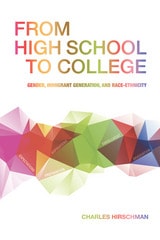
From High School to College
Gender, Immigrant Generation, and Race-EthnicityCharles Hirschman
Russell Sage Foundation, 2016
Today, over 75 percent of high school seniors aspire to graduate from college. However, only one-third of Americans hold a bachelor’s degree, and college graduation rates vary significantly by race/ethnicity and parental socioeconomic status. If most young adults aspire to obtain a college degree, why are these disparities so great? In From High School to College, Charles Hirschman analyzes the period between leaving high school and completing college for nearly 10,000 public and private school students across the Pacific Northwest.
Hirschman finds that although there are few gender, racial, or immigration-related disparities in students’ aspirations to attend and complete college, certain groups succeed at the highest rates. For example, he finds that women achieve better high school grades and report receiving more support and encouragement from family, peers, and educators. They tend to outperform men in terms of preparing for college, enrolling in college within a year of finishing high school, and completing a degree. Similarly, second-generation immigrants are better prepared for college than first-generation immigrants, in part because they do not have to face language barriers or learn how to navigate the American educational system.
Hirschman also documents that racial disparities in college graduation rates remain stark. In his sample, 35 percent of white students graduated from college within seven years of completing high school, compared to only 19 percent of black students and 18 percent of Hispanic students. Students’ socioeconomic origins—including parental education and employment, home ownership, and family structure—account for most of the college graduation gap between disadvantaged minorities and white students. Further, while a few Asian ethnic groups have achieved college completion rates on par with whites, such as Chinese and Koreans, others, whose socioeconomic origins more resemble those of black and Hispanic students, such as Filipinos and Cambodians, also lag behind in preparedness, enrollment, and graduation from college.
With a growing number of young adults seeking college degrees, understanding the barriers that different students encounter provides vital information for social scientists and educators. From High School to College illuminates how gender, immigration, and ethnicity influence the path to college graduation.

From Home Guards to Heroes
The 87th Pennsylvania and Its Civil War CommunityDennis W. Brandt
University of Missouri Press, 2007
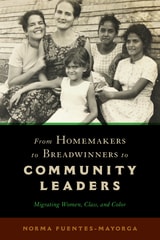
From Homemakers to Breadwinners to Community Leaders
Migrating Women, Class, and ColorNorma Fuentes-Mayorga
Rutgers University Press, 2022
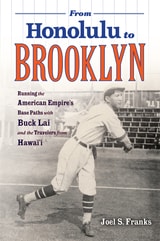
From Honolulu to Brooklyn
Running the American Empire’s Base Paths with Buck Lai and the Travelers from Hawai’iJoel S. Franks
Rutgers University Press, 2022

From Humors to Medical Science
A HISTORY OF AMERICAN MEDICINEJohn Duffy
University of Illinois Press, 1993
John Duffy's classic history, formerly titled The Healers, has
been thoroughly revised and updated for this second edition, which includes
new chapters on women and minorities in medicine and on the challenges
currently facing the health care field.
"This remains the only comprehensive history of American medicine.
The treatment of the emergence of modern medicine and the flowering of
surgery is especially fresh and well done. As one of the respected scholars
in our profession, John Duffy has again demonstrated his wide knowledge
of the subject."
-- Thomas N. Brunner, author of To the Ends of the Earth: Women's
Search for Education in Medicine
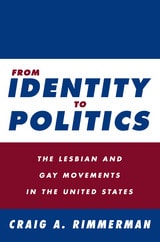
From Identity To Politics
Lesbian & Gay Movements In The U.S.Craig Rimmerman
Temple University Press, 2001
Enriched by eight years of interviews in Washington, D.C. and New York City, and by the author's experience as a Capitol Hill staffer, From Identity to Politics will provoke discussion in classrooms and caucus rooms across the United States.
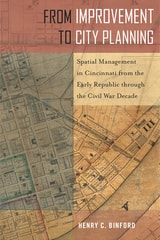
From Improvement to City Planning
Spatial Management in Cincinnati from the Early Republic through the Civil War DecadeHenry C. Binford
Temple University Press, 2021
From Improvement to City Planning emphasizes the ways people in nineteenth-century America managed urban growth. Historian Henry Binford shows how efforts to improve space were entwined with the evolution of urban governance (i.e., regulation)—and also influenced by a small group of advantaged families.
Binford looks specifically at Cincinnati, Ohio, then the largest and most important interior city west of the Appalachian Mountains. He shows that it was not just industrialization, but also beliefs about morality, race, health, poverty, and “slum” environments, that demanded an improvement of urban space. As such, movements for public parks and large-scale sanitary engineering in the 1840s and ’50s initiated the beginning of modern city planning. However, there were limitations and consequences to these efforts..
Many Americans believed that remaking city environments could also remake citizens. From Improvement to City Planning examines how the experiences of city living in the early republic prompted city dwellers to think about and shape urban space.
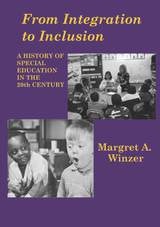
From Integration to Inclusion
A History of Special Education in the 20th CenturyMargret A. Winzer
Gallaudet University Press, 2009
Since Margret A. Winzer wrote her landmark work The History of Special Education, much has transpired in this field, which she again has captured in a remarkable display of scholarship. Winzer’s new study From Integration to Inclusion: A History of Special Education in the 20th Century focuses chiefly on the significant events of the twentieth and early twenty-first centuries in the United States and Canada. Its key dynamics consist of a retrospective overview of the paradigms that emerged from and shaped special education; a critical assessment of past progress and reform, including failures and disappointments; and an analysis of the theoretical diversity within the discipline.
In this stand-alone volume, Winzer juxtaposes the historical study of disability and of special schooling and service provision with reference to broader social systems, protocols, and practices. She documents how prevailing emotional and intellectual climates influence disability and schooling, and also takes into account the social, political, and ideological factors that affect educational theory and practice. Winzer recognizes that reform has been the Zeitgeist of the history of special education. Crucial problems such as defining exceptional conditions and separating them from one another were formulated in contexts organized along moral, theological, legislative, medical, and social dimensions. Many of these reforms failed for various reasons, which Winzer thoroughly explains in her study. Most of these reforms evolved from the long and honorable pedigree that the field of special education has possessed since its earliest antecedents, now admirably brought up to date by this outstanding work.
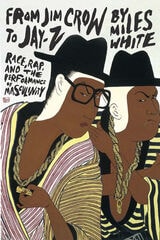
From Jim Crow to Jay-Z
Race, Rap, and the Performance of MasculinityMiles White
University of Illinois Press, 2011
From Jim Crow to Jay-Z traces black male representations to chattel slavery and American minstrelsy as early examples of fetishization and commodification of black male subjectivity. Continuing with diverse discussions including black action films, heavyweight prizefighting, Elvis Presley's performance of blackness, and white rappers such as Vanilla Ice and Eminem, White establishes a sophisticated framework for interpreting and critiquing black masculinity in hip-hop music and culture. Arguing that black music has undeniably shaped American popular culture and that hip-hop tropes have exerted a defining influence on young male aspirations and behavior, White draws a critical link between the body, musical sound, and the construction of identity.