Results by title
22279 books match the query 'Social Science' and 955 start with f

From Reverence to Rape
The Treatment of Women in the MoviesMolly Haskell
University of Chicago Press, 1987
"An incisive, exceedingly thoughtful look at the distorted lens through which Hollywood has historically viewed women. It is a valuable contribution not just of film criticism but to a society in which the vital role of women is just beginning to emerge."—Christian Science Monitor
"Haskell is interested in women—how they are used in movies, how they use movies, and how the parts they play function as projections and verifications of our myths about women's lot and woman's psyche and even, lately, women's lib."—Jane Kramer, Village Voice
"In examining the goddesses worshipped by an entire nation, Molly Haskell reveals a good deal about our national character and our most cherished sexual myths. . . . Concerned with the deeply ingrained belief of women's inferiority, she analyzes movies as a social product as well as a social arbiter, and she effectively demonstrates how women are encouraged to impose limitations on themselves by fashioning those selves after flickering shadows in a darkened auditorium—sexual creatures who possess neither ability nor ambition beyond their bodies. . . . Both as an examination of film and as sociology, From Reverence to Rape is excellent."—Harriet Kriegel, The Nation

From Reverence to Rape
The Treatment of Women in the Movies, Third EditionMolly Haskell
University of Chicago Press, 2016
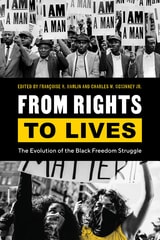
From Rights to Lives
The Evolution of the Black Freedom StruggleEdited by Françoise N. Hamlin and Charles W. McKinney Jr.
Vanderbilt University Press, 2024
From Rights to Lives critically engages the dynamic relationship between these two moments of liberatory possibility on the Black Freedom Struggle timeline. The book’s contributors explore what we can learn when we place these moments of struggle in dialogue with each other. They grapple with how our understanding of the postwar moment shapes our analysis of #BLM and wherein lie the discontinuities, in order to glean lessons for future moments of insurgency.
From Russia with Code
Programming Migrations in Post-Soviet TimesMario Biagioli and Vincent Antonin Lepinay, editors
Duke University Press, 2019
Contributors. Irina Antoschyuk, Mario Biagioli, Ksenia Ermoshina, Marina Fedorova, Andrey Indukaev, Alina Kontareva, Diana Kurkovsky, Vincent Lépinay, Alexandra Masalskaya, Daria Savchenko, Liubava Shatokhina, Alexandra Simonova, Ksenia Tatarchenko, Zinaida Vasilyeva, Dimitrii Zhikharevich
From SWEETBACK to SUPER FLY
Race and Film Audiences in Chicago's LoopGerald R. Butters, Jr.
University of Missouri Press, 2014
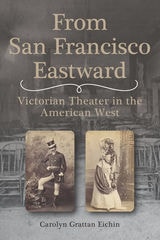
From San Francisco Eastward
Victorian Theater in the American WestCarolyn Grattan Eichin
University of Nevada Press, 2020
Finalist for the 2021 Will Rogers Medallion Award in Western Non-Fiction
Carolyn Grattan Eichin’s From San Francisco Eastward explores the dynamics and influence of theater in the West during the Victorian era. San Francisco, Eichin argues, served as the nucleus of the western theatrical world, having attained prominence behind only New York and Boston as the nation’s most important theatrical center by 1870. By focusing on the West’s hinterland communities, theater as a capitalist venture driven by the sale of cultural forms is illuminated against the backdrop of urbanization.
Using the vagaries of the West’s notorious boom-bust economic cycles, Eichin traces the fiscal, demographic, and geographic influences that shaped western theater. With an emphasis on the 1860s and 70s, this thoroughly researched work uses distinct notions of ethnicity, class, and gender to examine a cultural institution driven by a market economy. From San Francisco Eastward is a thorough analysis of the ever-changing theatrical personalities and strategies that shaped Victorian theater in the West, and the ways in which theater as a business transformed the values of a region.
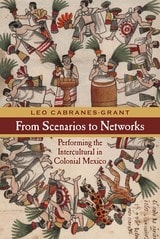
From Scenarios to Networks
Performing the Intercultural in Colonial MexicoLeo Cabranes-Grant
Northwestern University Press, 2016
In this innovative study, Leo Cabranes-Grant analyzes four intercultural events in the Viceroyalty of New Spain that took place between 1566 and 1690. Rather than relying on racial labels to describe alterations of identity, Cabranes-Grant focuses on experimentation, rehearsal, and the interaction between bodies and objects. His analysis shows how scenarios are invested with affective qualities, which in turn enable cultural and semiotic change. Central to his argument is Bruno Latour’s Actor-Network Theory, which figures society as a constantly evolving web of relationships among objects, people, and spaces. In examining these scenarios, Cabranes-Grant attempts to discern the reasons why the conditions of an intensified moment within this ceaseless flow take on a particular value and inspire their re-creation. Cabranes-Grant offers a fresh perspective on Latour’s theory and reorients debates concerning history and historiography in the field of performance studies.

From Single to Serious
Relationships, Gender, and Sexuality on American Evangelical CampusesMalone, Dana M.
Rutgers University Press, 2018
In From Single to Serious, Dana M. Malone shines a light on friendship, dating, and, sexuality, in both the ideals and the practical experiences of heterosexual students at U. S. evangelical colleges. She examines the struggles they have in balancing their gendered and religious presentations of self, the expectations of their campus community, and their desire to find meaningful romantic relationships.

From Skepticism to Competence
How American Psychiatrists Learn PsychotherapyMariana Craciun
University of Chicago Press, 2024
While many medical professionals can physically examine the body to identify and understand its troubles—a cardiologist can take a scan of the heart, an endocrinologist can measure hormone levels, an oncologist can locate a tumor—psychiatrists have a much harder time unlocking the inner workings of the brain or its metaphysical counterpart, the mind.
In From Skepticism to Competence, sociologist Mariana Craciun delves into the radical uncertainty of psychiatric work by following medical residents in the field as they learn about psychotherapeutic methods. Most are skeptical at the start. While they are well equipped to treat brain diseases through prescription drugs, they must set their expectations aside and learn how to navigate their patients’ minds. Their instructors, experienced psychotherapists, help the budding psychiatrists navigate this new professional terrain by revealing the inner workings of talk and behavioral interventions and stressing their utility in a world dominated by pharmaceutical treatments. In the process, the residents examine their own doctoring assumptions and develop new competencies in psychotherapy. Exploring the world of contemporary psychiatric training, Craciun illuminates novice physicians’ struggles to understand the nature and meaning of mental illness and, with it, their own growing medical expertise.
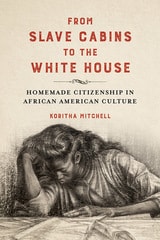
From Slave Cabins to the White House
Homemade Citizenship in African American CultureKoritha Mitchell
University of Illinois Press, 2021
Koritha Mitchell analyzes canonical texts by and about African American women to lay bare the hostility these women face as they invest in traditional domesticity. Instead of the respectability and safety granted white homemakers, black women endure pejorative labels, racist governmental policies, attacks on their citizenship, and aggression meant to keep them in "their place."
Tracing how African Americans define and redefine success in a nation determined to deprive them of it, Mitchell plumbs the works of Frances Harper, Zora Neale Hurston, Lorraine Hansberry, Toni Morrison, Michelle Obama, and others. These artists honor black homes from slavery and post-emancipation through the Civil Rights era to "post-racial" America. Mitchell follows black families asserting their citizenship in domestic settings while the larger society and culture marginalize and attack them, not because they are deviants or failures but because they meet American standards.
Powerful and provocative, From Slave Cabins to the White House illuminates the links between African American women's homemaking and citizenship in history and across literature.
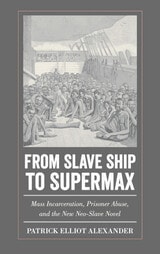
From Slave Ship to Supermax
Mass Incarceration, Prisoner Abuse, and the New Neo-Slave NovelPatrick Elliot Alexander
Temple University Press, 2017
In his cogent and groundbreaking book, From Slave Ship to Supermax, Patrick Elliot Alexander argues that the disciplinary logic and violence of slavery haunt depictions of the contemporary U.S. prison in late twentieth-century Black fiction. Alexander links representations of prison life in James Baldwin’s novel If Beale Street Could Talk to his engagements with imprisoned intellectuals like George Jackson, who exposed historical continuities between slavery and mass incarceration. Likewise, Alexander reveals how Toni Morrison’s Beloved was informed by Angela Y. Davis’s jail writings on slavery-reminiscent practices in contemporary women’s facilities. Alexander also examines recurring associations between slave ships and prisons in Charles Johnson’s Middle Passage, and connects slavery’s logic of racialized premature death to scenes of death row imprisonment in Ernest Gaines’ A Lesson Before Dying.
Alexander ultimately makes the case that contemporary Black novelists depict racial terror as a centuries-spanning social control practice that structured carceral life on slave ships and slave plantations—and that mass-produces prisoners and prisoner abuse in post–Civil Rights America. These authors expand free society’s view of torment confronted and combated in the prison industrial complex, where discriminatory laws and the institutionalization of secrecy have reinstated slavery’s system of dehumanization.
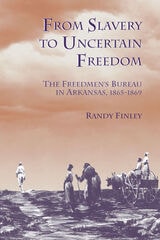
From Slavery to Uncertain Freedom
The Freedman's Bureau in Arkansas 1865-1869Randy Finley
University of Arkansas Press, 1996
In this account of hte gains made by Arkansas freedman during this period, Randy Finley describes the ways that blacks, whites, and bureau officials undertook their foles in a new society and began to live the complex reality of freedom.
1996 Certificate of Commendation American Association for State and Local History

From Sleep Unbound
Andrée Chedid
Ohio University Press, 1983

From Small Talk to Microaggression
A History of ScaleMichael Lempert
University of Chicago Press, 2024
In this ambitious, wide-ranging book, anthropologist Michael Lempert offers a conceptual history that explores how, why, and with what effects we have come to think of interactions as “scaled.” Focusing on the sciences of interaction in midcentury America, Lempert traces how they harnessed diverse tools and media technologies, from dictation machines to 16mm film, to study communication “microscopically.” In looking closely, many hoped to transform interaction: to improve efficiency, grow democracy, curb racism, and much else. Yet their descent into a microworld created troubles, with some critics charging that these scientists couldn’t see the proverbial forest for the trees. Exploring talk therapy and group dynamics studies, social psychology and management science, conversation analysis, “micropolitics,” and more, Lempert shows how scale became a defining problem across the behavioral sciences.
Ultimately, he argues, if we learn how our objects of study have been scaled in advance, we can better understand how we think and interact with them—and with each other—across disciplinary and ideological divides. Even as once-fierce debates over micro and macro have largely subsided, Lempert shows how scale lives on and continues to affect the ethics and politics of language and communication today.
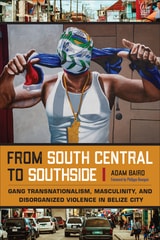
From South Central to Southside
Gang Transnationalism, Masculinity, and Disorganized Violence in Belize CityAdam Baird
Temple University Press, 2024
From South Central to Southside charts the genesis and evolution of a transnational gang culture. Baird provides firsthand interviews with gang members and “narco” families and explains the surprising source of Belize City’s severe violence and skyrocketing homicide rates. He identifies gang violence in the U.S. and Belize as stemming from populations blighted by historical, brutal inequality and marginalization. Analyzing the gendered dynamics as young men and women face the temptations, risks, and dangers of gang life, Baird shines a light on “chronic vulnerability" in Belize City.

From Spaniard to Creole
The Archaeology of Cultural Formation at Puerto Real, HaitiCharles Robin Ewen
University of Alabama Press, 1991
Tracing the archaeological origins of Creole identity in the early colonial Caribbean.
While most studies of intercultural contact focus on the impact of the intrusive power on the native culture, this book examines the effects of the colonization process on the Spaniards in the New World during the 16th century. The site of Puerto Real on the north coast of Haiti serves as a case study. Based on the results of excavations at both Puerto Real and St. Augustine, Florida, this study suggests that the introduction of New World and African cultural elements into Spanish colonial culture began almost at contact. The model of acculturative processes, developed in St. Augustine and tested at Puerto Real, can serve to guide future Spanish colonial research. It can also be applied to non-Hispanic colonial sites in the New World. Did the French and British adapt to their new environments in a manner similar to the Spanish? Work done at Puerto Real demonstrates the utility of archaeology in the study of the effects of culture contact.

From Spirituals to Symphonies
African-American Women Composers and Their MusicHelen Walker-Hill
University of Illinois Press, 2006
Helen Walker-Hill's unique study provides a carefully researched examination of the history and scope of musical composition by African American women composers from the nineteenth and twentieth centuries. Focusing on the effect of race, gender, and class, From Spirituals to Symphonies notes the important role played by individual personalities and circumstances in shaping this underappreciated category of American art. The study also provides in-depth exploration of the backgrounds, experiences, and musical compositions of eight African American women including Margaret Bonds, Undine Smith Moore, and Julia Perry, who combined the techniques of Western art music with their own cultural traditions and individual gifts. Despite having gained national and international recognition during their lifetimes, the contributions of many of these women are today forgotten.
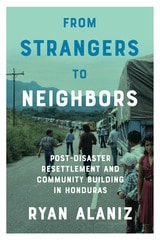
From Strangers to Neighbors
Post-Disaster Resettlement and Community Building in HondurasBy Ryan Alaniz
University of Texas Press, 2017
Natural disasters, the effects of climate change, and political upheavals and war have driven tens of millions of people from their homes and spurred intense debates about how governments and nongovernmental organizations (NGOs) should respond with long-term resettlement strategies. Many resettlement efforts have focused primarily on providing infrastructure and have done little to help displaced people and communities rebuild social structure, which has led to resettlement failures throughout the world. So what does it take to transform a resettlement into a successful community?
This book offers the first long-term comparative study of social outcomes through a case study of two Honduran resettlements built for survivors of Hurricane Mitch (1998) by two different NGOs. Although residents of each arrived from the same affected neighborhoods and have similar demographics, twelve years later one resettlement wrestles with high crime, low participation, and low social capital, while the other maintains low crime, a high degree of social cohesion, participation, and general social health. Using a multi-method approach of household surveys, interviews, ethnography, and analysis of NGO and community documents, Ryan Alaniz demonstrates that these divergent resettlement trajectories can be traced back to the type and quality of support provided by external organizations and the creation of a healthy, cohesive community culture. His findings offer important lessons and strategies that can be utilized in other places and in future resettlement policy to achieve the most effective and positive results.

From Submarines to Suburbs
Selling a Better America, 1939–1959Cynthia Lee Henthorn
Ohio University Press, 2006
From Submarines to Suburbs surveys the development, strategy, and effect of these campaigns over a span of twenty pivotal years. Cynthia Lee Henthorn takes a close look at how pre-fabricated suburban houses, high-tech kitchens, and miracle products developed from war-related industries were promoted as the hygienic solutions for establishing this better America, one led by the captains of free enterprise.
As Henthorn demonstrates, wartime advertising and marketing strategies tying consumer prosperity to war were easily adapted in the Cold War era, when a symbiotic relationship between military standing and standards of living intensified in a culture dependent on defense spending. Were the efforts to engineer a better America successful? Using documentary evidence in the form of numerous advertisements, From Submarines to Suburbs stands as a significant contribution to understanding how today’s “better” America evolved.
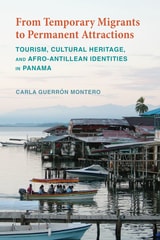
From Temporary Migrants to Permanent Attractions
Tourism, Cultural Heritage, and Afro-Antillean Identities in PanamaCarla Guerrón Montero
University of Alabama Press, 2020
A new reading of Panama’s nation-building process, interpreted through a lens of transnational tourism
Based on long-term ethnographic and archival research, From Temporary Migrants to Permanent Attractions: Tourism, Cultural Heritage, and Afro-Antillean Identities in Panama considers the intersection of tourism, multiculturalism, and nation building. Carla Guerrón Montero analyzes the ways in which tourism becomes a vehicle for the development of specific kinds of institutional multiculturalism and nation-building projects in a country that prides itself on being multiethnic and racially democratic.
The narrative centers on Panamanian Afro-Antilleans who arrived in Panama in the nineteenth century from the Greater and Leeward Antilles as a labor force for infrastructural projects and settled in Panama City, Colón, and the Bocas del Toro Archipelago. The volume discusses how Afro-Antilleans, particularly in Bocas del Toro, have struggled since their arrival to become part of Panama’s narrative of nationhood and traces their evolution from plantation workers for the United Fruit Company to tourism workers. Guerrón Montero notes that in the current climate of official tolerance, they have seized the moment to improve their status within Panamanian society, while also continuing to identify with their Caribbean heritage in ways that conflict with their national identity.

From Text to Context
The Turn to History in Modern JudaismIsmar Schorsch
Brandeis University Press, 1994

From Text to Context
The Turn to History in Modern JudaismIsmar Schorsch
University Press of New England, 2003

From Theory to Practice
How to Assess and Apply Impartiality in News and Current AffairsEdited by Leon Barkho
Intellect Books, 2013

From Threatening Guerrillas to Forever Illegals
US Central Americans and the Cultural Politics of Non-BelongingYajaira M. Padilla
University of Texas Press, 2022
The experience of Central Americans in the United States is marked by a vicious contradiction. In entertainment and information media, Salvadorans, Guatemalans, Nicaraguans, and Hondurans are hypervisible as threatening guerrillas, MS-13 gangsters, maids, and “forever illegals.” Central Americans are unseen within the broader conception of Latinx community, foreclosing avenues to recognition.
Yajaira M. Padilla explores how this regime of visibility and invisibility emerged over the past forty years—bookended by the right-wing presidencies of Ronald Reagan and Donald Trump—and how Central American immigrants and subsequent generations have contested their rhetorical disfiguration. Drawing from popular films and TV, news reporting, and social media, Padilla shows how Central Americans in the United States have been constituted as belonging nowhere, imagined as permanent refugees outside the boundaries of even minority representation. Yet in documentaries about cross-border transit through Mexico, street murals, and other media, US Central Americans have counteracted their exclusion in ways that defy dominant paradigms of citizenship and integration.
From Time Immemorial
Indigenous Peoples and State SystemsBy Richard J. Perry
University of Texas Press, 1996
Around the globe, people who have lived in a place "from time immemorial" have found themselves confronted by and ultimately incorporated within larger state systems. During more than three decades of anthropological study of groups ranging from the Apache to the indigenous peoples of Kenya, Richard J. Perry has sought to understand this incorporation process and, more importantly, to identify the factors that drive it. This broadly synthetic and highly readable book chronicles his findings.
Perry delves into the relations between state systems and indigenous peoples in Canada, the United States, Mexico, and Australia. His explorations show how, despite differing historical circumstances, encounters between these state systems and native peoples generally followed a similar pattern: invasion, genocide, displacement, assimilation, and finally some measure of apparent self-determination for the indigenous people—which may, however, have its own pitfalls.
After establishing this common pattern, Perry tackles the harder question—why does it happen this way? Defining the state as a nexus of competing interest groups, Perry offers persuasive evidence that competition for resources is the crucial factor in conflicts between indigenous peoples and the powerful constituencies that drive state policies.
These findings shed new light on a historical phenomenon that is too often studied in isolated instances. This book will thus be important reading for everyone seeking to understand the new contours of our postcolonial world.
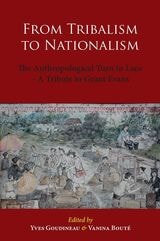
From Tribalism to Nationalism
The Anthropological Turn in Laos – A Tribute to Grant EvansEdited by Yves Goudineau and Vanina Bouté
National University of Singapore Press, 2022
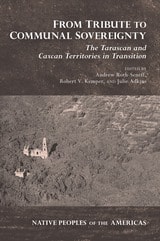
From Tribute to Communal Sovereignty
The Tarascan and Caxcan Territories in TransitionEdited by Andrew Roth-Seneff, Robert V. Kemper, and Julie Adkins
University of Arizona Press, 2015
The continuities elucidated concern ancestral territorial claims that date back centuries and reflect the stable geographic locations occupied by core populations of indigenous language–speakers in or near their pre-Columbian territories since the Postclassical period, from the thirteenth to late fifteenth centuries. A common theme of this volume is the strong cohesive forces present, not only in the colonial construction of Christian village communities in Purhépecha and Nahuatl groups in Michoacán but also in the demographically less inclusive Huichol (Wixarika), Cora, and Tepehuan groups, whose territories were more extensive.
The authors review a cluster of related themes: settlement patterns of the last five centuries in central western Mexico, language distribution, ritual representation of territoriality, processes of collective identity, and the forms of participation and resistance during different phases of Mexican state formation. From such research, the question arises: does the village community constitute a unique level of organization of the experience of the original peoples of central western Mexico? The chapters address this question in rich and complex ways by first focusing on the past configurations and changes in lifeways during the transition from pre-Columbian to Spanish rule in tributary empires, then examining the long-term postcolonial process of Mexican independence that introduced the emerging theme of the communal sovereignty.

From Victimhood to Citizenship
The Path of Roma IntegrationWill Guy
Central European University Press, 2013
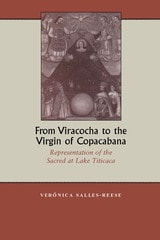
From Viracocha to the Virgin of Copacabana
Representation of the Sacred at Lake TiticacaBy Verónica Salles-Reese
University of Texas Press, 1997
Surrounded by the peaks of the Andean cordillera, the deep blue waters of Lake Titicaca have long provided refreshment and nourishment to the people who live along its shores. From prehistoric times, the Andean peoples have held Titicaca to be a sacred place, the source from which all life originated and the site where the divine manifests its presence.
In this interdisciplinary study, Verónica Salles-Reese explores how Andean myths of cosmic and ethnic origins centered on Lake Titicaca evolved from pre-Inca times to the enthronement of the Virgin of Copacabana in 1583. She begins by describing the myths of the Kolla (pre-Inca) people and shows how their Inca conquerors attempted to establish legitimacy by reconciling their myths of cosmic and ethnic origin with the Kolla myths. She also shows how a similar pattern occurred when the Inca were conquered in turn by the Spanish.
This research explains why Lake Titicaca continues to occupy a central place in Andean thought despite the major cultural disruptions that have characterized the region's history. This book will be a touchstone in the field of Colonial literature and an important reference for Andean religious and intellectual history.

From Walden Pond to Jurassic Park
Activism, Culture, and American StudiesPaul Lauter
Duke University Press, 2001
With anecdote peppered discussions ranging from specific literary texts and movies to the future of higher education and the efficacy of unions, From Walden Pond to Jurassic Park entertains even as it offers a twenty-first century account of how and why Americanists at home and abroad now do what they do. Drawing on his forty-five years of teaching and research as well as his experience as a political activist and a cultural radical, Lauter shows how a multifaceted increase in the United States’ global dominion has infused a particular political urgency into American Studies. With its military and economic influence, its cultural and linguistic reach, the United States is—for better or for worse—too formidable and potent not to be understood clearly and critically.

From War to Genocide
Criminal Politics in Rwanda, 1990–1994André Guichaoua, Translated by Don E. Webster, Foreword by Scott Straus
University of Wisconsin Press, 2017
Guichaoua draws on years of meticulous research to describe and analyze this history. He emphasizes that the same virulent controversies that fueled the conflict have often influenced judicial, political, and diplomatic responses to it, reproducing the partisan cleavages between the former belligerents and implicating state actors, international institutions, academics, and the media. Guichaoua insists upon the imperative of absolute intellectual independence in pursuing the truth about some of the gravest human rights violations of the twentieth century.
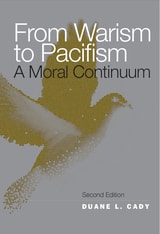
From Warism to Pacifism
A Moral ContinuumAuthored by Duane Cady
Temple University Press, 2010
Duane Cady views warism and pacifism as polar extremes on a continuum that embraces a full spectrum of ethical positions on the morality of war and peace. Realizing that he could not intellectually defend the notions of just-war theory, he found that he was a reluctant pacifist. In this new edition of From Warism to Pacifism, Cady continues to expose the pervasive, subconscious warism that is the dominant ideology in modern Western culture. He explores the changes over the last twenty years—from the end of the Cold War to the ongoing “war on terror,” as well as Barack Obama winning the Nobel Prize for Peace.
Like racism and sexism, the uncritical presumption that war is morally justifiable, even morally required, misguides our attitudes and institutions. In its place, Cady proposes the development of a positive concept of peace. Citing common objections to pacifist values, he describes peace as something more than the mere absence of war and demonstrates that pacifism is a defensible position.
From Welfare to Work
Judith M. Gueron
Russell Sage Foundation, 1991
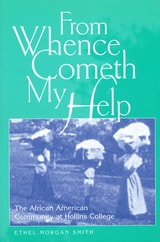
From Whence Cometh My Help
The African American Community at Hollins CollegeEthel Morgan Smith
University of Missouri Press, 2000
In 1842 Charles Lewis Cocke arrived in Roanoke, Virginia, with sixteen slaves; there, he founded Hollins College, an elite woman's school. Many of the early students also brought their slaves to the college with them. Upon Emancipation some of the African Americans of the community "mostly women" stayed on as servants, forming what is now called the Hollins Community. Although the servants played an integral part in the college's success, students were strongly discouraged from acknowledging them as people. Rules forbidding any "familiarity" with the servants perpetuated a prejudicial attitude toward the African American community that would persist well into the 1940s.
Determined to give voice to the African American community that served as the silent workforce for Hollins College, Ethel Morgan Smith succeeded in finding individuals to step forward and tell their stories. From Whence Cometh My Help examines the dynamics of an institution built on the foundations of slavery and so steeped in tradition that it managed to perpetuate servitude for generations. Interviewing senior community members, Smith gives recognition to the invisible population that provided and continues to provide the labor support for Hollins College for more than 150 years.
Although African American students have been admitted to the college for roughly thirty years, to date only one person from the Hollins Community has graduated from the college. From Whence Cometh My Help explores the subtle and complex relationship between the affluent white world of Hollins College and the proud African American community that has served it since its inception. Interweaving personal observations, historical documents, and poetry throughout a revealing oral history, Smith shares her fascinating discoveries and the challenges involved in telling a story silenced for so long.

From Workshop to Waste Magnet
Environmental Inequality in the Philadelphia RegionSicotte, Diane
Rutgers University Press, 2016
From Yahweh to Yahoo!
The Religious Roots of the Secular PressDoug Underwood
University of Illinois Press, 2001
Presenting religion as journalism's silent partner, From Yahweh to Yahoo!provides a fresh and surprising view of the religious impulses at work in contemporary newsrooms. Focusing on how the history of religion in the United States entwines with the growth of the media, Doug Underwood argues that American journalists draw from the nation's moral and religious heritage and operate, in important ways, as personifications of the old religious virtues.
Underwood traces religion's influence on mass communication from the biblical prophets to the Protestant Reformation, from the muckraker and Social Gospel campaigns of the late nineteenth and early twentieth centuries to the modern age of mass media. While forces have pushed journalists away from identifying themselves with religion, they still approach such secular topics as science, technology, and psychology in reverential ways. Underwood thoughtful analysis covers the press's formulaic coverage of spiritual experience, its failure to cover new and non-Christian religions in America, and the complicity of the mainstream media in launching the religious broadcasting movement.

From a Shattered Sun
Hierarchy, Gender, and Alliance in the Tanimbar IslandsSusan Mckinnon
University of Wisconsin Press, 1991
Among a growing number of ethnographies of eastern Indonesia that deal with cosmology, exchange, and kinship, From a Shattered Sun is the first to address squarely issues originally broached by Edmund Leach and Claude Lévi-Strauss concerning the relation between hierarchy and equality in asymmetric systems of marriage.
On the basis of extensive fieldwork in the Tamimbar islands, Susan McKinnon analyzes the simultaneous presence of both closed, asymmetric cycles and open, asymmetric pathways of alliance—of both egalitarian and hierarchical configurations. In addition, Tamimbarese society is marked by the existence of multiple, differentially valued forms of marriage, affiliation, and residence. Rather than seeing these various forms as analytically separable types, McKinnon demonstrates that it is only by viewing them as integrally related—in terms of culturally specific understandings of "houses," gender, and exchange—that one can perceive the processes through which hierarchy and equality are created.

From a Taller Tower
The Rise of the American Mass ShooterBy Seamus McGraw
University of Texas Press, 2021
We, as a nation, have become desensitized to the shock and pain in the wake of mass shootings. In the bottomless silence between gunshots, as political stalemate ensures inaction, the killing continues; the dying continues. From a Taller Tower attends to the silence that has left us empty in the aftermath of these atrocities. Veteran journalist Seamus McGraw chronicles the rise of the mass shooter to dismantle the myths we have constructed around the murderers and ourselves.
In 1966, America’s first mass shooter, from atop the University of Texas tower, unleashed a new reality: the fear that any of us may be targeted by a killer, and the complicity we bear in granting these murderers the fame or infamy they crave. Addressing individual cases in the epidemic that began in Austin, From a Taller Tower bluntly confronts our obsession with the shooters—and explores the isolation, narcissism, and sense of victimhood that fan their obsessions. Drawing on the experiences of survivors and first responders as well as the knowledge of mental health experts, McGraw challenges the notion of the “good guy with a gun,” the idolization of guns (including his own), and the reliability of traumatized memory. Yet in this terrible history, McGraw reminds us of the humanity that can stop the killing and the dying.

From that Place and Time
A Memoir, 1938-1947Dawidowicz, Lucy
Rutgers University Press, 2008
Nancy Sinkoff's new introduction explores the historical forces, particularly the dynamic world of secular Yiddish culture, which shaped Dawidowicz's decision to journey to Poland and her reassessment of those forces in the last years of her life.

From the Battlefront to the Bridal Suite
Media Coverage of British War Brides, 1942-1946Barbara G. Friedman
University of Missouri Press, 2007
With their gregarious natures and casual styles, American GIs in wartime England were instantly attractive to British women—especially in the absence of their fighting men. As a result, some seventy thousand British war brides returned to the United States—with many on the home front at first suspecting that the GIs were somehow being exploited.
The war brides’ stories have been told in memoirs, romantic novels, and immigration history. Barbara Friedman sheds new light on their experiences by focusing on media representations of sexuality and marriage in wartime, showing how mass media interpretations turned from public suspicion of war brides to popular acceptance.
Friedman tells how British media first insisted that GIs had come to fight, not to woo the locals, and shrugged off the first brides as an “American problem.” Yet, as Friedman shows, the British media were complicit in encouraging the relationships in the first place: the British press promoted a hospitality program that deemed the entertainment of American troops “patriotic duty,” while women’s magazines hailed American men as ideal husbands and the United States as a promised land.
From the American perspective, Friedman reveals, despite rules against foreign marriages, the U.S. Army encouraged GI-civilian fraternization through armed service publications, attitudes toward GI sexuality, and participation in the hospitality program. Armed service publications went from depicting British women as “frowsy dames” to honoring them as models of domesticity, while newspapers back home eventually legitimized the marriages by casting the brides as welcome additions to American society. Meanwhile, American women’s magazines viewed them as more similar to than different from their American counterparts and called on readers to help British brides master American homemaking.
By combining letters and diaries of brides with published accounts, Friedman identifies accuracies and inaccuracies in the media record as well as gaps in coverage. She considers how the brides saw themselves compared to their media images and shows how the media co-opted brides as symbols of the Anglo-American “special friendship,” postwar power imbalance, and gendered ideals of marriage and domestication.
From the Battlefront to the Bridal Suite is the untold story of overlooked participants in the most celebrated drama of the twentieth century—women whose lives were shaped profoundly by a war that was more than just a male enterprise. It shows the power of the press in the most unlikely matters and suggests a broader definition of the wartime experience.

From the Civil War to the Apocalypse
Postmodern History and American FictionTimothy Parrish
University of Massachusetts Press, 2008
In addressing the postmodernist claim that history works no differently than fiction, Timothy Parrish rejects the implication that history is dead or hopelessly relativistic. Rather, he shows how the best postmodern novelists compel their readers to accept their narratives as true in the same way that historians expect their readers to accept their narratives as true. These novelists write history as a form of fiction.
If the great pre-modernist American historians are Francis Parkman, George Bancroft, and Henry Adams, who are the great modernist or postmodernist historians? In the twentieth century, Parrish argues, the most powerful works of American history were written by William Faulkner, Toni Morrison, Thomas Pynchon, Don DeLillo, Joan Didion, and Cormac McCarthy. What survives a reading of these novels is the sense that writers otherwise identified as multicultural or postmodern share the view that nothing matters more than history and what one believes its possibilities to be. In other words, Parrish concludes, history, not identity, is the ground of postmodern American fiction.

From the Dance Hall to Facebook
Teen Girls, Mass Media, and Moral Panic in the United States, 1905-2010Shayla Thiel-Stern
University of Massachusetts Press, 2014
In From the Dance Hall to Facebook, Shayla Thiel-Stern takes a close look at several historical snapshots, including working-class girls in dance halls of the early 1900s; girls' track and field teams in the 1920s to 1940s; Elvis Presley fans in the mid-1950s; punk rockers in the late 1970s and early 1980s; and girls using the Internet in the early twenty-first century. In each case, issues of gender, socioeconomic status, and race are explored within their historical context. The book argues that by marginalizing and stereotyping teen girls over the past century, mass media have perpetuated a pattern of gendered crisis that ultimately limits the cultural and political power of the young women it covers.

From the Edge
Chicana/o Border Literature and the Politics of PrintFagan, Allison E
Rutgers University Press, 2016
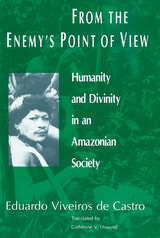
From the Enemy's Point of View
Humanity and Divinity in an Amazonian SocietyEduardo Viveiros de Castro
University of Chicago Press, 1992
Building upon ethnographic description and interpretation, Viveiros de Castro addresses the central aspect of the Arawete's concept of divinity—consumption—showing how its cannibalistic expression differs radically from traditional representations of other Amazonian societies. He situates the Araweté in contemporary anthropology as a people whose vision of the world is complex, tragic, and dynamic, and whose society commands our attention for its extraordinary openness to exteriority and transformation. For the Araweté the person is always in transition, an outlook expressed in the mythology of their gods, whose cannibalistic ways they imitate. From the Enemy's Point of View argues that current concepts of society as a discrete, bounded entity which maintains a difference between "interior" and "exterior" are wholly inappropriate in this and in many other Amazonian societies.
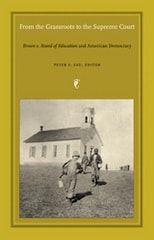
From the Grassroots to the Supreme Court
Brown v. Board of Education and American DemocracyPeter F. Lau, ed.
Duke University Press, 2004
The contributors illuminate the breadth of developments that led to Brown, from the parallel struggles for social justice among African Americans in the South and Mexican, Asian, and Native Americans in the West during the late nineteenth century to the political and legal strategies implemented by the National Association for the Advancement of Colored People (naacp) in the twentieth century. Describing the decision’s impact on local communities, essayists explore the conflict among African Americans over the implementation of Brown in Atlanta’s public schools as well as understandings of the ruling and its relevance among Puerto Rican migrants in New York City. Assessing the legacy of Brown today, contributors analyze its influence on contemporary law, African American thought, and educational opportunities for minority children.
Contributors
Tomiko Brown-Nagin
Davison M. Douglas
Raymond Gavins
Laurie B. Green
Christina Greene
Blair L. M. Kelley
Michael J. Klarman
Peter F. Lau
Madeleine E. Lopez
Waldo E. Martin Jr.
Vicki L. Ruiz
Christopher Schmidt
Larissa M. Smith
Patricia Sullivan
Kara Miles Turner
Mark V. Tushnet
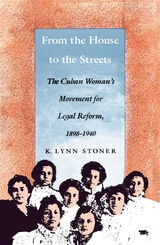
From the House to the Streets
The Cuban Woman's Movement for Legal Reform, 1898-1940K. Lynn Stoner
Duke University Press, 1991
Stoner draws on rich primary sources—texts, personal letters, journal essays, radio broadcasts, memoirs from women’s congresses—which allow these women to speak in their own voices. In reconstructing the mentalité of Cuban feminists, who came primarily from a privileged social status, Stoner shows how feminism drew from traditional notions of femininity and a rejection of gender equality to advance a cause that assumed women’s expanded roles were necessary for social progress. She also examines the values of the progressive male politicians who supported feminists and worked to change Cuban laws.
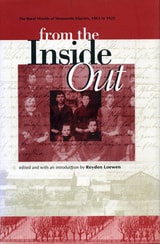
From the Inside Out
The Rural Worlds of Mennonite DiaristsRoyden Loewen
University of Manitoba Press, 1999

From the Jewish Heartland
Two Centuries of Midwest FoodwaysEllen F. Steinberg and Jack H. Prost
University of Illinois Press, 2013

From the Land of Ever Winter to the American Southwest
Athapaskan Migrations, Mobility, and EthnogenesisDeni J. Seymour
University of Utah Press, 2012
The Athapaskan departure from the Canadian Subarctic centuries ago and their subsequent arrival in the American Southwest has remained the subject of continuous debate in anthropological research. This book examines archaeological, genetic, linguistic, and traditional oral history data and brings them together in fresh ways, in many cases for the first time. With a backdrop of these new and interrelated lines of evidence, each subfield must now reevaluate its approach and the forms of evidence it uses to construct arguments.
The contributors here include the most knowledgeable scholars in each of the above fields, collectively providing the most up-to-date research on early Athapaskans and their movements and migrations. Each chapter approaches Athapaskan migration with data obtained from different regions, providing clarity as to the basis for individual arguments. Often, entrenched regional visualizations and localized conventions are clarified only when placed in juxtaposition to those of other regions. Because of this, conclusions rest on sometimes widely divergent theoretical and methodological underpinnings, thus expressing preference for and conveying weight to certain types of evidence and lines of reasoning. The goal of this volume is to expose these arguments in order to clarify appropriate directions for future research, making advances possible.
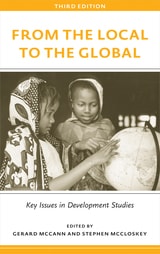
From the Local to the Global, Third Edition
Key Issues in Development StudiesEdited by Gerard McCann and Stephen McCloskey
Pluto Press, 2015
This completely revised third edition takes stock of the international development environment as it embarks on new policy frameworks to confront new challenges, ensuring that From the Local to the Global will continue to serve as an indispensable introduction to key development issues such as aid, debt, trade, migration, security, gender, and climate change.