Results by title
3785 books match the query 'Poetry' and 124 start with f
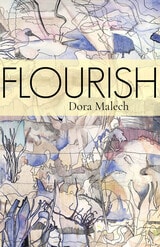
Flourish
Dora Malech
Carnegie Mellon University Press, 2020
Here, the lens zooms in and out to micro and macro levels, asking us to see the familiar with new eyes. The collection engages with the materials of the worlds we inhabit—natural worlds and those of our own making—and a full spectrum of poetry’s own materials, building worlds of words and illuminating the shadowed terrain of our interior landscapes as well.
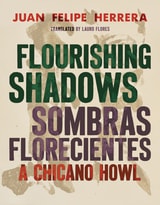
Flourishing Shadows / Sombras Florecientes
A Chicano HowlJuan Felipe Herrera; Translated by Lauro Flores
University of Arizona Press, 2026
From former U.S. poet laureate Juan Felipe Herrera comes a searing bilingual collection that speaks directly to America and all its peoples. Flourishing Shadows / Sombras Florecientes is a lyrical journey through migration, memory, and resistance—an urgent address to a nation grappling with its identity. Blending autobiography and Indigenous, Chicanx, and Beat traditions, Herrera reclaims language as a tool of compassion and truth. With ink drawings and evocative verse, this book honors the migrants who traverse borders and histories, flourishing even in the shadows. A call to listen, to remember, and to act.
More than a poetic critique, this book initiates a conversation—a direct address to readers that invites reflection, solidarity, and action. Drawing on his anthropological training and lived experience, Herrera weaves together the cultural richness of Indigenous Mexico, the urban vibrancy of San Francisco’s literary scene, and the enduring legacy of migrant journeys. Flourishing Shadows / Sombras Florecientes is a vital addition to the Camino del Sol series and a powerful testament to the resilience and humanity of those too often relegated to the margins.
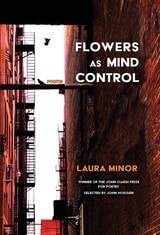
Flowers as Mind Control
poemsLaura Minor
BkMk Press, 2021
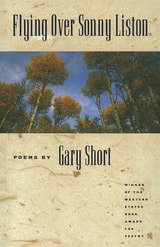
Flying Over Sonny Liston
PoemsGary Short
University of Nevada Press, 1996
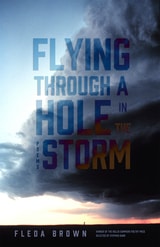
Flying through a Hole in the Storm
PoemsFleda Brown
Ohio University Press, 2021
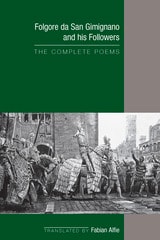
Folgore da San Gimignano and his Followers
The Complete PoemsFabian Alfie
Arizona Center for Medieval and Renaissance Studies, 2019

Folk Physics
New and Selected PoemsMolly Brodak
University of Iowa Press, 2027
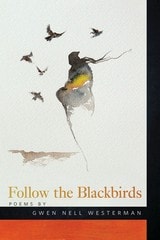
Follow the Blackbirds
Poems by Gwen Nell Westerman
Michigan State University Press, 2013
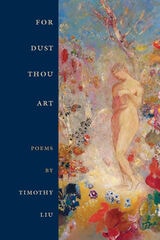
For Dust Thou Art
Timothy Liu
Southern Illinois University Press, 2005
Running the gamut from traditional to radical forms, Timothy Liu’s sixth collection of poems, For Dust Thou Art, continues the trajectory of his previous books but extends his lyrical range. The centerpiece of the volume’s tripartite structure is a meditation on the events surrounding 9/11 and its aftermath. In his poems, Liu explores what a twenty-first century American “poetry of witness” might look like and protests the charge that the poetic generation to which Liu belongs is stymied by a kind of jaded amorality. Whether taking on public spectacle or contemplating the fallout of a private life, these meditations move forward and backward through time, seeking spiritual consolation within a material world.
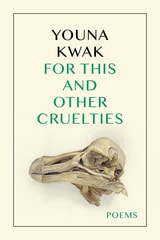
For This and Other Cruelties
Youna Kwak
University of Iowa Press, 2025
CALIBA’s 2025 Golden Poppy Book Award Winner, Poetry
The shadow of mothering has never been given a richer, fuller, more debased vision than in Youna Kwak’s For This and Other Cruelties. Kwak casts a cold eye on the splendid and cruel intransigence of maternal paradoxes in all their impossible double binds, monstrous pleasures, and profane mystifications. Shifting between lyric and prose poems, this collection throws slanted light on the ineffability of our deepest attachments, envisioning a world where mother is “a creature whose only enemy could be human.” Kwak brings us face to face with the irreconcilable facts of being mother, mothered, and alive.
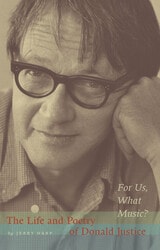
For Us, What Music?
The Life and Poetry of Donald JusticeJerry Harp
University of Iowa Press, 2010
When Donald Justice wrote in “On a Picture by Burchfield” that “art keeps long hours,” he might have been describing his own life. Although he early on struggled to find a balance between his life and art, the latter became a way of experiencing his life more deeply. He found meaning in human experience by applying traditional religious language to his artistic vocation. Central to his work was the translation of the language of devotion to a learned American vernacular. Art not only provided him with a wealth of intrinsically worthwhile experiences but also granted rich and nuanced ways of experiencing, understanding, and being in the world. For Donald Justice—recipient of some of poetry’s highest laurels, including the Pulitzer Prize, the Bollingen Prize, and the Lannan Literary Award for Poetry—art was a way of life.
Because Jerry Harp was Justice’s student, his personal knowledge of his subject—combined with his deep understanding of Justice’s oeuvre—works to remarkable advantage in For Us, What Music? Harp reads with keen intelligence, placing each poem within the precise historical moment it was written and locating it in the context of the literary tradition within which Justice worked. Throughout the text runs the narrative of Justice’s life, tying together the poems and informing Harp’s interpretation of them. For Us, What Music? grants readers a remarkable understanding of one of America’s greatest poets.
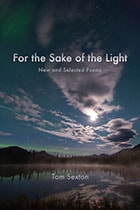
For the Sake of the Light
New and Selected PoemsTom Sexton
University of Alaska Press, 2009
This collection of new and selected poems by the former poet laureate of Alaska, Tom Sexton, opens a door on the essence of life in Alaska and Maine. Sexton divides his year between the two states, and he captures here the small but powerful sensual details of day-to-day life in these contrasting, yet similar, environs. His carefully crafted verse distills the birch and aspen, lynx and ptarmigan, and the snow on high peaks. Through his poems we thrill to experience encounters with the wild, the seasons, and the sublime landscape.
“His language is clear, without tricks or fancy moves, yet his directness is powerful, and the effects are human”—Paul Zimmer, Georgia Review
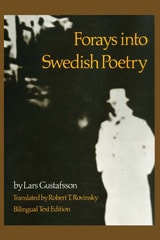
Forays into Swedish Poetry
By Lars Gustafsson
University of Texas Press, 1978
When poet/critic Lars Gustafsson was the editor of Bonniers Litterära Magasin, he was bombarded with the question, “What makes a good poem?” Forays into Swedish Poetry is his answer.
The fifteen poems in this volume range across the history of Swedish poetry from the 1640s, at the beginning of the Period of Great Power, to the late twentieth century. Poets as diverse as Skogekär Bergbo, Erik Johan Stagnelius, August Strindberg, and Vilhelm Ekelund are discussed from historical, psychological, and sociopolitical viewpoints. However, Gustafsson includes only those poems he considers excellent.
Each essay begins with a presentation of the poem both in Swedish and in English translation. Gustafsson’s analyses are built upon his subjective experiences with poems and poets and upon a more objective structural approach that investigates the actual machinery of the poems. Thus, Gustafsson enlightens us with his always imaginative, sometimes daring analyses, and we learn a great deal about the critic himself in the process. One of his main concerns is what he calls, in his discussion of Edith Södergran, the very mysteriousness of human existence. Time and again, Gustafsson emphasizes the enigmatic, arcane aspects of life in his analyses. In contrast, his vocabulary and approach also bespeak a constant interest in science and technology.
In his introduction, Robert T. Rovinsky, the volume’s translator, presents examples of Gustafsson’s various thematic interests as voiced in his poems, several of which are translated here for the first time. While “The Machines” explores his theory of people as automatons and “Conversation between Philosophers” his linguistic pessimism, Gustafsson’s work as a whole shows his enchantment with its major theme: the intrinsic mystery of life.
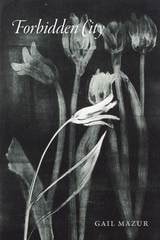
Forbidden City
Gail Mazur
University of Chicago Press, 2016
A draughtsman’s draughtsman, Hokusai at 70
thought he’d begun to grasp the structures
of birds and beasts, insects and fish, of the way
plants grow, hoped that by 90 he’d have
penetrated to their essential nature.
And more, by 100, I will have reached the stage
where every dot, every mark I make will be
alive. You always loved that resolve, you’d repeat
joyfully—Hokusai’s utterance of faith
in work’s possibilities, its reward, that,
at 130, he’d perhaps have learned to draw.
Gail Mazur’s poems in Forbidden City build an engaging meditative structure upon the elements of mortality and art, eloquently contemplating the relationship of art and life—and the dynamic possibilities of each in combination. At the collection’s heart is the poet’s long marriage to the artist Michael Mazur (1935–2009). A fascinating range of tone infuses the book—grieving, but clear-eyed rather than lugubrious, sometimes whimsical, even comical, and often exuberant. The note of pleasure, as in an old tradition enriched by transience, runs through the work, even in the final poem, “Grief,” where “our ravenous hold on the world” is a powerful central element.
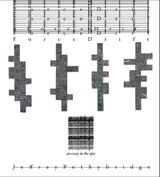
Force Drift
An Essay in the EpicJeffrey Pethybridge
Tupelo Press, 2025
The poems in Force Drift recall Gilles Deleuze’s insight that art “is not a matter of reproducing or inventing forms, but of capturing forces.” Through the formal range of this dynamic sequence, Pethybridge achieves something like a synthesis of Deleuze’s opposition whereby the invention of poetic form becomes the very means of capturing, registering forces: “a reckoning lyric.”
The task of reckoning renders visible the violence of the state that lies at the heart of the matter precisely because the state intends to conceal or justify its brutality through the invocation of emergency powers, as well as the state of exception, or how the state disappears persons in its network of black site prisons. As the political scientist Darius Rejali has demonstrated, it is in fact democracies that have refined “invisible tortures” such as sensory deprivation, stress-positions, and the waterboard.
Working at the intersection of documentary poetics and theories of the epic, Pethybridge recommits poetry to a responsibility for a description of history. As a poet-researcher, he asks: “what would be possible…if listening / were the leading-form of being.” Driven by argument, abstraction, and assemblage, the poems in Force Drift address themselves to the irreparable, the “traumaeffect,” within the war on terror’s record of atrocity. Force Drift is a cri de coeur, political critique, and essay in the epic.
Against the world-destroying violence of the US torture program, Force Drifts juxtaposes a catalog of energies, forms, and genres. It is abolitionist, citational, architectural, chromatic, and replete with visual poetries ranging from the arabasques of tzahibs to erasures to extreme measures of leading and kerning. Even when its language is reduced to the pure transcription of pain––”aiai aiai aiai”––Force Drift is committed to aliveness and embodiment as “final treaty of the person,” as conscience and counterworld to the history as catastrophe of US imperialism, “irrefutable as the sun to the eye.”
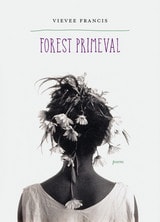
Forest Primeval
PoemsVievee Francis
Northwestern University Press, 2016
Winner, 2017 Kingsley Tufts Poetry Award
Winner, 2016 Hurston/Wright Legacy Award in the Poetry category
Finalist, 2015 Balcones Poetry Prize
Shortlist finalist, 2015 PEN Open Book Award for an exceptional book by an author of color
"Another Anti-Pastoral," the opening poem of Forest Primeval, confesses that sometimes "words fail." With a "bleat in [her] throat," the poet identifies with the voiceless and wild things in the composed, imposed peace of the Romantic poets with whom she is in dialogue. Vievee Francis’s poems engage many of the same concerns as her poetic predecessors—faith in a secular age, the city and nature, aging, and beauty. Words certainly do not fail as Francis sets off into the wild world promised in the title. The wild here is not chaotic but rather free and finely attuned to its surroundings. The reader who joins her will emerge sensitized and changed by the enduring power of her work.
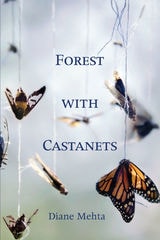
Forest with Castanets
Diane Mehta
Four Way Books, 2019
Forever Mistaken for Ourselves
Jenny Grassl
Tupelo Press, 2026
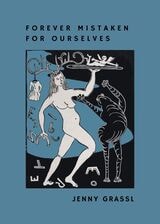
A collection of poems envisioned as a magic wardrobe of mirrors, vast with ocean and meadow, revealing reflections of the muses, a deer woman, and a sea-monster lover.
Forever Mistaken for Ourselves tells a story of transformations. Iron dresses, veils nailed to an hourglass, and a sex-changing flower/human defy or define a woman and her place in daily life and history. Queen Anne's black lace leaves holes open for a ghost. Never just coy, these characters and artifacts get up and do battle with complacency, in an all too often misogynistic world. Beasts come and go through the mirrors, a fish-man breaking through to deliver a whole-body kiss to a woman. Forests rise, and lawns “lean lethargies” to hold the reflected images of the speakers. Is there a confirmation of existence? “If she is—a silver say-so.”
Forgive the Body This Failure
Blas Falconer
Four Way Books, 2018
Form from Form
Christopher Bolin
University of Iowa Press, 2018
“Was it a crater or a sinkhole?” asks a voice in one of the mysterious, wonderstruck poems in Christopher Bolin’s Form from Form, whose cadences modulate with the energies of form-making, deformation, and elusive reformation. Natural forms and forms of human manufacture, forms of absence and those of urgent desire construct and deconstruct each other in Bolin’s singular music, which blends unnerving plainness and obliqueness, the childlike and the alien.
As their sites drift from workers’ camps to city squares, isolated coasts to windswept plains, the poems in Form from Form trace a map of a fragmented ecology, dense with physical detail of altered landscapes and displaced populations. In tones of austere beauty and harsh discordance, these poems provide a “field guide to luminescent things,” a visionary fretwork of the possibilities and impossibilities of faith in the present moment.
Forms of Discovery
Critical and Historical Essays on the Forms of the Short Poem in EnglishYvor Winters
Ohio University Press, 1967
Forms of Expansion
Recent Long Poems by WomenLynn Keller
University of Chicago Press, 1997
Arguing that women poets no longer feel intimidated by the traditional associations of long poems with the heroic, public realm or with great artistic ambition, Keller shows how the long poem's openness to sociological, anthropological, and historical material makes it an ideal mode for exploring women's roles in history and culture. In addition, the varied forms of long poems—from sprawling free verse epics to regular sonnet sequences to highly disjunctive experimental collages—make this hybrid genre easily adaptable to diverse visions of feminism and of contemporary poetics.
Forrest Gander
Poetry, Translation, EcologyEdited by Robert Baker
University of Michigan Press, 2026
Pulitzer Prize winner Forrest Gander is widely celebrated as a love poet, a meditative poet, and a poet of ecological awareness. He has always been a writer drawn to cross-cultural encounter, as active in translation as any poet of his generation. This collection of essays on his work brings together an international range of poets, novelists, critics, and translators, including Charles Altieri, Stephanie Burt, Julia Fiedorczuk, Jorie Graham, and Jeanette Winterson.
The collection features interviews as well as essays of different kinds—reviews, appreciations, and interpretations—and they address Gander’s poetry, fiction, and translations. They illuminate major concerns at the heart of all his work: eros, companionship, loss, renewal, an openness to the life all around us, and a rapt attention to the natural world.
Fort Necessity
David Gewanter
University of Chicago Press, 2018
Haunted by his father’s autopsy of a workman he witnessed as a child, Gewanter forges intensely personal poems that explore the fate of our laboring bodies, from the Carnegie era’s industrial violence and convict labor to our present day of broken trust, profiteering, and the Koch brothers. Guided by a moral vision to document human experience, this unique collection takes raw historical materials—newspaper articles, autobiography and letters, court testimony, a convict ledger, and even a menu—and shapes them into sonnets, ballads, free verse, and prose poems. The title poem weaves a startling lyric sequence from direct testimony by steelworkers and coal-miners, strikers and members of prison chain-gangs, owners and anarchists, revealing an American empire that feeds not just on oil and metal, but also on human energy, impulse, and flesh. Alongside Gewanter’s family are hapless souls who dream of fortune, but cannot make their fates, confronting instead the dark outcomes of love, loyalty, fantasy, and betrayal.
Fortino Sámano
The Overflowing of the PoemVirginie Lalucq and Jean-Luc Nancy
Omnidawn, 2012

Fountain and Furnace
Hadara Bar-Nadav
Tupelo Press, 2016
Four Quartets
Poetry in the PandemicEdited by Jeffrey Levine and Kristina Marie Darling
Tupelo Press, 2020
Fowling Piece
PoemsHeidy Steidlmayer
Northwestern University Press, 2012
Winner, 2013 Kate Tufts Discovery Award
Winner, 2012 John C. Zacharias First Book Award for best debut book by a Ploughshares writer
A remarkably mature first collection of poems, Heidy Steidlmayer’s Fowling Piece is the debut of a highly original voice. As they search for meaning in both the extraordinary and the everyday, these poems, in exquisitely compressed language, display a fierce attention to the history of individual words and a surprising wit. In Steidlmayer's poetic landscape, words strike the reader as at once familiar and exotic, becoming instruments through which she is able to access and make sense of the most profound, irreducible aspects of human experience. Her mastery of and experiments in form are exceptional for a poet of any age. Fowling Piece offers the rare gift of a new poet whose work is truly new.
Fractures
Carlos Andrés Gómez
University of Wisconsin Press, 2020
Franciscan Notes
Alan Williamson
Tupelo Press, 2019
Frank O'Hara
The Poetics of CoterieLytle Shaw
University of Iowa Press, 2006
Free Verse
An Essay on ProsodyCharles O. Hartman
Northwestern University Press, 1996
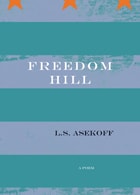
Freedom Hill
A PoemL.S. Asekoff
Northwestern University Press, 2011
Winner, 2012 Witter Bynner Award and Fellowship
L. S. Asekoff's Freedom Hill is a dramatic monologue divided into three sections. The first concerns the speaker's visit with his aging parents and the death of his father. The second, set at an art party, is a meditation on women, desire, and the nature of the self. In the third, we witness the effects on the speaker of a cerebral stroke, along with his gradual recovery. As readers of Asekoff's unique body of work have come to expect, this highly allusive poem encompasses a wide range of subject matter: Heidegger, C-SPAN, modern art, aging, capitalism, religion. Also familiar will be Asekoff's great variety of tone and verbal ingenuity. Although indebted to high modernism, Freedom Hill is an ambitious, thoroughly contemporary meditation on issues very much of the present.
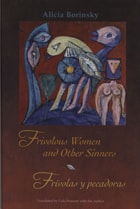
Frivolous Women and Other Sinners / Frívolas y pecadoras
Alicia Borinsky
Swan Isle Press, 2009
Frivolous Women invites us to visit the darker and lighter sides of laughter and love and feel the tenderness of recovered memories as we cross the bridges of relationships and stroll down the mysterious streets of childhood. Alicia Borinsky reminds us that the revelations of poetry are always intimate and dangerous. Cola Franzen’s agile and insightful translation, crafted in close collaboration with the poet, is faithful to the letter and spirit of the original Spanish in this bilingual edition.

From Blue Mills to Columbia
Cedar Falls and the Civil WarRobert K. Martin
University of Iowa Press, 1992
From Darkening Porches
PoemsJo McDougall
University of Arkansas Press, 1996
From Eves Rib
Gioconda Belli
Northwestern University Press, 1995
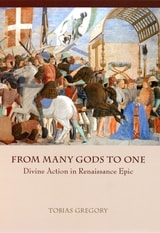
From Many Gods to One
Divine Action in Renaissance EpicTobias Gregory
University of Chicago Press, 2006
Epic poets of the Renaissance looked to emulate the poems of Greco-Roman antiquity, but doing so presented a dilemma: what to do about the gods? Divine intervention plays a major part in the epics of Homer and Virgil—indeed, quarrels within the family of Olympian gods are essential to the narrative structure of those poems—yet poets of the Renaissance recognized that the cantankerous Olympians could not be imitated too closely. The divine action of their classical models had to be transformed to accord with contemporary tastes and Christian belief.
From Many Gods to One offers the first comparative study of poetic approaches to the problem of epic divine action. Through readings of Petrarch, Vida, Ariosto, Tasso, and Milton, Tobias Gregorydescribes the narrative and ideological consequences of the epic’s turn from pagan to Christian. Drawing on scholarship in several disciplines—religious studies, classics, history, and philosophy, as well as literature—From Many Gods to One sheds new light on two subjects of enduring importance in Renaissance studies: the precarious balance between classical literary models and Christian religious norms and the role of religion in drawing lines between allies and others.
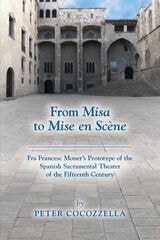
From Misa to Mise en Scène
Fra Francesc Moner’s Prototype of the Spanish Sacramental Theater of the Fifteenth CenturyPeter Cocozzella
Arizona Center for Medieval and Renaissance Studies, 2020

From Nothing
Daniel Tobin
Four Way Books, 2016
From Outlaw to Classic
Canons in American PoetryAlan Golding
University of Wisconsin Press, 1995
From Outlaw to Classic presents a sweeping history of the forces that have shaped, and continue to shape, the American poetry canon. Students, scholars, critics, and poets will welcome this enlightening and impressively documented book.
Recent writings by critics and theorists on literary canons have dealt almost exclusively with prose; Alan Golding shows that, like all canons, those of American poetry are characterized by conflict. Choosing a series of varied but representative instances, he analyzes battles and contentions among poets, anthologists, poetry magazine editors, and schools of thought in university English departments. The chapters:
• present a history of American poetry anthologies
• compare competing models of canon-formation, the aesthetic (poet-centered) and the institutional (critic-centered)
• discuss the influence of the New Critics, emphasizing their status as practicing poets, their anti-nationalist reading of American poetry, and the landmark textbook, Understanding Poetry by Cleanth Brooks and Robert Penn Warren
• examine the canonizing effects of an experimental “little magazine,” Origin
• trace how the Language poets address, in both their theory and their method, the canonizing institutions and canonical assumptions of the age.
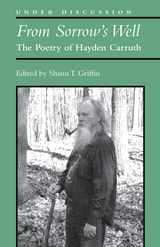
From Sorrow's Well
The Poetry of Hayden CarruthShaun T. Griffin
University of Michigan Press, 2015
Hayden Carruth survived isolation, mental health problems, and long struggle with drink and smoke to produce a vision of modern poetry rooted in the New England tradition but entirely his own. Many feel his best poems emerged from the isolation of rural Vermont, and his poems often are concerned with rural images and metaphors reflecting the land and hardscrabble people around him. Together with his second love, jazz, Carruth’s rural experiences infuse his poems with engaging and provocative ideas even as they present sometimes stark topics.
This volume collects essays and poems from such notable contributors as Donald Hall, Marilyn Hacker, Adrienne Rich, Philip Booth, Matthew Miller, and Sascha Feinstein, among many others. The book’s sections concern the kinds of writings, and the values expressed in his writings, for which Carruth was most famous, including what editor Shaun T. Griffin calls “social utility,” jazz, his impoverished rural environment, and “innovation” in poetic form.
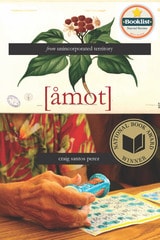
From Unincorporated Territory [åmot]
Craig Santos Perez
Omnidawn, 2023
This book is the fifth collection in Craig Santos Perez’s ongoing from unincorporated territory series about the history of his homeland, the western Pacific island of Guåhan (Guam), and the culture of his indigenous Chamoru people. “Åmot” is the Chamoru word for “medicine,” commonly referring to medicinal plants. Traditional Chamoru healers were known as yo’åmte; they gathered åmot in the jungle and recited chants and invocations of taotao’mona, or ancestral spirits, in the healing process.
Through experimental and visual poetry, Perez explores how storytelling can become a symbolic form of åmot, offering healing from the traumas of colonialism, militarism, migration, environmental injustice, and the death of elders.
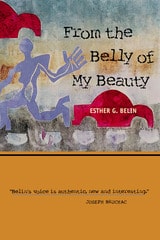
From the Belly of My Beauty
Esther G. Belin
University of Arizona Press, 1999
In this bold new collection of poems, Belin presents a startling vision of urban California—particularly Los Angeles—contrasted with Navajo life in the Four Corners region. She presents aspects of Diné life and history not normally seen by readers accustomed to accounts written by Navajos brought up on the reservation.
Her work reveals a difference in experience but a similarity in outlook. Belin's poems put familiar cultural forms in a new context, as Coyote "struts down east 14th / feeling good / looking good / feeling the brown." Her character Ruby dramatizes the gritty reality of a Native woman's life ("I laugh / sit / smoke a Virginia Slim / and talk to the spirits"). Her use of Diné language and poignant descriptions of family life will remind some of Joy Harjo's work, but with every turn of the page, readers will know that Belin is making her own mark on Native American literature.
From the Belly of My Beauty is also a ceremony of affirmation and renewal for those Native Americans affected by the Federal Indian Relocation Program of the 1950s and '60s, with its attempts to "assimilate" them into the American mainstream. They have survived by remembering who they were and where they came from. And they have survived so that they might bear witness, as Esther Belin so powerfully does. Belin holds American culture accountable for failing to treat its indigenous peoples with respect, but speaks for the ability of Native culture to survive and provide hope, even for mixed-blood or urban Indians. She is living proof that Native culture thrives wherever its people are found.
From the Book of Giants
Joshua Weiner
University of Chicago Press, 2006
Song
for Thom Gunn
There is no east or west
in the wood you fear and seek,
stumbling past a gate of moss
and what you would not take.
And what you thought you had
(the Here that is no rest)
you make from it an aid
to form no east, no west.
No east. No west. No need
for given map or bell,
vehicle, screen, or speed.
Forget the house, forget the hill.
Taking its title from a set of writings found in the Dead Sea Scrolls, From the Book of Giants retunes the signal broadcast from these ancient fragments, transmitting a new sound in the shape of a Roman drain cover, in imitations of Dante and Martial, in the voice of a cricket and the hard-boiled American photographer Weegee, in elegies both public and personal, and in poems that range from the social speech of letters to the gnomic language of riddles. Out of poetry’s “complex of complaint and praise,” Joshua Weiner discovers, in one poem, his own complicity in Empire during his son’s baseball game at the White House. In another, an embroidered parrot sings a hermetic nursery rhyme to an infant after 9/11.
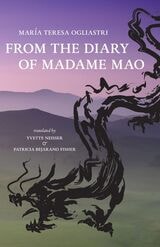
From the Diary of Madame Mao
María Teresa Ogliastri
Carnegie Mellon University Press, 2026
Fictionalized poems that embody the reality of life in twentieth-century China through the voice of Jiang Qing, the wife of Mao Zedong.
From the Diary of Madame Mao is a poetry collection of fictionalized diary entries in the voice of Jiang Qing, wife of Mao Zedong and a vilified leader of the “Gang of Four," a Maoist political faction which wielded unchecked and violent suppression of dissent during China’s Cultural Revolution (1966–76). The haunting voice in this collection recounts the events of twentieth-century China through the imagined inner thoughts of Jiang, a liberated woman in a male-dominated society who struggled to fend for herself but then, upon gaining totalitarian power, became “mentally ill.” Maria Teresa Ogliastri—who has lived under authoritarian regimes in Venezuela for more than two decades— “opts for compassion” in her portrayal of this infamous public figure, conveying the full complexity of human emotion and experience in her singular lyric voice.
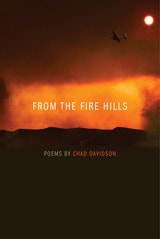
From the Fire Hills
Chad Davidson
Southern Illinois University Press, 2014
In From the Fire Hills, poet Chad Davidson shows us an Italy that is far from the romanticized notions of sun-drenched fields and self-discovery. Instead we see a maelstrom of chaos and contradiction, a place where the frenetic pace of modernity is locked in a daily struggle with recalcitrant history.
This autobiographical collection explores the myriad ways in which Italian culture survives its own parodies and evokes a modern ferocity that harkens back to Italy’s barbarian past. As the narrator, rendered vulnerable by language, embarks on his journey, lines of location, time, and perception blur. From the siren song of Dante’s grave to the heights of San Luca, from streets where policemen with Uzis tread a hair’s breadth away from the macabre remains of Capuchin monks, Davidson’s Italy is a study in contrast between the contemporary and the classical, the sacred and the profane. Within these poems sensual and savage revelations unfold, exposing new, uncanny, and often uncomfortable spaces to explore in this well-traveled realm of Western imagination.
Throughout the volume loom “the fire hills”: the scorched mountains of Sicily in summer; the memories of Italians living near the Gothic Line outside Bologna, where the Germans dug in and received heavy bombing at the close of World War II; even the wildfires igniting the San Gabriel foothills in southern California; all the way back to the burning city of Carthage in Virgil’s Aeneid. As the ash settles and the smoke clears, we realize that what we remember is often just remains, shells, and burned out wreckage, as if there were another type of memory.
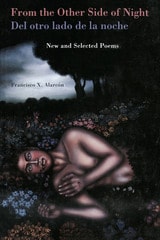
From the Other Side of Night/Del otro lado de la noche
New and Selected PoemsFrancisco X. Alarcón
University of Arizona Press, 2002
One of Chicano literature's premier poets, Alarcón has brought his luminous images to the page in such acclaimed volumes as Sonnets to Madness and Other Misfortunes and Snake Poems. Now he has assembled the best of his work from fifteen years, along with fourteen new poems, in a book that distills his magical sense of reality into a cup brimming with passion.
Raised in Guadalajara and now living in the San Francisco Bay area, Alarcón sees that " 'Mexican' / is not / a noun / or an / adjective / 'Mexican' / is a life / long / low-paying / job." Participating in a poetic tradition that goes back to the mystic Spanish poets of the sixteenth century, he brings us sonnets infused with romance and tenderness—and shorter poems that are direct and hard-hitting commentaries on American society, as he cries out for "a more godlike god," one "who spends nights / in houses / of ill repute / and gets up late / on Saturdays."
Alarcón invokes both the mysteries of Mesoamerica and the "otherness" of his gay identity. "My skin is dark / as the night / in this country / of noontime," he writes, "but my soul / is even darker / from all the light / I carry inside." In lyrical poems open to wide interpretation, he transcends ethnic concerns to address social, sexual, and historical issues of concern to all Americans. The fourteen new poems in From the Other Side of Night offer startling new commentaries on life and love, sex and AIDS.
Shifting effortlessly between English and Spanish—and even Nahuatl—Alarcón demonstrates the gift of language that has earned him both a wide readership and the admiration of fellow poets. With this book, he invites new readers to meet him where the darkness is palpable and the soul burns bright.
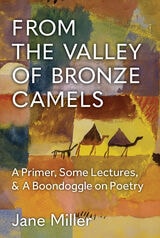
From the Valley of Bronze Camels
A Primer, Some Lectures, & A Boondoggle on PoetryJane Miller
University of Michigan Press, 2022
Jane Miller loves poetry. In these provocative and deeply insightful essays, she unpacks the work of giants like Adrienne Rich, Paul Celan, Marina Tsvetaeva, Osip Mandelstam, and Federico García Lorca alongside painters such as Caravaggio and Paul Klee, as well as ancient Chinese music and techniques of the contemporary poem. Miller explores the use of the question mark in the history of poetry and its function as a revelation of poetic voice. She considers the positive and negative aspects of surrealism on the contemporary poem, its anti-feminist origins in France, its contemporary usage, and the benefits of super-real images. Miller examines how identity politics might affect the imagination. She describes ancient Chinese musical instruments to show how their sounds resonate off/in American poems and on the aural integrity of the lyric poem. She interrogates the political implications of language and the degeneration and regeneration of words. Finally, in an essay about what she dares not say about poetry, she comes out against forms of surrealism, narrative, jargon, rhetoric, irony, and appropriation. This masterful work can be read as advice to a young writer, but it also invites us into the mind of a writer who has developed her craft through the course of a lifetime of writing, reading, and exploring the world, showing not only the ideas that influenced her—feminist, lesbian, and international works—but also how Miller has, in turn, influenced ideas.
From the Valley of Making
Essays on the Craft of PoetryDavid Wojahn
University of Michigan Press, 2015