Results by title
28167 books match the query 'History' and 1092 start with f
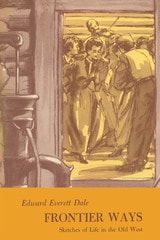
Frontier Ways
Sketches of Life in the Old WestBy Edward Everett Dale
University of Texas Press, 1959
Edward Everett Dale gives a first-hand account of the way pioneer families and cowboys of the frontier lived. Dr. Dale has lived in a sod house, and he once rode the range as cook to a group of cowboys. In this book he draws on his varied experiences to describe all aspects of frontier life—the building of a home, the problems of finding wood and water, the procuring and cooking of food, medical practices, and the cultural, social, and religious life of pioneer families.
This edition is a digital facsimile of the 1959 edition.
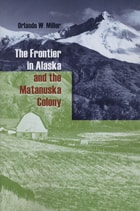
Frontier in Alaska and the Matanuska Colony
Orlando W. Miller
University of Alaska Press, 2008
During the Great Depression, Franklin D. Roosevelt gave more than two hundred families from some of the poorest areas in Minnesota, Wisconsin, and Michigan the opportunity to start their farms anew in the undeveloped land of Matanuska in Alaska. These transplanted midwesterners soon found themselves in a startling new climate and landscape that presented many unexpected challenges. Available for the first time in paperback, The Frontier in Alaska and the Matanuska Colony examines several case studies of these original families, dispelling many frontier myths and describing the reality of pioneering in Alaska. Despite the many impediments, Orlando W. Miller argues, much of the current agricultural success in Matanuska can be directly credited to the innovative farmers who settled there in the 1930s.
Frontiers of Freedom
Cincinnati’s Black Community 1802–1868Nikki M. Taylor
Ohio University Press, 2004
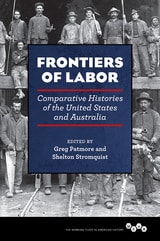
Frontiers of Labor
Comparative Histories of the United States and AustraliaEdited by Greg Patmore and Shelton Stromquist
University of Illinois Press, 2018
Greg Patmore and Shelton Stromquist curate innovative essays that use transnational and comparative analysis to explore the two nations’ differences. The contributors examine five major areas: World War I’s impact on labor and socialist movements; the history of coerced labor; patterns of ethnic and class identification; forms of working-class collective action; and the struggles related to trade union democracy and independent working-class politics. Throughout, many essays highlight how hard-won transnational ties allowed Australians and Americans to influence each other’s trade union and political cultures.
Contributors: Robin Archer, Nikola Balnave, James R. Barrett, Bradley Bowden, Verity Burgmann, Robert Cherny, Peter Clayworth, Tom Goyens, Dianne Hall, Benjamin Huf, Jennie Jeppesen, Marjorie A. Jerrard, Jeffrey A. Johnson, Diane Kirkby, Elizabeth Malcolm, Patrick O’Leary, Greg Patmore, Scott Stephenson, Peta Stevenson-Clarke, Shelton Stromquist, and Nathan Wise

Frontiers of Screen History
Imagining European Borders in Cinema, 1945-2010Edited by Raita Merivirta, Kimmo Ahonen, Heta Mulari, and Rami Mähkä
Intellect Books, 2013
Frontinus' Legacy
Essays on Frontinus' de aquis urbis RomaeDeane R. Blackman and A. Trevor Hodge, Editors
University of Michigan Press, 2001

Frozen
Mary Casanova
University of Minnesota Press, 2013
Sixteen-year-old Sadie Rose hasn’t said a word in eleven years—ever since the day she was found lying in a snowbank during a howling storm. Like her voice, her memories of her mother and what happened that night were frozen.
Set during the roaring 1920s in the beautiful, wild area on Rainy Lake where Minnesota meets Canada, Frozen tells the remarkable story of Sadie Rose, whose mother died under strange circumstances the same night that Sadie Rose was found, unable to speak, in a snowbank. Sadie Rose doesn’t know her last name and has only fleeting memories of her mother—and the conflicting knowledge that her mother had worked in a brothel. Taken in as a foster child by a corrupt senator, Sadie Rose spends every summer along the shores of Rainy Lake, where her silence is both a prison and a sanctuary.
One day, Sadie Rose stumbles on a half dozen faded, scandalous photographs—pictures, she realizes, of her mother. They release a flood of puzzling memories, and these wisps of the past send her at last into the heart of her own life’s great mystery: who was her mother, and how did she die? Why did her mother work in a brothel—did she have a choice? What really happened that night when a five-year-old girl was found shivering in a snowbank, her voice and identity abruptly shattered?
Sadie Rose’s search for her personal truth is laid against a swirling historical drama—a time of prohibition and women winning the right to vote, political corruption, and a fevered fight over the area’s wilderness between a charismatic, unyielding, powerful industrialist and a quiet man battling to save the wide, wild forests and waters of northernmost Minnesota. Frozen is a suspenseful, moving testimonial to the haves and the have-nots, to the power of family and memory, and to the extraordinary strength of a young woman who has lost her voice in nearly every way—but is utterly determined to find it again.
Fruit of Knowledge, Wheel of Learning (Vol I)
Essays in Honour of Professor Carole HillenbrandEdited by Ali M. Ansari
Gingko, 2021
Carole and Robert Hillenbrand are legendary British professors, both of whom have made immense contributions to the fields of Islamic history and art history, and they are highly respected and beloved by the academic community. For these two volumes, editors Melanie Gibson and Ali Ansari have gathered an eclectic mix of scholarly contributions by colleagues and by some of their most recent students who now occupy positions in universities worldwide. The eleven articles in the volume dedicated to Carole Hillenbrand include research on a range of topics, including the elusive Fatimid caliph al-Zafir, a crusader raid on Mecca, and the Persian bureaucrat Mirza Saleh Shirazi’s history of England. In Robert Hillenbrand's volume, the thirteen articles include studies of a rare eighth-century metal dish with Nilotic scenes, Chinese Qur’ans, the process of image-making in both theory and practice, and a shrine in Mosul destroyed by ISIS.
Fruit of Knowledge, Wheel of Learning (Vol II)
Essays in Honour of Professor Robert HillenbrandEdited by Melanie Gibson
Gingko, 2021
Carole and Robert Hillenbrand are legendary British professors, both of whom have made immense contributions to the fields of Islamic history and art history, and they are highly respected and beloved by the academic community. For these two volumes, editors Melanie Gibson and Ali Ansari have gathered an eclectic mix of scholarly contributions by colleagues and by some of their most recent students who now occupy positions in universities worldwide. The eleven articles in the volume dedicated to Carole Hillenbrand include research on a range of topics, including the elusive Fatimid caliph al-Zafir, a crusader raid on Mecca, and the Persian bureaucrat Mirza Saleh Shirazi’s history of England. In Robert Hillenbrand's volume, the thirteen articles include studies of a rare eighth-century metal dish with Nilotic scenes, Chinese Qur’ans, the process of image-making in both theory and practice, and a shrine in Mosul destroyed by ISIS.

Fruitful Sites
Garden Culture in Ming Dynasty ChinaCraig Clunas
Duke University Press, 1996
Who owned Ming gardens? Who visited them? How were they represented in words, in paintings, and in visual culture generally, and what meanings did these representations hold at different levels of Chinese society? How did the discourse of gardens intersect with other discourses such as those of aesthetics, agronomy, geomancy, and botany? By examining the gardens of the city of Suzhou from a number of different angles, Craig Clunas provides a rich picture of a complex cultural phenomenon—one that was of crucial importance to the self-fashioning of the Ming elite.
Drawing on a wide range of recent work in cultural theory, the author provides for the first time a historical and materialist account of Chinese garden culture, and replaces broad generalizations and orientalist fantasy with a convincing picture of the garden’s role in social life. Fruitful Sites will appeal to all students of China’s cultural history, to students of garden history from any part of the world, to art historians, and to readers engaged in Asian and cultural studies.
Fruitful Sites
Garden Culture in Ming Dynasty ChinaCraig Clunas
Reaktion Books, 1996
Who owned gardens? Who visited them? How were they represented in words, in paintings and in visual culture generally, and what meanings did these representations hold at different levels of Chinese society? Drawing on a wide range of recent work in cultural theory, Craig Clunas provides for the first time a historical and materialist account of Chinese garden culture, and replaces broad generalizations and orientalist fantasy with a convincing picture of the garden's role in social life.
Fuckology
Critical Essays on John Money's Diagnostic ConceptsLisa Downing, Iain Morland, and Nikki Sullivan
University of Chicago Press, 2014
In Fuckology, the authors contextualize and interrogate Money's writings and practices. The book focuses on his three key diagnostic concepts, “hermaphroditism,” “transsexualism,” and “paraphilia,” but also addresses his lesser-known work on topics ranging from animal behavior to the philosophy of science. The result is a comprehensive collection of new insights for researchers and students within cultural, historical, and gender studies, as well as for practitioners and activists in sexology, psychology, and patient rights.

Fuel Cycle to Nowhere
U.S. Law and Policy on Nuclear WasteRichard Burleson Stewart
Vanderbilt University Press, 2011
The first comprehensive history and overview of U.S. nuclear waste law and regulation, Fuel Cycle to Nowhere traces sixty years of nuclear weapons programs, the growth of nuclear power, and their waste legacies, the rise of environmentalism, and the responses of federal agencies. Richard and Jane Stewart expertly analyze the changing policies for storing low-level waste, transuranic waste, spent nuclear fuel, and high-level waste and for regulating their transport by rail and by truck. They also chronicle "a tale of two repositories"--one, the Waste Isolation Pilot Plant in New Mexico, known as WIPP, the world's only operating deep geologic nuclear waste disposal facility, which emerged from a contentious but ultimately successful struggle between federal and state interests; the other, Yucca Mountain, mandated top down by Congress and a failure.
Fuel Cycle to Nowhere provides the critical information and analysis on the waste disposal issues and solutions that the commission, Congress, the administration, journalists, policymakers, and the public so urgently need.
This book is a project of the Consortium for Risk Evaluation with Stakeholder Participation (CRESP), a Vanderbilt University-led, multi-university consortium supported as a cooperative agreement by the U.S. Department of Energy, Office of Environmental This book is a project of the Consortium for Risk Evaluation with Stakeholder Participation (CRESP), a Vanderbilt University-led, multi-university consortium supported as a cooperative agreement by the U.S. Department of Energy, Office of Environmental Management to support safe, effective, publicly credible, risk informed management of existing and future nuclear waste from government and civilian sources through independent strategic analysis, review, applied research and education.
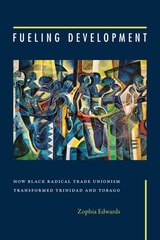
Fueling Development
How Black Radical Trade Unionism Transformed Trinidad and TobagoZophia Edwards
Duke University Press, 2025
Fugitive Dreams
An Anthology of Dutch Colonial LiteratureE. M. Beekman
University of Massachusetts Press, 1988
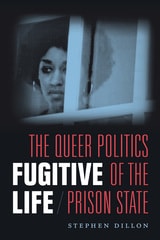
Fugitive Life
The Queer Politics of the Prison StateStephen Dillon
Duke University Press, 2018
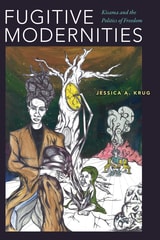
Fugitive Modernities
Kisama and the Politics of FreedomJessica A. Krug
Duke University Press, 2018
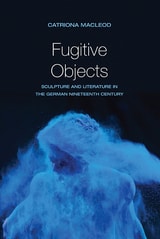
Fugitive Objects
Sculpture and Literature in the German Nineteenth CenturyCatriona MacLeod
Northwestern University Press, 2014
Winner of the 2014 Jean-Pierre Barricelli Prize for Best Book on Romanticism
In Fugitive Objects, Catriona MacLeod examines the question of why sculpture is both intensively discussed and yet rendered immaterial in German literature. She focuses on three forms of disappearance: sculpture’s vanishing as a legitimate art form at the beginning of the nineteenth century in German aesthetics, statues’ migration from the domain of high art into mass reproduction and popular culture, and sculpture’s dislodging and relocation into literary discourse. Through original readings of Clemens Brentano, Achim von Arnim, Adalbert Stifter, Leopold von Sacher-Masoch, and others, MacLeod reveals that if sculpture has disappeared from much of nineteenth-century German literature and aesthetics, it is a vanishing act that paradoxically relocates the statue back onto another cultural pedestal, attesting to the powerful force of the medium.
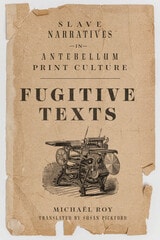
Fugitive Texts
Slave Narratives in Antebellum Print CultureMichaël Roy, translated by Susan Pickford
University of Wisconsin Press, 2024
In Fugitive Texts, Michaël Roy offers the first book-length study of the slave narrative as a material artifact. Drawing on a wide range of sources, he reconstructs the publication histories of a number of famous and lesser-known narratives, placing them against the changing backdrop of antebellum print culture. Slave narratives, he shows, were produced through a variety of print networks. Remarkably few were published under the full control of white-led antislavery societies; most were self-published and distributed by the authors, while some were issued by commercial publishers who hoped to capitalize on the success of Harriet Beecher Stowe’s Uncle Tom’s Cabin. The material lives of these texts, Roy argues, did not end within the pages. Antebellum slave narratives were “fugitive texts” apt to be embodied in various written, oral, and visual forms.
Published to rave reviews in French, Fugitive Texts illuminates the heterogeneous nature of a genre often described in monolithic terms and ultimately paves the way for a redefinition of the literary form we have come to recognize as “the slave narrative.”
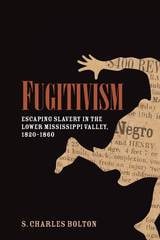
Fugitivism
Escaping Slavery in the Lower Mississippi Valley, 1820-1860S. Charles Bolton
University of Arkansas Press, 2019
Winner, 2020 Booker Worthen Literary Prize
During the antebellum years, over 750,000 enslaved people were taken to the Lower Mississippi Valley, where two-thirds of them were sold in the slave markets of New Orleans, Natchez, and Memphis. Those who ended up in Louisiana found themselves in an environment of swamplands, sugar plantations, French-speaking creoles, and the exotic metropolis of New Orleans. Those sold to planters in the newly-opened Mississippi Delta cleared land and cultivated cotton for owners who had moved west to get rich as quickly as possible, driving this labor force to harsh extremes.
Like enslaved people all over the South, those in the Lower Mississippi Valley left home at night for clandestine parties or religious meetings, sometimes “laying out” nearby for a few days or weeks. Some of them fled to New Orleans and other southern cities where they could find refuge in the subculture of slaves and free blacks living there, and a few attempted to live permanently free in the swamps and forests of the surrounding area. Fugitives also tried to returnto eastern slave states to rejoin families from whom they had been separated. Some sought freedom on the northern side of the Ohio River; othersfled to Mexico for the same purpose.
Fugitivism provides a wealth of new information taken from advertisements, newspaper accounts, and court records. It explains how escapees made use of steamboat transportation, how urban runaways differed from their rural counterparts, how enslaved people were victimized by slave stealers, how conflicts between black fugitives and the white people who tried to capture them encouraged a culture of violence in the South, and how runaway slaves from the Lower Mississippi Valley influenced the abolitionist movement in the North.
Readers will discover that along with an end to oppression, freedom-seeking slaves wanted the same opportunities afforded to most Americans.
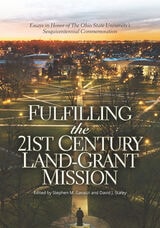
Fulfilling the 21st Century Land-Grant Mission
Essays in Honor of The Ohio State University’s Sesquicentennial CommemorationEdited by Stephen M. Gavazzi and David J. Staley
The Ohio State University Press, 2020
Gathered in honor of The Ohio State University’s sesquicentennial celebration, this collection of essays highlights the significant contributions that Ohio State continues to make as part of its twenty-first-century land-grant mission. Authors from across the university—representing fields as various as agriculture, dance, English, engineering, family science, geography, medicine, social work, and veterinary science—provide contributions that highlight the preeminent status of The Ohio State University. In addition, the perspectives of alumni, staff members, and senior administrators (both present and former) round out the picture of Ohio State as the first among equals regarding its land-grant peers. Overall, contributors draw on rich and varied institutional backgrounds to offer invaluable insights for higher education administrators and scholars across the US.
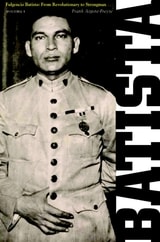
Fulgencio Batista
The Making of a DictatorArgote-Freyre, Frank
Rutgers University Press, 2000
Pawn of the U.S. government. Right-hand man to the mob. Iron-fisted dictator. For decades, public understanding of the pre-Revolutionary Cuban dictator Fulgencio Batista has been limited to these stereotypes. While on some level they all contain an element of truth, these superficial characterizations barely scratch the surface of the complex and compelling career of this important political figure.
Second only to Fidel Castro, Batista is the most controversial leader in modern Cuban history. And yet, until now, there has been no objective biography written about him. Existing biographical literature is predominantly polemical and either borders on hero worship or launches a series of attacks aimed at denigrating his entire legacy.
In this book, the first of two volumes, Frank Argote-Freyre provides a full and balanced portrait of this historically shadowed figure. He describes Batista's rise to power as part of a revolutionary movement and the intrigues and dangers that surrounded him. Drawing on an extensive review of Cuban newspapers, government records, memos, oral history interviews, and a selection of Batista's personal documents, Argote-Freyre moves beyond simplistic caricatures to uncover the real man-one with strengths and weaknesses and with a career marked by accomplishments as well as failures.
This volume focuses on Batista's role as a revolutionary leader from 1933 to 1934 and his image as a "strongman" in the years between 1934 and 1939. Argote-Freyre also uses Batista as an interpretive prism to review an entire era that is usually ignored by scholars-the Republican period of Cuban history. Bringing together global and local events, he considers the significance and relationship of the worldwide economic depression, the beginnings of World War II, and in Cuba, the Revolution of 1933, the expansion of the middle class, and the gradual development of democratic institutions.
Fulgencio Batista and most of Cuba's past prior to the Revolution of 1959 has been lost in the historical mists. Cuba had a rich and fascinating history before the Marxist Revolution and the reign of Fidel Castro. This captivating and long-overdue book uncovers it.
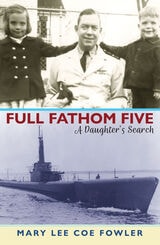
Full Fathom Five
A Daughter's SearchMary Lee Coe Fowler
University of Alabama Press, 2008
One woman’s quest for knowledge of her father lost at sea
Mary Lee Coe Fowler was a posthumous child, born after her father, a submarine skipper in the Pacific, was lost at sea in 1943. Her mother quickly remarried into a difficult and troubled relationship, and Mary Lee’s biological father was never mentioned. It was not until her mother died and Mary Lee was a middle-aged adult that she set out to learn not only who her father was, but what happened to him and his crew, and why—and also to confront why she had shied away from asking these questions until it was nearly too late.
Fowler searched through old ships’ logs, letters, and naval communiqués; visited submarine museums, the Naval Academy, and other pertinent sites; interviewed old friends and crew members who knew her dad and mom or served concurrently; and slowly reconstructed the world in which they lived. Beautifully written, Fowler’s memoir reveals what she eventually learned: of the perils and harships of submarine service in wartime, of the tragic irony of how her father’s sub was probably lost, and of the long-term damage experienced by the families of those who do not come home from war.
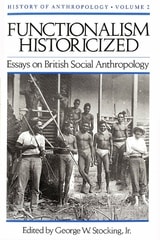
Functionalism Historicized
Essays on British Social AnthopologyEdited by George W. Stocking, Jr.
University of Wisconsin Press, 1988
" This volume is likely to prove indispensable to historians of anthropology in general and of British anthropology in particular. There are a wide range of historical skills on display, from traditional textual analysis to historical sociology of the most sophisticated sort, and there is a more or less thorough chronological coverage from the era of classical evolutionism virtually up to the present. One can only hope that historicizing anthropologists will sample some of these wares."—Journal of the History of the Behavioral Sciences
Functions of Victorian Culture at the Present Time
Christine L. Krueger
Ohio University Press, 2002
Fundamental Development of the Social Sciences
Rockefeller Philanthropy and the United States Social Science Research CouncilDonald Fisher
University of Michigan Press, 1993
The United States Social Science Research Council (SSRC), founded in 1923, was the first national social science institution in the world and might be said to represent the creation of a "science of society." In Fundamental Development of the Social Sciences , Donald Fisher shows how this institution, under the considerable influence of Rockefeller philanthropy, shaped an entire discipline.
Fisher demonstrates that the creation and growth of the SSRC during the 1920s and 1930s is essential to our understanding of the major developments in the social sciences since World War II. He shows that during this period, the place of social science and social scientists in American society was fixed in a way that has had substantial, lasting impact.
The author weaves a number of larger, related issues into his account of the wide-ranging influence of the SSRC: the role of social scientists in the political life of the societies in which they live; the way in which knowledge systems develop and change; the role of philanthropy in industrialized societies; and the formation and preservation of the modern capitalist state.
Donald Fisher's discussion of how an American institution sculpted an entire discipline will be of interest to all social scientists and historians of social science.
Fundamental Theology According to Newman
The Principles of ChristianityFernando Maria Cavaller
Catholic University of America Press, 2026
Fundamentalisms and the State
Remaking Polities, Economies, and MilitanceEdited by Martin E. Marty and R. Scott Appleby
University of Chicago Press, 1996
successful have they been in remaking political structures?
To answer this question, the contributors to this volume—
political scientists, historians of religion,
anthropologists, and sociologists—discuss the anti-
abortion movement, Operation Rescue in the United States, the
Islamic war of resistance in Afghanistan, Shi'ite
jurisprudence in Iran, and other issues. The volume
considers the effect that antisecular religious movements
have had over the past twenty-five years on national
economies, political parties, constitutional issues, and
international relations on five continents and within the
traditions of Islam, Christianity, Judaism, Buddhism,
Hinduism, and Sikhism. Marty and Appleby conclude with a
synthetic statement on the fundamentalist impact on polities,
economies, and state security.
The Fundamentalism Project, Volume 3
Martin E. Marty and R. Scott Appleby direct the
Fundamentalism Project. Marty, the Fairfax M. Cone
Distinguished Service Professor of the History of Modern
Christianity at the University of Chicago, is the senior
editor of the Christian Century and the author of
numerous books, including the multivolume Modern American
Religion, also published by the University of
Chicago Press. Appleby, a research associate at the
University of Chicago, is the author of “Church and
Age Unite!” The Modernist Impulse in American
Catholicism.
Fundamentals of Ground Radar for Air Traffic Control Engineers and Technicians
Ronald D. Bouwman
The Institution of Engineering and Technology, 2009
Funeral Orations
Saint Gregory Nazianzen
Catholic University of America Press, 1953

Fungible Life
Experiment in the Asian City of LifeAihwa Ong
Duke University Press, 2016
Funny Stuff
How Comedy Shaped American HistoryLaura LaPlaca
Rutgers University Press, 2026
A Junior Library Guild Gold Standard Selection
The National Comedy Center and Smithsonian Institution hold unparalleled collections of artifacts that illustrate the vitality and importance of comedy in American life, from vaudeville, silent films, and TV sitcoms to stand-up, sketch, and cartoons. Now, for the first time, these collections are brought together in vibrant photographs and illuminating essays that tell the story of how comedy shaped American history.
Written by historians responsible for safeguarding these cultural treasures, the book takes readers behind the scenes to uncover the stories behind American heirlooms like Groucho Marx’s tailcoat, George Carlin’s joke files, Carol Burnett’s “Went with the Wind” dress, Johnny Carson’s monologues, and the very first Saturday Night Live script, alongside materials from cultural touchstones like The Simpsons, The Muppet Show, In Living Color, All In the Family, and I Love Lucy.
With a foreword by comedy legend Mel Brooks, this dynamic work offers pop culture aficionados, history lovers, and comedy nerds alike a new perspective on America’s past and who we are as a nation through our comedy.
Fur Farms of Alaska
Two Centuries of History and a Forgotten StampedeSarah Crawford Isto
University of Alaska Press, 2012
Fur Trappers Traders Of The Far Southwest
Matthew Despain
Utah State University Press, 1997

Furnishing Fascism
Modernist Design and Politics in ItalyIgnacio G. Galán
University of Minnesota Press, 2025
The role of modernist interior design in the construction of Italian nationalism
Along with the rise of Mussolini’s fascist regime, the interwar years in Italy also saw the widespread development of its modernist interior design and furnishing practices. While the regime’s politics were overtly manifest in monumental government architecture, Furnishing Fascism examines the subtler yet effective role of household goods and decor in the cultivation of Italy’s exclusionary sense of national identity.
Presenting a fresh look at the work of various architects and designers, including iconic figures such as Gio Ponti and Carlo Enrico Rava, Ignacio G. Galán explores how seemingly neutral products of everyday life contributed to the propagation of fascist ideology. Through extensive promotion in popular magazines and department stores, on the film sets of Cinecittà Studios, and throughout the country’s colonial territories, Italy’s modernist design practices were part of a larger political project that aimed to produce a totalizing image of cultural hegemony.
Interweaving design theory, architectural history, and media scholarship, Furnishing Fascism reexamines the period’s so-called minor arts to reveal the political entanglement of modernism in early twentieth-century Italy and offers valuable insight into the complications of cultural production under the auspices of authoritarian power.
Retail e-book files for this title are screen-reader friendly with images accompanied by short alt text and/or extended descriptions.
Fusion of the Worlds
An Ethnography of Possession among the Songhay of NigerPaul Stoller
University of Chicago Press, 1989
"Stoller brilliantly recreates the reality of spirit presence; hosts are what they mediate, and spirits become flesh and blood in the 'fusion' with human existence. . . . An excellent demonstration of the benefits of a new genre of ethnographic writing. It expands our understanding of the harsh world of Songhay mediums and sorcerers."—Bruce Kapferer, American Ethnologist
"A vivid story that will appeal to a wide audience. . . . The voices of individual Songhay are evident and forceful throughout the story. . . . Like a painter, [Stoller] is concerned with the rich surface of things, with depicting images, evoking sensations, and enriching perceptions. . . . He has succeeded admirably." —Michael Lambek, American Anthropologist
"Events (ceremonies and life histories) are evoked in cinematic style. . . . [This book is] approachable and absorbing—it is well written, uncluttered by jargon and elegantly structured."—Richard Fardon, Times Higher Education Supplement
"Compelling, insightful, rich in ethnographic detail, and worthy of becoming a classic in the scholarship on Africa."—Aidan Southall, African Studies Review

Futbolera
A History of Women and Sports in Latin AmericaBy Brenda Elsey and Joshua Nadel
University of Texas Press, 2019
Latin American athletes have achieved iconic status in global popular culture, but what do we know about the communities of women in sport? Futbolera is the first monograph on women’s sports in Latin America. Because sports evoke such passion, they are fertile ground for understanding the formation of social classes, national and racial identities, sexuality, and gender roles. Futbolera tells the stories of women athletes and fans as they navigated the pressures and possibilities within organized sports.
Futbolera charts the rise of physical education programs for girls, often driven by ideas of eugenics and proper motherhood, that laid the groundwork for women’s sports clubs, which began to thrive beyond the confines of school systems. Futbolera examines how women challenged both their exclusion from national pastimes and their lack of access to leisure, bodily integrity, and public space. This vibrant history also examines women’s sports through comparative case studies of Argentina, Brazil, Chile, Costa Rica, Mexico, and others. Special attention is given to women’s sports during military dictatorships of the 1970s and 1980s as well as the feminist and democratic movements that followed. The book culminates by exploring recent shifts in mindset toward women’s football and dynamic social movements of players across Latin America.
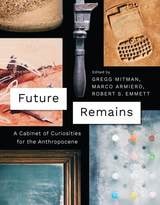
Future Remains
A Cabinet of Curiosities for the AnthropoceneEdited by Gregg Mitman, Marco Armiero, Robert S. Emmett
University of Chicago Press, 2018
Future Remains is a thoughtful and creative meditation on these questions. The fifteen objects gathered in this book resemble more the tarots of a fortuneteller than the archaeological finds of an expedition—they speak of planetary futures. Marco Armiero, Robert S. Emmett, and Gregg Mitman have assembled a cabinet of curiosities for the Anthropocene, bringing together a mix of lively essays, creatively chosen objects, and stunning photographs by acclaimed photographer Tim Flach. The result is a book that interrogates the origins, implications, and potential dangers of the Anthropocene and makes us wonder anew about what exactly human history is made of.
Future
A Recent HistoryBy Lawrence R. Samuel
University of Texas Press, 2009
The future is not a fixed idea but a highly variable one that reflects the values of those who are imagining it. By studying the ways that visionaries imagined the future—particularly that of America—in the past century, much can be learned about the cultural dynamics of the time.
In this social history, Lawrence R. Samuel examines the future visions of intellectuals, artists, scientists, businesspeople, and others to tell a chronological story about the history of the future in the past century. He defines six separate eras of future narratives from 1920 to the present day, and argues that the milestones reached during these years—especially related to air and space travel, atomic and nuclear weapons, the women's and civil rights movements, and the advent of biological and genetic engineering—sparked the possibilities of tomorrow in the public's imagination, and helped make the twentieth century the first century to be significantly more about the future than the past.
The idea of the future grew both in volume and importance as it rode the technological wave into the new millennium, and the author tracks the process by which most people, to some degree, have now become futurists as the need to anticipate tomorrow accelerates.
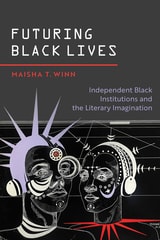
Futuring Black Lives
Independent Black Institutions and the Literary ImaginationMaisha T. Winn
Vanderbilt University Press, 2025
The rationale for establishing and valuing IBIs remains highly relevant, given the sociopolitical landscape of education today. In addition to persistent racial disparities in academic achievement and Black students’ highly disproportionate experiences of punishment and “discipline,” friction and legislation against critical examination of race, racism, and racist ideas in school settings are front and center, and children’s and young adult literature are under attack through censorship and outright book bans. Yet Black institution builders left useful maps of and for the educational future/s of Black children that remain available in journals, newspapers, pamphlets, and other ephemera. Author Maisha T. Winn demonstrates how and why the historiography-grounded futuring of Black education can and should inform current pursuits of equity, justice, and liberation through education.
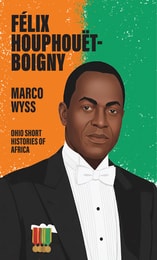
Félix Houphouët-Boigny
Marco Wyss
Ohio University Press, 0
Félix Houphouët-Boigny, who ruled Côte d’Ivoire from independence in 1960 until his death in 1993, remains one of the most influential and controversial figures in modern African history. Revered by some as the “old sage” who transformed his country into an economic powerhouse and a haven of stability during the Cold War and reviled by others as a neocolonial collaborator whose policies sowed the seeds of later crisis, Houphouët-Boigny left a legacy that continues to shape debates about postcolonial governance and African international relations. This first English-language biography offers a comprehensive and nuanced portrait of Houphouët-Boigny’s life and career. It traces his journey from Baoulé nobility and early prominence in colonial politics to his emergence as a leading African statesman after World War II. The book examines his shifting ideological positions—championing France’s imperial project, then embracing African nationalism during the collapse of the French Community—and his pivotal role in negotiating Côte d’Ivoire’s postcolonial relationship with France. Houphouët-Boigny consolidated domestic power into a de facto one-party state, furthering his increasingly authoritarian tendencies and his efforts to modernize Côte d’Ivoire through economic development and grand architectural projects. Beyond domestic issues, the biography explores Houphouët-Boigny’s ambitions on the continental stage. It details his Cold War maneuvers, often in partnership with France, as he pursued regional dominance against figures like Kwame Nkrumah, supported Moïse Tshombe in the Congo, aided Biafra during the Nigerian Civil War, and even engaged with apartheid South Africa. By situating Houphouët-Boigny within the broader dynamics of Françafrique—the enduring neocolonial entanglement between France and its former African colonies—this biography sheds light on the complexities of postcolonial rule. It offers essential insights into the political, economic, and diplomatic forces that shaped Africa in the second half of the twentieth century and that continue to resonate today.
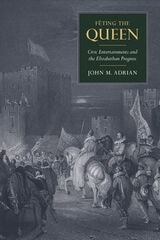
Fêting the Queen
Civic Entertainments and the Elizabethan ProgressJohn M Adrian
University of Massachusetts Press, 2021
While previous scholars have studied Elizabeth I and her visits to the homes of influential courtiers, Fêting the Queen places a new emphasis on the civic communities that hosted the monarch and their efforts to secure much needed support. Case studies of the cities of Oxford, Canterbury, Sandwich, Bristol, Worcester, and Norwich focus on the concepts of hospitality and space—including the intimate details of the built environment.