Results by title
28167 books match the query 'History' and 1092 start with f

Faraway Women and the "Atlantic Monthly"
Cathryn Halverson
University of Massachusetts Press, 2019
Winner of the 2020 Thomas J. Lyon Award from the Western Literature Association
In the first decades of the twentieth century, famed Atlantic Monthly editor Ellery Sedgwick chose to publish a group of nontraditional writers he later referred to as “Faraway Women,” working-class authors living in the western United States far from his base in Boston. Cathryn Halverson surveys these enormously popular Atlantic contributors, among them a young woman raised in Oregon lumber camps, homesteaders in Wyoming, Idaho, and Alberta, and a world traveler who called Los Angeles and Honolulu home.
Faraway Women and the “Atlantic Monthly” examines gender and power as it charts an archival journey connecting the least remembered writers and readers of the time with one of its most renowned literary figures, Gertrude Stein. It shows how distant friends, patrons, publishers, and readers inspired, fostered, and consumed the innovative life narratives of these unlikely authors, and it also tracks their own strategies for seizing creative outlets and forging new protocols of public expression. Troubling binary categories of east and west, national and regional, and cosmopolitan and local, the book recasts the coordinates of early twentieth-century American literature.

Fare Well, Illyria
David Binder
Central European University Press, 2014
Farewell to Prosperity
Wealth, Identity, and Conflict in Postwar AmericaLisle A. Rose
University of Missouri Press, 2014
Farm Girl
A Wisconsin MemoirBeuna Coburn Carlson
University of Wisconsin Press, 2020
Farm Girl is Beuna "Bunny" Coburn Carlson's loving tribute to the gently rolling hills of western Wisconsin. With an inviting and fluid voice, she shares intimate moments of happinesses from her childhood: collecting butternuts for homemade maple candy, watching her father read by the flickering light of a kerosene lamp, and the joy of finding a juicy orange at the bottom of a Christmas stocking. Underlying each vignette is the courage of a strong family surviving adversity and finding comfort in one another. Hers is a memoir that readers can dip in and out of with pleasure.
Farm House
College Farm to University MuseumAtherly, Mary E.
University of Iowa Press, 1995
Farm
A Multimodal ReaderJoyce Kinkead
Utah State University Press, 2020
The text guides the reader through the Jeffersonian idealism of the yeoman farmer (“cultivators of the earth are the chosen people of God”) to literature of the nineteenth and twentieth centuries (Thoreau’s “The Bean-Field,” Cather’s prairie trilogy, Steinbeck’s The Grapes of Wrath, and Carpenter’s Farm City). Contributors provide historical context for the literary texts, such as discussion of sharecropping vs. plantation systems, the rise of agribusiness and chemical farming, and Teddy Roosevelt’s Country Life Commission. Written, visual, and oral texts ask readers to consider the farm in art (Grant Wood), ecology (Rachel Carson’s Silent Spring), children’s and young adult literature (classic children’s books, YA novels, nonfiction, and poetry), advertising (from early boosterism to Chipotle videos), print culture (farmers’ market and victory garden posters from both world wars), folklore (food culture, vintners, and veterinarian practices), popular culture (Farm Aid concerts), and much more. Each reading is supported by activities, exercises, projects, and visual rhetorical elements that further connect students to agriculture and the essential work of farmers.

Farmcarts to Fords
A History of the Military Ambulance, 1790-1925John S. Haller
Southern Illinois University Press, 1992
This book is the first history of the techniques, systems, and technologies used to evacuate wounded from the battlefield. Historically, the word ambulance described those facilities that provided temporary assistance to the wounded, thus distinguishing them from stationary hospitals where military personnel received more permanent care. Americans and British, however, applied the term to the two-to four-wheeled transport conveyances that carried wounded from the battlefield to the war hospitals.
With the aid of fifty-four illustrations, John S. Haller traces the histories of both meanings of the word from the Napoleonic era through the Great War and its aftermath. He concentrates on the development of British and American evacuation procedures and technology with a focus on hand conveyances and wheeled vehicles. His intent is not to cover all aspects of medical evacuation but to accurately recount the common medical evacuation problems, incongruities, and controversies that existed for warring nations.
Farmers in Rebellion
The Rise and Fall of the Southern Farmers Alliance and People's Party in TexasBy Donna A. Barnes
University of Texas Press, 1984
The years after the Civil War brought struggle to the Southern farmer as the economic mainstay of the South—cotton—steadily dropped in price. Prompted by hard times, farmers in Lampasas County, Texas, gathered in 1877 to discuss what could be done. From these modest origins emerged the National Farmers Alliance and Industrial Union, later known as the Southern Farmers Alliance, a powerful protest movement that played an important role in the formation in 1892 of a new political force, the People's party. In the "solid South," particularly in Texas, large numbers of voters abandoned the Democratic party for the new party. Yet despite this support, the decline of the People's party after 1894 was swift.
Farmers in Rebellion recounts the compelling story of these two crucial and closely related movements. Donna A. Barnes examines their developmental histories, asking such important questions as: Under what conditions do protest movements remain weak? Under what conditions do they prosper, amassing large numbers of supporters? And under what conditions do successful protest movements lose their momentum and die? The author explores these complex questions with deft use of archival data that allows her to reflect on the adequacy of the past sociological answers to these questions.
Farmers in Rebellion is a book rich in detail and scope in its look at a critical juncture in the growth of national populist movements. Of interest to sociologists, historians, and political scientists, it stands as an important contribution to our understanding of a pivotal time in Texas, and national, history.

Farmers' Markets of the Heartland
Janine MacLachlan
University of Illinois Press, 2012
A visual feast of the Midwest's homegrown bounty
In this splendidly illustrated book, food writer and self-described farm groupie Janine MacLachlan embarks on a tour of seasonal markets and farmstands throughout the Midwest, sampling local flavors from Michigan, Ohio, Indiana, Illinois, Missouri, Iowa, Minnesota, and Wisconsin. She conducts delicious research as she meets farmers, tastes their food, and explores how their businesses thrive in the face of an industrial food supply. She tells the stories of a pair of farmers growing specialty crops on a few acres of northern Michigan for just a few months out of the year, an Ohio cattle farm that has raised heritage beef since 1820, and a Minnesota farmer who tirelessly champions the Jimmy Nardello sweet Italian frying pepper. Along the way, she savors vibrant red carrots, slurpy peaches, vast quantities of specialty cheeses, and some of the tastiest pie to cross anyone's lips.
Informed by debates about eating local, seasonal crops, organic farming, sanitation, and biodiversity, Farmers' Markets of the Heartland tantalizes with special recipes from farm-friendly chefs and dozens of luscious color photographs that will inspire you to harvest the homegrown flavors in your own neighborhood.

Farmers, Hunters, and Colonists
Interaction Between the Southwest and the Southern PlainsEdited by Katherine A. Spielmann
University of Arizona Press, 1991
Contributors:
Timothy G. Baugh
Judith A. Habicht-Mauche
Frances Levine
Christopher Lintz
David H. Snow
John D. Speth
Katherine A. Spielmann
David R. Wilcox
Farmers, Kings, and Traders
The People of Southern Africa, 200-1860Martin Hall
University of Chicago Press, 1990
Through a close reading of the accounts of early travelers, colonialists, archaeologists, and historians, Hall places in context the often contradictory histories that have been written of this region. The result is an illuminating look at how ideas about the past have themselves changed over time.
Farming and Famine
Landscape Vulnerability in Northeast Ethiopia, 1889–1991Donald E. Crummey; Edited by James C. McCann
University of Wisconsin Press, 2018
Crummey draws on photographs comparing identical landscapes in 1937 and 1997 as well as interviews with local farmers, among other sources. He reveals that forestation actually increased due to farmers' tree-planting initiatives. More broadly, he shows that, in the face of growing environmental stress, Ethiopian farmers have innovated and adapted. Yet the threat of famine remains because of constricted access to resources and erratic rainfall. To avoid future famines, Crummey suggests, Ethiopia's farmers must transform agricultural productivity, but they cannot achieve that on their own.

Farming, Hunting, and Fishing in the Olmec World
By Amber M. VanDerwarker
University of Texas Press, 2006
The Olmec who anciently inhabited Mexico's southern Gulf Coast organized their once-egalitarian society into chiefdoms during the Formative period (1400 BC to AD 300). This increase in political complexity coincided with the development of village agriculture, which has led scholars to theorize that agricultural surpluses gave aspiring Olmec leaders control over vital resources and thus a power base on which to build authority and exact tribute.
In this book, Amber VanDerwarker conducts the first multidisciplinary analysis of subsistence patterns at two Olmec settlements to offer a fuller understanding of how the development of political complexity was tied to both agricultural practices and environmental factors. She uses plant and animal remains, as well as isotopic data, to trace the intensification of maize agriculture during the Late Formative period. She also examines how volcanic eruptions in the region affected subsistence practices and settlement patterns. Through these multiple sets of data, VanDerwarker presents convincing evidence that Olmec and epi-Olmec lifeways of farming, hunting, and fishing were driven by both political and environmental pressures and that the rise of institutionalized leadership must be understood within the ecological context in which it occurred.

Fascinating Foods from the Deep South
Favorite Recipes from the University Club of Tuscaloosa, AlabamaAlline P. Van Duzor
University of Alabama Press, 2010
250 Recipes from the University of Alabama’s famed University Club in Tuscaloosa
The historic mansion at the corner of University Boulevard and Queen City Avenue in Tuscaloosa, Alabama has been home to the University of Alabama University Club since 1944. In its early years, the Club took shape around the vision and culinary expertise of the formidable Atlantan Alline P. Van Duzor, still remembered in Tuscaloosa for her impeccable and exacting standards. This book reveals her most beloved recipes.
Commissioned in the early 1960s by a New York publisher, this collection of her gastronomic creations sold through more than eight printings, further spreading her reputation.
The more than 250 favorite Southern recipes in this now-classic cookbook are written in Van Duzor’s straight-forward style, using common fresh and store-bought ingredients. This new edition has been augmented by a guide to portions and food brand names, an index to the recipes, and an appendix of past presidents of the University Club Board.
Cookbook collectors, local history buffs, the university community, and happy cooks everywhere will welcome this reissue of a popular cookbook that has won decades of fans.
Fascination with the Persecutor
George L. Mosse and the Catastrophe of Modern ManEmilio Gentile and and Stanley G. Payne, translated by John and Anne Tedeschi
University of Wisconsin Press, 2021
This translation makes Emilio Gentile’s groundbreaking study of Mosse’s life and work available to English language readers. A leading authority on fascism, totalitarianism, and Mosse’s legacy, Gentile draws on a wealth of published and unpublished material, including letters, interviews, lecture plans, and marginalia from Mosse’s personal library. Gentile details how the senior scholar eschewed polemics and employed rigorous academic standards to better understand fascism and the “catastrophe of the modern man”—how masculinity transformed into a destructive ideology. As long as wars are waged over political beliefs in popular culture, Mosse’s theories of totalitarianism will remain as relevant as ever.

Fascism and Antifascism since 1945
Mark Bray, Jessica Namakkal, Giulia Riccò, and Eric Roubinek, special issue editors
Duke University Press, 2020
Contributors. Benjamin Bland, Mark Bray, Rosa Hamilton, Jessica Namakkal, Giulia Riccò, Cole Rizki, Eric Roubinek, Antonino Scalia, Stuart Schrader, Vivian Shaw, Michael Staudenmaier
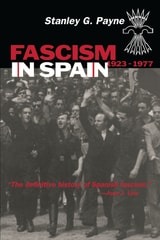
Fascism in Spain, 1923–1977
Stanley G. Payne
University of Wisconsin Press, 2000
Fascism in Spain, 1923–1977, by celebrated historian Stanley G. Payne, is the most comprehensive history of Spanish fascism to appear in any language. This authoritative study offers treatment of all the major doctrines, personalities, and defining features of the Spanish fascist movement, from its beginnings until the death of General Francisco Franco in 1977.
Payne describes and analyzes the development of the Falangist party both prior to and during the Spanish Civil War, presenting a detailed analysis of its transformation into the state party of the Franco regime—Falange Española Tradicionalista—as well as its ultimate conversion into the pseudofascist Movimiento Nacional. Payne devotes particular attention to the crucial years 1939–1942, when the Falangists endeavored to expand their influence and convert the Franco regime into a fully Fascist system. Fascism in Spain helps us to understand the personality of Franco, the way in which he handled conflict within the regime, and the reasons for the long survival of his rule. Payne concludes with the first full inquiry into the process of “defascistization,” which began with the fall of Mussolini in 1943 and extended through the Franco regime’s later efforts to transform the party into a more viable political entity.

Fascism
Comparison and DefinitionStanley G. Payne
University of Wisconsin Press, 1983

Fascism
History and TheoryDavid Renton
Pluto Press, 2020
To explain this disturbing trend, David Renton surveys the history of fascism in Europe from its pre-war origins to the present day, examining Marxist responses to fascism in the age of Hitler and Mussolini, the writings of Trotsky and Gramsci and contemporary theorists. Renton theorizes that fascism was driven by the chaotic and unstable balance between reactionary ambitions and the mass character of its support. This approach will arm a new generation of anti-fascists to resist those who seek to re-enact fascism.
Rewritten and revised for the twentieth anniversary of its first publication, Renton's classic book synthesizes the Marxist theory of fascism and updates it for our own times.
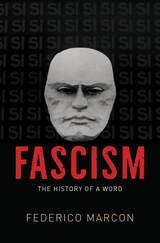
Fascism
The History of a WordFederico Marcon
University of Chicago Press, 2025
The rise and popular support for authoritarianism around the world and within traditional democracies have spurred debates over the meaning of the term “fascist” and when and whether it is appropriate to use it. The landmark study Fascism: The History of a Word takes this debate further by tackling its most fundamental questions: How did the terms “fascism” and “fascist” come to be in the first place? How and in what circumstances have they been used? How can they be understood today? And what are the advantages (or disadvantages) of using “fascism” to make sense of interwar authoritarianism as well as contemporary politics?
Exploring the writings and deeds of political leaders, activists, artists, authors, and philosophers, Federico Marcon traces the history of the term’s use (and usefulness) in relation to Mussolini’s political regime, antifascist resistance, and the quest of postwar historians to develop a definition of a “fascist minimum.” This investigation of the semiotics of “fascism” also aims to inquire about people’s voluntary renunciation of the modern emancipatory ideals of freedom, equality, and solidarity.

Fascism
Theory and PracticeDavid Renton
Pluto Press, 1999
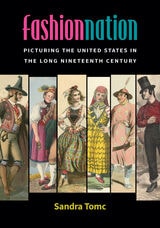
Fashion Nation
Picturing the United States in the Long Nineteenth CenturySandra Tomc
University of Michigan Press, 2021

Fashion, Desire and Anxiety
Image and Morality in the Twentieth CenturyArnold, Rebecca
Rutgers University Press, 2001
These dreams and freedoms, Rebecca Arnold proposes, are contradictory. Fashion and its surrounding imagery elicit fear and anxiety in their consumers as well as pleasure. Fashion has come to incorporate the underside of modern life, with violence and decay becoming a dominant theme in clothing design and photography.
Arnold draws on diverse written sources to explore the complex nature of modern fashion. She discusses a range of key themes: how fashion uses and abuses the power of wealth; the alienating promotion of "good" taste; the power plays of sex and display; and how identities can be blurred to disguise and confuse. In order to unravel the contradictory emotions of desire and anxiety they provoke, she never loses sight of the historical and cultural contexts in which fashion designers and photographers perform.
Generously illustrated, Fashion, Desire and Anxiety focuses on the last thirty years, from photographic works of the 1970s to the beginning of the twenty-first century.

Fashion, Desire and Anxiety
Image and Morality in the Twentieth CenturyArnold, Rebecca
Rutgers University Press, 2001
These dreams and freedoms, Rebecca Arnold proposes, are contradictory. Fashion and its surrounding imagery elicit fear and anxiety in their consumers as well as pleasure. Fashion has come to incorporate the underside of modern life, with violence and decay becoming a dominant theme in clothing design and photography.
Arnold draws on diverse written sources to explore the complex nature of modern fashion. She discusses a range of key themes: how fashion uses and abuses the power of wealth; the alienating promotion of "good" taste; the power plays of sex and display; and how identities can be blurred to disguise and confuse. In order to unravel the contradictory emotions of desire and anxiety they provoke, she never loses sight of the historical and cultural contexts in which fashion designers and photographers perform.
Generously illustrated, Fashion, Desire and Anxiety focuses on the last thirty years, from photographic works of the 1970s to the beginning of the twenty-first century.

Fashionable Food
Seven Decades of Food FadsSylvia Lovegren
University of Chicago Press, 2005
Well researched and delightfully illustrated, this collection of faddish recipes from the 1920s to the 1990s is a decade-by-decade tour of a hungry American century. From the Three P's Salad—that's peas, pickles, and peanuts—of the post-World War I era to the Fruit Cocktail and Spam Buffet Party loaf—all the rage in the ultra-modern 1950s, when cooking from a can epitomized culinary sophistication—Fashionable Food details the origins of these curious delicacies. In two chapters devoted to "exotic foods of the East," for example, Lovegren explores the long American love affair with Chinese food and the social status conferred upon anyone chic enough to eat pu-pu platters from Polynesia. Throughout, Lovegren supplements recipes—some mouth-watering, some appalling—from classic cookbooks and family magazines, with humorous anecdotes that chronicle how society and kitchen technology influenced the way we lived and how we ate.
Equal parts American and culinary history, Fashionable Food examines our collective past from the kitchen counter. Even if it's been a while since you last had Tang Pie and your fondue set is collecting dust in the back of the cupboard, Fashionable Food will inspire, entertain, and inform.
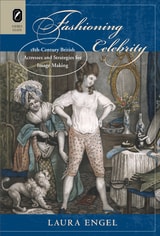
Fashioning Celebrity
Eighteenth-Century British Actresses and Strategies for Image MakingLaura Engel
The Ohio State University Press, 2011
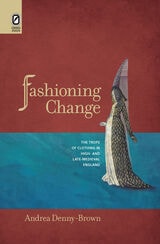
Fashioning Change
The Trope of Clothing in High- and Late-Medieval EnglandAndrea Denny-Brown
The Ohio State University Press, 2012
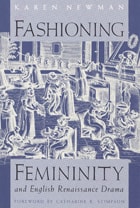
Fashioning Femininity and English Renaissance Drama
Karen Newman
University of Chicago Press, 1991
Through the critical lens of poststructuralism, Newman reads anatomies, conduct and domesticity handbooks, sermons, homilies, ballads, and court cases to delineate the ideologies of femininity they represented and produced. Arguing that drama, as spectacle, provides a peculiarly useful locus for analyzing the management of femininity, Newman considers the culture of early modern London to reveal how female subjectivity was fashioned and staged in the plays of Shakespeare, Jonson, and others.
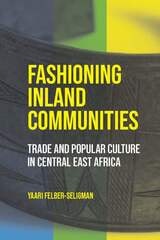
Fashioning Inland Communities
Trade and Popular Culture in Central East AfricaYaari Felber-Seligman
University of Wisconsin Press, 2025
Ruvuma used fashion to build varied communities, from local to pan-regional, reflecting the dynamic relationships among inland groups. Examples of Ruvuma popular fashions reveal processes of meaning making and community building that call for us to expand our attention to the ways in which East African peoples interacted alongside, as well as beyond, trade networks that sourced prestige and commercial goods. Popular culture here emerges as a heterarchical force that shaped lasting multidirectional connections across and between Ruvuma and their neighbors. As both a subject and a strategy for analysis, the history of popular fashion shifts how we view histories of small, decentralized societies as they encounter larger economies. Felber-Seligman demonstrates that this has implications for our understanding not only of trade but of material culture, community, gender, and family.

Fast Combat Support Ship HNLMS Zuiderkruis
Jantinus Mulder
Amsterdam University Press, 2023

Fast Forward
The Aesthetics and Ideology of Speed in Russian Avant-Garde Culture, 1910–1930Tim Harte
University of Wisconsin Press, 2009
Although modernism arrived somewhat late in Russia, the increased tempo of life at the start of the twentieth century provided Russia’s avant-garde artists with an infusion of creative dynamism and crucial momentum for revolutionary experimentation. In Fast Forward Tim Harte presents a detailed examination of the images and concepts of speed that permeated Russian modernist poetry, visual arts, and cinema. His study illustrates how a wide variety of experimental artistic tendencies of the day—such as “rayism” in poetry and painting, the effort to create a “transrational” language (zaum’) in verse, and movements seemingly as divergent as neo-primitivism and constructivism—all relied on notions of speed or dynamism to create at least part of their effects.
Fast Forward reveals how the Russian avant-garde’s race to establish a new artistic and social reality over a twenty-year span reflected an ambitious metaphysical vision that corresponded closely to the nation’s rapidly changing social parameters. The embrace of speed after the 1917 Revolution, however, paradoxically hastened the movement’s demise. By the late 1920s, under a variety of historical pressures, avant-garde artistic forms morphed into those more compatible with the political agenda of the Russian state. Experimentation became politically suspect and abstractionism gave way to orthodox realism, ultimately ushering in the socialist realism and aesthetic conformism of the Stalin years.
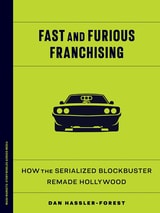
Fast and Furious Franchising
How the Serialized Blockbuster Remade HollywoodDan Hassler-Forest
University of Minnesota Press, 2026
What the popularity of the Fast and Furious film franchise says about Hollywood blockbusters and media production
Fast and Furious Franchising charts the transformation of Hollywood through the story of one of its most successful cinematic universes. Released in 2001, The Fast and the Furious became an unexpected hit, developing into a seven-billion-dollar media franchise with nine direct sequels (so far), one “sidequel,” copious spin-offs, and licensing deals from board games to theme park rides.
Dan Hassler-Forest shows how Fast and Furious paved the way for a new form of serialized storytelling that balanced new distribution practices and expansion into international markets with a savvy awareness of representational politics. By following the series’s development over the past twenty-five years, Fast and Furious Franchising reveals distinct phases that reflect larger media-industrial trends: the postclassical blockbuster era of the early 2000s; the emergence of the megafranchise between 2008 and 2014; the franchise’s “imperial” era, from 2015 through 2019; and the postpandemic crisis era of media saturation and franchise fatigue.
While examining this rapidly changing media landscape, Hassler-Forest offers lively, insightful analyses of the films as they have embraced ever-more-ludicrous plots and unlikely character turns while always maintaining their signature faith in the power of family. As he illuminates the role of the Fast and Furious movies in the global entertainment industry, Hassler-Forest shows how the films’ improbable success proves Dominic Toretto’s adage that, whether “you win by an inch or a mile . . . winning’s winning.”
Retail e-book files for this title are screen-reader friendly with images accompanied by short alt text and/or extended descriptions.
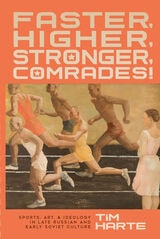
Faster, Higher, Stronger, Comrades!
Sports, Art, and Ideology in Late Russian and Early Soviet CultureTim Harte
University of Wisconsin Press, 2020
With interdisciplinary analysis of literature, painting, and film, Faster, Higher, Stronger, Comrades! traces how physical fitness had an even broader impact on culture and ideology in the Soviet Union than previously realized. From prerevolutionary writers and painters glorifying popular circus wrestlers to Soviet photographers capturing unprecedented athleticism as a means of satisfying their aesthetic ideals, the nation's artists embraced sports in profound, inventive ways. Though athletics were used for doctrinaire purposes, Tim Harte demonstrates that at their core, they remained playful, joyous physical activities capable of stirring imaginations and transforming everyday realities.

Fasti Ecclesiae Anglicanae 1300-1541
II: Hereford DioceseEdited by Joyce M. Horn and revised by David Lepine
University of London Press, 2009
Fasti Ecclesiae Anglicanae 1541–1857
The Welsh Dioceses XIVCompiled by William H. Campbell
University of London Press, 2026
A detailed history of the Church of England’s Welsh dioceses, including the building of cathedrals and churches.
The volumes in this series trace the process of reorganization and reform that took place in the Church of England after the Norman conquest, with the building of new cathedrals, the establishment of new constitutions for their chapters, and the appointment of foreign clergy. In this period, when many documents are undated, the chronological framework is provided by the careers of bishops, dignitaries, canons, and cathedral priors.
This volume covers the years 1541 to 1857, with a focus on the Welsh dioceses. During this period, six new dioceses were created out of larger dioceses, with former abbey churches named as their cathedrals. These fourteen cathedrals were known as the New Foundation, as compared with the thirteen medieval secular cathedrals of the Old Foundation. Further substantial reorganization took place in the 1830s, and additional dioceses were created to meet the needs of the period. This volume offers a detailed and comprehensive account of the period, making it an essential research tool for historians.

Fatal Isolation
The Devastating Paris Heat Wave of 2003Richard C. Keller
University of Chicago Press, 2015
Fatal Isolation tells the stories of these victims and the catastrophe that took their lives. It explores the multiple narratives of disaster--the official story of the crisis and its aftermath, as presented by the media and the state; the life stories of the individual victims, which both illuminate and challenge the ways we typically perceive natural disasters; and the scientific understandings of disaster and its management. Fatal Isolation is both a social history of risk and vulnerability in the urban landscape and a story of how a city copes with emerging threats and sudden, dramatic change.
Fate in My Hands
The Death Penalty in the Soviet UnionYana Skorobogatov
University of Chicago Press, 2026
A striking examination of the death penalty in the Soviet Union that documents in heart-rending detail how its citizens, hopeful for a new life post-Stalin, lost faith that their transgressions could be forgiven.
From 1954 to 1991 in the Soviet Union, nearly forty thousand citizens were executed after the death penalty was reinstated as a punishment for homicide. Fate in My Hands introduces readers to the many citizens in this period—women and men of all ages and backgrounds—who found themselves on death row and tried to escape it in the only way available to them: asking for forgiveness.
Examining the letters and objects the dead left behind, Skorobogatov recovers their voices and allows them to speak anew. She offers a striking portrait of life in the Soviet Union and the citizens who dreamed of new possibilities even as they faced their tragic end. Using a corpus of never-before-accessed criminal court records, Fate in My Hands brings readers not just into the police interrogation rooms, courthouses, and cells where the condemned awaited their fates, but into the homes, workplaces, and psychiatric hospitals where families and friends alike came together to pursue an elusive, bitter justice in the wake of violent tragedy.

Fatefully, Faithfully Feminist
A Critical History of Women, Patriarchy, and Mexican National DiscourseCarlos Monsiváis, edited by Norma Kahn and Ilana Luna
Vanderbilt University Press, 2024

Father Christmas' ABC
F. Warne & Co.
Bodleian Library Publishing, 2005
R is for the Reindeer, of Santa Claus hearty
W is for waggon laden with holly
X is for Xmas tree all light and toys jolly
The celebration of Christmas throughout history is marked by rich traditions around the globe, yet British festive customs—exchanging gifts, singing carols, trimming the magnificent tree, and sipping wassail—take pride of place in our imaginations. Allowing us a glimpse of some of these customs is a facsimile edition of an Father Christmas' ABC, an1894 Victorian classic that chronicles the activities surrounding the holiday more than a century ago.
Each charming color painting, one for each letter of the alphabet, reveals a custom of a Victorian Christmas. From the lighting of candles on the tree to bell ringing, ice skating, and making jam tarts, the beautiful illustrations vividly bring to life the spirit of the holiday and its history.
Accompanying the illustrations are clever ABC verses that at the time were an alphabet primer and now are an intimate glimpse of Victorian domestic life. The lively verse recounts various holiday traditions, transporting us to the warmth and cozy comfort of a British home at Christmastime.
Together, the rich illustrations and captivating verses create a unique and enchanting picture book on the special moments of Christmas. Father Christmas' ABC will appeal to readers of all ages as a nostalgic window into Christmases of a bygone time.

Father Groppi
Marching for Civil RightsStuart Stotts
Wisconsin Historical Society Press, 2013
Father Groppi Marched to Change Milwaukee
"Father Groppi: Marching for Civil Rights" tells the story of Father James Groppi, a Catholic priest from Milwaukee, Wis., who stood up for civil rights in the 1960s and 1970s.
This important new addition to the Badger Biographies series for young readers also tells about a turbulent time in Wisconsin history and sheds light on the civil rights movement and its place in the North.
Growing up on the south side of Milwaukee as the son of Italian immigrants, young James Groppi learned early on what it felt like to be made fun of just because of who you are, and he learned to respect people from other races and ethnic groups. Later, while studying to become a priest, he saw the discrimination African Americans faced. It made him angry, and he vowed to do whatever he could to fight racism.
Father Groppi marched with Dr. Martin Luther King Jr. and other leaders of the civil rights movement. But he knew there was work to be done in his own city. In Milwaukee, he teamed up with the NAACP and other organizations, protesting discrimination and segregation wherever they saw it. It wasn't always easy, and Father Groppi and the other civil rights workers faced great challenges.
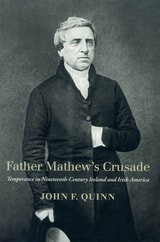
Father Mathew's Crusade
Temperance in Nineteenth-Century Ireland and Irish AmericaJohn F. Quinn
University of Massachusetts Press, 2002
For centuries, the Irish have been famed, and often derided, for their attachment to alcohol. Yet in the 1830s and 1840s, Ireland became a temperance stronghold. The man almost singlehandedly responsible for this surprising transformation was Father Theobald Mathew (1790–1856), a popular Franciscan friar. Over a ten-year period, five million Irish men, women, and children took the pledge at his hands, while hundreds of public houses were forced to shut their doors or switch to selling coffee and tea.
By the end of the 1840s, however, Mathew's “miracle” was already coming undone. The Great Famine was ravaging Ireland and Mathew's years of nonstop campaigning had left him sick, exhausted, and bankrupt. Undeterred, he traveled to the United States in 1849 to generate support and administer the pledge to as many new immigrants as he could find. Failing health forced him to return to Ireland where he died in 1856, leaving behind a weak and fragmented movement.
In the late nineteenth century, several Irish priests revived Mathew's crusade. In the United States, Irish American bishops supported the Catholic Total Abstinence Union (CTAU) and joined hands with the Women's Christian Temperance Union in their war against liquor. In Ireland, Father James Cullen formed the Pioneers, a total abstinence association for devout Catholics. While the CTAU languished after the United States Congress passed the Prohibition Amendment in 1919, the Pioneers continued to thrive in Ireland into the 1960s. Although the group's membership has declined in recent years, there are still today a large number of Irish teetotalers.

Fathers of Botany
The Discovery of Chinese Plants by European MissionariesJane Kilpatrick
Royal Botanic Gardens, Kew, 2014
But as Jane Kilpatrick shows in Fathers of Botany, the first Westerners to come upon and document this bounty were in fact cut from a different cloth: the clergy. Following the Opium Wars, European missionaries were the first explorers to dig further into the Chinese interior and send home evidence of one of the richest and most varied floras ever seen, and it was their discoveries that caused a sensation among Western plantsmen. Both men of faith and talented botanists alike, these missionaries lent their names to many of the plants they discovered, but their own stories disappeared into the leaf litter of history. Drawing on their letters and contemporary accounts, Kilpatrick focuses on the lives of four great French missionary botanists—Pères Armand David (of Davidia involucrata—the dove tree—and discoverer of the giant panda), Jean Marie Delavay, Paul Guillaume Farges, and Jean André Soulié—as well as a group of other French priests, Franciscan missionaries, and a single German Protestant pastor who all amassed significant plant collections, as she unearths a lost chapter of botanical history. In so doing, she reminds today’s gardeners and botanists—and any of us who stop to smell the roses—of the enormous debt owed to these obscure fathers of botany.
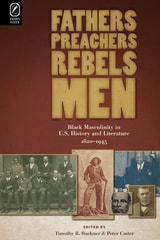
Fathers, Preachers, Rebels, Men
Black Masculinity in U.S. History and Literature, 1820–1945Timothy R. Buckner
The Ohio State University Press, 2011
Fathers, Preachers, Rebels, Men: Black Masculinity in U.S. History and Literature, 1820–1945,edited by Timothy R. Buckner and Peter Caster, brings together scholars of history and literature focused on the lives and writing of black men during the nineteenth and twentieth centuries in the United States. The interdisciplinary study demonstrates the masculine character of cultural practices developed from slavery through segregation. Black masculinity embodies a set of contradictions, including an often mistaken threat of violence, the belief in its legitimacy, and the rhetorical union of truth and fiction surrounding slavery, segregation, resistance, and self-determination. The attention to history and literature is necessary because so many historical depictions of black men are rooted in fiction. The essays of this collection balance historical and literary accounts, and they join new descriptions of familiar figures such as Charles W. Chesnutt and W. E. B. Du Bois with the less familiar but critically important William Johnson and Nat Love.

Faulkner and Hemingway
Biography of a Literary RivalryJoseph Fruscione
The Ohio State University Press, 2012

Faulkner the Storyteller
Blair Labatt
University of Alabama Press, 2006
A study exploring the role of event and plot in William Faulkner’s fiction.
Faulkner the Storyteller addresses the role of event and plot in Faulkner's fiction and the creation of an implied teller behind the tale. Novels like The Sound and the Fury and Absalom, Absalom! are often thought of as canonical modernist texts antagonistic to traditional notions of plot and storytelling. Blair Labatt, however, argues that Faulkner's fiction, regardless of its modernist gestures, is filled and driven by sophisticated manifestations of plot—willed challenges, structural targets, gambits, designs, engagements, and battles—a language of competition and conflict and a syntax of events.
Labatt examines Faulkner's short stories, such as "Mountain Victory," "That Evening Sun," and "Barn Burning," and the architecture of the Snopes Trilogy (The Hamlet, The Town, and The Mansion), and finds that Faulkner's deployment of cause and effect is central to his narratives. Labatt also explores how Faulkner's use of plot creates an implied voice that lends a humorous element to his story's twists and turns that often brackets and encloses the pathos of his characters.

Fault Lines and Controversies in the Study of Seventeenth-Century English Literature
Edited & Intro Claude J. Summers & Ted-Lary Pebworth
University of Missouri Press, 2002

Fauna and Flora, Earth and Sky
Brushes with Nature's WisdomTrudy Dittmar
University of Iowa Press, 2003

Fawn Island
Douglas Wood
University of Minnesota Press, 2018
Fawn Island is a place where crows serve as alarm clocks, white-throated sparrows leave the tracks of their songs upon the evening hush, and chickadees help a woodsman learn to whistle. The island is also a jumping-off place for journeys large and small, earthly and spiritual-to nearby Mallard Island, Gull Island, or Bald Rock, by sea kayak into the wild recesses of sprawling Voyageurs National Park, or on a midnight paddle in which the paddler can reach the silent wilderness of the stars themselves. In his latest book, best-selling author Douglas Wood guides the reader on a deep journey into the heart of the North Woods.
For Wood, Fawn Island is not merely a charming wilderness hideaway; it is the entry to realms of thought and meaning as well. From its pine-clad shores he probes for insights into the nature of neighborliness and independence, of community and solitude. Out of an ancient Ojibwe legend comes an exploration of personal loss and life after death. Wood questions the notion of being a “force of nature” and the concept of the passage of time in the context of seemingly eternal trees, lakes, rock ledges, and stars. From beneath the ascending trunks of pines comes an inquiry into the principles of optimism and, finally, a personal response to the eternal question: Is the universe a friendly place?
Embedded in the text like roots of the island’s pines is Wood’s gentle, self-effacing humor and the author’s own original pen-and-ink drawings that superbly evoke the poetry and mystery of this “small bit of rock and tree,” this “lucky place” in the wilderness.

Fear Reverence Terror
Carlo Ginzburg
Seagull Books, 2017
Fear, Reverence, Terror invites us to look at images slowly, with the help of a few examples: Picasso’s Guernica, the “Lord Kitchener Wants You” World War I recruitment poster, Jacques-Louis David’s Marat, the frontispiece of Thomas Hobbes’s Leviathan, and a cup of gilded silver with scenes from the conquest of the New World. Are these political images, Carlo Ginzburg asks? Yes, because every image is, in a sense, political—an instrument of power. Tacitus once wrote, unforgettably, that we are enslaved by lies of which we ourselves are the authors. Is it possible to break this bond? Fear, Reverence, Terror will answer this question.
Fear of Diversity
The Birth of Political Science in Ancient Greek ThoughtArlene W. Saxonhouse
University of Chicago Press, 1992
Saxonhouse opens up fresh understandings of such issues as the Greeks' fear of the feminine and their attempts to ignore the demands that gender, reproduction, and the family inevitably make on the individual.