Results by title
8128 books match the query 'Literary Criticism' and 298 start with f
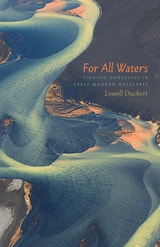
For All Waters
Finding Ourselves in Early Modern WetscapesLowell Duckert
University of Minnesota Press, 2017
Recent years have witnessed a surge in early modern ecostudies, many devoted to Shakespearean drama. Yet in this burgeoning discipline, travel writing appears moored in historicization, inorganic subjects are far less prevalent than organic ones, and freshwater sites are hardly visited. For All Waters explores these uncharted wetscapes.
Lowell Duckert shows that when playwrights and travel writers such as Sir Walter Raleigh physically interacted with rivers, glaciers, monsoons, and swamps, they composed “hydrographies,” or bodily and textual assemblages of human and nonhuman things that dissolved notions of human autonomy and its singular narrativity. With a playful, punning touch woven deftly into its theoretical rigor, For All Waters disputes fantasies of ecological solitude that would keep our selves high and dry and that would try to sustain a political ecology excluding water and the poor. The lives of both humans and waterscapes can be improved simultaneously through direct engagement with wetness.
For All Waters concludes by investigating waterscapes in peril today—West Virginia’s chemical rivers and Iceland’s vanishing glaciers—and outlining what we can learn from early moderns’ eco-ontological lessons. By taking their soggy and storied matters to heart, and arriving at a greater realization of our shared wetness, we can conceive new directions to take within the hydropolitical crises afflicting us today.
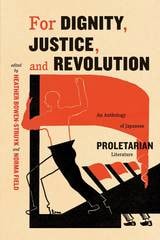
For Dignity, Justice, and Revolution
An Anthology of Japanese Proletarian LiteratureEdited by Heather Bowen-Struyk and Norma Field
University of Chicago Press, 2015
Contextualized by introductory essays, forty expertly translated stories touch on topics like perilous factories, predatory bosses, ethnic discrimination, and the myriad indignities of poverty. Together, they show how even intensely personal issues form a pattern of oppression. Fostering labor consciousness as part of an international leftist arts movement, these writers, lovers of literature, were also challenging the institution of modern literature itself. This anthology demonstrates the vitality of the “red decade” long buried in modern Japanese literary history.
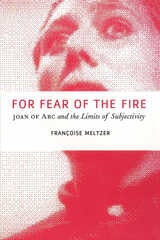
For Fear of the Fire
Joan of Arc and the Limits of SubjectivityFrançoise Meltzer
University of Chicago Press, 2001
Engaging a number of theorists, and alternating between Joan's historical and cultural context, Meltzer also explores the ways in which postmodern thinkers question subjectivity. She argues that the way masculine subjects imagine Joan betrays their fear of death and necessitates the role of women as cultural others: enigmatic, mysterious, dark, and impossible. As such, Joan serves as a useful model of the limits and risks of subjectivity. For Meltzer, she is both the first modern and the last medieval figure. From the ecclesial jury that burned her, to the theorists of today who deny their attraction to the supernatural, the philosophical assumptions that inform Joan's story, as Meltzer ultimately shows, have changed very little.
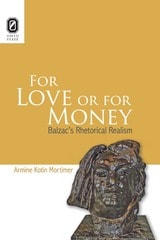
For Love or for Money
Balzac's Rhetorical RealismArmine Kotin Mortimer
The Ohio State University Press, 2011
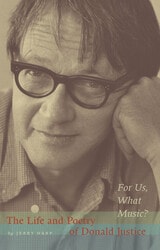
For Us, What Music?
The Life and Poetry of Donald JusticeJerry Harp
University of Iowa Press, 2010
When Donald Justice wrote in “On a Picture by Burchfield” that “art keeps long hours,” he might have been describing his own life. Although he early on struggled to find a balance between his life and art, the latter became a way of experiencing his life more deeply. He found meaning in human experience by applying traditional religious language to his artistic vocation. Central to his work was the translation of the language of devotion to a learned American vernacular. Art not only provided him with a wealth of intrinsically worthwhile experiences but also granted rich and nuanced ways of experiencing, understanding, and being in the world. For Donald Justice—recipient of some of poetry’s highest laurels, including the Pulitzer Prize, the Bollingen Prize, and the Lannan Literary Award for Poetry—art was a way of life.
Because Jerry Harp was Justice’s student, his personal knowledge of his subject—combined with his deep understanding of Justice’s oeuvre—works to remarkable advantage in For Us, What Music? Harp reads with keen intelligence, placing each poem within the precise historical moment it was written and locating it in the context of the literary tradition within which Justice worked. Throughout the text runs the narrative of Justice’s life, tying together the poems and informing Harp’s interpretation of them. For Us, What Music? grants readers a remarkable understanding of one of America’s greatest poets.
For a New Novel
Essays on FictionAlain Robbe-Grillet
Northwestern University Press, 1989
Forays into Swedish Poetry
By Lars Gustafsson
University of Texas Press, 1978
When poet/critic Lars Gustafsson was the editor of Bonniers Litterära Magasin, he was bombarded with the question, “What makes a good poem?” Forays into Swedish Poetry is his answer.
The fifteen poems in this volume range across the history of Swedish poetry from the 1640s, at the beginning of the Period of Great Power, to the late twentieth century. Poets as diverse as Skogekär Bergbo, Erik Johan Stagnelius, August Strindberg, and Vilhelm Ekelund are discussed from historical, psychological, and sociopolitical viewpoints. However, Gustafsson includes only those poems he considers excellent.
Each essay begins with a presentation of the poem both in Swedish and in English translation. Gustafsson’s analyses are built upon his subjective experiences with poems and poets and upon a more objective structural approach that investigates the actual machinery of the poems. Thus, Gustafsson enlightens us with his always imaginative, sometimes daring analyses, and we learn a great deal about the critic himself in the process. One of his main concerns is what he calls, in his discussion of Edith Södergran, the very mysteriousness of human existence. Time and again, Gustafsson emphasizes the enigmatic, arcane aspects of life in his analyses. In contrast, his vocabulary and approach also bespeak a constant interest in science and technology.
In his introduction, Robert T. Rovinsky, the volume’s translator, presents examples of Gustafsson’s various thematic interests as voiced in his poems, several of which are translated here for the first time. While “The Machines” explores his theory of people as automatons and “Conversation between Philosophers” his linguistic pessimism, Gustafsson’s work as a whole shows his enchantment with its major theme: the intrinsic mystery of life.
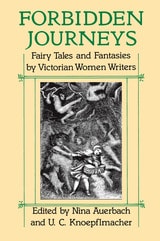
Forbidden Journeys
Fairy Tales and Fantasies by Victorian Women WritersEdited by Nina Auerbach and U. C. Knoepflmacher
University of Chicago Press, 1992
"Forbidden Journeys is not only a darkly entertaining book to read for the fantasies and anti-fantasies told, but also is a significant contribution to nineteenth-century cultural history, and especially feminist studies."—United Press International
"A service to feminists, to Victorian Studies, to children's literature and to children."—Beverly Lyon Clark, Women's Review of Books
"These are stories to laugh over, cheer at, celebrate, and wince at. . . . Forbidden Journeys is a welcome reminder that rebellion was still possible, and the editors' intelligent and fascinating commentary reveals ways in which these stories defied the Victorian patriarchy."—Allyson F. McGill, Belles Lettres
Forbidden Journeys
Fairy Tales and Fantasies by Victorian Women WritersEdited by Nina Auerbach and U. C. Knoepflmacher
University of Chicago Press, 1992
As these eleven dark and wild stories demonstrate, fairy tales by Victorian women constitute a distinct literary tradition, one startlingly subversive of the society that fostered it. From Anne Thackeray Ritchie's adaptations of "The Sleeping Beauty in the Wood" to Christina Rossetti's unsettling antifantasies in Speaking Likenesses, these are breathtaking acts of imaginative freedom, by turns amusing, charming, and disturbing. Besides their social and historical implications, they are extraordinary stories, full of strange delights for readers of any age.
"Forbidden Journeys is not only a darkly entertaining book to read for the fantasies and anti-fantasies told, but also is a significant contribution to nineteenth-century cultural history, and especially feminist studies."—United Press International
"A service to feminists, to Victorian Studies, to children's literature and to children."—Beverly Lyon Clark, Women's Review of Books
"These are stories to laugh over, cheer at, celebrate, and wince at. . . . Forbidden Journeys is a welcome reminder that rebellion was still possible, and the editors' intelligent and fascinating commentary reveals ways in which these stories defied the Victorian patriarchy."—Allyson F. McGill, Belles Lettres
Force and Form
Philosophy of Life in the Age of GoetheStephen Klemm
Bucknell University Press, 2027
This book offers a bold rethinking of how modern ideas of life, nature, and subjectivity took shape in late-eighteenth- and early-nineteenth-century German thought. Moving beyond familiar narratives based on Kantian autonomy or Romantic irrationalism, it uncovers a vitalist tradition stretching from Herder to Schiller and Goethe, one that understood nature as dynamic, self-forming, and internally animated by life-force. Drawing on philosophy, the life sciences, and aesthetics, this innovative study reveals how these thinkers challenged mechanistic models of matter and resisted strict divisions between mind and nature. In doing so, they developed a historically contingent and embodied concept of subjectivity in which reason emerges from natural, cultural, and physiological processes rather than standing outside them. By situating this tradition within debates about epigenesis, form, and development, the book not only reshapes our understanding of German intellectual history but also sheds new light on contemporary debates about naturalism, posthumanism, and theories of life.
Published by Bucknell University Press. Distributed worldwide by Rutgers University Press.
Foremother Love
Phillis Wheatley and Black Feminist CriticismDana Murphy
Duke University Press, 2025
Forget Me Not
The Rise of the British Literary Annual, 1823–1835Katherine D. Harris
Ohio University Press, 2015
By November 1822, the British reading public had already voraciously consumed both Walter Scott’s expensive novels and Rudolf Ackermann’s exquisite lithographs. The next decade, referred to by some scholars as dormant and unproductive, is in fact bursting with Forget Me Nots, Friendship’s Offerings, Keepsakes, and Literary Souvenirs. By wrapping literature, poetry, and art into an alluring package, editors and publishers saturated the market with a new, popular, and best-selling genre, the literary annual. In Forget Me Not, Katherine D. Harris assesses the phenomenal rise of the annual and its origins in other English, German, and French literary forms as well as its social influence on women, its redefinition of the feminine, and its effects on late nineteenth- and early twentieth-century print culture. Harris adopts an interdisciplinary approach that uses textual and social contexts to explore a forum of subversive femininity, where warfare and the masculine hero were not celebrated.
Initially published in diminutive, decoratively bound volumes filled with engravings of popularly recognized artwork and “sentimental” poetry and prose, the annuals attracted a primarily middle-class female readership. The annuals were released each November, making them an ideal Christmas gift, lover’s present, or token of friendship. Selling more than 100,000 copies during each holiday season, the annuals were accused of causing an epidemic and inspiring an “unmasculine and unbawdy age” that lasted through 1860 and lingered in derivative forms until the early twentieth century in both the United States and Europe. The annual thrived in the 1820s and after despite—or perhaps because of—its “feminine” writing and beautiful form.
Forgotten Friendships
Yugoslavia and the Anticolonial Francophone WorldAlexandra Perišic
Amherst College Press, 2025
Forgotten Friendships: Yugoslavia and the Anticolonial Francophone World examines transnational friendships and alliances between intellectuals from Yugoslavia and the Francophone African and Caribbean world during the mid-twentieth century. The book argues that transnational political friendships helped shape major intellectual movements like Négritude, African socialism, and global socialist feminisms, which surged beyond national, regional, and even diasporic spaces. Blending archival research, literary analysis, and biography, the book fills a significant gap in our understanding of how intellectuals from the Global South and the socialist world collaborated on shared goals of decolonization, anti-racism, and socialist worldmaking.
Forgotten Friendships emphasizes the ways in which writers, intellectuals, and activists envisioned alternative futures rooted in collaboration across peripheries. Personal bonds of friendship were not mere footnotes to the anti-colonial struggle, but vital political tools for rethinking global solidarity.
Forgotten Futures, Colonized Pasts
Transnational Collaboration in Nineteenth-Century Greater MexicoCara Anne Kinnally
Bucknell University Press, 2019
Published by Bucknell University Press. Distributed worldwide by Rutgers University Press.
Forgotten Paths
Etymology and the Allegorical MindsetDavide Del Bello
Catholic University of America Press, 2007
Forgotten Readers
Recovering the Lost History of African American Literary SocietiesElizabeth McHenry
Duke University Press, 2002
Forgotten Readers expands our definition of literacy and urges us to think of literature as broadly as it was conceived of in the nineteenth century. Elizabeth McHenry delves into archival sources, including the records of past literary societies and the unpublished writings of their members. She examines particular literary associations, including the Saturday Nighters of Washington, D.C., whose members included Jean Toomer and Georgia Douglas Johnson. She shows how black literary societies developed, their relationship to the black press, and the ways that African American women’s clubs—which flourished during the 1890s—encouraged literary activity. In an epilogue, McHenry connects this rich tradition of African American interest in books, reading, and literary conversation to contemporary literary phenomena such as Oprah Winfrey’s book club.
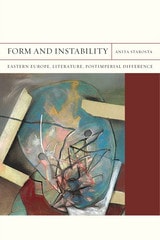
Form and Instability
Eastern Europe, Literature, Postimperial DifferenceAnita Starosta
Northwestern University Press, 2015
Located at the intersection of comparative literature, area studies, and literary theory, this interdisciplinary study has a twofold commitment: to Eastern Europe on the one hand and to literature on the other. It aims to intervene in the way we conceive of Eastern Europe by seeking to develop a more equitable way of thinking, one that avoids subordinating it to Eurocentric narratives of progress. At the same time, it marshals literature as both object and method of this rethinking, in order to extend existing conceptions of the usefulness and of the proper organization of literary studies. The three terms in the title of this book mark a passage—via literature—from “Eastern Europe” as an inadequate and obsolescent category to “post-imperial difference” as a more accurate, if provisional, account of the region. By way of original readings of particular texts, and by attending to literature as a critical
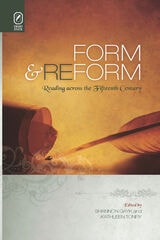
Form and Reform
Reading across the Fifteenth CenturyShannon Gayk and Kathleen Tonry
The Ohio State University Press, 2011
Form and Reform: Reading across the Fifteenth Century challenges the idea of any definitive late medieval moment and explores instead the provocatively diverse, notably untidy, and very rich literary culture of the age. These essays from leading medievalists, edited by Shannon Gayk and Kathleen Tonry, both celebrate and complicate the reemergence of the fifteenth century in literary studies. Moreover, this is the first collection to concentrate on the period between 1450 and 1500—the crucial five decades, this volume argues, that must be understood to comprehend the entire century’s engagement with literary form in shifting historical contexts.
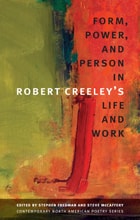
Form, Power, and Person in Robert Creeley’s Life and Work
Stephen Fredman
University of Iowa Press, 2010
By any measure—international reputation, influence upon fellow writers and later generations, number of books published, scholarly and critical attention—Robert Creeley (1926–2005) is a literary giant, an outstanding, irreplaceable poet. For many decades readers have remarked upon the almost harrowing emotional nakedness of Creeley’s writing. In the years since his death, it may be that the disappearance of the writer allows that nakedness to be observed more readily and without embarrassment.
Written by the foremost critics of his poetry, Form, Power, and Person in Robert Creeley’s Life and Work is the first book to treat Creeley’s career as a whole. Masterfully edited by Stephen Fredman and Steve McCaffery, the essays in this collection have been gathered into three parts. Those in “Form” consider a variety of characteristic formal qualities that differentiate Creeley from his contemporaries. In “Power,” writers reflect on the pressure exerted by emotions, gender issues, and politics in Creeley’s life and work. In “Person,” Creeley’s unique artistic and psychological project of constructing a person—reflected in his correspondence, teaching, interviews, collaborations, and meditations on the concept of experience—is excavated. While engaging these three major topics, the authors remain, as Creeley does, intent upon the ways such issues appear in language, for Creeley’s nakedness is most conspicuously displayed in his intimate relationship with words.
Contributors
Charles Altieri
Rachel Blau DuPlessis
Stephen Fredman
Benjamin Friedlander
Alan Golding
Michael Davidson
Steve McCaffery
Peter Middleton
Marjorie Perloff
Peter Quartermain
Libbie Rifkin
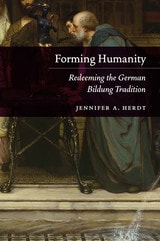
Forming Humanity
Redeeming the German Bildung TraditionJennifer A. Herdt
University of Chicago Press, 2019
Kant’s proclamation of humankind’s emergence from “self-incurred immaturity” left his contemporaries with a puzzle: What models should we use to sculpt ourselves if we no longer look to divine grace or received authorities? Deftly uncovering the roots of this question in Rhineland mysticism, Pietist introspection, and the rise of the bildungsroman, Jennifer A. Herdt reveals bildung, or ethical formation, as the key to post-Kantian thought. This was no simple process of secularization, in which human beings took responsibility for something they had earlier left in the hands of God. Rather, theorists of bildung, from Herder through Goethe to Hegel, championed human agency in self-determination while working out the social and political implications of our creation in the image of God. While bildung was invoked to justify racism and colonialism by stigmatizing those deemed resistant to self-cultivation, it also nourished ideals of dialogical encounter and mutual recognition. Herdt reveals how the project of forming humanity lives on in our ongoing efforts to grapple with this complicated legacy.
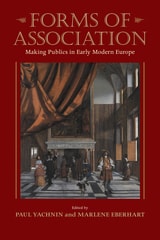
Forms of Association
Making Publics in Early Modern EuropePaul Yachnin
University of Massachusetts Press, 2015
In today's connected and interactive world, it is hard to imagine a time when cultural and intellectual interests did not lead people to associate with others who shared similar views and preoccupations. In this volume of essays, fifteen scholars explore how these kinds of relationships began to transform early modern European culture.
Forms of Association grows out of the “Making Publics: Media, Markets, and Association in Early Modern Europe” (MaPs) project, funded by the Social Sciences and Humanities Research Council of Canada. This scholarly initiative convened an interdisciplinary research team to consider how “publics”—new forms of association built on the shared interests of individuals—developed in Europe from 1500 to 1700. Drawing on a wide array of texts and histories, including the plays of Shakespeare, the legend of Robin Hood, paintings, and music as well as English gossip about France, the contributors develop a historical account of what publics were in early modern Europe. This collaborative study provides a dynamic way of understanding the political dimensions of artistic and intellectual works and opens the way toward a new history of early modernity.
Until his death in 2008, the great Renaissance scholar Richard Helgerson was a key participant in the MaPs project. The scholars featured in this volume originally met in Montreal to engage in a critical, commemorative conversation about Helgerson's work, the issues and questions coming out of the MaPs project, and how Helgerson's thinking advanced and could in turn be advanced by MaPs. This collection represents the fruits of that conversation.
Forms of Attention
Botticelli and HamletFrank Kermode
University of Chicago Press, 2011

Forms of Discovery
Critical and Historical Essays on the Forms of the Short Poem in EnglishYvor Winters
Ohio University Press, 1967
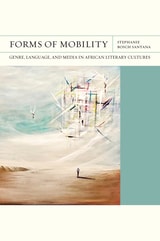
Forms of Mobility
Genre, Language, and Media in African Literary CulturesStephanie Bosch Santana
Northwestern University Press, 2025
Presents alternative categories of fiction through which to examine how contemporary writers have envisaged Africa’s changing literary terrains
Stephanie Bosch Santana analyzes southern African writers’ experimentations with literary form in periodical print and digital media since the mid-twentieth century in order to offer an alternative account of contemporary African imaginations of mobility. Based on an understudied archive of texts in English and Chichewa/Nyanja from Malawi, South Africa, Zimbabwe, and Zambia, Forms of Mobility: Genre, Language, and Media in African Literary Cultures examines new, noncanonical categories of fiction, including migrant forms, township tales, weekend stories, and digital diaries. These generically, linguistically, and geographically mobile forms map changing ideas of interconnection and belonging. By reading them “in motion,” as they travel across space, time, genre, and language and between publications and platforms, Bosch Santana limns multiple centers of literary influence and relation across southern African and Black diasporas, revealing forms of literary mobility and space making that are occluded by current models of world literature.
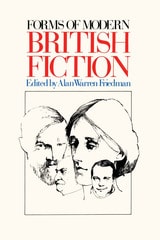
Forms of Modern British Fiction
Edited by Alan Warren Friedman
University of Texas Press, 1975
In Forms of Modern British Fiction six individualistic and strongminded critics delineate the "age of modernism" in British fiction. Dating the age and the movement from later Hardy works through the deaths of Joyce and Woolf, they present British fiction as a cohesive, self-contained unit of literary history.
Hardy appears as the first of the modern British novelists, Lawrence as the central, and Joyce and Woolf as the last. The writers and the modern movement are framed by precursors, such as Galsworthy, and by successors, Durrell, Beckett, and Henry Green—the postmoderns. The pattern of the essays suggests a growing self-consciousness on the part of twentieth-century writers as they seek not only to refine their predecessors but also to deny (and sometimes obliterate) them. The moderns thus deny the novel itself, a genre once firmly rooted in history and forms of social life. Their works do not assume that comfortable mimetic relationship between the fictive realities of art and life.
Consequently, there has now evolved a poetics of the novel that is virtually identifiable with modern fiction, a poetics still highly problematical in its attempt to denote a medium in whose name eclectic innovativeness and incessant revitalizing are proclaimed. Forms of Modern British Fiction refines and advances the discussion of the modern novel and the world it and we inhabit.
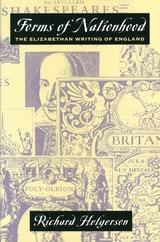
Forms of Nationhood
The Elizabethan Writing of EnglandRichard Helgerson
University of Chicago Press, 1992

Fornes
Theater in the Present TenseDiane Lynn Moroff
University of Michigan Press, 1996
Diane Lynn Moroff focuses on Fornes's major plays, providing illuminating readings of her unique and irreverent body of work. The book traces the career of this influential playwright, director, and teacher, including the reception of her plays, the range of critical responses (particularly those of feminist critics), and an introduction to Fornes's theatrical philosophies. It looks at such critical issues in Fornes's work as the representation of female subjectivity, theater as metaphor and context, art as ritual, and the role of the spectator. In a final chapter, Fornes's plays including Abingdon Square and her most recent work, What of the Night? are examined in the context of the sexualization of character, an ongoing theme for Fornes.
Fornes: Theater in the Present Tense will appeal to scholars and students in theater studies and women's studies and to anyone interested or engaged in contemporary theater.
Diane Lynn Moroff is Assistant Professor of English, Oglethorpe University.
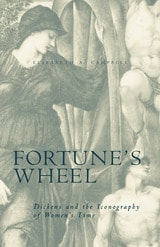
Fortune’s Wheel
Dickens and the Iconography of Women’s TimeElizabeth A. Campbell
Ohio University Press, 2003
In the first half of the nineteenth century, England became quite literally a world on wheels. The sweeping technological changes wrought by the railways, steam-powered factory engines, and progressively more sophisticated wheeled conveyances of all types produced a corresponding revolution in Victorian iconography: the image of the wheel emerged as a dominant trope for power, modernity, and progress.
In Fortune’s Wheel, an original and illuminating study, Elizabeth Campbell explores the ways in which Charles Dickens appropriated and made central to his novels the dominant symbol of his age. Between 1840 and 1860, a transformation took place in Dickens’ thinking about gender and time, and this revolution is recorded in iconographic representations of the goddess Fortune and wheel imagery that appear in his work.
Drawing on a rich history of both literary and visual representations of Fortune, Professor Campbell argues that Dickens’ contribution to both the iconographic and narrative traditions was to fuse the classical image of the wheel with the industrial one. As the wheel was increasingly identified as the official Victorian symbol for British industrial and economic progress, Dickens reacted by employing this icon to figure a more pessimistic historical vision—as the tragic symbol for human fate in the nineteenth century.
Fortune’s Wheel ably portrays the concept that, in both text and illustrations, images of fortune and the wheel in Dickens’ work record his abandonment of a linear, progressive, and arguably masculine view of history to embrace a cyclical model that has been identified with “women’s time.”
Foucault and the Kamasutra
The Courtesan, the Dandy, and the Birth of Ars Erotica as Theater in IndiaSanjay K. Gautam
University of Chicago Press, 2016
Gautam shows how closely intertwined the history of erotics in Indian culture is with the history of theater-aesthetics grounded in the discourse of love, and Foucault provides the framework for opening up an intellectual horizon of Indian thought. To do this, Gautam looks to the history of three inglorious characters in classical India: the courtesan and her two closest male companions—her patron, the dandy consort; and her teacher and advisor, the dandy guru. Foucault’s distinction between erotic arts and the science of sexuality drives Gautam’s exploration of the courtesan as a symbol of both sexual-erotic and aesthetic pleasure. In the end, by entwining together Foucault’s works on the history of sexuality in the West and the classical Indian texts on eros, Gautam transforms our understanding of both, even as he opens up new ways of investigating erotics, aesthetics, gender relations, and subjectivity.
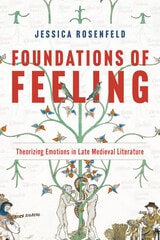
Foundations of Feeling
Theorizing Emotions in Late Medieval LiteratureJessica Rosenfeld
University of Chicago Press, 2026
A fresh reading of medieval literature as deeply concerned with thinking about feelings.
Are emotions primarily bodily or cognitive? Do “natural” emotions exist? What is the relationship between emotion and gender? In Foundations of Feeling, Jessica Rosenfeld shows how medieval literature informs contemporary ideas about how emotions operate. Ranging widely from love poetry to pastoral and theological writings, to political satire and more, Rosenfeld reveals a wealth of attention to emotions in both scientific and philosophical discourses of the time. By mining Latin, medieval French, and Middle English traditions, she relates medieval concerns to the most central, current debates (and impasses) in the fields of history of emotion and affect theory today, reframing how we think about and define feelings.
Founders of the Future
The Science and Industry of Spanish ModernizationÓscar Iván Useche
Bucknell University Press, 2022
Founding Farms
Portraits of Five Massachusetts Family FarmsStanley E. Sherer
University of Massachusetts Press, 1993
With each passing year, the number of family farms in the United States diminishes. Fewer people have the persistence and ingenuity to wrest a livelihood from the land in an era of corporate ownership and mass production. Yet some family farms survive.
Through words and photographs, this book documents the long lives of five of the oldest farms in Massachusetts. Each has remained in the same family for more than two, sometimes three, centuries and each has a distinctive history. The devotion to the land and family heritage is palpable in the stories these five families tell.
Stan Sherer’s remarkable photographs depict the activities of the family members as they go about their daily labors, planting crops, feeding animals, applying new technologies to ancient tasks, and coping with the vagaries of weather and state regulations. Michael E. C. Gery’s narrative traces how the farms began, what has sustained them through the generations, and how the families who run them today feel about their past, present, and future. These stories are told largely through the words of the people themselves.
The result is a complex portrait that moves beyond traditional stereotypes to reveal the realities of family farm life in an increasingly urbanized society.
Four Masterworks of American Indian Literature
Quetzalcoatl, the Ritual of Condolence, Cuceb, the Night ChantEdited by John Bierhorst
University of Arizona Press, 1984
"This comparative application of the epic poetry tradition to Amerind literature is a scholarly success.... this book is a most noteworthy item in the field of American Indian studies, and is not to be missed by any serious devotee." --Library Journal
"Biehorst's introductions and notes are brilliant, thorough, and an important contribution to the scholarship on these works. His new translation of the Quetzalcoatl is also excellent." --Choice

Four Shakespearean Period Pieces
Margreta de Grazia
University of Chicago Press, 2021
Yet recent theoretical work has called for their reappraisal. Anachronisms, previously condemned as errors in the order of time, are being hailed as alternatives to that order. Conversely chronology and periods, its mainstays, are now charged with having distorted the past they have been entrusted to represent, and secularization, once considered the driving force of the modern era, no longer holds sway over the past or the present.
In light of this reappraisal, can Shakespeare studies continue unshaken? This is the question Four Shakespearean Period Pieces takes up, devoting a chapter to each term: on the rise of anachronism, the chronologizing of the canon, the staging of plays “in period,” and the use of Shakespeare in modernity’s secularizing project.
To read these chapters is to come away newly alert to how these fraught concepts have served to regulate the canon’s afterlife. Margreta de Grazia does not entirely abandon them but deftly works around and against them to offer fresh insights on the reading, editing, and staging of the author at the heart of our literary canon.

Four Years in Izumi
Village Japan in the Early Sixteenth CenturyLee Butler
University of Michigan Press, 2026
Four Years in Izumi takes an in-depth and critical approach to understanding Japanese village life through analysis of the diary of Kujō Masamoto, the former chancellor of the imperial court who resided briefly in one of his provincial estates from 1501 to 1504. For a high ranking courtier to travel to the countryside and manage a family estate was unheard of during the era of Sengoku, the “country at war.” The diary Masamoto kept offers a remarkably rich and vivid portrait of village Japan, which has seen no significant study in English-language scholarship.
Through extensive examination of the diary and close and critical reading of it and complementary sources, Lee Butler provides a window into the inner workings of late-medieval village life that challenges typical portrayals of the period. In Four Years in Izumi, we see the complexity of relations between commoners and elites in action. We also see the ways in which an estate functioned in practice at the heart of the medieval economy and local social structure.
Fourteen Landing Zones
Approaches to Vietnam War LiteraturePhilip K. Jason
University of Iowa Press, 1991
It is in the spirit of the LZ that the essayists in Fourteen Landing Zones approach the writings of the Vietnam War. These fourteen diverse and powerful works by some of today's leading critics in Vietnam studies begin to answer the question of how we will filter the writings of the Vietnam War—including fiction, poetry, drama, and memoirs. What will survive the process of critical acclaim and societal affirmation—and why? Included is an incisive introduction by Jason that provides an overview of the burgeoning body of Vietnam War literature and its peculiar life in the literary and academic marketplace. This strong, often emotional volume will be of particular importance to all those interested in the literature of the Vietnam War, contemporary literature, and contemporary culture and history.

Fractured Borders
Reading Women's Cancer LiteratureMary K. DeShazer
University of Michigan Press, 2010
Fractured Borders: Reading Women's Cancer Literature surveys a wide range of contemporary writing about breast, uterine, and ovarian cancer, including works by Marilyn Hacker, Margaret Edson, Carole Maso, Audre Lorde, Eve Sedgwick, Mahasweta Devi, Lucille Clifton, Alicia Ostriker, Jayne Anne Phillips, Terry Tempest Williams, and Jeanette Winterson, among many others. DeShazer's readings bring insights from body theory, performance theory, feminist literary criticism, French feminisms, and disability studies to bear on these works, shining new light on a literary subject that is engaging more and more writers.
"An important and useful book that will appeal to people in a variety of fields and walks of life, including scholars, teachers, and anyone interested in this subject."
--Suzanne Poirier, University of Illinois at Chicago
"A book on a timely and important topic, wisely written beyond scholarly boundaries and crossing many theoretical and disciplinary lines."
--Patricia Moran, University of California, Davis
Fragments and Assemblages
Forming Compilations of Medieval LondonArthur Bahr
University of Chicago Press, 2013
Fragments for a History of a Vanishing Humanism
Edited by Myra Seaman and Eileen A. Joy
The Ohio State University Press, 2016
This volume, edited by Myra Seaman and Eileen A. Joy, insists on the always provisional and contingent formations of the human, and of various humanisms, over time, while also aiming to demonstrate the different ways these formations emerge (and also disappear) in different times and places, from the most ancient past to the most contemporary present. The essays are offered as “fragments” because the authors do not believe there can ever be a “total history” of either the human or the post/human as they play themselves out in differing historical contexts. At the same time, the volume as a whole argues that defining what “the human” (or “post/human”) is has always been an ongoing, never finished cultural project.
Framed Time
Toward a Postfilmic CinemaGarrett Stewart
University of Chicago Press, 2007
Framed Visions
Popular Culture, Americanization, and the Contemporary German and Austrian ImaginationGerd Gemunden
University of Michigan Press, 1998
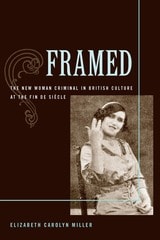
Framed
The New Woman Criminal in British Culture at the Fin de SiecleElizabeth Carolyn Miller
University of Michigan Press, 2008
Framed uses fin de siècle British crime narrative to pose a highly interesting question: why do female criminal characters tend to be alluring and appealing while fictional male criminals of the era are unsympathetic or even grotesque?
In this elegantly argued study, Elizabeth Carolyn Miller addresses this question, examining popular literary and cinematic culture from roughly 1880 to 1914 to shed light on an otherwise overlooked social and cultural type: the conspicuously glamorous New Woman criminal. In so doing, she breaks with the many Foucauldian studies of crime to emphasize the genuinely subversive aspects of these popular female figures. Drawing on a rich body of archival material, Miller argues that the New Woman Criminal exploited iconic elements of late nineteenth- and early twentieth-century commodity culture, including cosmetics and clothing, to fashion an illicit identity that enabled her to subvert legal authority in both the public and the private spheres.
"This is a truly extraordinary argument, one that will forever alter our view of turn-of-the-century literary culture, and Miller has demonstrated it with an enrapturing series of readings of fictional and filmic criminal figures. In the process, she has filled a gap between feminist studies of the New Woman of the 1890s and more gender-neutral studies of early twentieth-century literary and social change. Her book offers an extraordinarily important new way to think about the changing shape of political culture at the turn of the century."
---John Kucich, Professor of English, Rutgers University
"Given the intellectual adventurousness of these chapters, the rich material that the author has brought to bear, and its combination of archival depth and disciplinary range, any reader of this remarkable book will be amply rewarded."
---Jonathan Freedman, Professor of English and American Culture, University of Michigan
Elizabeth Carolyn Miller is Assistant Professor of English at the University of California, Davis.
digitalculturebooks is an imprint of the University of Michigan and the Scholarly Publishing Office of the University of Michigan Library dedicated to publishing innovative and accessible work exploring new media and their impact on society, culture, and scholarly communication. Visit the website at www.digitalculture.org.
Frames of Friction
Black Genealogies, White Hegemony, and the Essay as Critical InterventionCarsten Junker
Campus Verlag, 2010
In Frames of Friction, Carsten Junker maps out a dazzling panorama of critical cultural debatesfrom the twentieth century to explore the ways in which African American speakers and writers established their authority and gained recognition. Taking into account the latest ideas from gender studies and African American studies, as well as current essay theory, Junker juxtaposes the ways in which African American authors and speakers from the 1920s to the 1970s debated critical topics with their white and Jewish contemporaries in order to emphasize the dialogic nature of the essay form. Ultimately, Junker hones in on the genre of essay itself, arguing that it is repeatedly questioned and reconstituted during times of social change.
Framing Faust
Twentieth-Century Cultural StrugglesInez Hedges
Southern Illinois University Press, 2009
In this interdisciplinary cultural history that encompasses film, literature, music, and drama, Inez Hedges follows the thread of the Faustian rebel in the major intellectual currents of the last hundred years. She presents Faust and his counterpart Mephistopheles as antagonistic—yet complementary—figures whose productive conflict was integral to such phenomena as the birth of narrative cinema, the rise of modernist avant-gardes before World War II, and feminist critiques of Western cultural traditions.
Framing Faust: Twentieth-Century Cultural Struggles pursues a dialectical approach to cultural history. Using the probing lens of cultural studies, Hedges shows how claims to the Faustian legacy permeated the struggle against Nazism in the 1930s while infusing not only the search for socialist utopias in Russia, France, and Germany, but also the quest for legitimacy on both sides of the Cold War divide after 1945.
Hedges balances new perspectives on such well-known works as Thomas Mann’s Dr. Faustus and Jack Kerouac’s Dr. Sax with discussions of previously overlooked twentieth-century expressions of the Faust myth, including American film noir and the Faust films of Stan Brakhage. She evaluates musical compositions—Hanns Eisler’s Faust libretto, the opera Votre Faust by Henri Pousseur and Michel Butor, and Alfred Schnittke’s Faust Cantata—as well as works of fiction and drama in French and German, many of which have heretofore never been discussed outside narrow disciplinary confines.
Enhanced by twenty-four illustrations, Framing Faust provides a fascinating and focused narrative of some of the major cultural struggles of the past century as seen through the Faustian prism, and establishes Faust as an important present-day frame of reference.
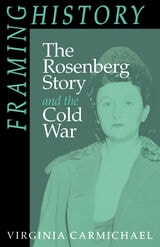
Framing History
The Rosenberg Story and the Cold WarVirginia Carmichael
University of Minnesota Press, 1993
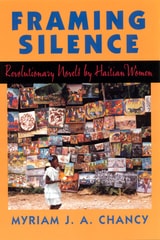
Framing Silence
Revolutionary Novels by Haitian WomenChancy, Myriam J
Rutgers University Press, 1992
Raped and colonized, coerced and silenced--this has been the position of Haitian women within their own society, as well as how they have been seen by foreign occupiers. Romanticized symbols of nationhood, they have served, however unwillingly, as a politicized site of contestation between opposing forces.
In this first book-length study in English devoted exclusively to Haitian women's literature, Myriam Chancy finds that Haitian women have their own history, traditions, and stories to tell, tales that they are unwilling to suppress or subordinate to narratives of national autonomy. Issues of race, class, color, caste, nationality, and sexuality are all central to their fiction--as is an urgent sense of the historical place of women between the two U.S. occupations of the country. Their novels interrogate women's social and political stance in Haiti from an explicitly female point of view, forcefully responding to overt sexual and political violence within the nation's ambivalent political climate. Through daring and sensitive readings, simultaneously historical, fictional and autobiographical, Chancy explores this literature, seeking to uncover answers to the current crisis facing these women today, both within their country and in exile.The writers surveyed include Anne-christine d'Adesky, Ghislaine Rey Charlier, Marie Chauvet, Jan J. Dominique, Nadine Magloire, and Edwidge Danticat, whose work has recently achieved such high acclaim.
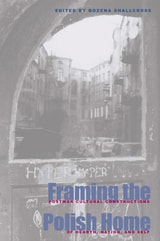
Framing the Polish Home
Postwar Cultural Constructions of Hearth, Nation, and SelfBozena Shallcross
Ohio University Press, 2002
As the subject of ideological, aesthetic, and existential manipulations, the Polish home and its representation is an ever-changing phenomenon that absorbs new tendencies and, at the same time, retains its centrality to Polish literature, whether written in Poland or abroad. Framing the Polish Home is a pioneering work that explores the idea of home as fundamental to the question of cultural and national identity within Poland's recent history and its tradition.
In this inaugural volume of the Polish and Polish-American Studies Series, the Polish home emerges in its rich verbal and visual representations and multiple material embodiments, as the discussion moves from the loss of the home during wartime to the Sovietized politics of housing and from the exilic strategies of having a home to the the idyllic evocation of the abodes of the past.
Although, as Bożena Shallcross notes in her introduction, “few concepts seem to have such universal appeal as the notion of the home,” this area of study is still seriously underdeveloped. In essays from sixteen scholars, Framing the Polish Home takes a significant step to correct that oversight, covering a broad range of issues pertinent to the discourse on the home and demonstrating the complexity of the home in Polish literature and culture.
Frances Burney and Narrative Prior to Ideology
Brian McCrea
University of Delaware Press, 2014
Frances Burney and Narrative Prior to Ideology works between Burney’s Journals and Letters and her fiction more thoroughly than any study of her in the past twenty-five years. By doing so, it offers significant reinterpretations of Burney’s four novels: Evelina, Cecilia, Camilla, and The Wanderer. It describes Burney’s eluding the major modern–isms through which critics have tried to read her: Feminism (with its “gendering” of beauty and reversal of gender roles); Capitalism and its Marxist critique (here the details of Burney’s housekeeping become important); Professionalism (as a response to status inconsistency and class conflict); and Ian Watt’s “Formal Realism” (Burney perhaps saved the novel from a sharp decline it suffered in the 1770s, even as she tried to distance herself from the genre).
Burney’s most successful writing appeared before the coining of “ideology.” But her standing “prior to ideology” is not a matter of chronological accident. Rather, she quietly but forcefully resisted shared explanations—domesticity as model for household management, debt as basis for family finance, professional status as a means to social confidence, the novel as the dominant literary genre—that became popular during her long and eventful life.
Frederic Jameson has described Paul de Man, “in private conversation,” claiming, “Marxism . . . has no way of understanding the eighteenth century.” Frances Burney and Narrative Prior to Ideology conjoins Burney’s “eighteenth-centuryness” with her modernity.
Published by University of Delaware Press. Distributed worldwide by Rutgers University Press.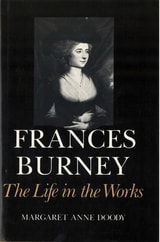
Frances Burney
The Life in the WorksDoody, Margaret A
Rutgers University Press, 1988
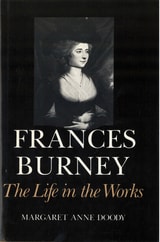
Frances Burney
The Life in the WorksDoody, Margaret A
Rutgers University Press, 1988