Results by title
8812 books match the query 'Political Science' and 329 start with f
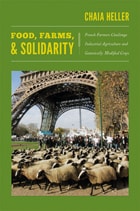
Food, Farms, and Solidarity
French Farmers Challenge Industrial Agriculture and Genetically Modified CropsChaia Heller
Duke University Press, 2012
Food, Fiber, and the Arid Lands
Edited by William G. McGinnies, Bram J. Goldman, and Patricia G. Paylore
University of Arizona Press, 1971
The world’s dramatic awakening to the impact of ecology on the quality of human life, and a new awareness of the potential for exploitation of the desert environment—in which our particular interest lies—give rise to more thoughtful, even sober, attention to the problems faced by those aspiring only to bigger yields from crops and more protein from animals. To these very basic needs of food and fiber, we are, therefore, addressing ourselves further to a consideration of housing, educational programs, and nonagrarian resource evolution, to the end that the planners and the decision makers may have the benefit of the most intelligent and contemporary understanding possible of the cultural and social aspects of arid lands as well as the latest technological advances on a wide-ranging spectrum of scientific developments.
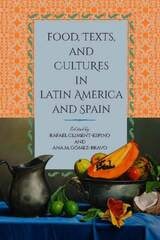
Food, Texts, and Cultures in Latin America and Spain
Rafael Climent-Espino
Vanderbilt University Press, 2020
The studies span from the Middle Ages to the twenty-first century, and the contributing scholars occupy diverse fields within Latin American and Hispanic Studies. As such, their essays showcase eclectic critical and theoretical approaches to the subject of Latin American and Iberian food.
Food, Texts, and Cultures in Latin America and Spain also introduces the first English-language publication of works from such award-winning scholars as Adolfo Castañón of the Mexican Academy of Language; Sergio Ramírez, winner of the 2017 Miguel de Cervantes Prize in Literature; and Carmen Simón Palmer, winner of the 2015 Julián Marías Prize for Research.

Fools' Crusade
Yugoslavia, NATO and Western DelusionsDiana Johnstone
Pluto Press, 2002
Thanks to massive deception and self-deception by media and politicians, even the anti-globalisation movement failed to grasp the implications of the aggressive military globalisation pursued by the United States, from Iraq to Afghanistan and beyond.
In this study, Diana Johnstone identifies the common geopolitical interests running through all these past, present and future military interventions. She argues persuasively that outside intervention creates rather than solves problems and cannot be justified.
Johnstone shows that the 'War in Kosovo' was in reality the model for future destruction of countries seen as potential threats to the hegemony of the 'International Community', led by the United States.

Football and Colonialism
Body and Popular Culture in Urban MozambiqueNuno Domingos
Ohio University Press, 2017
In articles for the newspaper O Brado Africano in the mid-1950s, poet and journalist José Craveirinha described the ways in which the Mozambican football players in the suburbs of Lourenço Marques (now Maputo) adapted the European sport to their own expressive ends. Through gesture, footwork, and patois, they used what Craveirinha termed “malice”—or cunning—to negotiate their places in the colonial state. “These manifestations demand a vast study,” Craveirinha wrote, “which would lead to a greater knowledge of the black man, of his problems, of his clashes with European civilization, in short, to a thorough treatise of useful and instructive ethnography.”
In Football and Colonialism, Nuno Domingos accomplishes that study. Ambitious and meticulously researched, the work draws upon an array of primary sources, including newspapers, national archives, poetry and songs, and interviews with former footballers. Domingos shows how local performances and popular culture practices became sites of an embodied history of Mozambique. The work will break new ground for scholars of African history and politics, urban studies, popular culture, and gendered forms of domination and resistance.

For Better and For Worse
Welfare Reform and the Well-Being of Children and FamiliesGreg J. Duncan
Russell Sage Foundation, 2001

For Dear Life
Women's Decriminalization and Human Rights in FocusCarol Jacobsen
University of Michigan Press, 2019
For Emplacement
Political Ontology in Two ActsMario Blaser
Duke University Press, 2025

For God and Country?
Religious Student-Soldiers in the Israel Defense ForcesBy Elisheva Rosman-Stollman
University of Texas Press, 2014
In many modern armies the religious soldier is suspect. Civilians and officers alike wonder if such a soldier might represent a potential fifth column. This concern is especially prominent in the public discourse over the presence of religious Orthodox Jews serving in the Israel Defense Forces. Will they obey their commanding officer or their rabbi? With research collected over almost a decade, including hundreds of hours of interviews, Elisheva Rosman examines this question of loyalties and reveals how religious soldiers negotiate a place for themselves in an institution whose goals and norms sometimes conflict with those of Orthodox Judaism.
For God and Country? focuses on the pre-service study programs available to religious conscripts. Many journalists and scholars in Israel are suspicious of the student-soldiers who participate in these programs, but in fact, as Rosman’s research demonstrates, the pre-service study programs serve as mediating structures between the demands of Religious Zionism and the demands of the Israel Defense Forces and do not encourage their students to disobey orders. This was especially apparent during the disengagement from Gaza in 2005. Many in Israeli society predicted student-soldiers would defy their orders, per the instruction of their religious leaders, but this did not happen as expected. In high profile cases such as this and in matters encountered daily by religious soldiers—the mixing of the sexes, for instance—Rosman has discovered that the pre-service study programs can successfully serve as agents of civil society, both able to curb the military’s efforts to meddle in civilian affairs and vice versa.
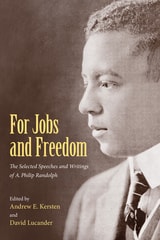
For Jobs and Freedom
Selected Speeches and Writings of A. Philip RandolphAndrew E. Kersten
University of Massachusetts Press, 2014
This volume documents Randolph's life and work through his own writings. The editors have combed through the files of libraries, manuscript collections, and newspapers, selecting more than seventy published and unpublished pieces that shed light on Randolph's most significant activities. The book is organized thematically around his major interests—dismantling workplace inequality, expanding civil rights, confronting racial segregation, and building international coalitions. The editors provide a detailed biographical essay that helps to situate the speeches and writings collected in the book. In the absence of an autobiography, this volume offers the best available presentation of Randolph's ideas and arguments in his own words.
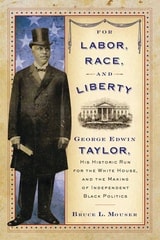
For Labor, Race, and Liberty
George Edwin Taylor, His Historic Run for the White House, and the Making of Independent Black PoliticsBruce L. Mouser
University of Wisconsin Press, 2010
More than one hundred years before Barack Obama, George Edwin Taylor made presidential history. Born in the antebellum South to a slave and a freed woman, Taylor became the first African American ticketed as a political party’s nominee for president of the United States, running against Theodore Roosevelt in 1904.
Orphaned as a child at the peak of the Civil War, Taylor spent several years homeless before boarding a Mississippi riverboat that dropped him in La Crosse, Wisconsin. Taken in by an African American farm family, Taylor attended a private school and eventually rose to prominence as the owner/editor of a labor newspaper and as a vocal leader in Wisconsin’s People’s Party. At a time when many African Americans felt allegiance to the Republican Party for its support of abolition, Taylor’s sympathy with the labor cause drew him first to the national Democratic Party and then to an African American party, the newly formed National Liberty Party, which in 1904 named him its presidential candidate. Bruce L. Mouser follows Taylor’s life and career in Arkansas, Illinois, Wisconsin, Iowa, and Florida, giving life to a figure representing a generation of African American idealists whose initial post-slavery belief in political and social equality in America gave way to the despair of the Jim Crow decades that followed.
Best Books for Special Interests, selected by the American Association for School Libraries
Best Books for Professional Use, selected by the American Association for School Libraries
Best Books for General Audiences, selected by the Public Library Association
Second Place, Biography, Society of Midland Authors
Honorable Mention, Benjamin F. Shambough Award, the State Historical Society of Iowa

For Might and Right
Cold War Defense Spending and the Remaking of American DemocracyMichael Brenes
University of Massachusetts Press, 2020
How did the global Cold War influence American politics at home? For Might and Right traces the story of how Cold War defense spending remade participatory politics, producing a powerful and dynamic political coalition that reached across party lines. This “Cold War coalition” favored massive defense spending over social welfare programs, bringing together a diverse array of actors from across the nation, including defense workers, community boosters, military contractors, current and retired members of the armed services, activists, and politicians. Faced with neoliberal austerity and uncertainty surrounding America's foreign policy after the 1960s, increased military spending became a bipartisan solution to create jobs and stimulate economic growth, even in the absence of national security threats.
Using a rich array of archival sources, Michael Brenes draws important connections between economic inequality and American militarism that enhance our understanding of the Cold War's continued impact on American democracy and the resilience of the military-industrial complex, up to the age of Donald Trump.
For a Just and Better World
Engendering Anarchism in the Mexican Borderlands, 1900-1938Sonia Hernandez
University of Illinois Press, 2021
A vivid look at a radical activist and her times, For a Just and Better World illuminates the lives and work of Mexican women battling for labor rights and gender equality in the early twentieth century.
For the Culture
Hip-Hop and the Fight for Social JusticeLakeyta M. Bonnette-Bailey and Adolphus G. Belk, Jr., Editors
University of Michigan Press, 2022
For the Good of Humanity
Ludwik Rajchman, Medical StatesmanMarta A. Balinska
Central European University Press, 1998
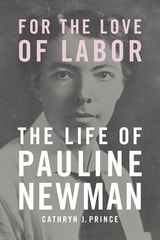
For the Love of Labor
The Life of Pauline NewmanCathryn J. Prince
University of Illinois Press, 2026
Prince follows Newman’s life from a youth split between Lithuania and New York City sweatshops to her work as an advisor to New Deal–era labor secretary Frances Perkins. Newman’s long hours at the Triangle Shirtwaist Factory informed her entrée into labor activism. In the following years, she tirelessly advocated for workers, ran for New York Secretary of State as a socialist, and became the first woman to serve as the ILGWU general organizer. Her interest in the health of workers led to service on the Joint Board of Sanitary Control and a decades-long term as education director of the ILGWU health center. Membership in Eleanor Roosevelt’s circle opened doors to government positions and advisory roles that continued into the postwar era. Prince also weaves in the details of Newman’s fifty-year relationship with a woman, her struggles with her sexual identity, and her final years.
Engaging and panoramic, For the Love of Labor is the first major biography of an important figure in labor and women’s history.
For the Many or the Few
The Initiative, Public Policy, and American DemocracyJohn G. Matsusaka
University of Chicago Press, 2004
Drawing upon a century of evidence, Matsusaka argues against the popular belief that initiative measures are influenced by wealthy special interest groups that neglect the majority view. Examining demographic, political, and opinion data, he demonstrates how the initiative process brings about systematic changes in tax and expenditure policies of state and local governments that are generally supported by the citizens. He concludes that, by and large, direct democracy in the form of the initiative process works for the benefit of the many rather than the few.
An unprecedented, comprehensive look at the historical, empirical, and theoretical components of how initiatives function within our representative democracy to increase political competition while avoiding the tyranny of the majority, For the Many or the Few is a most timely and definitive work.
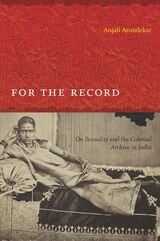
For the Record
On Sexuality and the Colonial Archive in IndiaAnjali Arondekar
Duke University Press, 2009
The logic and the interpretive resources of For the Record arise out of two entangled and minoritized historiographies: one in South Asian studies and the other in queer/sexuality studies. Focusing on late colonial India, Arondekar examines the spectacularization of sexuality in anthropology, law, literature, and pornography from 1843 until 1920. By turning to materials and/or locations that are familiar to most scholars of queer and subaltern studies, Arondekar considers sexuality at the center of the colonial archive rather than at its margins. Each chapter addresses a form of archival loss, troped either in a language of disappearance or paucity, simulacrum or detritus: from Richard Burton’s missing report on male brothels in Karáchi (1845) to a failed sodomy prosecution in Northern India, Queen Empress v. Khairati (1884), and from the ubiquitous India-rubber dildos found in colonial pornography of the mid-to-late nineteenth century to the archival detritus of Kipling’s stories about the Indian Mutiny of 1857.
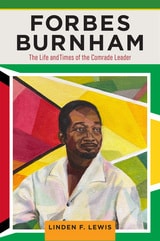
Forbes Burnham
The Life and Times of the Comrade LeaderLinden F. Lewis
Rutgers University Press, 2024
Forbes Burnham: The Life and Times of the Comrade Leader is the first political biography of this complex and influential figure. It charts how the political party he founded, the People’s National Congress, combined nationalist rhetoric, socialist policies, and Pan-Africanist philosophies. It also explores how, in a country already deeply divided between the descendants of African slaves and Indian indentured servants, Burnham consolidated political power by intensifying ethnic polarizations. Drawing from historical archives as well as new interviews with the people who knew Burnham best, sociologist Linden F. Lewis examines how his dictatorial tendencies coexisted with his progressive convictions. Forbes Burnham is a compelling study of the nature of postcolonial leadership and its pitfalls.

Forced Passages
Imprisoned Radical Intellectuals and the U.S. Prison RegimeDylan Rodríguez
University of Minnesota Press, 2006
In Forced Passages, Dylan Rodríguez argues that the cultural production of such imprisoned intellectuals as Mumia Abu-Jamal, Angela Davis, Leonard Peltier, George Jackson, José Solis Jordan, Ramsey Muniz, Viet Mike Ngo, and Marilyn Buck should be understood as a social and intellectual movement in and of itself, unique in context and substance. Rodríguez engages with a wide range of texts, including correspondence, memoirs, essays, poetry, communiqués, visual art, and legal writing, drawing on published works by widely recognized figures and by individuals outside the public’s field of political vision or concern. Throughout, Rodríguez focuses on the conditions under which imprisoned intellectuals live and work, and he explores how incarceration shapes the ways in which insurgent knowledge is created, disseminated, and received.
More than a series of close readings of prison literature, Forced Passages identifies and traces the discrete lineage of radical prison thought since the 1970s, one formed by the logic of state violence and by the endemic racism of the criminal justice system.
Dylan Rodríguez is assistant professor of ethnic studies at the University of California, Riverside.
Foreign Aid
Diplomacy, Development, Domestic PoliticsCarol Lancaster
University of Chicago Press, 2006
A twentieth-century innovation, foreign aid has become a familiar and even expected element in international relations. But scholars and government officials continue to debate why countries provide it: some claim that it is primarily a tool of diplomacy, some argue that it is largely intended to support development in poor countries, and still others point out its myriad newer uses. Carol Lancaster effectively puts this dispute to rest here by providing the most comprehensive answer yet to the question of why governments give foreign aid. She argues that because of domestic politics in aid-giving countries, it has always been—and will continue to be—used to achieve a mixture of different goals.
Drawing on her expertise in both comparative politics and international relations and on her experience as a former public official, Lancaster provides five in-depth case studies—the United States, Japan, France, Germany, and Denmark—that demonstrate how domestic politics and international pressures combine to shape how and why donor governments give aid. In doing so, she explores the impact on foreign aid of political institutions, interest groups, and the ways governments organize their giving. Her findings provide essential insight for scholars of international relations and comparative politics, as well as anyone involved with foreign aid or foreign policy.
Foreign Intervention in Africa after the Cold War
Sovereignty, Responsibility, and the War on TerrorElizabeth Schmidt
Ohio University Press, 2018
In Foreign Intervention in Africa after the Cold War—interdisciplinary in approach and intended for nonspecialists—Elizabeth Schmidt provides a new framework for thinking about foreign political and military intervention in Africa, its purposes, and its consequences. She focuses on the quarter century following the Cold War (1991–2017), when neighboring states and subregional, regional, and global organizations and networks joined extracontinental powers in support of diverse forces in the war-making and peace-building processes. During this period, two rationales were used to justify intervention: a response to instability, with the corollary of responsibility to protect, and the war on terror.
Often overlooked in discussions of poverty and violence in Africa is the fact that many of the challenges facing the continent today are rooted in colonial political and economic practices, in Cold War alliances, and in attempts by outsiders to influence African political and economic systems during the decolonization and postindependence periods. Although conflicts in Africa emerged from local issues, external political and military interventions altered their dynamics and rendered them more lethal. Foreign Intervention in Africa after the Cold War counters oversimplification and distortions and offers a new continentwide perspective, illuminated by trenchant case studies.
Foreign Policy Advocacy and Entrepreneurship
How a New Generation in Congress Is Shaping U.S. Engagement with the WorldJeffrey S. Lantis
University of Michigan Press, 2019
Cases of entrepreneurship by junior members of Congress represent a puzzle for traditional foreign policy studies that focus on seniority, party discipline, and rigid institutional systems on Capitol Hill. By melding entrepreneurship and policy advocacy literature, this book advances a new typology of foreign policy entrepreneurship, recognizing the impact of multidimensional strategies of influence. The arrival of new members of the 116th Congress, the most diverse in history, provides an exciting laboratory to further test these propositions.
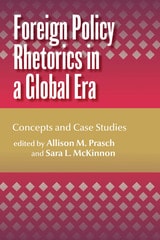
Foreign Policy Rhetorics in a Global Era
Concepts and Case StudiesAllison M. Prasch
Michigan State University Press, 2024
Among the cases researched in this collection are foreign policy rhetoric from Cold War foreign policy in Latin America, the rhetoric of Vladimir Putin’s Ukraine war messages, and the development challenges of the Ford Foundation and the Kenya Women Finance Trust, among many others.
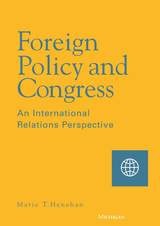
Foreign Policy and Congress
An International Relations PerspectiveMarie T. Henehan
University of Michigan Press, 2000
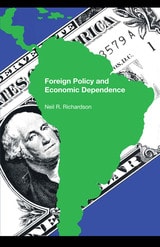
Foreign Policy and Economic Dependence
By Neil R. Richardson
University of Texas Press, 1978
In an era of increasing interdependence among nations, the foreign policies of poor countries are becoming a subject of critical interest to scholars and the public alike. Neil R. Richardson adopts a political economy perspective to examine the foreign policy repercussions of international economic dependence.
Are dependent countries compliant in their foreign policies, acquiescing to the preferences of the industrial giants on which they rely for foreign trade, investment, and aid revenues? Or are they instead prepared to defy their dominant economic partners? These are the major concerns of Richardson’s rigorous investigation.
The book begins with a characterization of economic dependence and its possible impact on the foreign policy decisions of dependent governments. Ideas from both “interdependence” and dependencia scholarship are extracted in order to explain the reliance of poor countries on their rich partners. These economics are linked to the foreign policies of poorer countries by considering how the mechanisms of dependence may create pressures on foreign policymakers. Several combinations of pressures are plausible, and each set yields a differing expectation about their foreign policies.
The second part of the book is an empirical test of these foreign policy predictions for the years 1950–1973. Richardson analyzes the foreign policy behavior (as reflected in certain votes in the United Nations General Assembly) of a number of poor countries that are economically dependent on the United States to varying degrees.
The results suggest several surprising conclusions. Contrary to one common assumption, these mostly Latin American and Caribbean countries are not necessarily locked into a condition of perpetual dependence. Richardson finds that the foreign policies of the economic dependencies are not easily manipulated by the United States. Not only do annual changes in their external economic reliance fail to correspond to their U.N. voting behavior, but the dependencies as a group are no longer clear voting allies of the United States after the late 1960s. These and other results bear theoretical and policy implications that conclude the book.
Foreign Policy and Economic Dependence will be of interest to specialists in quantitative international relations and American foreign policy.
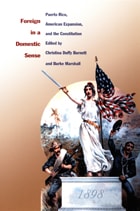
Foreign in a Domestic Sense
Puerto Rico, American Expansion, and the ConstitutionChristina Duffy Burnett and Burke Marshall, eds.
Duke University Press, 2001
More than four million U.S. citizens currently live in five “unincorporated” U.S. territories. The inhabitants of these vestiges of an American empire are denied full representation in Congress and cannot vote in presidential elections. Focusing on Puerto Rico, the largest and most populous of the territories, Foreign in a Domestic Sense sheds much-needed light on the United States’ unfinished colonial experiment and its legacy of racially rooted imperialism, while insisting on the centrality of these “marginal” regions in any serious treatment of American constitutional history. For one hundred years, Puerto Ricans have struggled to define their place in a nation that neither wants them nor wants to let them go. They are caught in a debate too politicized to yield meaningful answers. Meanwhile, doubts concerning the constitutionality of keeping colonies have languished on the margins of mainstream scholarship, overlooked by scholars outside the island and ignored by the nation at large.
This book does more than simply fill a glaring omission in the study of race, cultural identity, and the Constitution; it also makes a crucial contribution to the study of American federalism, serves as a foundation for substantive debate on Puerto Rico’s status, and meets an urgent need for dialogue on territorial status between the mainland and the territories.
Contributors. José Julián Álvarez González, Roberto Aponte Toro, Christina Duffy Burnett, José A. Cabranes, Sanford Levinson, Burke Marshall, Gerald L. Neuman, Angel R. Oquendo, Juan Perea, Efrén Rivera Ramos, Rogers M. Smith, E. Robert Statham Jr., Brook Thomas, Richard Thornburgh, Juan R. Torruella, José Trías Monge, Mark Tushnet, Mark Weiner

Forever Broke
How Baby Boomers are Bankrupting the Millennial GenerationAndrew Stiles
Templeton Press, 2018
Some of his key findings include:
- U.S. debt is approaching 100 percent of GDP, the highest level since World War II.
- By 2050, debt is on track to reach an unprecedented 145 percent of GDP. Under one pessimistic (but probably more realistic) scenario, CBO estimates that debt could rise to 244 percent of GDP, which means lights out.
- By 2050, federal spending is projected to exceed 29 percent of GDP, levels not seen since the height of World War II. We’re on track to spending more money on baby boomers in retirement than we did to defeat the Nazis.
- Since 1984, the median net worth for households headed by someone under the age of 35 has declined 68 percent. For retirement age households, net worth has increased 42 percent over that same period. The result is the largest generational wealth gap in history. Boomers did better than their kids in early adulthood, and will do better than their kids in retirement.
- As millennials remain childless and single for longer, they face one of the highest tax rates (16.9 percent) for their demographic in the developed world.
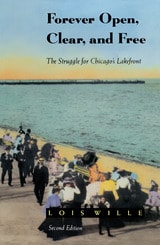
Forever Open, Clear, and Free
The Struggle for Chicago's LakefrontLois Wille
University of Chicago Press, 1991
Illustrated with historic and contemporary photographs, Wille's book tells how Chicago's lakefront has survived a century of development. The story serves as a warning to anyone who thinks the struggle for the lakefront is over, or who takes for granted the beauty of its public beaches and parks.
"A thoroughly fascinating and well-documented narrative which draws the reader into the sights, smells and sounds of Chicago's story. . . . Everyone who cares about the development of land and its conservation will benefit from reading Miss Wille's book."—Daniel J. Shannon, Architectural Forum
"Not only good reading, it is also a splendid example of how to equip concerned citizens for their necessary participation in the politics of planning and a more livable environment."—Library Journal
Forever Suspect
Racialized Surveillance of Muslim Americans in the War on TerrorSelod, Saher
Rutgers University Press, 2018

Forever Vietnam
How a Divisive War Changed American Public MemoryDavid Kieran
University of Massachusetts Press, 2014
Kieran focuses his analysis on the recent remembrance of six events, three of which occurred before the Vietnam War and three after it ended. The first group includes the siege of the Alamo in 1836, the incarceration of Union troops at Andersonville during the Civil War, and the experience of American combat troops during World War II. The second comprises the 1993 U.S. intervention in Somalia, the crash of United Airlines Flight 93 on September 11, 2001, and the Iraq and Afghanistan wars.
In each case a range of actors—military veterans, policymakers, memorial planners, and the general public—used memorial practices associated with the Vietnam War to reinterpret the contemporary significance of past events. A PBS program about Andersonville sought to cultivate a sense of national responsibility for the My Lai massacre. A group of Vietnam veterans occupied the Alamo in 1985, seeing themselves as patriotic heirs to another lost cause. A World War II veteran published a memoir in 1980 that reads like a narrative of combat in Vietnam. Through these and other examples, Forever Vietnam reveals not only the persistence of the past in public memory but also its malleability in the service of the political present.
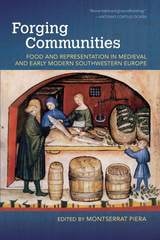
Forging Communities
Food and Representation in Medieval and Early Modern Southwestern EuropeMontserrat Piera
University of Arkansas Press, 2018
This interdisciplinary study of food in medieval and early modern communities connects threads of history conventionally examined separately or in isolation. The intersection of foodstuffs with politics, religion, economics, and culture enhances our understanding of historical developments and cultural continuities through the centuries, giving insight that today, as much as in the past, we are what we eat and what we eat is never devoid of meaning.

Forging an Integrated Europe
Barry Eichengreen and Jeffry Frieden, Editors
University of Michigan Press, 1998
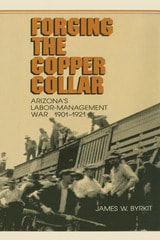
Forging the Copper Collar
Arizona's Labor-Management War of 1901–1921James W. Byrkit
University of Arizona Press, 1982
Just after dawn, two thousand armed vigilantes took to the streets of this remote Arizona mining town to round up members and sympathizers of the radical Industrial Workers of the World. Before the morning was over, nearly twelve hundred alleged Wobblies had been herded onto waiting boxcars. By day's end, they had been hauled off to New Mexico.
While the Bisbee Deportation was the most notorious of many vigilante actions of its day, it was more than the climax of a labor-management war—it was the point at which Arizona donned the copper collar. That such an event could occur, James Byrkit contends, was not attributable so much to the marshaling of public sentiment against the I.W.W. as to the outright manipulation of the state's political and social climate by Eastern business interests.
In Forging the Copper Collar, Byrkit paints a vivid picture of Arizona in the early part of this century. He demonstrates how isolated mining communities were no more than mercantilistic colonies controlled by Eastern power, and how that power wielded control over all the Arizona's affairs—holding back unionism, creating a self-serving tax structure, and summarily expelling dissidents.
Because the years have obscured this incident and its background, the writing of Copper Collar involved extensive research and verification of facts. The result is a book that captures not only the turbulence of an era, but also the political heritage of a state.
Forging the World
Strategic Narratives and International RelationsAlister Miskimmon, Ben O'Loughlin, and Laura Roselle, Editors
University of Michigan Press, 2017
Forgotten Futures, Colonized Pasts
Transnational Collaboration in Nineteenth-Century Greater MexicoCara Anne Kinnally
Bucknell University Press, 2019
Published by Bucknell University Press. Distributed worldwide by Rutgers University Press.

Formal Modeling in Social Science
Carol Mershon and Olga Shvetsova
University of Michigan Press, 2019
A formal model in the social sciences builds explanations when it structures the reasoning underlying a theoretical argument, opens venues for controlled experimentation, and can lead to hypotheses. Yet more importantly, models evaluate theory, build theory, and enhance conjectures. Formal Modeling in Social Science addresses the varied helpful roles of formal models and goes further to take up more fundamental considerations of epistemology and methodology.
The authors integrate the exposition of the epistemology and the methodology of modeling and argue that these two reinforce each other. They illustrate the process of designing an original model suited to the puzzle at hand, using multiple methods in diverse substantive areas of inquiry. The authors also emphasize the crucial, though underappreciated, role of a narrative in the progression from theory to model.
Transparency of assumptions and steps in a model means that any analyst will reach equivalent predictions whenever she replicates the argument. Hence, models enable theoretical replication, essential in the accumulation of knowledge. Formal Modeling in Social Science speaks to scholars in different career stages and disciplines and with varying expertise in modeling.
Formations of Violence
The Narrative of the Body and Political Terror in Northern IrelandAllen Feldman
University of Chicago Press, 1991
"A sophisticated and persuasive late-modernist political analysis that consistently draws the reader into the narratives of the author and those of the people of violence in Northern Ireland to whom he talked. . . . Simply put, this book is a feast for the intellect"—Thomas M. Wilson, American Anthropologist
"One of the best books to have been written on Northern Ireland. . . . A highly imagination and significant book. Formations of Violence is an important addition to the literature on political violence."—David E. Schmitt, American Political Science Review

Forms of Nationhood
The Elizabethan Writing of EnglandRichard Helgerson
University of Chicago Press, 1992
Forsaken Causes
Liberal Democracy and Anticommunism in Cold War LaosRyan Wolfson-Ford
University of Wisconsin Press, 2024
Forsaken Causes offers a groundbreaking intellectual history of the Royal Lao Government (RLG) from 1945 to 1975. In Ryan Wolfson-Ford’s account, the Lao people emerge as not merely pawns of the superpowers but agents in their own right, with the Lao elite wielding particular influence over the nation’s trajectory. Their prevailing ideologies—liberal democracy and anticommunism—were not imposed from outside, but rather established by Lao themselves in the fight against French colonialism. These ideologies were rooted in Lao culture, which prized its traditional monarchy, Buddhist faith, French learning, and nationalist conception of a Lao race. Against histories that have dismissed Lao elites as instruments of foreign powers, Wolfson-Ford shows that the RLG charted its own course, guided by complex motivations, rationales, and beliefs. During this time Lao enjoyed unprecedented democratic freedoms, many of which have not been seen since the government fell to communist takeover in 1975.
By recentering the Lao in their own history, Wolfson-Ford restores our understanding of this robust but often forgotten liberal democracy, recovers lost voices, and broadens our understanding of postcolonial and Cold War Southeast Asia as a whole.
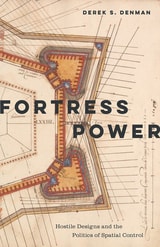
Fortress Power
Hostile Designs and the Politics of Spatial ControlDerek S. Denman
University of Minnesota Press, 2025
A compelling treatise on the relationship between power and enclosure
Fortress Power presents a genealogy of fortification as a material and political technology intent on obstruction, tracing its implementation across battlefields, borders, and urban environments. Drawing on the influential work of philosophers Michel Foucault and Giorgio Agamben, Derek S. Denman places the fortress alongside the archetypes of the prison and the camp, citing them as paradigmatic of how space is transformed into a tool of domination and control.
Focusing on the defensive architecture of bastion fortresses, urban design, and border landscapes, Fortress Power charts the rise of a form of governance grounded in hostility, extending the scope of its subject from a piece of military construction to a much broader political concept. Detailing how power manifests in everything from city centers to international boundaries, the book analyzes the logic of fortification as it moves through various contexts in the advancement of surveillance, exploitation, warfare, and political authority.
Through a unique blend of architecture and design studies, political theory, international relations, geography, and migration studies, Denman outlines the disquieting legacy of the fortress to highlight its role in the formation of modern government and the enactment of violence. In an era marked by the increasing prevalence of authoritarian power and conflicting geopolitical boundaries, he presents an insightful investigation of the weaponization of the built environment.
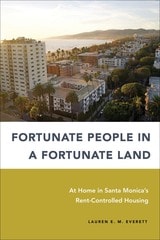
Fortunate People in a Fortunate Land
At Home in Santa Monica's Rent-Controlled HousingLauren E. M. Everett
Temple University Press, 2025
Everett seeks to understand the extent to which individuals feel at home or not at home and what factors contribute to those experiences. She also explores the nexus of Santa Monica’s tenant protection policies, infrastructure, and resources and the extent to which they inform stability—both perceived and actual—and life decisions.
The first scholarly book to take a tenant-centered approach to examining the benefits and problems of rent control, Fortunate People in a Fortunate Land examines the residential experience in this specific local context and explains how it relates to policy and other externalities in cities where homeownership is not financially viable for most renters.
In the series Urban Life, Landscape, and Policy

Fortune Is a Woman
Gender and Politics in the Thought of Niccolo MachiavelliHanna Fenichel Pitkin
University of Chicago Press, 1999
Hanna Pitkin's provocative and enduring study of Machiavelli was the first to systematically place gender at the center of its exploration of his political thought. In this edition, Pitkin adds a new afterword, in which she discusses the book's critical reception and situates the book's arguments in the context of recent interpretations of Machiavelli's thought.
"A close and often brilliant exegesis of Machiavelli's writings."—The American Political Science Review
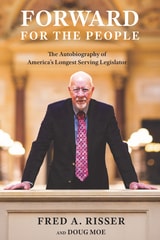
Forward for the People
The Autobiography of America's Longest Serving LegislatorFred A. Risser and Doug Moe
Wisconsin Historical Society Press, 2025
When Fred Risser retired from the Wisconsin Senate in 2021, his sixty-four years in state government made him the longest serving legislator in US history. Now, in this candid and illuminating autobiography, Risser shares his singular perspective on events that transformed the state and the nation over the course of his remarkable career. From his role in the “Joe Must Go” drive to recall US Senator Joseph McCarthy in the 1950s to his position as the senior senator among the “Fab Fourteen” Wisconsin Democrats who opposed Governor Scott Walker’s Act 10 legislation against collective bargaining in 2011, Risser was a leader in state politics for decades, always maintaining an unwavering belief that political action can change people’s lives for the better.
Forward for the People provides a unique peek behind the political curtain from the viewpoint of someone who saw it all. Risser worked with thirteen governors and authored more than 240 bills that became law, championing public health and safety, environmental protection, women’s and reproductive rights, organized labor, civil rights, and social justice, among many other causes. Risser also recounts interactions with prominent national politicians, including Robert La Follette Jr., Hubert Humphrey, Jimmy Carter, and Bill Clinton. More than forty photographs from Risser’s personal collection and the Wisconsin Senate paint a vivid picture of his six-decade journey through Wisconsin politics.
Forward for the People details Risser’s experiences out of state, from a stint in the Panama Canal Zone as a navy hospital corpsman to his undergraduate debate-team days at Minnesota’s Carleton College to his years studying law at the University of Oregon and his travels to all seven continents. The book also depicts the quirky habits that made Risser a memorable and beloved politician: biking his age in miles every birthday and never taking the elevator in his sixty-four years at the Wisconsin State Capitol. Enhanced with details sourced from correspondence, personal notes, newspaper accounts, and recollections from friends and former colleagues, Risser and coauthor Doug Moe have crafted an engaging account of an extraordinary life in public service.
Forward for the People
The Autobiography of America's Longest Serving LegislatorFred A. Risser and Doug Moe
Wisconsin Historical Society Press, 2026
When Fred Risser retired from the Wisconsin Senate in 2021, his sixty-four years in state government made him the longest serving legislator in US history. Now, in this candid and illuminating autobiography, Risser shares his singular perspective on events that transformed the state and the nation over the course of his remarkable career. From his role in the “Joe Must Go” drive to recall US Senator Joseph McCarthy in the 1950s to his position as the senior senator among the “Fab Fourteen” Wisconsin Democrats who opposed Governor Scott Walker’s Act 10 legislation against collective bargaining in 2011, Risser was a leader in state politics for decades, always maintaining an unwavering belief that political action can change people’s lives for the better.
Forward for the People provides a unique peek behind the political curtain from the viewpoint of someone who saw it all. Risser worked with thirteen governors and authored more than 240 bills that became law, championing public health and safety, environmental protection, women’s and reproductive rights, organized labor, civil rights, and social justice, among many other causes. Risser also recounts interactions with prominent national politicians, including Robert La Follette Jr., Hubert Humphrey, Jimmy Carter, and Bill Clinton.
Forward for the People details Risser’s experiences out of state, from a stint in the Panama Canal Zone as a navy hospital corpsman to his undergraduate debate-team days at Minnesota’s Carleton College to his years studying law at the University of Oregon and his travels to all seven continents. The book also depicts the quirky habits that made Risser a memorable and beloved politician: biking his age in miles every birthday and never taking the elevator in his sixty-four years at the Wisconsin State Capitol. Enhanced with details sourced from correspondence, personal notes, newspaper accounts, and recollections from friends and former colleagues, Risser and coauthor Doug Moe have crafted an engaging account of an extraordinary life in public service.
Foucault and Political Reason
Liberalism, Neo-Liberalism, and Rationalities of GovernmentEdited by Andrew Barry, Thomas Osborne, and Nikolas Rose
University of Chicago Press, 1996
These twelve essays provide a critical introduction to Foucault's work on politics, exploring its relevance to past and current thinking about liberal and neo-liberal forms of government. Moving away from the great texts of liberal political philosophy, this book looks closely at the technical means with which the ideals of liberal political rationalities have been put into practice in such areas as schools, welfare, and the insurance industry.
This fresh approach to one of the seminal thinkers of the twentieth century is essential reading for anyone interested in social and cultural theory, sociology, and politics.
Foucault and the Iranian Revolution
Gender and the Seductions of IslamismJanet Afary and Kevin B. Anderson
University of Chicago Press, 2005
In this important and controversial account, Janet Afary and Kevin B. Anderson illuminate Foucault's support of the Islamist movement. They also show how Foucault's experiences in Iran contributed to a turning point in his thought, influencing his ideas on the Enlightenment, homosexuality, and his search for political spirituality. Foucault and the Iranian Revolution informs current discussion on the divisions that have reemerged among Western intellectuals over the response to radical Islamism after September 11. Foucault's provocative writings are thus essential for understanding the history and the future of the West's relationship with Iran and, more generally, to political Islam. In their examination of these journalistic pieces, Afary and Anderson offer a surprising glimpse into the mind of a celebrated thinker.

Foucault in Iran
Islamic Revolution after the EnlightenmentBehrooz Ghamari-Tabrizi
University of Minnesota Press, 2016
Were the thirteen essays Michel Foucault wrote in 1978–1979 endorsing the Iranian Revolution an aberration of his earlier work or an inevitable pitfall of his stance on Enlightenment rationality, as critics have long alleged? Behrooz Ghamari-Tabrizi argues that the critics are wrong. He declares that Foucault recognized that Iranians were at a threshold and were considering if it were possible to think of dignity, justice, and liberty outside the cognitive maps and principles of the European Enlightenment.
Foucault in Iran centers not only on the significance of the great thinker’s writings on the revolution but also on the profound mark the event left on his later lectures on ethics, spirituality, and fearless speech. Contemporary events since 9/11, the War on Terror, and the Arab Uprisings have made Foucault’s essays on the Iranian Revolution more relevant than ever. Ghamari-Tabrizi illustrates how Foucault saw in the revolution an instance of his antiteleological philosophy: here was an event that did not fit into the normative progressive discourses of history. What attracted him to the Iranian Revolution was precisely its ambiguity.
Theoretically sophisticated and empirically rich, this interdisciplinary work will spark a lively debate in its insistence that what informed Foucault’s writing was not an effort to understand Islamism but, rather, his conviction that Enlightenment rationality has not closed the gate of unknown possibilities for human societies.
Foucault's Discipline
The Politics of SubjectivityJohn S. Ransom
Duke University Press, 1997
Foucault’s Discipline demonstrates how Foucault’s valorization of descriptive critique over prescriptive plans of action can be applied to the decisively altered political landscape of the end of this millennium. By reconstructing the philosopher’s arguments concerning the significance of disciplinary institutions, biopower, subjectivity, and forms of resistance in modern society, Ransom shows how Foucault has provided a different way of looking at and responding to contemporary models of government—in short, a new depiction of the political world.
Foucault, Politics, and Violence
Johnanna Oksala
Northwestern University Press, 2012