Results by title
4155 books match the query 'State & Local' and 177 start with f

From Quarry to Cornfield
The Political Economy of Mississippian Hoe ProductionCharles Richard Cobb
University of Alabama Press, 2001
An innovative model for examining the technology of hoe production and its contribution to the agriculture of Mississippian communities.
Lithic specialist Charles Cobb examines the political economy in Mississippian communities through a case study of raw material procurement and hoe production and usage at the Mill Creek site on Dillow Ridge in southwest Illinois. Cobb outlines the day-to-day activities in a Mississippian chiefdom village that flourished from about A.D. 1250 to 1500. In so doing, he provides a fascinating window into the specialized tasks of a variety of "day laborers" whose contribution to the community rested on their production of stone hoes necessary in the task of feeding the village. Overlooked in most previous studies, the skills and creativity of the makers of the hoes used in village farming provide a basis for broader analysis of the technology of hoe use in Mississippian times.
Although Cobb's work focuses on Mill Creek, his findings at this site are representative of the agricultural practices of Mississippian communities throughout the eastern United States. The theoretical underpinnings of Cobb's study make a clear case for a reexamination of the accepted definition of chiefdom, the mobilization of surplus labor, and issues of power, history, and agency in Mississippian times. In a well-crafted piece of writing, Cobb distinguishes himself as one of the leaders in the study of lithic technology. From Quarry to Cornfield will find a well-deserved place in the ongoing discussions of power and production in the Mississippian political economy.
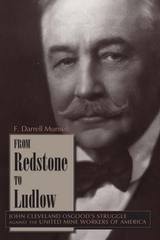
From Redstone to Ludlow
John Cleveland Osgood's Struggle against the United Mine Workers of AmericaF. Darrell Munsell
University Press of Colorado, 2009
From Redstone to Ludlow depicts the bipolarity of his approach to the threat of unionism. The "Redstone experiment," a model industrial village designed to improve the lives of workers through social programs, showed Osgood's efforts to attain his anti-union goals through compassion. Conversely, the Ludlow tent colony and the events that transpired there, marked by armed gunmen and machine guns paid for by Osgood, illustrate his willingness to resort to violence and intimidation for the same purpose. A leading participant in the transformation of the West, Osgood helped to shape the character of the Gilded Age. Today, the beautiful village of Redstone and a granite memorial at Ludlow are reminders of Osgood's complex role in the clash between labor and management during the most violent industrial struggle in American history.

From Sail to Steam
Four Centuries of Texas Maritime History, 1500-1900By Richard V. Francaviglia
University of Texas Press, 1998
Second Place, Presidio La Bahia Award, Sons of the Republic of Texas
The Gulf Coast has been a principal place of entry into Texas ever since Alonso Alvarez de Pineda explored these shores in 1519. Yet, nearly five hundred years later, the maritime history of Texas remains largely untold. In this book, Richard V. Francaviglia offers a comprehensive overview of Texas' merchant and military marine history, drawn from his own extensive collection of maritime history materials, as well as from research in libraries and museums around the country.
Based on recent discoveries in nautical archaeology, Francaviglia tells the stories of the Spanish flotilla that wrecked off Padre Island in 1554 and of La Salle's flagship Belle, which sank in 1687. He explores the role of the Texas Navy in the Texas Revolution of 1835-1836 and during the years of the Texas Republic and also describes the Civil War battles at Galveston and Sabine Pass. Finally, he recounts major developments of the nineteenth century, concluding with the disastrous Galveston Hurricane in 1900. More than one hundred illustrations, many never before published, complement the text.
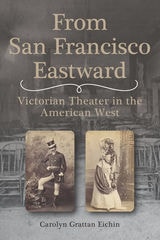
From San Francisco Eastward
Victorian Theater in the American WestCarolyn Grattan Eichin
University of Nevada Press, 2020
Finalist for the 2021 Will Rogers Medallion Award in Western Non-Fiction
Carolyn Grattan Eichin’s From San Francisco Eastward explores the dynamics and influence of theater in the West during the Victorian era. San Francisco, Eichin argues, served as the nucleus of the western theatrical world, having attained prominence behind only New York and Boston as the nation’s most important theatrical center by 1870. By focusing on the West’s hinterland communities, theater as a capitalist venture driven by the sale of cultural forms is illuminated against the backdrop of urbanization.
Using the vagaries of the West’s notorious boom-bust economic cycles, Eichin traces the fiscal, demographic, and geographic influences that shaped western theater. With an emphasis on the 1860s and 70s, this thoroughly researched work uses distinct notions of ethnicity, class, and gender to examine a cultural institution driven by a market economy. From San Francisco Eastward is a thorough analysis of the ever-changing theatrical personalities and strategies that shaped Victorian theater in the West, and the ways in which theater as a business transformed the values of a region.

From Six-on-Six to Full Court Press
A Century of Iowa Girls' BasketballJanice A. Beran
University of Iowa Press, 1993
“From Six-on-Six to Full Court Press is a complete history of Iowa women’s high school, college, and recreational basketball. Beran’s exhaustive research . . . covers legendary players and coaches, changes in rules, stats on Iowa girls’ high school records, alterations in playing styles and uniforms, along with the heart-stopping excitement of the state tournament.”—Hoop Source
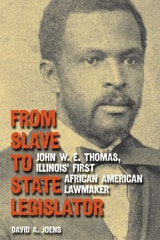
From Slave to State Legislator
John W. E. Thomas, Illinois' First African American LawmakerDavid A. Joens
Southern Illinois University Press, 2012
As the first African American elected to the Illinois General Assembly, John W. E. Thomas was the recognized leader of the state’s African American community for nearly twenty years and laid the groundwork for the success of future Black leaders in Chicago politics. Despite his key role in the passage of Illinois’ first civil rights act and his commitment to improving his community against steep personal and political barriers, Thomas’s life and career have been long forgotten by historians and the public alike. This fascinating full-length biography—the first to address the full influence of Thomas or any Black politician from Illinois during the Reconstruction Era—is also a pioneering effort to explain the dynamics of African American politics and divisions within the Black community in post–Civil War Chicago.
In From Slave to State Legislator, David A. Joens traces Thomas’s trajectory from a slave owned by a doctor’s family in Alabama to a prominent attorney believed to be the wealthiest African American man in Chicago at the time of his death in 1899. Providing one of the few comprehensive looks at African Americans in Chicago during this period, Joens reveals how Thomas’s career represents both the opportunities available to African Americans in the postwar period and the limits still placed on them. When Thomas moved to Chicago in 1869, he started a grocery store, invested in real estate, and founded the first private school for African Americans before becoming involved in politics.
From Slave to State Legislator provides detailed coverage of Thomas’s three terms in the legislature during the 1870s and 1880s, his multiple failures to be nominated for reelection, and his loyalty to the Republican Party at great political cost, calling attention to the political differences within a Black community often considered small and homogenous. Even after achieving his legislative legacy—the passage of the first state civil rights law—Thomas was plagued by patronage issues and an increasingly bitter split with the African American community frustrated with slow progress toward true equality. Drawing on newspapers and an array of government documents, Joens provides the most thorough review to date of the first civil rights legislation and the two controversial “colored conventions” chaired by Thomas.
Joens cements Thomas’s legacy as a committed and conscientious lawmaker amid political and personal struggles. In revealing the complicated rivalries and competing ambitions that shaped Black northern politics during the Reconstruction Era, Joens shows the long-term impact of Thomas’s friendship with other burgeoning African American political stars and his work to get more black representatives elected. The volume is enhanced by short biographies of other key Chicago African American politicians of the era.

From Thorns to Blossoms
A Japanese American Family in War and PeaceMitzi Asai Loftus
Oregon State University Press, 2024
Mitsuko “Mitzi” Asai was not yet ten years old in the spring of 1942 when President Roosevelt’s Executive Order 9066 sent 120,000 people of Japanese ancestry—about two-thirds of them US citizens—from their homes on the West Coast to inland prison camps. They included Mitzi and most of her family, who owned a fruit orchard in Hood River, Oregon. The Asais spent much of World War II in the camps while two of the older sons served in the Pacific in the US Army. Three years later, when the camps began to close, the family returned to Hood River to find an altered community. Shop owners refused to serve neighbors they had known for decades; racism and hostility were open and largely unchecked. Humiliation and shame drove teenaged Mitzi to reject her Japanese heritage, including her birth name. More than a decade later, her life took another turn when a Fulbright grant sent her to teach in Japan, where she reconnected with her roots.
In From Thorns to Blossoms, Mitzi recounts her rich and varied life, from a childhood surrounded by barbed wire and hatred to a successful career as a high school English teacher and college instructor in English as a Second Language. Today, Asai descendants continue to tend the Hood River farm while the town confronts its shameful history. Originally published in 1990 as Made in Japan and Settled in Oregon, this revised and expanded edition describes the positive influence Mitzi’s immigrant parents had on their children, provides additional context for her story, and illuminates the personal side of a dark chapter in US history. It’s the remarkable story of a transformation from thorns into blossoms, pain into healing.

From Warm Center to Ragged Edge
The Erosion of Midwestern Literary and Historical Regionalism, 1920-1965Jon K. Lauck
University of Iowa Press, 2017
This book explains the factors that triggered the demise of the Midwest’s regionalist energies, from anti-midwestern machinations in the literary world and the inability of midwestern writers to break through the cultural politics of the era to the growing dominance of a coastal, urban culture. These developments paved the way for the proliferation of images of the Midwest as flyover country, the Rust Belt, a staid and decaying region. Yet Lauck urges readers to recognize persisting and evolving forms of midwestern identity and to resist the forces that squelch the nation’s interior voices.

From the Center of America
Steamboats and Shipyards Along the Lower Ohio RiverRobert H. Swenson
Southern Illinois University Press, 2026
Charting the legacy of mid-America's shipyards and iconic steamboats
Before the railroad stitched together the American landscape, the dominant mode of transportation in the United States was by steamboat. These grand vessels, their iconic paddlewheels churning the country’s rivers, have long captured the national imagination as symbols of innovation and adventure.
In the heart of America, four major rivers converge—the Cumberland and Tennessee with the Ohio; then the Ohio with the Mississippi. These three confluences, which author Robert Swenson christens the Four Rivers Reach, played a unique role in the development of the steamboats that dominated American continental transport for almost 100 years. Between 1825 and 1936, the river towns of Smithland, Paducah, Metropolis, Mound City, and Cairo launched 295 wood-hulled, steam-powered vessels. Drawing from a wealth of archival sources, Swenson presents detailed histories of these steamboats over a span of 110 years, accompanied by nearly one hundred illustrations and photographs.
The book focuses on distinct events in steamboat history, tracing the impact of these shipyards on the economies and communities of the river towns where they were built. It reveals how the availability of steamboats along this sixty-mile Reach affected migration, politics, and the US economy of the nineteenth century. Steamboats built at the Four Rivers Reach played pivotal roles in the forced relocation of Native Americans from southern Appalachia to Oklahoma, the outcome of the Civil War, and the Montana gold rush. From the Center of America demonstrates how steamboat building shaped the culture, people, and economy of this region—and how, in turn, the area and its steamships influenced the growth of the young United States.
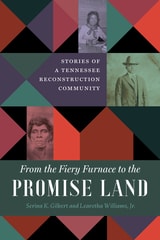
From the Fiery Furnace to the Promise Land
Stories of a Tennessee Reconstruction CommunitySerina K. Gilbert and Learotha Williams Jr.
Vanderbilt University Press, 2025
In time the community encompassed approximately 1,000 acres with more than 50 homes, several stores, three churches, and an elementary school. But by the mid‑twentieth century, the community had dwindled to just a handful of families. Now all that remains physically is a church and the old school building. But in the hearts of the descendants of those families, Promise Land remains a vital and thriving community of friends, family, and, albeit virtual, neighbors who continue to support each other.
This is the story of this town told through the memories of the people who lived there. Serina Gilbert grew up in the community and is now one of the revered storytellers and story‑keepers of Promise Land. Along with historian Learotha Williams, she is sharing the history of a community that thrived and continues to thrive in the face of almost insurmountable obstacles.
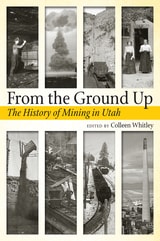
From the Ground Up
A History of Mining in Utahedited by Colleen K. Whitley
Utah State University Press, 2025
Mining had an enormous role, only partly measurable, in the history of Utah. Its multidimensional impact continues today. Economically, it made a major long-term contribution to the wealth, employment, and tax base of the state and stimulated a seemingly endless range of secondary businesses and enterprises. It helped shape the state's social history, determining the location, distribution, and composition of many communities and bringing transportation systems and a wide variety of institutions to them. It developed cultural diversity by drawing to Utah miners and families from otherwise underrepresented ethnic and national backgrounds. It ignited strife, particularly between labor and management, but those issues often spread into or connected with other conflicts in and between communities, classes, and factions. It influenced political platforms, generated candidates, and helped decide elections. Throughout the state, mining dramatically transformed the landscape, most obviously at what has been called the world's largest open-pit mine, which removed much of a mountain on the west side of Salt Lake Valley, but at innumerable other places too.
Despite all mining has done and meant, there has not been, until now, a book that surveyed its history in Utah. From the Ground Up fills that gap in a collection of essays by leading experts, among them historians Thomas G. Alexander, Martha Sonntag Bradley-Evans, James E. Fell Jr., Laurence P. James, Brigham D. Madsen, Philip F. Notarianni, Allen Kent Powell, W. Paul Reeve, Raye C. Ringholz, and Janet Burton Seegmiller and geologists J. Wallace Gwynn and William T. Parry. The book is divided into three comprehensive parts. The first looks at "The Ground of Utah Mining": the geology that has produced extractable minerals, the economic history of the industry, "father of Utah mining" Patrick E. Connor, and the lore of mines and miners. Part II reviews the history of a handful of particularly significant mineral industries: salines, coal, uranium, and beryllium. The last part takes a region-by-region approach to survey the important, primarily for hard-rock mining, areas of the state, including places from Silver Reef to Alta, the East Tintic Range to the Uinta Basin, and Park City to Frisco.

From the Jewish Heartland
Two Centuries of Midwest FoodwaysEllen F. Steinberg and Jack H. Prost
University of Illinois Press, 2013

From the Lookout
Memories of Peninsula State Park’s Summer Camp for GirlsKathleen Harris
Wisconsin Historical Society Press, 2020
With big ideas, little money, and no experience, Alice Orr Clark and Frances Louise “Kidy” Mabley founded Meenahga as a place for young women to refine their manners, enjoy outdoor leisure activities, and learn woodcraft. From the Lookout is an account of these experiences, a history of Camp Meenahga informed by what campers, counselors, and others left behind, including letters home, notes from Clark and Mabley, and many pages from the camp yearbook and newsletter Pack and Paddle.
Brimming with nostalgia, From the Lookout brings to life the sights, sounds, and smells of an idyllic summer retreat, one that long after it closed lived on as a place of respite in the memories of those who knew and loved it best.

From the Mountains to the Sea
Protecting Nature in Postwar New HampshireKimberly A. Jarvis
University of Massachusetts Press, 2020
Shaped by New Hampshire's unique conservation focus on both resource use and preservation that developed during the first years of the twentieth century, as well as on the tradition of home rule in the state, the outcome of each campaign relied on the insight into, appreciation for, and dedication to protecting the historic and aesthetic values of these three places.

From the Republic of the Rio Grande
A Personal History of the Place and the PeopleBy Beatriz de la Garza
University of Texas Press, 2013
The Republic of the Rio Grande had a brief and tenuous existence (1838–1840) before most of it was reabsorbed by Mexico and the remainder annexed by the United States, yet this region that straddles the Rio Grande has retained its distinctive cultural identity to the present day. Born on one side of the Rio Grande and raised on the other, Beatriz de la Garza is a product of this region. Her birthplace and its people are the subjects of this work, which fuses family memoir and borderlands history.
From the Republic of the Rio Grande brings new insights and information to the study of transnational cultures by drawing from family papers supplemented by other original sources, local chronicles, and scholarly works. De la Garza has fashioned a history of this area from the perspective of individuals involved in the events recounted. The book is composed of nine sections spanning some two hundred years, beginning in the mid-1700s. Each section covers not only a chronological period but also a particular theme relating to the history of the region. De la Garza takes a personal approach, opening most sections with an individual observation or experience that leads to the central motif, whether this is the shared identity of the inhabitants, their pride in their biculturalism and bilingualism, or their deep attachment to the land of their ancestors.
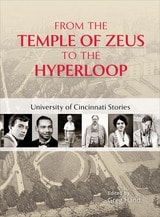
From the Temple of Zeus to the Hyperloop
University of Cincinnati StoriesEdited by Greg Hand
University of Minnesota Press, 2018
Former Ohio Governor Bob Taft remembers his law school days in a building named for his great-grandfather. Broadway star Faith Prince recalls her musical theater start at UC’s College-Conservatory of Music. More than thirty-five contributors provide their own unique perceptions of this extraordinary urban university. Some are well-known names like Taft and Prince, while others are current students and alumni whose education and futures were profoundly shaped by memorable experiences connected to UC. Clark Beck recounts the struggles he initially faced upon coming to UC and offers readers an inspiring story of perseverance and tenacity. Sid Thatham gives a captivating tale of his move from India and the home base he made in Cincinnati with UC graduate students. Other contributors celebrate the relationships, such as that between the strong-willed duo of Jack Rouse and Helen Laird, that give UC its storied past.
In From the Temple of Zeus to the Hyperloop, anyone can find a person, whether it be the trailblazing Lucy Braun or the celebrated Carl Blegen, or a place, be it the changing landscape of Ludlow Avenue or the new frontier for the DAAP College, to which he or she can relate. Such figures, places, and stories present a sampling of the UC experience. From the Temple of Zeus to the Hyperloop offers readers an inside look at the many lives that have influenced UC and the opportunity to envision how their own stories can be a part of its future.
Just as Hand titles his introduction, “a dedicated crew of bearcats assembled this book,” the University of Cincinnati and its story continue to be a community effort, deeply intertwined with the lives of the people who have made up the university and its two-hundred years.

Frontier Doctor
Observations on Central Oregon and the Changing WestUrling C. Coe
Oregon State University Press, 1996

Frontier Doctor
Observations on Central Oregon and the Changing WestUrling C. Coe
Oregon State University Press, 1940
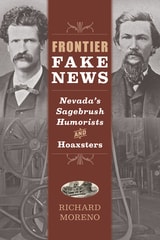
Frontier Fake News
Nevada's Sagebrush Humorists and HoaxstersRichard Moreno
University of Nevada Press, 2023
When readers see the names Mark Twain and Dan De Quille, fake news may not be the first thing that comes to mind. But these legendary journalists were some of the original, and most prolific, fake news writers in the early years of Nevada’s history. Frontier Fake News puts a spotlight on the hoaxes, feuds, pranks, outright lies, witty writing, and other literary devices utilized by a number of the Silver State’s frontier newsmen from the mid-nineteenth through the early twentieth centuries. Often known collectively as the Sagebrush School, these journalists were opinionated, talented, and individualistic.
While Mark Twain (Samuel Clemens), who got his start at Virginia City’s Territorial Enterprise, and Dan De Quille (William Wright), who some felt was a better writer than Twain, are the most well-known members of the Sagebrush School, author Richard Moreno includes others such as Fred Hart, who concocted a fake social club and reported on its gatherings for Austin’s Reese River Reveille, and William Forbes, who enjoyed sprinkling clever puns with political undertones in his newspaper articles.
Moreno traces the beginnings of genuine fake news from founding father Benjamin Franklin’s “Supplement to the Boston Independent Chronicle, Number 705, March 1782,” a fake newspaper aimed at swaying British public opinion, to the fake news articles of New York and Baltimore papers in the early 1800s. But these examples are only a prelude to the amazing accounts of petrified men, freeze-inducing solar armor, magically magnetic rocks, blood-curdling massacres, and other nonsense stories that appeared in Nevada’s frontier newspapers and beyond.
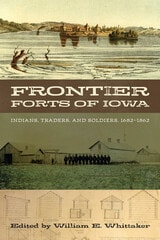
Frontier Forts of Iowa
Indians, Traders, and Soldiers, 1682-1862William E. Whittaker
University of Iowa Press, 2009
At least fifty-six frontier forts once stood in, or within view of, what is now the state of Iowa. The earliest date to the 1680s, while the latest date to the Dakota uprising of 1862. Some were vast compounds housing hundreds of soldiers; others consisted of a few sheds built by a trader along a riverbank. Regardless of their size and function—William Whittaker and his contributors include any compound that was historically called a fort, whether stockaded or not, as well as all military installations—all sought to control and manipulate Indians to the advantage of European and American traders, governments, and settlers. Frontier Forts of Iowa draws extensively upon the archaeological and historical records to document this era of transformation from the seventeenth-century fur trade until almost all Indians had been removed from the region.
The earliest European-constructed forts along the Mississippi, Des Moines, and Missouri rivers fostered a complex relationship between Indians and early traders. After the Louisiana Purchase of 1804, American military forts emerged in the Upper Midwest, defending the newly claimed territories from foreign armies, foreign traders, and foreign-supported Indians. After the War of 1812, new forts were built to control Indians until they could be moved out of the way of American settlers; forts of this period, which made extensive use of roads and trails, teamed a military presence with an Indian agent who negotiated treaties and regulated trade. The final phase of fort construction in Iowa occurred in response to the Spirit Lake massacre and the Dakota uprising; the complete removal of the Dakota in 1863 marked the end of frontier forts in a state now almost completely settled by Euro-Americans.
By focusing on the archaeological evidence produced by many years of excavations and by supporting their words with a wealth of maps and illustrations, the authors uncover the past and connect it with the real history of real places. In so doing they illuminate the complicated and dramatic history of the Upper Midwest in a time of enormous change. Past is linked to present in the form of a section on visiting original and reconstructed forts today.
Gayle F. Carlson
Jeffrey T. Carr
Lance M. Foster
Kathryn E. M. Gourley
Marshall B. McKusick
Cindy L. Nagel
David J. Nolan
Cynthia L. Peterson
Leah D. Rogers
Regena Jo Schantz
Christopher M. Schoen
Vicki L. Twinde-Javner
William E. Whittaker
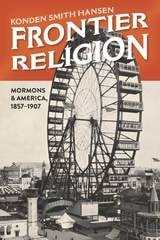
Frontier Religion
Mormons and America, 1857–1907Konden Smith Hansen
University of Utah Press, 2019
In Frontier Religion Konden Smith Hansen examines the dramatic influence these perceptions of the frontier had on Mormonism and other religions in America. Endeavoring to better understand the sway of the frontier on religion in the United States, this book follows several Mormon-American conflicts, from the Utah War and the antipolygamy crusades to the Reed Smoot hearings. The story of Mormonism’s move toward American acceptability represents a larger story of the nation’s transition to modernity and the meaning of religious pluralism. This book challenges old assumptions and provokes further study of the ever changing dialectic between society and faith.

Frontier Swashbuckler
The Life and Legend of John Smith TDick Steward
University of Missouri Press, 2000
Few frontiersmen in the late eighteenth century and early nineteenth century epitomized the reckless energies of the West and the lust for adventure as did John Smith T—pioneer, gunfighter, entrepreneur, militia colonel, miner, judge, and folk hero. In this fascinating biography, Dick Steward traces the colorful Smith T's life from his early days in Virginia through his young adulthood. He then describes Smith T's remarkable career in the wilds of Missouri and his armed raids to gain land from Indians, Spaniards, and others.
Born into the fifth generation of Virginia gentry, young Smith first made his name on the Tennessee frontier. It was there that he added the "T" to his name to distinguish his land titles and other enterprises from those of the hosts of other John Smiths. By the late 1790s he owned or laid claim to more than a quarter million acres in Tennessee and northern Alabama.
In 1797, Smith T moved to Missouri, then a Spanish territory, and sought to gain control of its lead-mining district by displacing the most powerful American in the region, Moses Austin. He acquired such public positions as judge of the court of common pleas, commissioner of weights and levies, and lieutenant colonel of the militia, which enabled him to mount a spirited assault on Austin's virtual monopoly of the lead mines. Although neither side emerged a winner from that ten-year-old conflict, it was during this period that Smith T's fame as a gunfighter and duelist spread across the West. Known as the most dangerous man in Missouri, he was said to have killed fourteen men in duels.
Smith T was also recognized by many for his good works. He donated land for churches and schools and was generous to the poor and downtrodden. He epitomized the opening of the West, helping to build towns, roads, and canals and organizing trading expeditions.
Even though Smith T was one of the most notorious characters in Missouri history, by the late nineteenth century he had all but disappeared from the annals of western history. Frontier Swashbuckler seeks to rescue both the man and the legend from historical obscurity. At the same time, it provides valuable insights into the economic, political, and social dynamics of early Missouri frontier history.

Frontier Ways
Sketches of Life in the Old WestBy Edward Everett Dale
University of Texas Press, 1959
Edward Everett Dale gives a first-hand account of the way pioneer families and cowboys of the frontier lived. Dr. Dale has lived in a sod house, and he once rode the range as cook to a group of cowboys. In this book he draws on his varied experiences to describe all aspects of frontier life—the building of a home, the problems of finding wood and water, the procuring and cooking of food, medical practices, and the cultural, social, and religious life of pioneer families.
This edition is a digital facsimile of the 1959 edition.
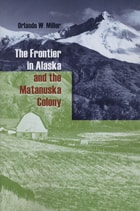
Frontier in Alaska and the Matanuska Colony
Orlando W. Miller
University of Alaska Press, 2008
During the Great Depression, Franklin D. Roosevelt gave more than two hundred families from some of the poorest areas in Minnesota, Wisconsin, and Michigan the opportunity to start their farms anew in the undeveloped land of Matanuska in Alaska. These transplanted midwesterners soon found themselves in a startling new climate and landscape that presented many unexpected challenges. Available for the first time in paperback, The Frontier in Alaska and the Matanuska Colony examines several case studies of these original families, dispelling many frontier myths and describing the reality of pioneering in Alaska. Despite the many impediments, Orlando W. Miller argues, much of the current agricultural success in Matanuska can be directly credited to the innovative farmers who settled there in the 1930s.
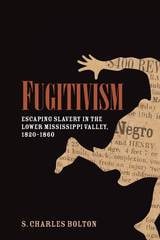
Fugitivism
Escaping Slavery in the Lower Mississippi Valley, 1820-1860S. Charles Bolton
University of Arkansas Press, 2019
Winner, 2020 Booker Worthen Literary Prize
During the antebellum years, over 750,000 enslaved people were taken to the Lower Mississippi Valley, where two-thirds of them were sold in the slave markets of New Orleans, Natchez, and Memphis. Those who ended up in Louisiana found themselves in an environment of swamplands, sugar plantations, French-speaking creoles, and the exotic metropolis of New Orleans. Those sold to planters in the newly-opened Mississippi Delta cleared land and cultivated cotton for owners who had moved west to get rich as quickly as possible, driving this labor force to harsh extremes.
Like enslaved people all over the South, those in the Lower Mississippi Valley left home at night for clandestine parties or religious meetings, sometimes “laying out” nearby for a few days or weeks. Some of them fled to New Orleans and other southern cities where they could find refuge in the subculture of slaves and free blacks living there, and a few attempted to live permanently free in the swamps and forests of the surrounding area. Fugitives also tried to returnto eastern slave states to rejoin families from whom they had been separated. Some sought freedom on the northern side of the Ohio River; othersfled to Mexico for the same purpose.
Fugitivism provides a wealth of new information taken from advertisements, newspaper accounts, and court records. It explains how escapees made use of steamboat transportation, how urban runaways differed from their rural counterparts, how enslaved people were victimized by slave stealers, how conflicts between black fugitives and the white people who tried to capture them encouraged a culture of violence in the South, and how runaway slaves from the Lower Mississippi Valley influenced the abolitionist movement in the North.
Readers will discover that along with an end to oppression, freedom-seeking slaves wanted the same opportunities afforded to most Americans.
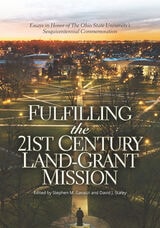
Fulfilling the 21st Century Land-Grant Mission
Essays in Honor of The Ohio State University’s Sesquicentennial CommemorationEdited by Stephen M. Gavazzi and David J. Staley
The Ohio State University Press, 2020
Gathered in honor of The Ohio State University’s sesquicentennial celebration, this collection of essays highlights the significant contributions that Ohio State continues to make as part of its twenty-first-century land-grant mission. Authors from across the university—representing fields as various as agriculture, dance, English, engineering, family science, geography, medicine, social work, and veterinary science—provide contributions that highlight the preeminent status of The Ohio State University. In addition, the perspectives of alumni, staff members, and senior administrators (both present and former) round out the picture of Ohio State as the first among equals regarding its land-grant peers. Overall, contributors draw on rich and varied institutional backgrounds to offer invaluable insights for higher education administrators and scholars across the US.

Fur Trappers Traders Of The Far Southwest
Matthew Despain
Utah State University Press, 1997