Results by title
3576 books match the query 'American' and 75 start with g
Games of Property
Law, Race, Gender, and Faulkner's Go Down, MosesThadious M. Davis
Duke University Press, 2003
Ganbatte
Sarah Kortemeier
University of Wisconsin Press, 2019
Garland in His Own Time
A Biographical Chronicle of His Life, Drawn from Recollections, Interviews, and Memoirs by Family, Friends, and AssociatesKeith Newlin
University of Iowa Press, 2013
Gary Snyder and the Pacific Rim
Creating Countercultural CommunityTimothy Gray
University of Iowa Press, 2006
Gray’s introduction tracks the increased use of “Pacific Rim discourse” by politicians and business leaders following World War II. Ensuing chapters analyze Snyder’s countercultural invocation of this regional idea, concentrating on the poet’s migratory or “creaturely” sensibility, his gift for literary translation, his physical embodiment of trans-Pacific ideals, his role as tribal spokesperson for Haight-Ashbury hippies, and his burgeoning interest in environmental issues. Throughout, Gray’s citations of such writers as Allen Ginsberg, Philip Whalen, and Joanne Kyger shed light on Snyder’s communal role, providing an amazingly intimate portrait of the west coast counterculture. An interdisciplinary project that utilizes models of ecology, sociology, and comparative religion to supplement traditional methods of literary biography, Gary Snyder and the Pacific Rim offers a unique perspective on Snyder’s life and work.
This book will fascinate literary and Asian studies scholars as well as the general reader interested in the Beat movement and multicultural influences on poetry.
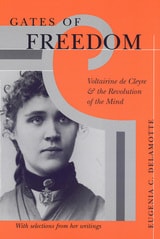
Gates of Freedom
Voltairine de Cleyre and the Revolution of the MindEugenia C. DeLamotte
University of Michigan Press, 2004
---Cary Nelson, University of Illinois
"The question of souls is old; we demand our bodies, now." These words are not from a feminist manifesto of the late twentieth century, but from a fiery speech given a hundred years earlier by Voltairine de Cleyre, a leading anarchist and radical thinker. A contemporary of Emma Goldman---who called her "the most gifted and brilliant anarchist woman America ever produced"---de Cleyre was a significant force in a major social movement that sought to transform American society and culture at its root. But she belongs to a group of late-nineteenth-century freethinkers, anarchists, and sex-radicals whose writing continues to be excluded from the U.S. literary and historical canon.
Gates of Freedom considers de Cleyre's speeches, letters, and essays, including her most well known essay, "Sex Slavery." Part I brings current critical concerns to bear on de Cleyre's writings, exploring her contributions to the anarchist movement, her analyses of justice and violence, and her views on women, sexuality, and the body. Eugenia DeLamotte demonstrates both de Cleyre's literary significance and the importance of her work to feminist theory, women's studies, literary and cultural studies, U.S. history, and contemporary social and cultural analysis. Part II presents a thematically organized selection of de Cleyre's stirring writings, making Gates of Freedom appealing to scholars, students, and anyone interested in Voltairine de Cleyre's fascinating life and rousing work.
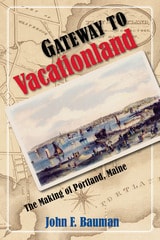
Gateway to Vacationland
The Making of Portland, MaineJohn F. Bauman
University of Massachusetts Press, 2012
Situated on a peninsula jutting into picturesque Casco Bay, Portland has long been admired for its geographical setting—the “beautiful city by the sea,” as native son Henry Wadsworth Longfellow called it. At the same time, Portland's deep, ice-free port has made it an ideal site for the development of coastal commerce and industry. Much of the city's history, John F. Bauman shows, has been defined by the effort to reconcile the competing interests generated by these attributes—to balance the imperatives of economic growth with a desire to preserve Portland's natural beauty.
Caught in the crossfire of British and French imperial ambitions throughout the colonial era, Portland emerged as a prosperous shipbuilding center and locus of trade in the decades following the American Revolution. During the nineteenth century it became a busy railroad hub and winter port for Canadian grain until a devastating fire in 1866 reduced much of the city to ruins. Civic leaders responded by reinventing Portland as a tourist destination, building new hotels, parks, and promenades, and proclaiming it the “Gateway to Vacationland.”
After losing its grain trade in the 1920s and suffering through the Great Depression, Portland withered in the years following World War II as it wrestled with the problems of deindustrialization, suburbanization, and an aging downtown. Efforts at urban renewal met with limited success until the 1980s, when a concerted plan of historic preservation and the restoration of the Old Port not only revived the tourist trade but eventually established Portland as one of America's “most livable cities.”
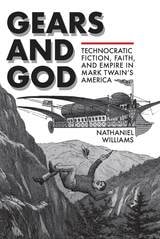
Gears and God
Technocratic Fiction, Faith, and Empire in Mark Twain's AmericaNathaniel Williams
University of Alabama Press, 2018
In Gears and God: Technocratic Fiction, Faith, and Empire in Mark Twain’s America, Nathaniel Williams analyzes the genre of technology-themed exploration novels—dime novel adventure stories featuring steam-powered and electrified robots, airships, and submersibles. This genre proliferated during the same cultural moment when evolutionary science was dismantling Americans’ prevailing, biblically based understanding of human history.
While their heyday occurred in the late 1800s, technocratic adventure novels like Twain’s A Connecticut Yankee in King Arthur’s Court inspired later fiction about science and technology. Similar to the science fiction plotlines of writers like Jules Verne and H. Rider Haggard, and anticipating the adventures of Tom Swift some decades later, these novels feature Americans using technology to visit and seize control of remote locales, a trait that has led many scholars to view them primarily as protoimperialist narratives. Their legacy, however, is more complicated. As they grew in popularity, such works became as concerned with the preservation of a fraught Anglo-Protestant American identity as they were with spreading that identity across the globe.
Many of these novels frequently assert the Bible’s authority as a historical source. Collectively, such stories popularized the notion that technology and travel might essentially “prove” the Bible’s veracity—a message that continues to be deployed in contemporary debates over intelligent design, the teaching of evolution in public schools, and in reality TV shows that seek historical evidence for biblical events. Williams argues that these fictions performed significant cultural work, and he consolidates evidence from the novels themselves, as well as news articles, sermons, and other sources of the era, outlining and mapping the development of technocratic fiction.
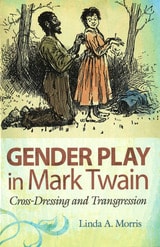
Gender Play in Mark Twain
Cross-Dressing and TransgressionLinda A. Morris
University of Missouri Press, 2007
Huckleberry Finn dressing as a girl is a famously comic scene in Mark Twain’s novel but hardly out of character—for the author, that is. Twain “troubled gender” in much of his otherwise traditional fiction, depicting children whose sexual identities are switched at birth, tomboys, same-sex married couples, and even a male French painter who impersonates his own fictive sister and becomes engaged to another man.
This book explores Mark Twain’s extensive use of cross-dressing across his career by exposing the substantial cast of characters who masqueraded as members of the opposite sex or who otherwise defied gender expectations. Linda Morris grounds her study in an understanding of the era’s theatrical cross-dressing and changing mores and even events in the Clemens household. She examines and interprets Twain’s exploration of characters who transgress gendered conventions while tracing the degree to which themes of gender disruption interact with other themes, such as his critique of race, his concern with death in his classic “boys’ books,” and his career-long preoccupation with twins and twinning.
Approaching familiar texts in surprising new ways, Morris reexamines the relationship between Huck and Jim; discusses racial and gender crossing in Pudd’nhead Wilson; and sheds new light on Twain’s difficulty in depicting the most famous cross-dresser in history, Joan of Arc. She also considers a number of his later “transvestite tales” that feature transgressive figures such as Hellfire Hotchkiss, who is hampered by her “misplaced sex.”
Morris challenges views of Twain that see his work as reinforcing traditional notions of gender along sharply divided lines. She shows that Twain depicts cross-dressing sometimes as comic or absurd, other times as darkly tragic—but that even at his most playful, he contests traditional Victorian notions about the fixity of gender roles.
Analyzing such characteristics of Twain’s fiction as his fascination with details of clothing and the ever-present element of play, Morris shows us his understanding that gender, like race, is a social construction—and above all a performance. Gender Play in Mark Twain: Cross-Dressing and Transgression broadens our understanding of the writer as it lends rich insight into his works.

Gender and the Gothic in the Fiction of Edith Wharton
Kathy A. Fedorko
University of Alabama Press, 1995
Revealing the Gothic foundations of Edith Wharton's vision of gender and identity.
Gender and the Gothic in the Fiction of Edith Wharton is an innovative study that provides fresh insights into Wharton’s male characters while at the same time showing how Wharton’s imagining of a fe/male self evolves throughout her career. Using feminist archetypal theory and theory of the female Gothic, Kathy A. Fedorko shows how Wharton, in sixteen short stories and six major novels written during four distinct periods of her life, adopts and adapts Gothic elements to explore the nature of feminine and masculine ways of knowing and being and to dramatize the tension between them.
Edith Wharton’s contradictory views of women and men—her attitudes toward the feminine and the masculine—reflect a complicated interweaving of family and social environment, historical time, and individual psychology. Studies of Wharton have exhibited this same kind of contradiction, with some seeing her as disparaging men and the masculine and others depicting her as disparaging women and the feminine. The use of Gothic elements in her fiction provided Wharton, who was often considered the consummate realist, with a way to dramatize the conflict between feminine and masculine selves as she experienced them and to evolve an alternative to the dualism.
Fedorko’s work is unique in its careful consideration of Wharton’s sixteen Gothic works, which are seldom discussed. Further, the revelation of how these Gothic stories are reflected in her major realistic novels. In the novels with Gothic texts, Wharton draws multiple parallels between male and female protagonists, indicating the commonalities between women and men and the potential for a female self. Eventually, in her last completed novel and her last short story, Wharton imagines human beings who are comfortable with both gender selves.
Genesis, Structure, and Meaning in Gary Snyder's Mountains and Rivers Without End
Anthony Hunt
University of Nevada Press, 2016
Genre Fission
A New Discourse Practice for Culture StudiesMarleen S. Barr
University of Iowa Press, 2000
Barr expands postmodern assumptions about cultural studies by suggesting that "genre fission" is occurring among discrete literary and cultural "types" of events--mainstream novels, science fiction, historical narratives, film, paintings, and museum displays. For her literary insights, Barr turns her attention to such mainstream authors as Saul Bellow, John Updike, Marge Piercy, and John Barth as well as science fiction writers Ursula Le Guin and Octavia Butler and Hispanic American writers Julia Alvarez, Ana Castillo, and Cristina García, among others.
Barr moves from literary to culture studies by addressing such phenomena from contemporary mass culture as the urban landscapes of New York and Los Angeles, Jackie Kennedy, the Star Trek industry, Lynn Redgrave, Amsterdam's red light district, Lorena Bobbitt, and the Apollo astronauts--to provide only a few of the relevant examples. Thus Genre Fission attains what Barr herself designates (in describing the art of Judy Chicago and Lee Bontecou) as "utopian interweavings of difference," crossing numerous boundaries in order to frame a larger territory for exploration.

Genre Migrations
Rhetorical Borders in Post-9/11 U.S. LiteratureLiliana M. Naydan
University of Iowa Press, 2026
Genre Migrations argues that authors Jhumpa Lahiri, Valeria Luiselli, Ling Ma, Claudia Rankine, and Gary Shteyngart address immigration in both their content and innovative literary form. These authors highlight the relationship between immigrant identities and others, exposing borders—and genres—as porous and malleable constructs. Through their revisionist aesthetics and rhetorical engagements, these writers challenge the logic of globalization and xenophobia and condemn blind adherence to the limiting conventions of genres and life.
Gentefication
Antonio de Jesús López
Four Way Books, 2021
“Gentefication” nuances Latinidad as not just an immigration question, but an academic one. It deals with Latinx death not as the literal passing
of bodies, but as first tied with language. It asks, what are the hauntings of a tongue that is repeatedly told, ‘one must learn English in order to succeed in this country’? What is the psychological trauma deployed not by right-wing bigots, but of white liberal institutions that give scholarships to Latinx students, but nevertheless prop up white supremacy by viewing their payments as charity? How do Latinx students become complicit in this tokenizing? “Gentefication” wrestles with this ‘survivor’s guilt’ of higher education, of feeling as if you’re the only one among your homies that ‘made it.’ And in an American moment dealing with scandals across multiple universities this work is a timely intervention that advocates for first-generation audiences, for readers of color, and for all those vested in the protracted struggle for our fair shot.
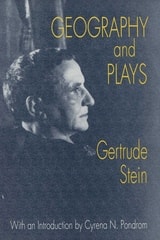
Geography and Plays
Gertrude Stein; Introduction by Cyrena N. Pondrom
University of Wisconsin Press, 1993
Geography of the Forehead
Ron Koertge
University of Arkansas Press, 2000
From short, acerbic lyrics to hilarious prose poems about nutty German professors and Dracula’s teenage girlfriend, readers laugh out loud at simple turns of phrase before they are jerked sober by startling insights into the way we live—and Koertge knows how we live.
Nothing in American culture is safe from the scythe of his irony—not Joan Crawford, not Superman, nor Frank Sinatra. He lampoons our literary heroes and historical giants with the gentlest touch, and we find ourselves grinning before we realize that Koertge is redefining what we thought we knew. His poems are alternately funny or poignantly sad because they are always true, and that truth lingers long after the reading is over.
In Geography of the Forehead, Ron Koertge offers us nearly sixty poems, each a brilliant testament to the human condition. “Though he has been writing his influential and highly original poems for many years,” Charles Harper Webb declares, “he is still something of a secret: a poet of dazzling wit, and surprising sweetness. With this collection, however, the secret is out.”

George Sand
Writing for Her LifeIsabelle Hoog Naginski
Rutgers University Press, 1991

George Sherwood
Wind, Waves, and LightGeorge Sherwood
The Artist Book Foundation, 2024
Intricate and innovative, George Sherwood's kinetic sculptures invite us to observe, experience, contemplate and engage more fully in the natural world around us.
American sculptor George Sherwood, with degrees in both art and engineering, explores aesthetic systems of space and time, as well as the dynamic interplay of objects in motion. Sherwood’s kinetic sculptures invite us to observe, experience, contemplate and engage more fully in the natural world around us. His works are often made of stainless steel, a reflective material that serves to integrate the works into the unique and often transient light of their environments. The choreography of each piece is governed by a set of basic movements, facilitated by an arrangement of aerodynamic surfaces connected by rotational points.
The Artist Book Foundation is pleased to present George Sherwood: Wind, Waves, and Light, the first monograph on this award-winning artist’s lustrous, subtly transformative works. Featuring 100 sculptures from Sherwood’s early whimsical explorations to his monumental commissions that have graced private and public gardens, city sites, and exhibition spaces around the world, readers will witness how changing winds, shades of light, times of day, precipitation, and the seasons’ changing colors alter the sculptures, animate their surroundings, and ignite the imagination.
Georgia O'Keeffe
A LifeRoxana Robinson
Brandeis University Press, 2020
When Roxana Robinson’s definitive biography of O’Keeffe was first published in 1989, it received rave reviews and was named a New York Times Notable Book of the Year. This new edition features a new foreword by the author setting O’Keefe in an artistic context over the last thirty years since the book was first published, as well as previously unpublished letters of the young O’Keeffe to her lover, Arthur MacMahon. It also relates the story of Robinson’s own encounter with the artist. As interest in O’Keeffe continues to grow among museum-goers and scholars alike, this book remains indispensable for understanding her life and art.
Gerry Studds
America's First Openly Gay CongressmanMark Robert Schneider
University of Massachusetts Press, 2017
The defining moment of his career, however, came in 1983, when he was censured by the House for having had an affair with a page ten years previously. On the floor of Congress, Studds confessed to having behaved inappropriately and then courageously declared that he was a gay man—becoming the country's first openly gay member of Congress. Defying all expectations, Studds won reelection in a bruising campaign. For the rest of his career, he remained loyal to his constituents' concerns while also championing AIDS research and care, leading the effort in Congress to allow gays and lesbians to serve in the military, and opposing the Defense of Marriage Act. Once a deeply conflicted man, he ultimately found a balance between his public service and his private life, which included a happy, legally recognized marriage.
Gertrude Stein and the Essence of What Happens
Dana Cairns Watson
Vanderbilt University Press, 2005
Seeking to sustain Stein's lively, pleasant, populist spirit, Watson shows how the writer's playful entanglement of sight and sound--of silent reading and social speaking--reveals the crucial ambiguity by which reading and conversation build communities of meaning, and thus form not only personal relationships but also our very selves and the larger political structures we inhabit. Stein reminds us that the residual properties of words and the implications behind the give-and-take of ordinary conversation offer alternatives to linear structures of social order, alternatives especially precious in times of political oppression. For example, her novels Mrs. Reynolds and Brewsie and Willie, both written in embattled Vichy France, contemplate the speech patterns of totalitarian leaders and the ways in which everyday discourse might capitulate to--or resist--such verbal tyranny.
Like recent theorists, Stein recognized the repressiveness of conventional order--carried in language and thus in thought and social organization--but as Watson persuasively shows, she also insisted that the free will of individuals can persist in language and enable change. In the play of literary aesthetics, Stein saw a liberating force.
Gertrude Stein and the Reinvention of Rhetoric
Sharon J. Kirsch
University of Alabama Press, 2014
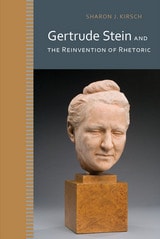
For humanities scholars as well as popular audiences, the relationship between rhetoric and literature remains vexed, in part due to rhetoric’s contemporary affiliation with composition, which makes it separate from, if not subordinate to, the study of literature. Gertrude Stein recognized no such separation, and this disciplinary policing of the study of English has diminished our understanding of her work, Kirsch argues. Stein’s career unfolded at the crossroads of literary composition and rhetorical theory, a site where she alternately challenged, satirized, and reinvented the five classical canons of rhetoric—invention, arrangement, style, memory, and delivery—even as she invented new trajectories of literary experimentation.
Kirsch follows Stein from her days studying composition and philosophy at Harvard through her expatriate years in France, fame in the 1930s, and experience of the Second World War. She frames Stein’s explorations of language as an inventive poetics that reconceived practices and theories of rhetorical invention during a period that saw the rise of literary studies and the decline of rhetorical studies. Through careful readings of canonical and lesser-known works, Kirsch offers a convincing critical portrait of Stein as a Sophistic provocateur who reinvented the canons by making a productive mess of canonical rhetoric and modernist categories of thought.
Readers will find much of interest in Gertrude Stein and the Reinvention of Rhetoric. Kirsch offers myriad insights to scholars of Stein, to those interested in the interdisciplinary intersections of literature, rhetoric, and philosophy, as well as to scholars and students in the field of rhetoric and communication studies. Positioning Stein as a major twentieth-century rhetorical theorist is particularly timely given increasing interest in historical and theoretical resonances between rhetoric and poetics and given the continued lack of recognition for women theorists in rhetorical studies.
Gertrude Stein
The Language That Rises: 1923-1934Ulla E. Dydo
Northwestern University Press, 2008
The first extensive examination of Stein's notebooks, manuscripts and letters, prepared over a period of twenty years, Gertrude Stein: The Language That Rises asks new questions and explores new ways of reading Stein. This definitive study give us a finely detailed, deeply felt understanding of Stein, the great modernist, throughout one of her most productive periods. From "An Elucidation" in 1923 to Lectures In America in 1934, Ulla E. Dydo examines the process of the making and remaking of Stein's texts as they move from notepad to notebook to manuscript, from an idea to the ultimate refinement of the author's intentions. The result is an unprecedented view of the development of Stein's work, word by word, text by text, and over time.
Getting A Life
Everyday Uses of AutobiographySidonie Smith
University of Minnesota Press, 1996
Getting at the Author
Reimagining Books and Reading in the Age of American RealismBarbara Hochman
University of Massachusetts Press, 2009
But reading practices were slow to change; many resisted the effort to reconceptualize the relationship among writers, readers, and books. Even the most consistent advocates of "impartial" narration found it difficult to imagine a book without an author or to dissociate the experience of reading from the idea of a reciprocal human transaction.
In analyzing the battle over realism and the gradual shift in conventional reading practices, Hochman draws on a rich array of sources, including popular works, advertisements, and letters. She combines traditional modes of literary inquiry with methods adapted from the new historicism, cultural studies, and book history. By elucidating the realists' ambivalence about their own aesthetic criteria, she shows how a late nineteenth century conflict about reading practices reflected pressing tensions in American culture, and how that conflict shaped criteria of literary value for most of the twentieth century.
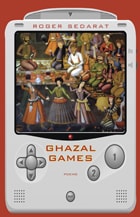
Ghazal Games
PoemsRoger Sedarat
Ohio University Press, 2011
As an Iranian American poet, Roger Sedarat fuses Western and Eastern traditions to reinvent the classicalPersian form of the ghazal. For its humor as well as its spirituality, the poems in this collection can perhapsbest be described as “Wallace Stevens meets Rumi.” Perhaps most striking is the poet’s use of the ancient ghazal form in the tradition of the classical masters like Hafez and Rumi to politically challenge the Islamic Republic of Iran’s continual crackdown on protesters. Not since the late Agha Shahid Ali has a poet translated the letter as well as the spirit of this form into English, using musicality and inventive rhyme to extend the reach of the ghazal in a new language and tradition.
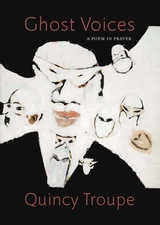
Ghost Voices
A Poem in PrayerQuincy Troupe
Northwestern University Press, 2019
we are crossing, / we are / crossing, / we are crossing in big salt water, // we are crossing, // crossing under a sky of no guilt / we have left home // though we know we will go back / someday, / see our people / as we knew them . . .
Troupe re-creates the history of lost voices between the waters of Africa, Cuba, and the United States. His daring poetics drenched in new forms-notably the seven-elevens-clench transformative narratives spurred on by a relentless, rhythmic language that mimics the foaming waves of the Atlantic Ocean and the Caribbean Sea. His personae speak quantum litanies within one epic, sermonic-gospel to articulate our most ancient ways of storytelling and survival.
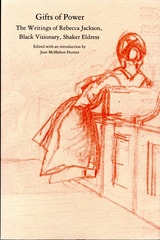
Gifts of Power
The Writings of Rebecca Jackson, Black Visionary, Shaker EldressJean M. Humez
University of Massachusetts Press, 1981
A free black woman in antebellum America, Rebecca Cox Jackson (1795–1871) was an independent itinerant preacher and religious visionary who founded a Shaker community in Philadelphia that survived her death by twenty-five years. Gifts of Power contains her complete extant writings, covering the period 1830 to 1864.

Girl's Guide to Leaving
Laura Villareal
University of Wisconsin Press, 2022

Girls Who Wore Black
Women Writing the Beat GenerationJohnson, Ronna C
Rutgers University Press, 2002
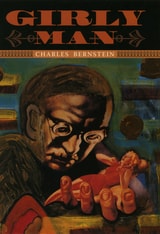
Girly Man
Charles Bernstein
University of Chicago Press, 2006
After 9/11, postmodernism and irony were declared dead. Charles Bernstein here proves them alive and well in poems elegiac, defiant, and resilient to the point of approaching song. Heir to the democratic and poetic sensibilities of Walt Whitman and Allen Ginsberg, Bernstein has always crafted verse that responds to its historical moment, but no previous collection of his poems so specifically addresses the events of its time as Girly Man, whichfeatures works written on the evening of September 11, 2001, and in response to the war in Iraq. Here, Bernstein speaks out, combining self-deprecating humor with incisive philosophical and political thinking.
Composed of works of very different forms and moods—etchings from moments of acute crisis, comic excursions, formal excavations, confrontations with the cultural illogics of contemporary political consciousness—the poems work as an ensemble, each part contributing something necessary to an unrealizable and unrepresentable whole. Indeed, representation—and related claims to truth and moral certainty—is an active concern throughout the book. The poems of Girly Man may be oblique, satiric, or elusive, but their sense is emphatic. Indeed, Bernstein’s poetry performsits ideas so that they can be experienced as well as understood.
A passionate defense of contingency, resistance, and multiplicity, Girly Man is a provocative and aesthetically challenging collection of radical verse from one of America’s most controversial poets.
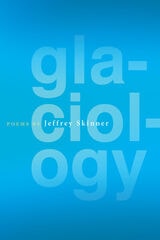
Glaciology
Jeffrey Skinner
Southern Illinois University Press, 2013
At the center of the book, the eighteen-part title poem “Glaciology” takes readers to the core of misunderstandings as it juxtaposes the work of a glaciologist with fractured language, misread cues, and a literalness that defies conventional explanation. The lives of the glaciers are reported with a careful, scientific language that keeps readers emotionally at bay from the effects of their demise, and the speaker comments, “I consider language / mistreated these days, asked to explain itself / to justify at the same time it bears / meaning, to own up / to creation at the moment of use / only, and only that meaning.”
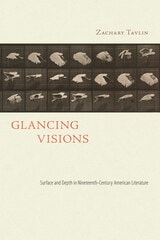
Glancing Visions
Surface and Depth in Nineteenth-Century American LiteratureZachary Tavlin
University of Alabama Press, 2023
How the “glance” rather than the “gaze” in nineteenth-century literature and art anticipates the turn to modernism
The sweeping vantages that typify American landscape painting from the nineteenth century by Thomas Cole and other members of the Hudson River School are often interpreted for their geopolitical connotations, as visual attempts to tame the wild, alleviating fears of a savage frontier through views that subdue the landscape to the eye. But many literary figures of the era display a purposeful disdain for the “possessive gaze,” signaling a preference for subtle glances, often informed by early photography, Impressionism, new techniques in portraiture, and, soon after, the dawn of cinema. The visual subjectivities and contingencies introduced by these media made room for a visual counternarrative, one informed by a mode of seeing that moves fast and lightly across the surface of things.
Tavlin probes Nathaniel Hawthorne’s theory of the imagination at a turning point in the history of photography, when momentary glances take on new narrative potentials. The poetry of Frances Ellen Watkins Harper toggles between gazes and glances, unsettling two competing forms of racialized seeing as they pertain to nineteenth-century Black life and racial hierarchies—the sentimental gaze and the slave trader’s glance—highlighting the life-and-death stakes of looking and looking away. Emily Dickinson’s syntactical oddities and her lifelong process of stitching and unstitching the poems that constitute her corpus all derive from a commitment to immanence associated with animal perception. Tavlin investigates, as well, Henry James’s vexed relationship to painterly Impressionism and William Carlos Williams’s imagist poetics as a response to early cinema’s use of the cut as the basis for a new visual grammar.
Each of these literary artists—via their own distinctive sensibilities and the artistic or technological counterparts that informed them—refuse the authoritative, all-possessive gaze in favor of the glance, a mode of seeing, thinking, and being that made way for the twentieth century’s twist on modernity. Glancing Visions will be of interest to scholars and teachers of American literature and literary history, visual culture, visual theory, aesthetic philosophy, and phenomenology.
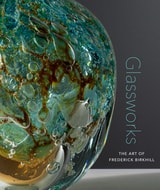
Glassworks
The Art of Frederick BirkhillFrederick Birkhill
The Artist Book Foundation, 2020
Glass as an art form has an ancient tradition; the archaeological record suggests that artisans in Egypt and Mesopotamia were fabricating glass vessels and ornaments during the fourth millennium BCE. Its durable nature, range of colors, malleability, and most of all, its optical transparency are qualities that have made glass a premiere art medium. Over a lifetime, Frederick Birkhill (1951–2023) has explored the unique qualities of glass and the numerous techniques and intricacies of working with it. The result of these decades of study is a body of work that is extraordinary in scope, technical expertise, and sheer virtuosity. The Artist Book Foundation is delighted to present a new monograph honoring this gifted artist: Glassworks: The Art of Frederick Birkhill.
From his time in England at Burleighfield House, the studio of stained-glass artist Patrick Reyntiens, to his unprecedented visit to Lauscha, the village in the former East Germany famous for both its art and scientific glass production, and his subsequent career as an explorer, teacher, and master of the glass arts, Birkhill has devoted himself to furthering the appreciation of the medium and sharing his vast experience with colleagues, collectors, and students.
Complementing the scholarly contributions by authors with significant backgrounds in the glass arts, the book features in its extensive plate section the lavish photography of Henry Leutwyler, which offers readers an opportunity to examine the complex details and artistic mastery of Birkhill's oeuvre. In addition, the monograph offers a glossary of glass-art terms, a detailed chronology of the artist's life, his extensive exhibition history, and a list of the numerous awards he has received. For those who are passionate about the glass arts, this monograph is a feast for the eyes.
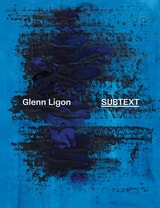
Glenn Ligon
SubtextEdited by Molly Donovan
University of Chicago Press, 0
A stunning survey of work by Glenn Ligon, an artist known for explorations of cultural literacy and Blackness.
Throughout his practice, artist Glenn Ligon has explored the power of language to visualize and materialize the Black experience in America. Accompanying a major touring exhibition, Glenn Ligon: Subtext highlights the artist’s consistent attention to literary and artistic production.
Ligon’s works cite a variety of texts, from a historical civil rights protest sign and dream books to writings by James Baldwin, Toni Morrison, and other literary giants. His citations invite viewers to consider the subtexts underlying complex discourses around representation and cultural literacy. This volume traces how Ligon layers his sources into a wide range of media, including monumental paintings, prints and drawings, and neon sculptures. The book also examines Ligon’s own curatorial practice, itself another way he cites artistic influences.
Alongside the presentation of new works, this book considers Ligon’s multidisciplinary practice through contributions from acclaimed scholars and artists, including Molly Donovan, Jennie C. Jones, Julie Mehretu, and Ligon himself. With stunning gatefolds and illustrations spanning nearly forty years of Ligon’s career, this book offers an expansive view of a leading American artistic voice, underscoring Ligon’s recurring focus on language and texts, and specifically on the crucial role played by Black and queer voices.

Global Trade and Visual Arts in Federal New England
Patricia Johnston
University of New Hampshire Press, 2014
This book will appeal to a broad audience of historians and students of American visual art, as well as scholars and students of fine and decorative arts.
Hardcover is un-jacketed.
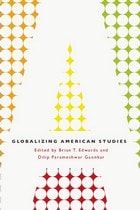
Globalizing American Studies
Edited by Brian T. Edwards and Dilip Parameshwar Gaonkar
University of Chicago Press, 2010
The discipline of American studies was established in the early days of World War II and drew on the myth of American exceptionalism. Now that the so-called American Century has come to an end, what would a truly globalized version of American studies look like? Brian T. Edwards and Dilip Parameshwar Gaonkar offer a new standard for the field’s transnational aspiration with Globalizing American Studies.
The essays here offer a comparative, multilingual, or multisited approach to ideas and representations of America. The contributors explore unexpected perspectives on the international circulation of American culture: the traffic of American movies within the British Empire, the reception of the film Gone with the Wind in the Arab world, the parallels between Japanese and American styles of nativism, and new incarnations of American studies itself in the Middle East and South Asia. The essays elicit a forgotten multilateralism long inherent in American history and provide vivid accounts of post–Revolutionary science communities, late-nineteenth century Mexican border crossings, African American internationalism, Cold War womanhood in the United States and Soviet Russia, and the neo-Orientalism of the new obsession with Iran, among others.
Bringing together established scholars already associated with the global turn in American studies with contributors who specialize in African studies, East Asian studies, Latin American studies, media studies, anthropology, and other areas, Globalizing American Studies is an original response to an important disciplinary shift in academia.
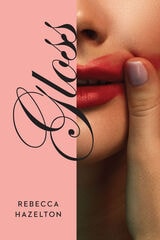
Gloss
Rebecca Hazelton
University of Wisconsin Press, 2019
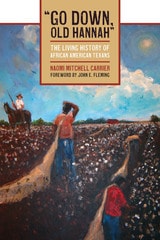
Go Down, Old Hannah
The Living History of African American TexansBy Naomi Mitchell Carrier
University of Texas Press, 2010
Living history is a style of instructive and entertaining performance that seeks to bring history to life with the use of costumes, tools, and reenactments appropriate to a specific time period. Done well, living history performances illuminate human experience in powerful, unforgettable ways.
The fifteen living history plays in this collection were commissioned by museums and historic sites in Texas to show the interdependence of African American experiences and contributions to the living history of Texas. The plays cover subject matter ranging from slave celebrations, family breakups, and running away, to the Civil War, emancipation, and Reconstruction. Each play is research based and performed by Talking Back Living History Theatre as a festival production. These scripts are easily performed, and author Naomi Mitchell Carrier has included production notes in the overviews that precede each play. Lesson plans are also included, which add to the collection's appeal as a classroom tool.
Carrier's talent for bringing historical figures to life is exceptional. The names of most primary characters in these plays are real. By giving them faces, feelings, intelligence, and dignity, Carrier aims to give them new life.
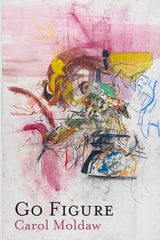
Go Figure
Carol Moldaw
Four Way Books, 2024
In Go Figure, Carol Moldaw demonstrates an incandescent mastery of figuration in its many forms. As the title suggests, these poems invite readers to draw their own conclusions. Observing, inquiring, and delving, Moldaw brings the intertwined strands of life and art to light at their most intimate. A wife-muse who interrogates the role, a mother hard-pressed by motherhood, a daughter whose own mother’s decline causes her to probe their connection, and an artist with an exacting eye and ear who contemplates the creative mysteries, Moldaw is driven to understand and articulate the self in all its manifestations. Like a skater cutting first lines in ice, Moldaw displays lyric immediacy and lyric expanse in her poems with an unswerving command. Complex and inviting, with deft wit, the poems engage public and private life and voice a necessary and resounding affirmation of the feminine and of language emerging through silence.
Goatfoot Milktongue Twinbird
Interviews, Essays, and Notes on Poetry, 1970-76Donald Hall
University of Michigan Press, 1978

God In The Street
New York Writing from The Penny Press to MelvilleHans Bergmann
Temple University Press, 1995
In the fast changing culture of antebellum New York, writers of every stripe celebrated "the City" as a stage for the daily urban encounter between the familiar and the inexplicable. Probing into these richly varied texts, Hans Bergmann uncovers the innovations in writing that accompanied the new market society— the penny newspapers' grandiose boastings, the poetic catalogues of Walt Whitman, the sentimental realism of charity workers, the sensationalism of slum visitors, and the complex urban encounters of Herman Melville's fiction.
The period in which New York, the city itself, became firmly established as a subject invented a literary form that attempts to capture the variety of the teeming city and the flaneur, the walking observer. But Bergmann does not simply lead a parade of images and themes; he explores the ways in which these observers understood what was happening around them and to them, always attentive to class struggle and race and gender issues.
God in the Street shows how the penny press and Whitman's New York poetry create a new mass culture hero who interprets and dignifies the city's confusions. New York writers, both serious and sensationalist, meditate upon street encounters with tricksters and confidence-men and explore the meanings of encounters. Melville's "Bartleby, the Scrinever" underlines the unrelenting isolation and inability to control the interpreter. Bergmann reinterprets Melville's The Confidence Man as an example of how a complex literary form arises directly from its own historical materials and is itself socially symbolic. Bergmann sees Melville as special because he recognizes his inability to make sense of the surface of chaotic images and encounters. In mid-century New York City, Melville believes God is in the street, unavailable and unrecognizable, rather than omnipresent and guiding.
God's Scrivener
The Madness and Meaning of Jones VeryClark Davis
University of Chicago Press, 2023
In September of 1838, a few months after Ralph Waldo Emerson delivered his controversial Divinity School address, a twenty-five-year-old tutor and divinity student at Harvard named Jones Very stood before his beginning Greek class and proclaimed himself “the second coming.” Over the next twenty months, despite a brief confinement in a mental hospital, he would write more than three hundred sonnets, many of them in the voice of a prophet such as John the Baptist or even of Christ himself—all, he was quick to claim, dictated to him by the Holy Spirit.
Befriended by the major figures of the Transcendentalist movement, Very strove to convert, among others, Elizabeth and Sophia Peabody, Bronson Alcott, Nathaniel Hawthorne, and most significantly, Emerson himself. Though shocking to some, his message was simple: by renouncing the individual will, anyone can become a “son of God” and thereby usher in a millennialist heaven on earth. Clark Davis’s masterful biography shows how Very came to embody both the full radicalism of Emersonian ideals and the trap of isolation and emptiness that lay in wait for those who sought complete transcendence.
God’s Scrivener tells the story of Very’s life, work, and influence in depth, recovering the startling story of a forgotten American prophet, a “brave saint” whose life and work are central to the development of poetry and spirituality in America.
Going Underground
Race, Space, and the Subterranean in the Nineteenth-Century United StatesLara Langer Cohen
Duke University Press, 2023

Going Wild
Hunting, Animal Rights, and the Contested Meaning of NatureJan E. Dizard
University of Massachusetts Press, 1999
A probing study of the way diverse conceptions of nature shape our responses to specific environmental issues, this book examines the recent clash over a proposed deer hunt on the largest public watershed in Massachusetts, the Quabbin reservoir. In analyzing this public dispute, Jan E. Dizard draws on a wide range of sources, including interviews with resource managers, animal rights advocates, hunters, and environmentalists. He shows how each faction, while sharing some common ground with the others, projects different meanings onto nature.
Gold Bee
Bruce Bond
Southern Illinois University Press, 2016
Blending humor and pathos, Bond examines the absurdities of contemporary life: “The modern air so full of phantom wires, / hard to tell the connected from the confused / who yak out loud to their beleaguered angels.” At other times, his intricately crafted lyrics weave together myth and history to explore the various roles music and art play in the human experience, as when Bond’s poems meditate on Orphean themes, descending to the underworld of loneliness, commercialism, or death and emerging with hard (and hard-won) truths.
Addressing broadly ranging topics—from a retelling of the story of Artephius, the fabled father of alchemy, to a meditation on a fashion ad’s wind machine—Bond’s voice is always penetrating in its examination, yet wondering in the face of beauty, conjuring for the reader a world where music has “the power / to move stones, not far, but far enough.”
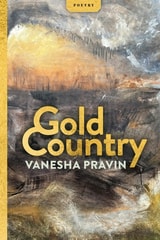
Gold Country
Vanesha Pravin
The Ohio State University Press, 2026
In Gold Country, Vanesha Pravin crafts indelible vignettes of labor, race, and contemporary existence that together offer a panoramic view of today’s United States. Through each life that she conveys line by startling line, she traces the disparity between aspiration and reality when it comes to the American dream: an undocumented worker waits on a celebrity, a government contractor compromises his integrity to secure the future of his children, a career waiter is haunted by the contrast between his inner life and reality, and an orderly steals credit cards for a fix. Wistful and weary, her protagonists wrestle with thwarted dreams and personal shame, but in stitching together a patchwork from their lives, Pravin asks us all to confront the wider realities of deprivation, greed, and their insidious influence on how we function as a society. Gold Country offers a gorgeously nuanced portrait of working life in a supposedly democratic country, airing hard truths about labor, complicity, and the rifts between us.
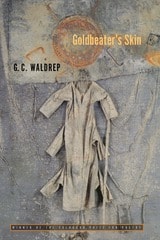
Goldbeater's Skin
G. C. Waldrep
University Press of Colorado, 2003
Published by the Center for Literary Publishing at Colorado State University
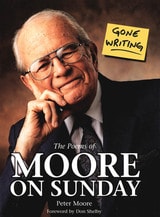
Gone Writing
The Poems of Moore on SundayPeter Moore
University of Minnesota Press, 1999
Humorous poetry from the television program hosted by a beloved Minnesota news anchor.
In the 1950s, Dave Moore, a young actor born and raised in Minneapolis, accepted a newscaster position with the local CBS affiliate, WCCO-TV-a job Walter Cronkite turned down. For the next three decades, until his death in 1998, he delivered the evening news with integrity, conviction, humor, and flair, making him a fixture in Minnesota living rooms.
At the end of his weekly news-in-review program, Moore on Sunday (or, as he liked to call it, “Moron Sunday”), Moore often signed off by reciting a poem. These poems, composed by Moore’s son Peter and collected here for the first time, offer a fresh and funny take on the common and not-so-common stuff of our everyday lives. Reminiscent of Ogden Nash and Tom Lehrer, with a dash of Dr. Seuss, Peter Moore’s verse captures the essence of his father’s wit, common sense, honesty, and warmth.

Good Bones
Maggie Smith
Tupelo Press, 2017
Good Bones is a collection of modern poetry that speaks to the world we live in. Maggie Smith contemplates the past and our future, life and death, childhood and motherhood. She writes out of the experience of motherhood, inspired by watching her own children read the world like a book they’ve just opened, knowing nothing of the characters or plot. Smith takes in the dark world around her with a critical eye, always searching for the hidden goodness: compassion, empathy, honesty. “There is a light,” she tells us, “and the light is good.” Smith skillfully reveals the layers of the world around us through lyric language and vivid imagery: “For every bird there is a stone thrown at a bird. / For every loved child, a child broken, bagged, / sunk in a lake.” These poems stare down darkness while cultivating and sustaining possibility and addressing a larger world. We come away from this collection hopeful about making the world a better place, a place to share with future generations. As Smith tells us in Good Bones, “This place could be beautiful, right? You could make this place beautiful.”
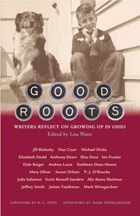
Good Roots
Writers Reflect on Growing Up in OhioLisa Watts
Ohio University Press, 2007
Winner of the Ohioana Library’s 2008 Ohio Legacy Citation
2014-2015 Choose to Read Ohio selection
“A good place to be from.” That’s how some people might characterize the Buckeye State. The writings in Good Roots: Writers Reflect on Growing Up in Ohio, are testimony to the truth of that statement. By prominent writers such as P. J. O’Rourke, Susan Orlean, and Alix Kates Shulman, these contributions are alternately nostalgic, irreverent, and sincere, and offer us a personal sense of place. Their childhoods are as varied as their work. Some were raised in urban Cleveland, Akron, and Cincinnati, others in the small Ohio towns that typify the Midwest, and still others in the countryside. Yet what they have to tell us about their roots resonates with a shared heritage, a sense of what is universal and enduring about growing up in the heartland.
Their collective résumé reads like a literary Who’s Who, including four Pulitzer Prizes, several National Book Awards, and many prestigious fellowships. Good Roots is also plain good reading from some of our country’s most accomplished contemporary writers.
Contributors include: Jill Bialosky, Dan Cryer, Michael Dirda, Elizabeth Dodd, Anthony Doerr, Rita Dove, Ian Frazier, Dale Keiger, Andrea Louie, Kathleen Dean Moore, Mary Oliver, Susan Orlean, P. J. O’Rourke, Julie Salamon, Scott Russell Sanders, Alix Kates Shulman, Jeffery Smith, James Toedtman, and Mark Winegardner.