Results by title
67 books match the query 'Austria' and 2 start with g
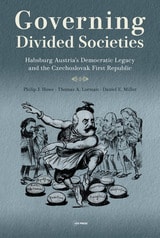
Governing Divided Societies
Habsburg Austria’s Democratic Legacy and the Czechoslovak First RepublicPhilip Howe
Central European University Press, 2026
The authors of this volume challenge conventional notions about Habsburg and Czechoslovak politics, arguing that they were more democratic than they often appear. They use the consociational model of democracy as a means of combining political science and history. The theory, associated with Arend Lijphart, asserts that consociationalism guarantees minorities a say in government and helps preserve democracy in societies that experience deep ideological, cultural, or ethnic divisions. Consociationalism enables the main segments to be isolated organizationally from each other, thus avoiding conflict but affording the leaders opportunities to make compromises for the good of the whole.
Consociationalism has proven its worth as a model for describing contemporary democracies and diagnosing their ills. By exploring the institutions and practices of the Habsburg Monarchy before 1918 and the Czechoslovak First Republic, Howe, Lorman, and Miller prove the value of the consociational theory in analyzing the past. They hold that a multitude of parties, frequent cabinet changes, and reliance on cabinets of experts do not necessarily signal flawed democracies. In fact, they are features of consociationalism. This volume challenges historians and social scientists to view the Austrian half of the Habsburg Monarchy before 1918 as evolving toward consociational democracy and the Czechoslovak First Republic as a fully consociational state.
Consociationalism has proven its worth as a model for describing contemporary democracies and diagnosing their ills. By exploring the institutions and practices of the Habsburg Monarchy before 1918 and the Czechoslovak First Republic, Howe, Lorman, and Miller prove the value of the consociational theory in analyzing the past. They hold that a multitude of parties, frequent cabinet changes, and reliance on cabinets of experts do not necessarily signal flawed democracies. In fact, they are features of consociationalism. This volume challenges historians and social scientists to view the Austrian half of the Habsburg Monarchy before 1918 as evolving toward consociational democracy and the Czechoslovak First Republic as a fully consociational state.
[more]
Gustav Mahler--Richard Strauss
Correspondence 1888-1911Gustav Mahler and Richard Strauss
University of Chicago Press, 1984
Gustav Mahler and Richard Strauss came to know one another as young conductors in Leipzig in 1887. From then until Mahler's death in 1911—the year of the first performance of Der Rosenkavalier—they kept in touch. Mahler himself described their relationship as that of two miners tunneling from opposite directions with the hope of eventually meeting.
This first publication of their correspondence, which includes twenty-five previously unknown Strauss letters, offers a portrait of two men who were as antithetical in their musical means and goals as in their temperaments and personalities, but who exercised a strong fascination for one another. These sixty-three letters show both composers advancing in their careers as they battled against adverse conditions in the musical world at the turn of the century. They present Mahler's energetic support of Strauss's Symphonia Domestica, which Mahler conducted in 1904 and, in turn, Strauss's championing of Mahler's music, especially the Second and Third Symphonies.
The correspondence is fully annotated and is supplemented with a major essay by Herta Blaukopf.
"Unfailingly absorbing. . . . An indispensable addition to the literature on these composers."—Norman Del Mar, Times Literary Supplement
[more]