Results by title
975 books match the query 'Case studies' and 19 start with g
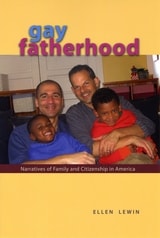
Gay Fatherhood
Narratives of Family and Citizenship in AmericaEllen Lewin
University of Chicago Press, 2009
Men are often thought to have less interest in parenting than women, and gay men are generally assumed to prefer pleasure over responsibility. The toxic combination of these two stereotypical views has led to a lack of serious attention being paid to the experiences of gay fathers. But the truth is that more and more gay men are setting out to become parents and succeeding—and Gay Fatherhood aims to tell their stories.
Ellen Lewin takes as her focus people who undertake the difficult process of becoming fathers as gay men, rather than having become fathers while married to women. These men face unique challenges in their quest for fatherhood, negotiating specific bureaucratic and financial conditions as they pursue adoption or surrogacy and juggling questions about their future child’s race, age, sex, and health. Gay Fatherhood chronicles the lives of these men, exploring how they cope with political attacks from both the "family values" right and the "radical queer" left—while also shedding light on the evolving meanings of family in twenty-first-century America.

Gendered Tradeoffs
Women, Family, and Workplace Inequality in Twenty-One CountriesBecky Pettit
Russell Sage Foundation, 2009

Get Yo' Life
Black Queer PlacemakingR. J. Millhouse
The Ohio State University Press, 2025
Getting a Job
A Study of Contacts and CareersMark Granovetter
University of Chicago Press, 1995
This second edition is updated with a new Afterword and includes Granovetter's influential article "Economic Action and Social Structure: The Problems of Embeddedness."
"Who would imagine that a book with such a prosaic title as 'getting a job' could pose such provocative questions about social structure and even social policy? In a remarkably ingenious and deceptively simple analysis of data gathered from a carefully designed sample of professional, technical, and managerial employees . . . Granovetter manages to raise a number of critical issues for the economic theory of labor markets as well as for theories of social structure by exploiting the emerging 'social network' perspective."—Edward O. Laumann, American Journal of Sociology
"This short volume has much to offer readers of many disciplines. . . . Granovetter demonstrates ingenuity in his design and collection of data."—Jacob Siegel, Monthly Labor Review
"A fascinating exploration, for Granovetter's principal interest lies in utilizing sociological theory and method to ascertain the nature of the linkages through which labor market information is transmitted by 'friends and relatives.'"—Herbert Parnes, Industrial and Labor Relations Review
Ghosts of Organizations Past
Communities of Organizations as Settings for ChangeDan Ryan
Temple University Press, 2015
Ryan draws on concepts from the study of organizations, social capital, and social networks to re-think questions such as “What kind of thing is a community?” and “Why is it so difficult to build community initiatives out of organizations?” He provides a social organizational explanation for problems familiar to anyone who has been involved in community programs, issues that are usually understood as personal incompetence, turf wars, greed, or corruption.
Ghosts of Organizations Past describes the challenges of using organizations to create change in places in dire need of it.
Giants Among Us
First-Generation College Graduates Who Lead Activist LivesSandria Rodriguez
Vanderbilt University Press, 2001
The daughter of parents who didn't finish elementary school, Rodriguez uses many examples from her own life in the course of examining the participants' experiences before, during, and after college that directed them toward social or educational activism. Together, the seventeen represent a wide range of diversity in terms of race, ethnicity, age, geographical area of childhood, and profession. Twelve of the seventeen hold advanced degrees, all are working professionals, and all come from families who were poor. Jerry, the son of German immigrants, owns an engineering company in Chicago; Chang, a native of China, is the first from his village to go to college; Grant, a sharecropper's son, is a lawyer with a nationally prominent law firm in Washington, D.C., and patron of fine arts; Arlene, a Mohawk Indian, is a storyteller and social activist; Alex, from Spanish Harlem, is an elementary school principal.
The book is divided into four parts. In the first two chapters, we meet the participants. In the three chapters that follow, Rodriguez examines how the participants as children perceived themselves within their families, schools, and communities. Chapters four and five focus on the campus life and the participants' activist experiences. Finally, chapter six offers recommendations for mentoring disadvantaged children, so that they can successfully "switch the track" and aim for something better.
Giants Among Us is an essential resource for college administrators, faculty, counselors, and student support-services staff--as well as K-12 educators--concerned with preparing, retaining and mentoring first-generation students.
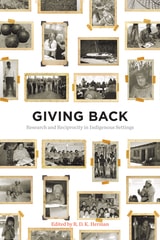
Giving Back
Research and Reciprocity in Indigenous SettingsR. D. K. Herman
Oregon State University Press, 2018
Over the past several decades—and especially since the evolution of feminist methodologies, participatory research, and the post-colonial turn in the 1990s—there have been calls for research to be less exploitative, but also for researchers and for the research itself to give something back. Giving Back: Research and Reciprocity in Indigenous Settings addresses the need for reciprocity in the research process, especially (though not exclusively) in regard to Indigenous Communities.
The twelve case studies in this volume demonstrate that giving back can happen through the research itself – through the careful framing of questions, co-production of knowledge, and dissemination of results – but also through the day-to-day actions and attitudes of researchers that inevitably occur in the field. It can range from everyday give and take, to the sharing of research materials, to larger and longer-term engagements.
As practitioners of community-based research gain greater awareness of these issues, scholars and institutions need guidance and strategies for ensuring reciprocity in the research process. This volume presents a variety of situations from a wide range of research contexts, discussing what has and hasn’t worked, and exploring what issues remain.
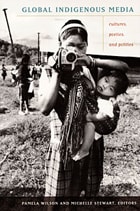
Global Indigenous Media
Cultures, Poetics, and PoliticsPamela Wilson and Michelle Stewart, eds.
Duke University Press, 2008
Global Indigenous Media addresses Indigenous self-representation across many media forms, including feature film, documentary, animation, video art, television and radio, the Internet, digital archiving, and journalism. The volume’s sixteen essays reflect the dynamism of Indigenous media-making around the world. One contributor examines animated films for children produced by Indigenous-owned companies in the United States and Canada. Another explains how Indigenous media producers in Burma (Myanmar) work with NGOs and outsiders against the country’s brutal regime. Still another considers how the Ticuna Indians of Brazil are positioning themselves in relation to the international community as they collaborate in creating a CD-ROM about Ticuna knowledge and rituals. In the volume’s closing essay, Faye Ginsburg points out some of the problematic assumptions about globalization, media, and culture underlying the term “digital age” and claims that the age has arrived. Together the essays reveal the crucial role of Indigenous media in contemporary media at every level: local, regional, national, and international.
Contributors: Lisa Brooten, Kathleen Buddle, Cache Collective, Michael Christie, Amalia Córdova,
Galina Diatchkova, Priscila Faulhaber, Louis Forline, Jennifer Gauthier, Faye Ginsburg, Alexandra Halkin, Joanna Hearne, Ruth McElroy, Mario A. Murillo, Sari Pietikäinen, Juan Francisco Salazar,
Laurel Smith, Michelle Stewart, Pamela Wilson

Globalization and Nationalism
The Cases of Georgia and the Basque CountryNatalie Sabanadze
Central European University Press, 2010
This book argues for an original, unorthodox conception about the relationship between globalization and contemporary nationalism. While the prevailing view holds that nationalism and globalization are forces of clashing opposition, Sabanadze establishes that these tend to become allied forces. It acknowledges that nationalism does react against the rising globalization and represents a form of resistance against globalizing influences, but the Basque and Georgian cases prove that globalization and nationalism can be complementary rather than contradictory tendencies.
Nationalists have often served as promoters of globalization, seeking out globalizing influences and engaging with global actors out of their very nationalist interests. In the case of both Georgia and the Basque Country, there is little evidence suggesting the existence of strong, politically organized nationalist opposition to globalization.
Globalization and Nationalism discusses why, on a broader scale, different forms of nationalism develop differing attitudes towards globalization and engage in different relationships.

God Knows His Name
The True Story of John Doe No. 24David Bakke. Foreword by Mary Chapin Carpenter
Southern Illinois University Press, 2000
Police found John Doe No. 24 in the early morning hours of October 11, 1945, in Jacksonville, Illinois. Unable to communicate, the deaf and mute teenager was labeled “feeble minded” and sentenced by a judge to the nightmarish jumble of the Lincoln State School and Colony in Jacksonville. He remained in the Illinois mental health care system for over thirty years and died at the Sharon Oaks Nursing Home in Peoria on November 28, 1993.
Deaf, mute, and later blind, the young black man survived institutionalized hell: beatings, hunger, overcrowding, and the dehumanizing treatment that characterized state institutions through the 1950s. In spite of his environment, he made friends, took on responsibilities, and developed a sense of humor. People who knew him found him remarkable.
Award-winning journalist Dave Bakke reconstructs the life of John Doe No. 24 through research into a half-century of the state mental health system, personal interviews with people who knew him at various points during his life, and sixteen black-and-white illustrations. After reading a story about John Doe in the New York Times, acclaimed singer-songwriter Mary Chapin Carpenter wrote and recorded “John Doe No. 24” and purchased a headstone for his unmarked grave. She contributes a foreword to this book.
As death approached for the man known only as John Doe No. 24, his one-time nurse Donna Romine reflected sadly on his mystery. “Ah, well,” she said, “God knows his name.”

God's Choice
The Total World of a Fundamentalist Christian SchoolAlan Peshkin
University of Chicago Press, 1988
In God's Choice, Alan Peshkin offers readers the opportunity to consider this question in depth. Given the outsider's rare chance to observe such a school firsthand, Peshkin spent eighteen months studying Bethany's high school—interviewing students, parents, and educators, living in the home of Bethany Baptist Church members, and participating fully in the church's activities. From this intimate research he has fashioned a rich account of Christian schooling and an informed analysis of a clear alternative to public education.

God's Schools
Wagner, Melinda Bollar
Rutgers University Press, 1990
Many of us assume that Christian day schools foster a strict and conservative environment that is very different from the rest of the United States. Christian educators themselves foster this view when they say that following biblical strictures requires that they not always conform to this world. Melinda Wagner goes beyond this stereotype to portray the way these schools foster American popular culture and "professional education culture" as well as "Christian culture." In her participant observation study of a variety of Christian schools (sponsored by fundamentalist, evangelical, new charismatic, Holiness, and Pentecostal Christians), Wagner describes and interprets how such compromises are made.
In American culture, children are taught to meet challenges, to compete, and are rewarded for individual achievement. Conservative Christians label this individualism as "secular humanism," and find it antithetical to their view of the self. Instead, these Christians seek a culture of love, compassion, orderliness, non-competitiveness, and separation from the material trappings of this world.
But in reality, Wager finds that the schools mix Christian values with the values of American culture. She discovers that even in Christian schools students compete fiercely and are recognized for individual achievements. Christian schools incorporate norms and strategies from mainstream American education. Alternative Christian schools are not as alternative as they could be; they are walking the Christian walk the American way.
The Christian schools serve as a case study of the process of culture building. Conservative Christians are trying to revitalize their culture. Yet all along the way, they quite consciously compromise.

God's Schools
Choice and Compromise in American SocietyWagner, Melinda Bollar
Rutgers University Press, 1990
Many of us assume that Christian day schools foster a strict and conservative environment that is very different from the rest of the United States. Christian educators themselves foster this view when they say that following biblical strictures requires that they not always conform to this world. Melinda Wagner goes beyond this stereotype to portray the way these schools foster American popular culture and "professional education culture" as well as "Christian culture." In her participant observation study of a variety of Christian schools (sponsored by fundamentalist, evangelical, new charismatic, Holiness, and Pentecostal Christians), Wagner describes and interprets how such compromises are made.
In American culture, children are taught to meet challenges, to compete, and are rewarded for individual achievement. Conservative Christians label this individualism as "secular humanism," and find it antithetical to their view of the self. Instead, these Christians seek a culture of love, compassion, orderliness, non-competitiveness, and separation from the material trappings of this world.
But in reality, Wager finds that the schools mix Christian values with the values of American culture. She discovers that even in Christian schools students compete fiercely and are recognized for individual achievements. Christian schools incorporate norms and strategies from mainstream American education. Alternative Christian schools are not as alternative as they could be; they are walking the Christian walk the American way.
The Christian schools serve as a case study of the process of culture building. Conservative Christians are trying to revitalize their culture. Yet all along the way, they quite consciously compromise.

Godly Women
Fundamentalism and Female PowerBrasher, Brenda E
Rutgers University Press, 1997
Going Home
Black Representatives and Their ConstituentsRichard F. Fenno
University of Chicago Press, 2003
Fenno follows the careers of four black representatives—Louis Stokes, Barbara Jordan, Chaka Fattah, and Stephanie Tubbs Jones—from their home districts to the halls of the Capitol. He finds that while these politicians had different visions of how they should represent their districts (in part based on their individual preferences, and in part based on the history of black politics in America), they shared crucial organizational and symbolic connections to their constituents. These connections, which draw on a sense of "linked fates," are ones that only black representatives can provide to black constituents.
His detailed portraits and incisive analyses will be important for anyone interested in the workings of Congress or in black politics.
Going Virtual
Programs and Insights from a Time of CrisisSarah Ostman
American Library Association, 2021
- COVID-19 Misinformation Challenge, featuring an email quiz, to encourage participants to separate fact from fiction;
- weekly virtual storytimes;
- community cooking demonstrations via Zoom;
- an online grocery store tour, complete with tips about shopping healthy on a budget;
- a virtual beer tasting that boasted 80 attendees;
- socially distanced "creativity crates" for summer reading;
- an online Minecraft club for kids ages 6 and up;
- a Zoom presentation about grieving and funerals during COVID, featuring the director of a local funeral home;
- Art Talk Tuesday, a one-hour, docent-led program;
- a virtual lecture on the history of witchcraft, presented by a public library in partnership with a university rare book room, that drew thousands of viewers;
- "knitting for knewbies" kits for curbside pickup;
- Songs from the Stacks, an ongoing virtual concert series in the style of NPR’s “Tiny Desk”;
- a pink supermoon viewing party that included people howling at the moon together from their homes on Facebook Live;
- and many others

Grant Park
The Evolution of Chicago's Front YardDennis H. Cremin
Southern Illinois University Press, 2013
2014 Illinois State Historical Society Book of the Year
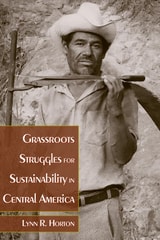
Grassroots Struggles for Sustainability in Central America
Lynn R. Horton
University Press of Colorado, 2007
With a comparative, empirical approach, Horton also analyzes dominant practices linked to sustainable development - neoliberal reforms, project interventions, and environmental protection. She reveals how these practices support or undermine economic, cultural, and political opportunities for the rural and indigenous poor and impact these communities' advancement of their own visions of sustainability. Finally, the author explores processes of empowerment that enable communities to articulate and put into practice local visions of sustainability, which contribute toward broader social and structural transformations.
Grassroots Struggles for Sustainability in Central America will interest sociologists, anthropologists, and others who study the theory and practice of sustainable development.

Greed, Rage, and Love Gone Wrong
Murder in MinnesotaBruce Rubenstein
University of Minnesota Press, 2006