Results by title
319 books match the query 'Communication Studies' and 6 start with g

Geoengineering, Persuasion, and the Climate Crisis
A Geologic RhetoricEhren Helmut Pflugfelder
University of Alabama Press, 2023
A rhetorical exploration of an underexamined side of climate change—the ongoing research into and development of geoengineering strategies
Geoengineering, Persuasion, and the Climate Crisis: A Geologic Rhetoric exposes the deeply worrying state of discourse over geoengineering—the intentional manipulation of the earth’s climate as means to halt or reverse global warming. These climate-altering projects, which range from cloud-whitening to carbon dioxide removal and from stratospheric aerosol injection to enhanced weathering, are all technological solutions to more complex geosocial problems.
Geoengineering represents one of the most alarming forms of deliberative discourse in the twenty-first century. Yet geoengineering could easily generate as much harm as the environmental traumas it seeks to cure. Complicating these deliberations is the scarcity of public discussion. Most deliberations transpire within policy groups, behind the closed doors of climate-oriented startups, between subject-matter experts at scientific conferences, or in the disciplinary jargon of research journals. Further, much of this conversation occurs primarily in the West.
Ehren Helmut Pflugfelder makes clear how the deliberative rhetorical strategies coming from geoengineering advocates have been largely deceptive, hegemonic, deterministic, and exploitative. In this volume, he investigates how geoengineering proponents marshal geologic actors into their arguments—and how current discourse could lead to a greater exploitation of the earth in the future.
Pflugfelder’s goal is to understand the structure, content, purpose, and effect of these discourses, raise the alarm about their deliberative directions, and help us rethink our approach to the climate. In highlighting both the inherent problems of the discourses and the ways geologic rhetoric can be made productive, he attempts to give “the geologic” a place at the table to better understand the roles that all earth systems continue to play in our lives, now and for years to come.
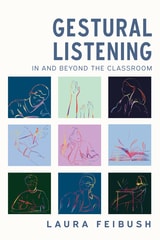
Gestural Listening In and Beyond the Classroom
Laura Feibush
Utah State University Press, 2026
Attuned to the subtle choreographies of the classroom, Gestural Listening In and Beyond the Classroom investigates how students and instructors show that they are listening to each other—and, sometimes, that they are not. While rhetorical scholarship traditionally focuses on speaking and writing, listening can also be understood as a rhetorical force that makes things happen. Listening has the power to move, bring about, cause, and catalyze. This conductive aspect of listening is its embodied manifestation—termed “gestural listening.”
Laura Feibush first traces the roots of embodied listening through cultural and rhetorical history and then uses findings from a classroom study to inform an insightful discussion of respect, resistance, and self-regulation as the key dynamics that characterize listening in contemporary educational spaces. She reveals how the gestures of listening refract across identity categories in ways that have surprising effects on how classroom participants respond to one another. This accessibly written book attends to hands and faces, nodding and note-taking, and the presence of phones and laptops, as well as other forms of nonverbal backchanneling, such as where people sit, when they interrupt, and when they engage in impactful quietness.
The power of gestural listening is not limited to the classroom. Its quiet yet profound influence can elucidate many sites of interaction: in-person and virtual academic settings as well as those far beyond the educational space, such as scenes of protest, worship, and performance. Gestural Listening In and Beyond the Classroom shows how, when understood as possessing its own repertoire of impressive and expressive capacities, listening emerges as a fascinating site of study and offers exercises, activities, and other materials to help educators, counselors, and all those engaging in communicative work enact a new awareness of gestural listening as a rhetorical force.
Gilbert Austin's "Chironomia" Revisited
Sympathy, Science, and the Representation of MovementSara Newman and Sigrid Streit
Southern Illinois University Press, 2020
Austin did not simply categorize gesture mechanically, separating delivery from rhetoric and the discipline’s overall goals, but instead he provided a theoretical framework of written descriptions and illustrations that positions delivery as central to effective rhetoric and civic interactions. Balancing the variable physical elements of human interactions as well as the demands of communication, Austin’s system fortuitously anticipated contemporary inquiries into embodied and nonverbal communication. Enlightenment rhetoricians, scientists, and physicians relied on sympathy and its attendant vivacious and lively ideas to convey feelings and facts to their varied audiences. During the seventeenth and eighteenth-centuries, as these disciplines formed increasingly distinct, specialized boundaries, they repurposed existing, shared communication conventions to new ends. While the emerging standards necessarily diverged, each was grounded in the subjective, embodied bedrock of the sympathetic, magical tradition.

Graphic News
How Sensational Images Transformed Nineteenth-Century JournalismAmanda Frisken
University of Illinois Press, 2020

Grassroots Activisms
Public Rhetorics in Localized ContextsEdited by Lisa L. Phillips, Sarah Warren-Riley, and Julie Collins Bates
The Ohio State University Press, 2024
What is the nature of grassroots activism? How and why do individuals get involved or attempt to make change for themselves, others, or their own communities? What motivates activists to maintain momentum when their efforts to redress injustices or paths toward change seem difficult or personally risky to navigate? These questions and more are addressed in Grassroots Activisms: Public Rhetorics in Localized Contexts. Featuring a diverse array of both local activist profiles and original scholarly essays, the collection amplifies and analyzes the tactics of grassroots activists working locally to intervene in a variety of social injustices—from copwatching and policy reform to Indigenous resistance against land colonization to #RageAgainstRape.
Attuned to the demanding—and often underappreciated—work of grassroots activism, this book interrogates how such efforts unfold within and against existing historical, cultural, social, and political realities of local communities; are informed by the potentials and constraints of coalition-building; and ultimately shape different facets of society at the local level. This collection acknowledges and celebrates the complexity of grassroots activist work, showing how these less-recognized efforts often effect change where institutions have failed.

Green Communication and China
On Crisis, Care, and Global FuturesJingfang Liu
Michigan State University Press, 2020