Results by title
438 books match the query 'Hispanic & Latino' and 12 start with g
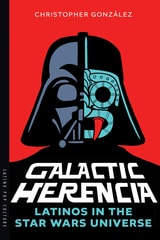
Galactic Herencia
Latinos in the Star Wars UniverseChristopher González
University of Arizona Press, 2027
In 1977, George Lucas created a galaxy far, far away that somehow contained no Latinos. Forty-seven years later, Diego Luna’s Cassian Andor speaks unapologetically accented English as he leads a rebel cell against the Empire, Pedro Pascal’s Din Djarin anchors Disney’s flagship series, and Oscar Isaac’s Poe Dameron commands X-wing squadrons with a confidence that refuses to apologize for difference. The transformation didn’t happen by accident—it was fought for character by character, film by film, against resistance both corporate and cultural.
In Galactic Herencia, Christopher González uses personal, historical, and critical reflection to trace this long arc from erasure to visibility, examining how Latinx actors bring cultural resonance to roles in a fictional universe that never explicitly acknowledges their heritage—and what it means when so few performers must carry the hopes of so many. The book moves from the painful absences of the original trilogy through the breakthrough moments of Rogue One and The Mandalorian, to the current struggles over authentic representation in an era of franchise expansion and toxic fandom. By centering Latinx perspectives on a globally dominant franchise, Galactic Herencia makes visible the cultural work that representation does—demonstrating that genuine inclusion isn’t about quotas but about empowering stories that affirm our full humanity.
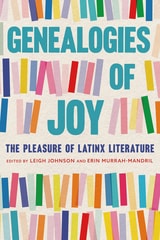
Genealogies of Joy
The Pleasure of Latinx LiteratureEdited by Leigh Johnson and Erin Murrah-Mandril; Foreword by Melina Vizcaíno-Alemán
University of Arizona Press, 2027
What does it mean to center joy in a world that insists on Latinx suffering? Genealogies of Joy: The Pleasure of Latinx Literature argues that joy is not a luxury or distraction but a radical, sustaining force woven through Latinx literature and culture. From humor and food to protest, friendship, sexuality, and aging, the essays gathered here reveal joy as an embodied, communal practice—one that refuses racialized shame and imagines liberatory futures.
Organized into three sections—Memory, Method, and Maps—the volume traces a genealogy of joy across time and space. Contributors explore how writers such as Gloria Anzaldúa, Julia de Burgos, Erika Sánchez, Javier Zamora, Myriam Gurba, Aidan Thomas, and Sandra Cisneros transform grief into resilience, invert dominant narratives, and reclaim pleasure as political praxis. Whether through irreverent laughter, queer desire, culinary memory, or vulnerable resistance, Latinx authors insist that pleasure and politics are bound together.
Engaging affect theory, Black joy scholarship, borderlands studies, and archival studies, this collection asserts that Latinx joy resists the quantification and commodification of late-stage capitalism. At once rigorous and celebratory, Genealogies of Joy invites readers to recognize joy as a human right and a vital source of connection, creativity, and collective flourishing.
Contributors
Soffía Blystra
Norma Cantú
Margaret Cantú-Sánchez
Karina Diaz
Stephanie Fetta
Elena Foulis
Eva Maria Geicht
Leigh Johnson
Mark J. Mascia
Regina Marie Mills
Erin Murrah-Mandril
Jeannine Ortega
Nancy Ríos
Rey M. Rodríguez
Rosarito Rodríguez-González
Alexandra Rodríguez Sabogal
Karen Roybal
Bianca S. Rubalcava
Suzanne Uzzilia
Natalia Villanueva-Nieves
Melina Vizcaíno-Alemán
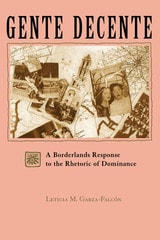
Gente Decente
A Borderlands Response to the Rhetoric of DominanceBy Leticia Magda Garza-Falcón
University of Texas Press, 1998
In his books The Great Plains, The Great Frontier, and The Texas Rangers, historian Walter Prescott Webb created an enduring image of fearless, white, Anglo male settlers and lawmen bringing civilization to an American Southwest plagued with "savage" Indians and Mexicans. So popular was Webb's vision that it influenced generations of historians and artists in all media and effectively silenced the counter-narratives that Mexican American writers and historians were concurrently producing to claim their standing as "gente decente," people of worth.
These counter-narratives form the subject of Leticia M. Garza-Falcón's study. She explores how prominent writers of Mexican descent-such as Jovita González, Américo Paredes, María Cristina Mena, Fermina Guerra, Beatriz de la Garza, and Helena María Viramontes -have used literature to respond to the dominative history of the United States, which offered retrospective justification for expansionist policies in the Southwest and South Texas. Garza-Falcón shows how these counter-narratives capture a body of knowledge and experience excluded from "official" histories, whose "facts" often emerged more from literary techniques than from objective analysis of historical data.
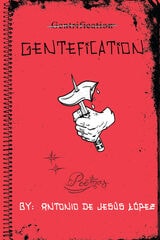
Gentefication
Antonio de Jesús López
Four Way Books, 2021
“Gentefication” nuances Latinidad as not just an immigration question, but an academic one. It deals with Latinx death not as the literal passing
of bodies, but as first tied with language. It asks, what are the hauntings of a tongue that is repeatedly told, ‘one must learn English in order to succeed in this country’? What is the psychological trauma deployed not by right-wing bigots, but of white liberal institutions that give scholarships to Latinx students, but nevertheless prop up white supremacy by viewing their payments as charity? How do Latinx students become complicit in this tokenizing? “Gentefication” wrestles with this ‘survivor’s guilt’ of higher education, of feeling as if you’re the only one among your homies that ‘made it.’ And in an American moment dealing with scandals across multiple universities this work is a timely intervention that advocates for first-generation audiences, for readers of color, and for all those vested in the protracted struggle for our fair shot.
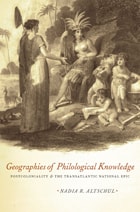
Geographies of Philological Knowledge
Postcoloniality and the Transatlantic National EpicNadia R. Altschul
University of Chicago Press, 2012
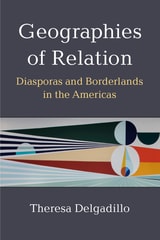
Geographies of Relation
Diasporas and Borderlands in the AmericasTheresa Delgadillo
University of Michigan Press, 2024
Not only does Delgadillo offer a rare extended analysis of Black Latinidades in Chicanx literature and theory, but she also considers over a century’s worth of literary, cinematic, and performative texts to support her argument about the significance of these cultural sites and overlaps. Chapters illuminate the significance of Toña La Negra in the Golden Age of Mexican cinema, reconsider feminist theorist Gloria Anzaldúa’s work in revising exclusionary Latin American ideologies of mestizaje, delve into the racial and gender frameworks Sandra Cisneros attempts to rewrite, unpack encounters between African Americans and Black Puerto Ricans in texts by James Baldwin and Marta Moreno Vega, explore the African diaspora in colonial and contemporary Peru through Daniel Alarcón’s literature and the documentary Soy Andina, and revisit the centrality of Black power in ending colonialism in Cuban narratives. Geographies of Relation demonstrates the long histories of networks and exchanges across the Americas as well as the interrelationships among Indigenous, Black, African American, mestizx, Chicanx, and Latinx peoples. It offers a compelling argument that geographies of relation are as significant as national frameworks in structuring cultural formation and change in this hemisphere.
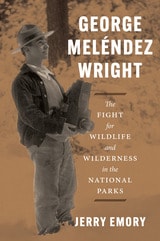
George Meléndez Wright
The Fight for Wildlife and Wilderness in the National ParksJerry Emory
University of Chicago Press, 2023
When twenty-three-year-old George Meléndez Wright arrived in Yosemite National Park in 1927 to work as a ranger naturalist—the first Hispanic person to occupy any professional position in the National Park Service (NPS)—he had already visited every national park in the western United States, including McKinley (now Denali) in Alaska. Two years later, he would organize the first science-based wildlife survey of the western parks, forever changing how the NPS would manage wildlife and natural resources. At a time when national parks routinely fed bears garbage as part of “shows” and killed “bad” predators like wolves, mountain lions, and coyotes, Wright’s new ideas for conservation set the stage for the modern scientific management of parks and other public lands.
Tragically, Wright died in a 1936 car accident while working to establish parks and wildlife refuges on the US-Mexico border. To this day, he remains a celebrated figure among conservationists, wildlife experts, and park managers. In this book, Jerry Emory, a conservationist and writer connected to Wright’s family, draws on hundreds of letters, field notes, archival research, interviews, and more to offer both a biography of Wright and a historical account of a crucial period in the evolution of US parks and the wilderness movement. With a foreword by former NPS director Jonathan B. Jarvis, George Meléndez Wright is a celebration of Wright’s unique upbringing, dynamism, and enduring vision that places him at last in the pantheon of the great American conservationists.
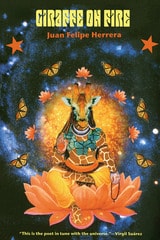
Giraffe on Fire
Juan Felipe Herrera
University of Arizona Press, 2001
A poetic collage of voices, genres, and time-spaces. A display of power over language and rhythm. A postmodern performance of naked figures hanging in the nebulae of a militarized universe. A new millennium cubist manifesto against decrepit political machines. A mystic song in search of birth and love. In this new collection of poems, Juan Felipe Herrera's natural talent for capturing the raw dimensions of reality merges with his wild imagination and technical prowess.
Things, names, places, histories, herstories, desires, wills, minds, and their effects and progeny are re-mixed, re-mastered, and re-cast into a new narrative theater. Characters in a constant and stubborn rush, appearance, disappearance, and flow—with, against, and for each other—create the fire and give birth to the hallucinatory spotted and leaf-eating, long-necked child. Exciting and original, cutting-edge and risk-taking, Giraffe on Fire is a breathtaking addition to a respected body of work by a poet not afraid to speak out about how poetry reflects the raw beauty and truth of life.
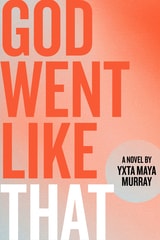
God Went Like That
A NovelYxta Maya Murray
Northwestern University Press, 2023
In award-winning legal scholar and novelist Yxta Maya Murray’s new novel, federal agent Reyna Rodriguez reports on a real-life nuclear reactor meltdown and accidents that occurred in 1959, 1964, and 1968 at the Santa Susana Field Laboratory. An infamous research and development complex in California’s Simi Valley, the lab was eventually dismantled by the US government—but not before it created a toxic legacy of contamination and numerous cancer clusters. Toxins and nuclear residue may have been further released by the 2018 Woolsey Fire and 2019 floods in the area.
God Went Like That takes the form of an EPA report in which Reyna presents riveting interviews with individuals affected by the disasters. With imagination and artistry, Murray brings to life an actual 2011 Department of Energy dossier that detailed the catastrophes and the ensuing public health fallout and highlights the high costs of governmental malfeasance and environmental racism.
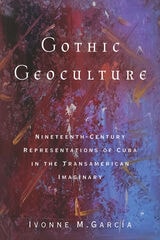
Gothic Geoculture
Nineteenth-Century Representations of Cuba in the Transamerican ImaginaryIvonne M. García
The Ohio State University Press, 2019
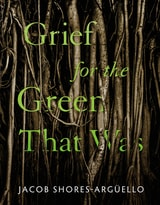
Grief for the Green That Was
Jacob Shores-Argüello
University of Arizona Press, 2026
Moving tenderly across memory, continents, and literary forms, Jacob Shores-Argüello’s tightly woven cross-genre collection evolves a private family bereavement into an exploration of collective ecological grief. Following the death of his mother, the speaker navigates between his Costa Rican heritage and his Oklahoma upbringing, eventually arriving at something like healing on the banks of New Zealand’s Whanganui River—the first river in the world granted legal personhood.
Structured around a Spanish nursery rhyme, Grief for the Green That Was finds solace in the prospect of citizenship for a more-than-human world, a possibility it approaches through perspectival shifts and innovative forms—including footnoted poems, hybrid fiction, and an experimental choose-your-own-adventure sequence—that overturn lyric and storytelling conventions.
A book about what we inherit and what we leave behind, both in families and in landscapes, Grief for the Green That Was examines how climate change affects not just the physical world but also our emotional and spiritual relationships to place. Here Shores-Argüello creates a new language for twenty-first-century grief that refuses to separate the personal from the planetary.
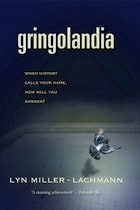
Gringolandia
Lyn Miller-Lachmann
Northwestern University Press, 2009
After papá’s arrest in 1980, Daniel’s family fled to the United States. Now Daniel has a new life, playing guitar in a rock band and dating Courtney, a minister’s daughter. He hopes to become a US citizen as soon as he turns eighteen.
When Daniel’s father is released and rejoins his family, they see what five years of prison and torture have done to him. Marcelo is partially paralyzed, haunted by nightmares, and bitter about being exiled to “Gringolandia.” Daniel worries that Courtney’s scheme to start a bilingual human rights newspaper will rake up papá’s past and drive him further into alcohol abuse and self-destruction. Daniel dreams of a real father-son relationship, but he may have to give up everything simply to save his papá’s life.
This powerful coming-of-age story portrays an immigrant teen’s struggle to reach his tortured father and find his place in the world.