Results by title
5448 books match the query 'History and criticism' and 96 start with g
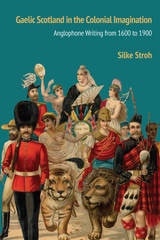
Gaelic Scotland in the Colonial Imagination
Anglophone Writing from 1600 to 1900Silke Stroh
Northwestern University Press, 2017

Gamelan Gong Kebyar
The Art of Twentieth-Century Balinese MusicMichael Tenzer
University of Chicago Press, 2000
Combining the tools of the anthropologist, composer, music theorist, and performer, Tenzer moves fluidly between ethnography and technical discussions of musical composition and structure. In an approach as intricate as one might expect in studies of Western classical music, Tenzer's rigorous application of music theory and analysis to a non-Western orchestral genre is wholly original. Illustrated throughout, the book also includes nearly 100 pages of musical transcription (in Western notation) that correlate with 55 separate tracks compiled on two accompanying compact discs.
The most ambitious work on gamelan since Colin McPhee's classic Music in Bali, this book will interest musicians of all kinds and anyone interested in the art and culture of Southeast Asia, Indonesia, and Bali.
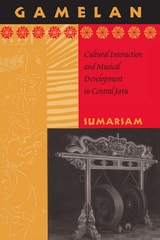
Gamelan
Cultural Interaction and Musical Development in Central JavaSumarsam
University of Chicago Press, 1995
Drawing on sources ranging from a twelfth-century royal poem to the writing of a twentieth-century nationalist, Sumarsam shows how the Indian-inspired contexts and ideology of the Javanese performing arts were first adjusted to the Sufi tradition and later shaped by European performance styles in the eighteenth and nineteenth centuries. He then turns to accounts of gamelan theory and practice from the colonial and postcolonial periods. Finally, he presents his own theory of gamelan, stressing the relationship between purely vocal melodies and classical gamelan composition.
Games In The Global Village
A 50 Nation Study Of Entertainment TelevisionAnne Cooper-Chen
University of Wisconsin Press, 1994
Game shows can run the gamut of many subject areas or focus on one, such as rock music (MTV’s Remote Control) or football (ESPN's NFL Trivia Game). They can spotlight dazzlingly high IQs (the BBC’s erudite Mastermind) or nude assistants and contestants (Germany’s Tutti Frutti). They can limp along in mid-morning time slots or smash the competition in prime time (France’s La Roue de la Fortune).
This is the first comprehensive comparison of TV entertainment content, and it gives new meaning to McLuhan’s concept of the “Global Village.”
Gay and Lesbian Themes in Latin American Writing
By David William Foster
University of Texas Press, 1991
A taboo subject in many cultures, homosexuality has been traditionally repressed in Latin America, both as a way of life and as a subject for literature. Yet numerous writers have attempted to break the cultural silence surrounding homosexuality, using various strategies to overtly or covertly discuss lesbian and gay themes. In this study, David William Foster examines more than two dozen texts that deal with gay and lesbian topics, drawing from them significant insights into the relationship between homosexuality and society in different Latin American countries and time periods.
Foster's study includes works both sympathetic and antagonistic to homosexuality, showing the range of opinion on this topic. The preponderance of his examples come from Argentina, Brazil, and Mexico, countries with historically active gay communities, although he also includes material on other countries. Noteworthy among the authors covered are Reinaldo Arenas, Adolfo Caminha, Isaac Chocrón, José Donoso, Sylvia Molloy, Alejandra Pizarnik, and Luis Zapata.
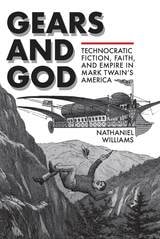
Gears and God
Technocratic Fiction, Faith, and Empire in Mark Twain's AmericaNathaniel Williams
University of Alabama Press, 2018
In Gears and God: Technocratic Fiction, Faith, and Empire in Mark Twain’s America, Nathaniel Williams analyzes the genre of technology-themed exploration novels—dime novel adventure stories featuring steam-powered and electrified robots, airships, and submersibles. This genre proliferated during the same cultural moment when evolutionary science was dismantling Americans’ prevailing, biblically based understanding of human history.
While their heyday occurred in the late 1800s, technocratic adventure novels like Twain’s A Connecticut Yankee in King Arthur’s Court inspired later fiction about science and technology. Similar to the science fiction plotlines of writers like Jules Verne and H. Rider Haggard, and anticipating the adventures of Tom Swift some decades later, these novels feature Americans using technology to visit and seize control of remote locales, a trait that has led many scholars to view them primarily as protoimperialist narratives. Their legacy, however, is more complicated. As they grew in popularity, such works became as concerned with the preservation of a fraught Anglo-Protestant American identity as they were with spreading that identity across the globe.
Many of these novels frequently assert the Bible’s authority as a historical source. Collectively, such stories popularized the notion that technology and travel might essentially “prove” the Bible’s veracity—a message that continues to be deployed in contemporary debates over intelligent design, the teaching of evolution in public schools, and in reality TV shows that seek historical evidence for biblical events. Williams argues that these fictions performed significant cultural work, and he consolidates evidence from the novels themselves, as well as news articles, sermons, and other sources of the era, outlining and mapping the development of technocratic fiction.
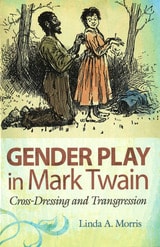
Gender Play in Mark Twain
Cross-Dressing and TransgressionLinda A. Morris
University of Missouri Press, 2007
Huckleberry Finn dressing as a girl is a famously comic scene in Mark Twain’s novel but hardly out of character—for the author, that is. Twain “troubled gender” in much of his otherwise traditional fiction, depicting children whose sexual identities are switched at birth, tomboys, same-sex married couples, and even a male French painter who impersonates his own fictive sister and becomes engaged to another man.
This book explores Mark Twain’s extensive use of cross-dressing across his career by exposing the substantial cast of characters who masqueraded as members of the opposite sex or who otherwise defied gender expectations. Linda Morris grounds her study in an understanding of the era’s theatrical cross-dressing and changing mores and even events in the Clemens household. She examines and interprets Twain’s exploration of characters who transgress gendered conventions while tracing the degree to which themes of gender disruption interact with other themes, such as his critique of race, his concern with death in his classic “boys’ books,” and his career-long preoccupation with twins and twinning.
Approaching familiar texts in surprising new ways, Morris reexamines the relationship between Huck and Jim; discusses racial and gender crossing in Pudd’nhead Wilson; and sheds new light on Twain’s difficulty in depicting the most famous cross-dresser in history, Joan of Arc. She also considers a number of his later “transvestite tales” that feature transgressive figures such as Hellfire Hotchkiss, who is hampered by her “misplaced sex.”
Morris challenges views of Twain that see his work as reinforcing traditional notions of gender along sharply divided lines. She shows that Twain depicts cross-dressing sometimes as comic or absurd, other times as darkly tragic—but that even at his most playful, he contests traditional Victorian notions about the fixity of gender roles.
Analyzing such characteristics of Twain’s fiction as his fascination with details of clothing and the ever-present element of play, Morris shows us his understanding that gender, like race, is a social construction—and above all a performance. Gender Play in Mark Twain: Cross-Dressing and Transgression broadens our understanding of the writer as it lends rich insight into his works.

Gender Politics And MTV
Voicing the DifferenceLisa Lewis
Temple University Press, 1991
Gender Politics in Modern China
Writing and FeminismTani E. Barlow, ed.
Duke University Press, 1993
Ranging from interviews with contemporary writers, to historical accounts of gendered writing in Taiwan and semi-colonial China, to close feminist readings of individual authors, these essays confront the degree to which textual stategies construct notions of gender. Among the specific themes discussed are: how femininity is produced in texts by allocating women to domestic space; the extent to which textual production lies at the base of a changing, historically specific code of the feminine; the extent to which women in modern Chinese societies are products of literary canons; the ways in which the historical processes of gendering have operated in Chinese modernity vis à vis modernity in the West; the representation of feminists as avengers and as westernized women; and the meager recognition of feminism as a serious intellectual current and a large body of theory.
Originally published as a special issue of Modern Chinese Literature (Spring & Fall 1988), this expanded book represents some of the most compelling new work in post-Mao feminist scholarship and will appeal to all those concerned with understanding a revitalized feminism in the Chinese context.
Contributors. Carolyn Brown, Ching-kiu Stephen Chan, Sung-sheng Yvonne Chang, Yu-shih Chen, Rey Chow, Randy Kaplan, Richard King, Wolfgang Kubin, Wendy Larson, Lydia Liu, Seung-Yeun Daisy Ng, Jon Solomon, Meng Yue, Wang Zheng
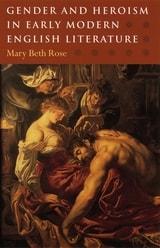
Gender and Heroism in Early Modern English Literature
Mary Beth Rose
University of Chicago Press, 2001
Interweaving discourses of gender, Rose explores ways in which this heroics of endurance became the dominant model. She examines the glamorous, failed destinies of heroes in plays by Shakespeare, Jonson, and Marlowe; Elizabeth I's creation of a heroic identity in her public speeches; the autobiographies of four ordinary women thrust into the public sphere by civil war; and the seduction of heroes into slavery in works by Milton, Aphra Behn, and Mary Astell. Ultimately, her study demonstrates the importance of the female in the creation of modern heroism, while offering a critique of both idealized action and suffering.
Gender and Nation in the Spanish Modernist Novel
Roberta Johnson
Vanderbilt University Press, 2003
The book begins by tracing the history of public discourse on gender from the 1890s through the 1930s, a discourse that included the rise of feminism. Each chapter then analyzes works by female and male novelists that address key issues related to gender and nationalism: the concept of intrahistoria, or an essential Spanish soul; modernist uses of figures from the Spanish literary tradition, notably Don Quixote and Don Juan; biological theories of gender prevalent in the 1920s and 1930s; and the growth of an organized feminist movement that coincided with the burgeoning Republican movement.
This is the first book dealing with this period of Spanish literature to consider women novelists, such as Maria Martinez Sierra, Carmen de Burgos, and Concha Espina, alongside canonical male novelists, including Miguel de Unamuno, Ramon del Valle-Inclan, and Pio Baroja. With its contrasting conceptions of modernism, Johnson's work provides a compelling new model for bridging the gender divide in the study of Spanish fiction.
Gender and National Literature
Heian Texts in the Constructions of Japanese ModernityTomiko Yoda
Duke University Press, 2004
Moving back and forth between a critique of modern discourses on Heian literature and close analyses of the Heian texts themselves, Yoda sheds light on some of the most persistent interpretive models underwriting Japanese literary studies, particularly the modern paradigm of a masculine national subject. She proposes new directions for disciplinary critique and suggests that historicized understandings of premodern texts offer significant insights into contemporary feminist theories of subjectivity and agency.
Gender and Rhetorical Space in American Life, 1866-1910
Nan Johnson
Southern Illinois University Press, 2002
Nan Johnson demonstrates that after the Civil War, nonacademic or “parlor” traditions of rhetorical performance helped to sustain the icon of the white middle class woman as queen of her domestic sphere by promoting a code of rhetorical behavior for women that required the performance of conventional femininity. Through a lucid examination of the boundaries of that gendered rhetorical space—and the debate about who should occupy that space—Johnson explores the codes governing and challenging the American woman’s proper rhetorical sphere in the postbellum years.
While men were learning to preach, practice law, and set political policies, women were reading elocution manuals, letter-writing handbooks, and other conduct literature. These texts reinforced the conservative message that women’s words mattered, but mattered mostly in the home. Postbellum pedagogical materials were designed to educate Americans in rhetorical skills, but they also persistently directed the American woman to the domestic sphere as her proper rhetorical space. Even though these materials appeared to urge the white middle class women to become effective speakers and writers, convention dictated that a woman’s place was at the hearthside where her rhetorical talents were to be used in counseling and instructing as a mother and wife.
Aided by twenty-one illustrations, Johnson has meticulously compiled materials from historical texts no longer readily available to the general public and, in so doing, has illuminated this intersection of rhetoric and feminism in the nineteenth century. The rhetorical pedagogies designed for a postbellum popular audience represent the cultural sites where a rethinking of women’s roles becomes open controversy about how to value their words. Johnson argues this era of uneasiness about shifting gender roles and the icon of the “quiet woman” must be considered as evidence of the need for a more complete revaluing of women’s space in historical discourse.

Gender and the Gothic in the Fiction of Edith Wharton
Kathy A. Fedorko
University of Alabama Press, 1995
Revealing the Gothic foundations of Edith Wharton's vision of gender and identity.
Gender and the Gothic in the Fiction of Edith Wharton is an innovative study that provides fresh insights into Wharton’s male characters while at the same time showing how Wharton’s imagining of a fe/male self evolves throughout her career. Using feminist archetypal theory and theory of the female Gothic, Kathy A. Fedorko shows how Wharton, in sixteen short stories and six major novels written during four distinct periods of her life, adopts and adapts Gothic elements to explore the nature of feminine and masculine ways of knowing and being and to dramatize the tension between them.
Edith Wharton’s contradictory views of women and men—her attitudes toward the feminine and the masculine—reflect a complicated interweaving of family and social environment, historical time, and individual psychology. Studies of Wharton have exhibited this same kind of contradiction, with some seeing her as disparaging men and the masculine and others depicting her as disparaging women and the feminine. The use of Gothic elements in her fiction provided Wharton, who was often considered the consummate realist, with a way to dramatize the conflict between feminine and masculine selves as she experienced them and to evolve an alternative to the dualism.
Fedorko’s work is unique in its careful consideration of Wharton’s sixteen Gothic works, which are seldom discussed. Further, the revelation of how these Gothic stories are reflected in her major realistic novels. In the novels with Gothic texts, Wharton draws multiple parallels between male and female protagonists, indicating the commonalities between women and men and the potential for a female self. Eventually, in her last completed novel and her last short story, Wharton imagines human beings who are comfortable with both gender selves.
Gender and the Musical Canon
Marcia J. Citron
University of Illinois Press, 2000
A classic in gender studies in music
Marcia J. Citron's comprehensive, balanced work lays a broad foundation for the study of women composers and their music. Drawing on a diverse body of feminist and interdisciplinary theory, Citron shows how the western art canon is not intellectually pure but the result of a complex mixture of attitudes, practices, and interests that often go unacknowledged and unchallenged.
Winner of the Pauline Alderman Prize from the International Alliance of Women in Music, Gender and the Musical Canon explores important elements of canon formation, such as notions of creativity, professionalism, and reception. Citron surveys the institutions of power, from performing organizations and the academy to critics and the publishing and recording industries, that affect what goes into the canon and what is kept out. She also documents the nurturing role played by women, including mothers, in cultivating female composers. In a new introduction, she assesses the book's reception by composers and critics, especially the reactions to her controversial reading of Cécile Chaminade's sonata for piano.
A key volume in establishing how the concepts and assumptions that form the western art music canon affect female composers and their music, Gender and the Musical Canon also reveals how these dynamics underpin many of the major issues that affect musicology as a discipline.

Gendering Bodies/Performing Art
Dance and Literature in Early Twentieth-Century British CultureAmy Koritz
University of Michigan Press, 1995
Generation X Rocks
Contemporary Peninsular Fiction, Film, and Rock CultureChristine Henseler
Vanderbilt University Press, 2007
Genesis in Late Antique Poetry
Andrew Faulkner
Catholic University of America Press, 2022
Genre Fission
A New Discourse Practice for Culture StudiesMarleen S. Barr
University of Iowa Press, 2000
Barr expands postmodern assumptions about cultural studies by suggesting that "genre fission" is occurring among discrete literary and cultural "types" of events--mainstream novels, science fiction, historical narratives, film, paintings, and museum displays. For her literary insights, Barr turns her attention to such mainstream authors as Saul Bellow, John Updike, Marge Piercy, and John Barth as well as science fiction writers Ursula Le Guin and Octavia Butler and Hispanic American writers Julia Alvarez, Ana Castillo, and Cristina García, among others.
Barr moves from literary to culture studies by addressing such phenomena from contemporary mass culture as the urban landscapes of New York and Los Angeles, Jackie Kennedy, the Star Trek industry, Lynn Redgrave, Amsterdam's red light district, Lorena Bobbitt, and the Apollo astronauts--to provide only a few of the relevant examples. Thus Genre Fission attains what Barr herself designates (in describing the art of Judy Chicago and Lee Bontecou) as "utopian interweavings of difference," crossing numerous boundaries in order to frame a larger territory for exploration.

Genre Migrations
Rhetorical Borders in Post-9/11 U.S. LiteratureLiliana M. Naydan
University of Iowa Press, 2026
Genre Migrations argues that authors Jhumpa Lahiri, Valeria Luiselli, Ling Ma, Claudia Rankine, and Gary Shteyngart address immigration in both their content and innovative literary form. These authors highlight the relationship between immigrant identities and others, exposing borders—and genres—as porous and malleable constructs. Through their revisionist aesthetics and rhetorical engagements, these writers challenge the logic of globalization and xenophobia and condemn blind adherence to the limiting conventions of genres and life.

Genre in Popular Music
Fabian Holt
University of Chicago Press, 2007
The popularity of the motion picture soundtrack O Brother, Where Art Thou? brought an extraordinary amount of attention to bluegrass, but it also drew its share of criticism from some aficionados who felt the album’s inclusion of more modern tracks misrepresented the genre. This soundtrack, these purists argued, wasn’t bluegrass, but “roots music,” a new and, indeed, more overarching category concocted by journalists and marketers. Why is it that popular music genres like these and others are so passionately contested? And how is it that these genres emerge, coalesce, change, and die out?
In Genre in Popular Music, Fabian Holt provides new understanding as to why we debate music categories, and why those terms are unstable and always shifting. To tackle the full complexity of genres in popular music, Holt embarks on a wide-ranging and ambitious collection of case studies. Here he examines not only the different reactions to O Brother, but also the impact of rock and roll’s explosion in the 1950s and 1960s on country music and jazz, and how the jazz and indie music scenes in Chicago have intermingled to expand the borders of their respective genres. Throughout, Holt finds that genres are an integral part of musical culture—fundamental both to musical practice and experience and to the social organization of musical life.
Genre of Autobiography in Victorian Literature
Clinton Machann
University of Michigan Press, 1995
Genre, Race, and the Production of Subjectivity in German Romanticism
Stephanie Galasso
Northwestern University Press, 2024
Late Enlightenment philosophers and writers like Herder, Goethe, and Schiller broke with conventions of form and genre to prioritize an idealized, and racially coded, universality. Newly translated literatures from colonial contexts served as the basis for their evaluations of how to contribute to a distinctly “German” national literary tradition, one that valorized modernity and freedom and thus fortified crucial determinants of modern concepts of whiteness. Through close readings of both canonical and less-studied Romantic texts, Stephanie Galasso examines the intimately entwined histories of racialized subjectivity and aesthetic theory and shows how literary genre is both symptomatic and generative of the cultural violence that underpinned the colonial project.
Poetic expression and its generic conventions continue to exert pressure on the framing and reception of the stories that can be told about interpersonal and structural experiences of oppression. Genre, Race, and the Production of Subjectivity in German Romanticism explores how white subjectivity is guarded by symbolic and material forms of violence.
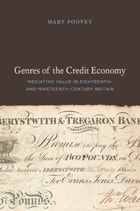
Genres of the Credit Economy
Mediating Value in Eighteenth- and Nineteenth-Century BritainMary Poovey
University of Chicago Press, 2008
Chronicling the process by which some of our most important conceptual categories were naturalized, Mary Poovey explores complex relationships among forms of writing that are not usually viewed together, from bills of exchange and bank checks, to realist novels and Romantic poems, to economic theory and financial journalism. Taking up all early forms of financial and monetarywriting, Poovey argues that these genres mediated for early modern Britons the operations of a market system organized around credit and debt. By arguing that genre is a critical tool for historical and theoretical analysis and an agent in the events that formed the modern world, Poovey offers a new way to appreciate the character of the credit economy and demonstrates the contribution historians and literary scholars can make to understanding its operations.
Much more than an exploration of writing on and around money, Genres of the Credit Economy offers startling insights about the evolution of disciplines and the separation of factual and fictional genres.
Gente Decente
A Borderlands Response to the Rhetoric of DominanceBy Leticia Magda Garza-Falcón
University of Texas Press, 1998
In his books The Great Plains, The Great Frontier, and The Texas Rangers, historian Walter Prescott Webb created an enduring image of fearless, white, Anglo male settlers and lawmen bringing civilization to an American Southwest plagued with "savage" Indians and Mexicans. So popular was Webb's vision that it influenced generations of historians and artists in all media and effectively silenced the counter-narratives that Mexican American writers and historians were concurrently producing to claim their standing as "gente decente," people of worth.
These counter-narratives form the subject of Leticia M. Garza-Falcón's study. She explores how prominent writers of Mexican descent-such as Jovita González, Américo Paredes, María Cristina Mena, Fermina Guerra, Beatriz de la Garza, and Helena María Viramontes -have used literature to respond to the dominative history of the United States, which offered retrospective justification for expansionist policies in the Southwest and South Texas. Garza-Falcón shows how these counter-narratives capture a body of knowledge and experience excluded from "official" histories, whose "facts" often emerged more from literary techniques than from objective analysis of historical data.
Gentleman Troubadours and Andean Pop Stars
Huayno Music, Media Work, and Ethnic Imaginaries in Urban PeruJoshua Tucker
University of Chicago Press, 2013

Geographies of Flight
Phillis Wheatley to Octavia ButlerWilliam Merrill Decker
Northwestern University Press, 2020
African American writing commonly represents New World topography as a set of entrapments, contesting the open horizons, westward expansion, and individual freedom characteristic of the white, Eurocentric literary tradition. Geographies of Flight: Phillis Wheatley to Octavia Butler provides the first comprehensive treatment of the ways in which African American authors across three centuries have confronted the predicament of inhabiting space under conditions of bondage and structural oppression. William Merrill Decker examines how, in testifying to those conditions, fourteen black authors have sought to transform a national cartography that, well into the twenty-first century, reflects white supremacist assumptions. These writers question the spatial dimensions of a mythic American liberty and develop countergeographies in which descendants of the African diaspora lay claim to the America they have materially and culturally created.
Tracking the testimonial voice in a range of literary genres, Geographies of Flight explores themes of placement and mobility in the work of Phillis Wheatley, Olaudah Equiano, David Walker, Frederick Douglass, Harriet Jacobs, Booker T. Washington, Ida B. Wells-Barnett, W. E. B. Du Bois, Richard Wright, Ralph Ellison, Malcolm X, James Baldwin, Toni Morrison, and Octavia Butler.
Geographies of Philological Knowledge
Postcoloniality and the Transatlantic National EpicNadia R. Altschul
University of Chicago Press, 2012
Geographies of Relation
Diasporas and Borderlands in the AmericasTheresa Delgadillo
University of Michigan Press, 2024
Not only does Delgadillo offer a rare extended analysis of Black Latinidades in Chicanx literature and theory, but she also considers over a century’s worth of literary, cinematic, and performative texts to support her argument about the significance of these cultural sites and overlaps. Chapters illuminate the significance of Toña La Negra in the Golden Age of Mexican cinema, reconsider feminist theorist Gloria Anzaldúa’s work in revising exclusionary Latin American ideologies of mestizaje, delve into the racial and gender frameworks Sandra Cisneros attempts to rewrite, unpack encounters between African Americans and Black Puerto Ricans in texts by James Baldwin and Marta Moreno Vega, explore the African diaspora in colonial and contemporary Peru through Daniel Alarcón’s literature and the documentary Soy Andina, and revisit the centrality of Black power in ending colonialism in Cuban narratives. Geographies of Relation demonstrates the long histories of networks and exchanges across the Americas as well as the interrelationships among Indigenous, Black, African American, mestizx, Chicanx, and Latinx peoples. It offers a compelling argument that geographies of relation are as significant as national frameworks in structuring cultural formation and change in this hemisphere.
George Eliot’s Serial Fiction
Carol A. Martin
The Ohio State University Press, 1994
Germaine De Staël, George Sand, and the Victorian Woman Artist
Linda M. Lewis
University of Missouri Press, 2003

German Literature on the Middle East
Discourses and Practices, 1000-1989Nina Berman
University of Michigan Press, 2013
German Literature on the Middle East explores the dynamic between German-speaking and Middle Eastern states and empires from the time of the Crusades to the end of the Cold War. This insightful study illuminates the complex relationships among literary and other writings on the one hand, and economic, social, and political processes and material dimensions on the other. Focusing on German-language literary and nonfiction writings about the Middle East (including historical documents, religious literature, travel writing, essays, and scholarship), Nina Berman evaluates the multiple layers of meaning contained in these works by emphasizing the importance of culture contact; a wide web of political, economic, and social practices; and material dimensions as indispensible factors for the interpretive process.
This analysis of literary and related writing reveals that German views about the Middle East evolved over the centuries and that various forms of action toward the Middle East differed substantially as well. Ideas about religion, culture, race, humanism, nation, and modernity, which emerged successively but remain operative to this day, have fashioned Germany's changed attitudes toward the Middle East. Exploring the interplay between textual discourses and social, political, and economic practices and materiality, German Literature on the Middle East offers insights that challenge accepted approaches to the study of literature, particularly approaches that insist on the centrality of the linguistic construction of the world. In addition, Berman presents evidence that the German encounter with the Middle East is at once distinct and yet at the same time characterized by patterns shared with other European countries. By addressing the individual nature of the German encounter in the larger European context, this study fills a considerable gap in current scholarship.
The interdisciplinary approach of German Literature on the Middle East will be of interest to the humanities in general, and specifically to scholars of German studies, comparative literature, Middle Eastern studies, and history.
Nina Berman is Professor of Comparative Studies at The Ohio State University.
Jacket image: Map of Europe by Giovanni Magini, from his “Geography.” Venice, [1598]. From the University of Michigan Map Library.
Political Map of the World, April 2008. From the University of Texas Perry-Castañeda Library, Map Collection.

German Orientalisms
Todd Kontje
University of Michigan Press, 2004
-Russell Berman, Stanford University
"Intellectually rigorous and conceptually nuanced, Todd Kontje's German Orientalisms is a valuable contribution to the debate on identity politics in German cultural history. Through an erudite and insightful analysis of the German fictions of a broadly defined 'Orient' from the Middle Ages to the present, Kontje illustrates how German literature situated itself within a 'symbolic geography,' whose coordinates are defined by both its representations of the Orient and its affiliation with the Occident. German Orientalisms offers not only an admirable synthesis of the scholarship on German linguistic and cultural nationalism but also sophisticated interpretive strategies for a better understanding of our perceptions and misconceptions of alterity."
-Azade Seyhan, Bryn Mawr College
"This is a fascinating topic, and the book opens new scholarly vistas. In an age of increased specialization, Kontje takes a macro view, looking at German literature almost
from its beginnings to the present, from Wolfram to Özdamar. He also has the courage to link his well-researched work to topics like globalization, the culture wars, and canon formation. He doesn't merely proclaim literature's importance, he shows by example how the literary imagination-creative as it is, dodging dogmatism, and able to confound ideologies-can thrive in an era of cultural studies."
-Sara Friedrichsmeyer, University of Cincinnati
Todd Kontje's German Orientalisms offers a fresh examination of the role of the East in German literary imagination, ranging from the Middle Ages to the present. In its wide historical sweep, this book offers important new insights into many of the most famous writers in the German language, from Goethe to Thomas Mann to Günter Grass.
Building on Edward Said's Orientalism-which defined Orientalism as a form of Western knowledge directly linked to imperial power-Kontje offers a more nuanced version as seen through the lens of German literature of the last thousand years.
Said's focus was on British and French Orientalists-two nations with colonial interests in the East. Germany was different in that it had no stake in the Orient. Far from diminishing an Orientalist perspective, however, the absence of a German empire in the East produced a peculiarly German brand of Orientalism, one in which German writers alternated between identification with the rest of Europe and allying themselves with parts of the East against the West.
Above all, Kontje asks how German writers conceived of their place in "the land of the center" (das Land der Mitte) and how their literary works help to create the imagined community of the German nation.

German Ways of War
The Affective Geographies and Generic Transformations of German War FilmsJaimey Fisher
Rutgers University Press, 2022
German Writing, American Reading
Women and the Import of Fiction, 1866–1917Lynne Tatlock
The Ohio State University Press, 2012

Germany's Wild East
Constructing Poland as Colonial SpaceKristin Kopp
University of Michigan Press, 2012
While conventional definitions locate colonial space overseas, Kristin Kopp argues that it was possible to understand both distant continents and adjacent Eastern Europe as parts of the same global periphery dependent upon Western European civilizing efforts. However, proximity to the source of aid translated to greater benefits for Eastern Europe than for more distant regions.
Ghostly Communion
Cross-Cultural Spiritualism in Nineteenth-Century American LiteratureJohn J. Kucich
Dartmouth College Press, 2015
Ghostly Figures
Memory and Belatedness in Postwar American PoetryAnn Keniston
University of Iowa Press, 2015
Ghostly Figures contends that this poetics of belatedness, along with the way it is bound to questions of poetic making, is a central, if critically neglected, force in postwar American poetry. Discussing works by Sylvia Plath, Adrienne Rich, Jorie Graham, Susan Howe, and a group of poets responding to the AIDS epidemic, Ann Keniston draws on and critically assesses trauma theory and psychoanalysis, as well as earlier discussions of witness, elegy, lyric trope and figure, postmodernism, allusion, and performance, to define the ghosts that clearly dramatize poetics of belatedness throughout the diverse poetry of post–World War II America.
Ghostly Past, Capitalist Presence
A Social History of Fear in Colonial BengalTithi Bhattacharya
Duke University Press, 2024
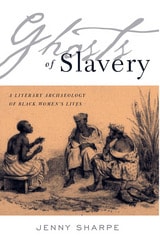
Ghosts Of Slavery
A Literary Archaeology of Black Women’s LivesJenny Sharpe
University of Minnesota Press, 2002
Questions traditional assumptions about power and agency in slave women’s everyday lives.
Through their open defiance, women like Harriet Tubman and Sojourner Truth had a significant impact on the institution of slavery. But what of the countless other women who did not commit public or even private acts of resistance? Are their stories worthy of our attention? While some scholars imply that only the struggle for freedom was legitimate, Jenny Sharpe complicates the linear narrative-from slavery to freedom and literacy-that emerged from the privileging of autobiographical accounts like that of Frederick Douglass. She challenges a paradigm that equates agency with resistance and self-determination, and introduces new ways to examine negotiations for power within the constraints of slavery.
In Ghosts of Slavery, Sharpe introduces a wider range of everyday practices by examining the lives of three distinctive Caribbean women: a maroon leader, a mulatto concubine, and a fugitive slave. Through them she explains how the diasporic experience of slavery enabled black women to claim an authority that they didn’t possess in Africa, how concubines empowered themselves through their mimicry of white women, and how less-privileged slave women manipulated situations that they were powerless to change. Finding the highly mediated portrayal of slave women in the historical records limited and sometimes misleading, Sharpe turns to unconventional sources for investigating these women’s lives. In this fascinating and historically rich account, she calls for new strategies of reading that question traditional narratives of history, and she finds alternative ways to integrate oral storytelling, slave songs, travel writing, court documents, proslavery literature, and contemporary literature into black history. Ultimately, this layered approach not only produces a more complex picture of the slave women’s agency than conventional readings, it encourages a more nuanced understanding of the roles of slaves in the history of slavery.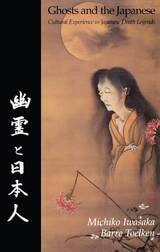
Ghosts and The Japanese
Cultural Experience in Japanese Death LegendsMichiko Iwasaka & Barre Toelken
Utah State University Press, 1994
The Japanese have ambivalent attitudes toward death, deeply rooted in pre-Buddhist traditions. In this scholarly but accessible work, authors Iwasaka and Toelken show that everyday beliefs and customs--particularly death traditions--offer special insight into the living culture of Japan.
Ghosts and the Overplus
Reading Poetry in the Twenty-First CenturyChristina Pugh
University of Michigan Press, 2024
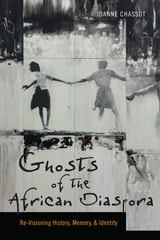
Ghosts of the African Diaspora
Re-Visioning History, Memory, and IdentityJoanne Chassot
Dartmouth College Press, 2018
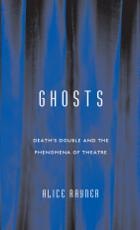
Ghosts
Death’S Double And The Phenomena Of TheatreAlice Rayner
University of Minnesota Press, 2006
In Ghosts, Alice Rayner examines theatre as a memorial practice that is haunted by the presence of loss, looking at how aspects of stagecraft turn familiar elements into something uncanny. Citing examples from the works of Shakespeare, Beckett, and Suzan-Lori Parks as well as the films Vertigo, Gaslight, and The Sixth Sense, she begins by describing time as it is employed by theatre with multiple aspects of presence, duration, and passage. Suggesting that objects connect past to present through the sense of touch, she explores how props are suspended backstage between motion and meaning. Her final chapters consider the curtain as theatre’s means for attempting to divide real and imaginary worlds.
If ghosts hover where secrets—secrets of the past, secrets from oneself, secrets of life and death—are kept, then, according to Rayner, “theatre is where ghosts best make their appearances and let communities and individuals know that we live amid secrets hiding in plain sight.”
Alice Rayner is associate professor of drama at Stanford University and author of, most recently, To Act, To Do, To Perform: Drama and the Phenomenology of Action.
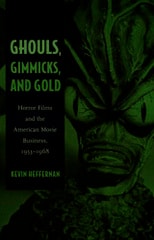
Ghouls, Gimmicks, and Gold
Horror Films and the American Movie Business, 1953–1968Kevin Heffernan
Duke University Press, 2004
Heffernan argues that major cultural and economic shifts in the production and reception of horror films began at the time of the 3-d film cycle of 1953–54 and ended with the 1968 adoption of the Motion Picture Association of America’s ratings system and the subsequent development of the adult horror movie—epitomized by Rosemary’s Baby. He describes how this period presented a number of daunting challenges for movie exhibitors: the high costs of technological upgrade, competition with television, declining movie attendance, and a diminishing number of annual releases from the major movie studios. He explains that the production and distribution branches of the movie industry responded to these trends by cultivating a youth audience, co-producing features with the film industries of Europe and Asia, selling films to television, and intensifying representations of sex and violence. Shining through Ghouls, Gimmicks, and Gold is the delight of the true horror movie buff, the fan thrilled to find The Brain that Wouldn’t Die on television at 3 am.
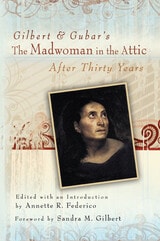
Gilbert and Gubar's The Madwoman in the Attic after Thirty Years
Edited by Annette R. Federico, Foreward by Sandra M. Gilbert
University of Missouri Press, 2011
When it was published in 1979, Sandra M. Gilbert and Susan Gubar's The Madwoman in the Attic: The Woman Writer and the Nineteenth-Century Literary Imaginationwas hailed as a pathbreaking work of criticism, changing the way future scholars would read Jane Austen, Mary Shelley, the Brontës, George Eliot, and Emily Dickinson. This thirtieth-anniversary collection adds both valuable reassessments and new readings and analyses inspired by Gilbert and Gubar’s approach. It includes work by established and up-and-coming scholars, as well as retrospective accounts of the ways in which The Madwoman in the Attic has influenced teaching, feminist activism, and the lives of women in academia.
These contributions represent both the diversity of today’s feminist criticism and the tremendous expansion of the nineteenth-century canon. The authors take as their subjects specific nineteenth- and twentieth-century women writers, the state of feminist theory and pedagogy, genre studies, film, race, and postcolonialism, with approaches ranging from ecofeminism to psychoanalysis. And although each essay opens Madwoman to a different page, all provocatively circle back—with admiration and respect, objections and challenges, questions and arguments—to Gilbert and Gubar's groundbreaking work.
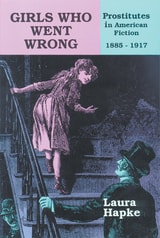
Girls Who Went Wrong
Prostitutes in American Fiction, 1885–1917Laura Hapke
University of Wisconsin Press, 1989
The period 1885 to 1917 saw thousands of American crusaders working hard to “save the fallen women,” but little on the part of American social protest writers. In this first work on the subject, Laura Hapke examines how writers attempted to turn an outcast into a heroine in a literature otherwise known for its puritanical attitude toward the fallen woman. She focuses on how these authors (all male) expressed late-Victorian conflicts about female sexuality. If, as they all maintained, women have an innate preference for chastity, how could they account for the prostitute? Was she a sinner, suggesting the potential waywardness of all women? Or, if she was a victim, what of her “depravity”?
Girls Who Wore Black
Women Writing the Beat GenerationJohnson, Ronna C
Rutgers University Press, 2002
Giving Voice to Stones
Place and Identity in Palestinian LiteratureBy Barbara McKean Parmenter
University of Texas Press, 1994
"A struggle between two memories" is how Palestinian poet Mahmud Darwish describes the conflict between Palestinians and Israelis. Within this struggle, the meanings of land and home have been challenged and questioned, so that even heaps of stones become points of contention. Are they proof of ancient Hebrew settlement, or rubble from a bulldozed Palestinian village? The memory of these stones, and of the land itself, is nurtured and maintained in Palestinian writing and other modes of expression, which are used to confront and counter Israeli images and rhetoric. This struggle provides a rich vein of thought about the nature of human experience of place and the political uses to which these experiences are put.
In this book, Barbara McKean Parmenter explores the roots of Western and Zionist images of Palestine, then draws upon the work of Darwish, Ghassan Kanafani, and other writers to trace how Palestinians have represented their experience of home and exile since the First World War. This unique blending of cultural geography and literary analysis opens an unusual window on the struggle between these two peoples over a land that both divides them and brings them together.
Glamorous Sorcery
Magic and Literacy in the High Middle AgesDavid Rollo
University of Minnesota Press, 2000