Results by title
456 books match the query 'India' and 12 start with g
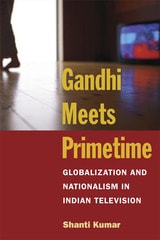
Gandhi Meets Primetime
Globalization and Nationalism in Indian TelevisionShanti Kumar
University of Illinois Press, 2005
Kumar argues that India's hybrid national identity is manifested in the discourses found in this variety of empirical sources. He deconstructs representations of Mahatma Gandhi as the Father of the Nation on the state-sponsored network Doordarshan and those found on Rupert Murdoch's STAR TV network. The book closely analyzes print advertisements to trace the changing status of the television set as a cultural commodity in postcolonial India and examines publicity brochures, promotional materials and programming schedules of Indian-language networks to outline the role of vernacular media in the discourse of electronic capitalism. The empirical evidence is illuminated by theoretical analyses that combine diverse approaches such as cultural studies, poststructuralism and postcolonial criticism.
Gandhi in India
In His Own WordsMahatma Gandhi and Martin Green
Brandeis University Press, 1987
Gender, Law, and Resistance in India
Erin P. Moore
University of Arizona Press, 1988

General Firebrand and His Red Atlas
Tathagata Bhattacharya
Seagull Books, 2024
In a world on the brink of totalitarian rule, one man rises from the shadows to ignite a revolution and becomes the unlikely leader of a war of resistance that will shake the very foundations of power. General Firebrand, an unsocial and recovered alcoholic, considered a pariah by society, rises up against the country’s fascist regime. In this guerrilla war, Firebrand garners support from the unlikeliest allies. Beasts and birds of the jungle join the struggle. Spirits of historical figures from past wars and fictional characters with supernatural abilities lend their strength to the cause. As a devastating secret is revealed that moves Firebrand to the core, the battle for liberation takes on new dimensions, exposing the fragility of rationality and the weight of historical wrongs committed in the name of a supposedly humane ideology.
With zany, irreverent prose and a breakneck pace, General Firebrand and His Red Atlas is an explosive debut novel that challenges conventional wisdom and explores the complexities of courage, doubt, and the pursuit of justice in a world dominated by fear.
Ghostly Past, Capitalist Presence
A Social History of Fear in Colonial BengalTithi Bhattacharya
Duke University Press, 2024
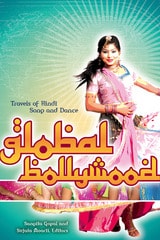
Global Bollywood
Travels of Hindi Song and DanceSangita Gopal
University of Minnesota Press, 2008
Bollywood movies and their signature song-and-dance spectacles are an aesthetic familiar to people around the world, and Bollywood music now provides the rhythm for ads marketing goods such as computers and a beat for remixes and underground bands. These musical numbers have inspired scenes in Western films such as Vanity Fair and Moulin Rouge.
Global Bollywood shows how this currency in popular culture and among diasporic communities marks only the latest phase of the genre’s world travels. This interdisciplinary collection describes the many roots and routes of the Bollywood song-and-dance spectacle. Examining the reception of Bollywood music in places as diverse as Indonesia and Israel, the essays offer a stimulating redefinition of globalization, highlighting the cultural influence of Hindi film music from its origins early in the twentieth century to today.
Contributors: Walter Armbrust, Oxford U; Anustup Basu, U of Illinois, Urbana-Champaign; Nilanjana Bhattacharjya, Colorado College; Edward K. Chan, Kennesaw State U; Bettina David, Hamburg U; Rajinder Dudrah, U of Manchester; Shanti Kumar, U of Texas, Austin; Monika Mehta, Binghamton U; Anna Morcom, Royal Holloway College; Ronie Parciack, Tel Aviv U; Biswarup Sen, U of Oregon; Sangita Shrestova; Richard Zumkhawala-Cook, Shippensburg U.
Sangita Gopal is assistant professor of English at the University of Oregon. Sujata Moorti is professor of women’s and gender studies at Middlebury College.
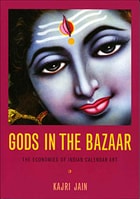
Gods in the Bazaar
The Economies of Indian Calendar ArtKajri Jain
Duke University Press, 2007
Jain draws on interviews with artists, printers, publishers, and consumers as well as analyses of the prints themselves to trace the economies—of art, commerce, religion, and desire—within which calendar images and ideas about them are formulated. For Jain, an analysis of the bazaar, or vernacular commercial arena, is crucial to understanding not only the calendar art that circulates within the bazaar but also India’s postcolonial modernity and the ways that its mass culture has developed in close connection with a religiously inflected nationalism. The bazaar is characterized by the coexistence of seemingly incompatible elements: bourgeois-liberal and neoliberal modernism on the one hand, and vernacular discourses and practices on the other. Jain argues that from the colonial era to the present, capitalist expansion has depended on the maintenance of these multiple coexisting realms: the sacred, the commercial, and the artistic; the official and the vernacular.
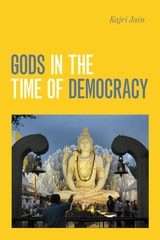
Gods in the Time of Democracy
Kajri Jain
Duke University Press, 2021

Gods, Demons, and Others
R. K. Narayan llustrated by R. K. Laxman
University of Chicago Press, 1993
"Mr. Narayan gives vitality and an original viewpoint to the most ancient of legends, lacing them with his own blend of satire, pertinent explanation and thoughtful commentary."—Santha Rama Rau, New York Times
"Narayan's narrative style is swift, firm, graceful, and lucid . . . thoroughly knowledgeable, skillful, entertaining. One could hardly hope for more."—Rosanne Klass, Times Literary Supplement
Governance and Foreign Investment in China, India, and Taiwan
Credibility, Flexibility, and International BusinessYu Zheng
University of Michigan Press, 2014
Yu Zheng challenges the idea that democracy is the prerequisite for developing countries to attract foreign direct investment (FDI) and promote economic growth. He examines the relationship between political institutions and FDI through the use of cross-national analysis and case studies of three rapidly growing Asian economies with a focus on the role of microinstitutional “special economic zones” (SEZ).
China’s authoritarian system allows for bold, radical economic reform, but China has attracted FDI largely because of its increasingly credible investment environment as well as its central and local governments’ efforts to overcome constraints on investment. India’s democratic institutions provide more political assurance to foreign investors, but its market became conducive to FDI only when the government adopted more flexible investment policies. Taiwan’s democratic transition shifted its balance of policy credibility and flexibility, which was essential for the nation’s economic takeoff and sustained growth.
Zheng concludes that a more accurate understanding of the relationship between political institutions and FDI comes from careful analysis of institutional arrangements that entail a trade-off between credibility and flexibility of governance.
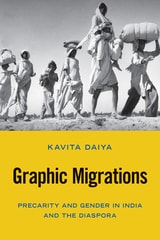
Graphic Migrations
Precarity and Gender in India and the DiasporaKavita Daiya
Temple University Press, 2020
In Graphic Migrations, Kavita Daiya provides a literary and cultural archive of refugee stories and experiences to respond to the question “What is created?” after decolonization and the 1947 Partition of India. She explores how stories of Partition migrations shape and influence the political and cultural imagination of secularism and contribute to gendered citizenship for South Asians in India and its diasporas.
Daiya analyzes modern literature, Bollywood films, Margaret Bourke-White’s photography, advertising, and print culture to show how they memorialize or erase refugee experiences. She also uses oral testimonies of Partition refugees from Hong Kong, South Asia, and North America to draw out the tensions of the nation-state, ethnic discrimination, and religious difference. Employing both Critical Refugee Studies and Feminist Postcolonial Studies frameworks, Daiya traces the cultural, affective, and political legacies of Partition migrations.
The precarity generated by modern migration and expressed through public culture prompts a rethinking of how dominant media represents gendered migrants and refugees. Graphic Migrations demands that we redraw the boundaries of how we tell the story of modern world history and the intricately interwoven, intimate production of statelessness and citizenship across the world’s communities.

Greener Pastures
Politics, Markets, and Community among a Migrant Pastoral PeopleArun Agrawal
Duke University Press, 1999
Agrawal analyzes the institutions developed by the shepherds to solve livelihood problems. First, by focusing on the relations of the shepherds with their landholder neighbors, he explains why the shepherds migrate. He shows that struggles between these two groups led to a sociopolitical squeeze on the access of shepherds to the fodder resources they need to feed their sheep. Then, in an examination of why the shepherds migrate in groups, he demonstrates how their migratory lives depend on market exchanges and points to the social and political forces that influence prices and determine profits. Finally, he looks at decision-making processes such as division of labor and the delegation of power. Politics is ubiquitous in the interactions of the shepherds with their neighbors and with state officials, in their exchanges in markets and with farmers, and in their internal relations as a community.
Interspersing the words of the Raikas themselves with a sophisticated deployment of political theory, Agrawal has produced a volume that will interest scholars in a broad range of academic disciplines, including Asian studies, political science, human ecology, anthropology, comparative politics, rural sociology, and environmental studies and policy.