Results by title
944 books match the query 'Indians of North America' and 18 start with g
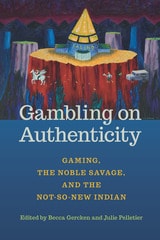
Gambling on Authenticity
Gaming, the Noble Savage, and the Not-So-New IndianBecca Gercken
Michigan State University Press, 2017
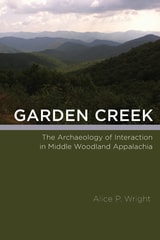
Garden Creek
The Archaeology of Interaction in Middle Woodland AppalachiaAlice P. Wright
University of Alabama Press, 2020
Presents archaeological data to explore the concept of glocalization as applied in the Hopewell world
Originally coined in the context of twentieth-century business affairs, the term glocalization describes how the global circulation of products, services, or ideas requires accommodations to local conditions, and, in turn, how local conditions can significantly impact global markets and relationships. Garden Creek: The Archaeology of Interaction in Middle Woodland Appalachia presents glocalization as a concept that can help explain the dynamics of cross-cultural interaction not only in the present but also in the deep past.
Alice P. Wright uses the concept of glocalization as a framework for understanding the mutual contributions of large-scale and small-scale processes to prehistoric transformations. Using geophysical surveys, excavations, and artifact analysis, Wright shows how Middle Woodland cultural contact wrought changes in religious practices, such as mound building and the crafting of ritual objects for exchange or pilgrimage.
Wright presents and interprets original archaeological data from the Garden Creek site in western North Carolina as part of a larger study of the Hopewell Interaction Sphere, a well-known but poorly understood episode of cross-cultural interaction that linked communities across eastern North America during the Middle Woodland period. Although Hopewellian culture contact did not encompass the entire planet, it may have been “global” to those who experienced and created it, as it subsumed much of the world as Middle Woodland people knew it. Reimagining Hopewell as an episode of glocalization more fully accounts for the diverse communities, interests, and processes involved in this “global” network.
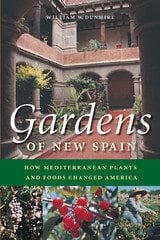
Gardens of New Spain
How Mediterranean Plants and Foods Changed AmericaBy William W. Dunmire
University of Texas Press, 2004
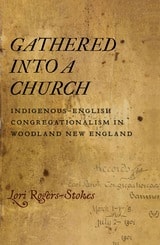
Gathered into a Church
Indigenous-English Congregationalism in Woodland New EnglandLori Rogers-Stokes
University of Massachusetts Press, 2025
Uncovering how and where Indigenous and settler communities found common ground using newly public church records
Puritans in the American colonies created Congregationalism, a Protestant denomination where power rested in each congregation rather than a larger central body. As has often been told, the official Puritan mission included outreach to Indigenous people. This may appear as nothing more than forced conversion under colonization, but church records from Massachusetts—digitized and made public for the first time—reveal the authenticity of this Indigenous religious experience, as evidenced by commonalities between the Congregational way and some aspects of local Native American cultures. The records also show how the decentralized churches stood in contrast to a growing civil government in the colonies.
Lori Rogers-Stokes focuses on the Massachusetts Bay Colony during the decades around the turn of the eighteenth century, a period bookended by King Philip’s War and the First Great Awakening. She uses as her primary source the many records kept by individual Congregational churches of the time. These records, accumulated over generations, have been missing from the historical record, allowing overly simplistic accounts of this religious community to circulate. With church records now available, Rogers-Stokes reveals a more realistic picture of diverse congregations and contrasts their internal workings—which show inherent flexibility and a focus on a shared creation of community—with a developing civil government focused on consolidating power around white landowners. The result is a story that can expand how scholars write about this period, this region, and these communities, both settler and Indigenous.
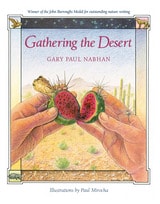
Gathering the Desert
Gary Paul Nabhan; Illustrations by Paul Mirocha
University of Arizona Press, 1985
To the untrained eye, a desert is a wasteland that defies civilization; yet the desert has been home to native cultures for centuries and offers sustenance in its surprisingly wide range of plant life. Gary Paul Nabhan has combed the desert in search of plants forgotten by all but a handful of American Indians and Mexican Americans. In Gathering the Desert readers will discover that the bounty of the desert is much more than meets the eye—whether found in the luscious fruit of the stately organpipe cactus or in the lowly tepary bean.
Nabhan has chosen a dozen of the more than 425 edible wild species found in the Sonoran Desert to demonstrate just how bountiful the land can be. From the red-hot chiltepines of Mexico to the palms of Palm Springs, each plant exemplifies a symbolic or ecological relationship which people of this region have had with plants through history. Each chapter focuses on a particular plant and is accompanied by an original drawing by artist Paul Mirocha. Word and picture together create a total impression of plants and people as the book traces the turn of seasons in the desert.
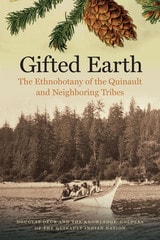
Gifted Earth
The Ethnobotany of the Quinault and Neighboring TribesDouglas Deur
Oregon State University Press, 2022
Gifted Earth features traditional Native American plant knowledge, detailing the use of plants for food, medicines, and materials. It presents a rich and living tradition of plant use within the Quinault Indian Nation in a volume collaboratively developed and endorsed by that tribe.
The Quinault Reservation on the Olympic Peninsula of Washington state is a diverse tribal community, embodying the traditional knowledge of tribes along the entire Pacific Northwest coast. Its membership consists of descendants of many tribes—from the northwestern Olympic Peninsula to the northern Oregon coast—including the Quinault, but also many others who were relocated to the reservation in the nineteenth and early twentieth centuries. Individuals descended from these tribal communities, including Chinook, Chehalis, Hoh, Quileute, Queets, Cowlitz, Tillamook, Clatsop, and others, have contributed to Gifted Earth, giving it remarkable breadth and representation.
A celebration of enduring Native American knowledge, this book will help non-specialists as they discover the potential of the region’s wild plants, learning how to identify, gather, and use many of the plants that they encounter in the Northwestern landscape. Part ethnobotanical guide and part “how-to” manual, Gifted Earth also prepares plant users for the minor hazards and pitfalls that accompany their quest—from how to avoid accidentally eating a bug hidden within a salal berry to how to prevent blisters when peeling the tender stalks of cow parsnip.
As beautiful as it is informative, Gifted Earth sets the standard for a new generation of ethnobotanical guides informed by the values, vision, and voice of Native American communities eager to promote a sustainable, balanced relationship between plant users and the rich plant communities of traditional tribal lands.
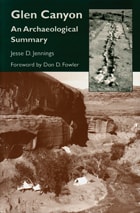
Glen Canyon
An Archaeological SummaryJesse D Jennings
University of Utah Press, 1998
In 1956, Congress passed legislation that provided authorization and funds for emergency research to be conducted in Glen Canyon in response to the threat of losses posted by the construction of the Glen Canyon Dam in northern Arizona. For eight years, scientists worked against the clock to record the archaeology, geology, history, and paleontology of the region before the waters of Lake Powell covered the area.
In this highly interpretive summary, Jesse Jennings preserves the achievements of the salvage team and explains how the finds affected previous conclusions. Maps and photographs capture archaeological artifacts as well as the landscape of the area. This book also highlights the larger consequences of the massive salvage project — among them the stimulation of additional Southwest research, the applications of techniques made in response to emergency situations, and a valuable perspective on the Pueblo culture. Because this area is becoming increasingly controversial, with a raging debate over whether Lake Powell should be drained, Glen Canyon: An Archaeological Summary stands as more than a model of salvage archaeology. It is also a record and testament of the rich history of Glen Canyon.
Global Indigenous Health
Reconciling the Past, Engaging the Present, Animating the FutureEdited by Robert Henry, Amanda LaVallee, Nancy Van Styvendale, and Robert Alexander Innes
University of Arizona Press, 2018
Building on Indigenous knowledge systems of health and critical decolonial theories, the volume’s contributors—who are academic and community researchers from Canada, the United States, Sweden, and New Zealand—weave a narrative to explore issues of Indigenous health within four broad themes: ethics and history, environmental and ecological health, impacts of colonial violence on kinship, and Indigenous knowledge and health activism. Chapters also explore how Indigenous peoples are responding to both the health crises in their communities and the ways for non-Indigenous people to engage in building positive health outcomes with Indigenous communities.
Global Indigenous Health is unique and timely as it deals with the historical and ongoing traumas associated with colonization and colonialism, understanding Indigenous concepts of health and healing, and ways of moving forward for health equity.
Contributors:
Sharon Leslie Acoose
Seth Adema
Peter Butt
John E. Charlton
Colleen Anne Dell
Debra Dell
Paul DePasquale
Judy A. Dow
C. Randy Duncan
Carina Fiedeldey-Van Dijk
Barbara Fornssler
Chelsea Gabel
Eleanor Louise Hadden
Laura Hall
Robert Henry
Carol Hopkins
Robert Alexander Innes
Simon Lambert
Amanda LaVallee
Josh Levy
Rachel Loewen Walker
David B. MacDonald
Peter Menzies
Christopher Mushquash
David Mykota
Nancy Poole
Alicia Powell
Ioana Radu
Margo Rowan
Mark F. Ruml
Caroline L. Tait
Lisa Tatonetti
Margaretha Uttjek
Nancy Van Styvendale
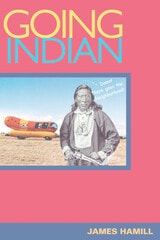
Going Indian
James Hamill
University of Illinois Press, 2006
Going Indian explores Indian (as opposed to tribal) ethnic identity among Native American people in Oklahoma through their telling, in their own words, of how they became Indian and what being Indian means to them today. Divided into four parts, the book features Oklahoma Indians' constructions of their histories and their view of today's native populations, their experiences with forced removals and Indian educational institutions, the meaning they place on blood quantum and ancestry in relation to Indian identity, and their practice of religion in Native churches.
James Hamill makes extensive use of the Indian Pioneer and Doris Duke material at the University of Oklahoma's Western History Library to assemble these narratives, using interviews collected between 1937-38 and 1967-70, as well as interviews he conducted from 2000 to 2001. While most books on Native American people in Oklahoma focus on tribes and their histories, Hamill instead explores the use of Indian symbolism across a wide field of experience to reveal what they thought and what they think about these various issues, and how these have influenced and affected their self-perceptions over time.
Going Through Ghosts
Mary Sojourner
University of Nevada Press, 2010
Maggie Foltz is a fifty-five-year-old cocktail waitress in a rundown casino in the southern Nevada Mojave Desert. She spends her days serving drinks to lonely old folks playing the slot machines and her nights trying to escape her bitter past. When she befriends Sarah, a young Native American woman who is hired to cook in the casino coffee shop, her life begins to change. Maggie finds herself falling in love with a memory-haunted Vietnam veteran and warily begins to hope that together they can find peace. Then Sarah is mysteriously murdered, and Sarah’s ghost enlists Maggie to accompany her on a quest for the wisdom that she needs in order to move into the next world. The story ranges from smoky casinos into the harsh magnificence of the desert and the reservation where Sarah’s people are trying to preserve their culture and find their own place in a modern world that seems to want them to be either shamans or losers. Sojourner’s characters are compellingly real, and the Mojave setting has rarely been depicted as sensitively or truthfully. This is a memorable story of love, redemption, and solace, told by one of the West’s finest writers.
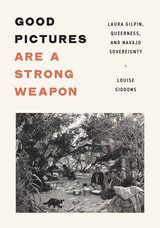
Good Pictures Are a Strong Weapon
Laura Gilpin, Queerness, and Navajo SovereigntyLouise Siddons
University of Minnesota Press, 2024
What are the limits of political solidarity, and how can visual culture contribute to social change?
A fundamental dilemma exists in documentary photography: can white artists successfully portray Indigenous lives and communities in a manner that neither appropriates nor romanticizes them? With an attentive and sensitive eye, Louise Siddons examines lesbian photographer Laura Gilpin’s classic 1968 book The Enduring Navaho to illuminate the intersectional politics of photography, Navajo sovereignty, and queerness over the course of the twentieth century.
Gilpin was a New York–trained fine arts photographer who started working with Navajo people when her partner accepted a job as a nurse in Arizona. She spent more than three decades documenting Navajo life and creating her book in collaboration with Navajo friends and colleagues. Framing her lesbian identity and her long relationship with the Navajo people around questions of allyship, Good Pictures Are a Strong Weapon addresses the long and problematic history of White photographers capturing images of Native life. Simultaneously, Siddons uses Gilpin’s work to explore the limitations of White advocacy in a political moment that emphasized the need for Indigenous visibility and voices.
Good Pictures Are a Strong Weapon introduces contemporary Diné (Navajo) artists as interlocutors, critics, and activists whose work embodies and extends the cultural sovereignty politics of earlier generations and makes visible the queerness often left implicit in Gilpin’s photographs. Siddons puts their work in conversation with Gilpin’s, taking up her mandate to viewers and readers of The Enduring Navajo to address Navajo aesthetics, traditions, politics, and people on their own terms.
Retail e-book files for this title are screen-reader friendly with images accompanied by short alt text and/or extended descriptions.
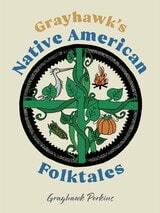
Grayhawk's Native American Folktales
Grayhawk Perkins
University of Alabama Press, 2025
Beloved Houma/Choctaw storyteller Grayhawk Perkins shares age-old wisdom in an unforgettable collection of folktales.
Grayhawk’s Native American Folktales is the eagerly awaited collection of stories by Grayhawk Perkins, a noted Houma storyteller from Louisiana. Drawing on traditional Indigenous tales, Grayhawk transforms these narratives into stories that captivate contemporary readers and audiences.
The collection features universal animal characters such as Deer, Rabbit, Bobcat, Turtle, and Snake that embody a variety of traits. Their adventures and challenges in the natural world reveal human behavior and lessons about how to treat others. Creation stories explain how the world and its inhabitants came to be, including the diligent Crawfish, the origin of skunk stripes, and why opossums are white. Although written for children ages 7 to 12 and their families, all will be charmed by Grayhawk’s contributions to Indigenous literature.
Great Basin Indians
An Encyclopedic HistoryMichael Hittman
University of Nevada Press, 2024
Great Basin Indians is an essential resource for any reader interested in the Native peoples of the American West and in western history in general.
Great Basin Rock Art
Archaeological PerspectivesAngus R. Quinlan
University of Nevada Press, 2007
Rock art is one of humankind’s most ancient forms of artistic expression, and one of its most enigmatic. For centuries, scholars and other observers have struggled to interpret the meaning of the mysterious figures incised or painted on natural rocks and to understand their role in the lives of their long-vanished creators. The Great Basin of the American West is especially rich in rock art, but until recently North American archaeologists have largely ignored these most visible monuments left by early Native Americans and have given little attention to the terrain surrounding them. In Great Basin Rock Art, twelve respected rock art researchers examine a number of significant sites from the dual perspectives of settlement archaeology and contemporary Native American interpretations of the role of rock art in their cultural past. The authors demonstrate how modern archaeological methodology and interpretations are providing a rich physical and cultural context for these ancient and hitherto puzzling artifacts. They offer exciting new insights into the lives of North America’s first inhabitants. This is essential reading for anyone interested in the petroglyphs of the American West and in the history of the Great Basin and its original peoples.
Great Lake
An Unnatural History of Lake MichiganTheodore J. Karamanski
University of Michigan Press, 2026
Great Lake is a comprehensive survey of the manifold ways Americans, from the first Native American communities to the present age, have abused, nurtured, loved, and neglected this massive freshwater resource. Extending 307 miles from north to south, the lake cuts across climatic, environmental, and physiographic zones, from the prairies of Illinois to the boreal forests of the north. Bordered by large cities like Chicago and Milwaukee as well as smaller Wisconsin resorts and northern Michigan mines and mill towns, the lake touches people in urban centers and countryside. Thus, the history of Lake Michigan combines the history of frontier resource extraction, agricultural abundance, industrialization, and dense urbanization in the American heartland. Great Lake is the story of the ever-escalating and divergent demands Americans have placed on Lake Michigan, how the lake’s ecosystem responded to those changes, and how together they have shaped the modern American Midwest.
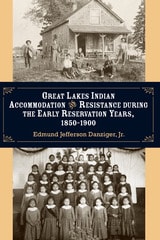
Great Lakes Indian Accommodation and Resistance during the Early Reservation Years, 1850-1900
Edmund Jefferson Danziger, Jr.
University of Michigan Press, 2009
During the four decades following the War of 1812, Great Lakes Indians were forced to surrender most of their ancestral homelands and begin refashioning their lives on reservations. The challenges Indians faced during this period could not have been greater. By century's end, settlers, frontier developers, and federal bureaucrats possessed not only economic and political power but also the bulk of the region's resources. It is little wonder that policymakers in Washington and Ottawa alike anticipated the disappearance of distinctive Indian communities within a single generation. However, these predictions have proved false as Great Lakes Indian communities, though assaulted on both sides of the international border to this day, have survived. Danziger's lively and insightful book documents the story of these Great Lakes Indians---a study not of victimization but of how Aboriginal communities and their leaders have determined their own destinies and preserved core values, lands, and identities against all odds and despite ongoing marginalization.
Utilizing eyewitness accounts from the 1800s and an innovative, cross-national approach, Danziger explores not only how Native Americans adapted to their new circumstances---including attempts at horse and plow agriculture, the impact of reservation allotment, and the response to Christian evangelists---but also the ways in which the astute and resourceful Great Lakes chiefs, councils, and clan mothers fought to protect their homeland and preserve the identity of their people. Through their efforts, dreams of economic self-sufficiency and self-determination as well as the historic right to unimpeded border crossings---from one end of the Great Lakes basin to the other---were kept alive.
Edmund Jefferson Danziger, Jr., is a Distinguished Teaching Professor in the Department of History at Bowling Green State University. Danziger is well known among historians and anthropologists for his interpretive histories of Great Lakes Native Americans.
Photo of girls at Lac du Flambeau School courtesy Wisconsin Historical Society, image 55938; photo of Ojibwa farm family at Garden River Reservation courtesy Archives of Ontario, image S 16361.
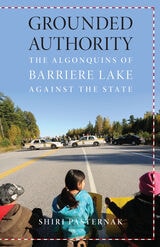
Grounded Authority
The Algonquins of Barriere Lake against the StateShiri Pasternak
University of Minnesota Press, 2017
Western Political Science Association's Clay Morgan Award for Best Book in Environmental Political Theory
Canadian Studies Network Prize for the Best Book in Canadian Studies
Nominated for Best First Book Award at NAISA
Honorable Mention: Association for Political and Legal Anthropology Book Prize
Since Justin Trudeau’s election in 2015, Canada has been hailed internationally as embarking on a truly progressive, post-postcolonial era—including an improved relationship between the state and its Indigenous peoples. Shiri Pasternak corrects this misconception, showing that colonialism is very much alive in Canada. From the perspective of Indigenous law and jurisdiction, she tells the story of the Algonquins of Barriere Lake, in western Quebec, and their tireless resistance to federal land claims policy.
Grounded Authority chronicles the band’s ongoing attempts to restore full governance over its lands and natural resources through an agreement signed by settler governments almost three decades ago—an agreement the state refuses to fully implement. Pasternak argues that the state’s aversion to recognizing Algonquin jurisdiction stems from its goal of perfecting its sovereignty by replacing the inherent jurisdiction of Indigenous peoples with its own, delegated authority. From police brutality and fabricated sexual abuse cases to an intervention into and overthrow of a customary government, Pasternak provides a compelling, richly detailed account of rarely documented coercive mechanisms employed to force Indigenous communities into compliance with federal policy.
A rigorous account of the incredible struggle fought by the Algonquins to maintain responsibility over their territory, Grounded Authority provides a powerful alternative model to one nation’s land claims policy and a vital contribution to current debates in the study of colonialism and Indigenous peoples in North America and globally.
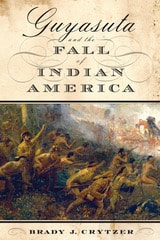
Guyasuta and the Fall of Indian America
Brady J. Crytzer
Westholme Publishing, 2013
Nearly a century before the United States declared the end of the Indian Wars, the fate of Native Americans was revealed in the battle of Fallen Timbers. In 1794, General Anthony Wayne led the first American army— the Legion of the United States—against a unified Indian force in the Ohio country. The Indians were routed and forced to vacate their lands. It was the last of a series of Indian attempts in the East to retain their sovereignty and foreshadowed what would occur across the rest of the continent. In Guyasuta and the Fall of Indian America, historian Brady J. Crytzer traces how American Indians were affected by the wars leading to American Independence through the life of one of the period’s most influential figures. Born in 1724, Guyasuta is perfectly positioned to understand the emerging political landscape of America in the tumultuous eighteenth century. As a sachem of the vaunted Iroquois Confederacy, for nearly fifty years Guyasuta dedicated his life to the preservation and survival of Indian order in a rapidly changing world, whether it was on the battlefield, in the face of powerful imperial armies, or around a campfire negotiating with his French, British, and American counterparts. Guyasuta was present at many significant events in the century, including George Washington’s expedition to Fort Le Boeuf, the Braddock disaster of 1755, Pontiac’s Rebellion and the Battle of Bushy Run in 1763, and the Battle of Oriskany during the American Revolution. Guyasuta’s involvement in the French and British wars and the American War for Independence were all motivated by a desire to retain relevance for Indian society. It was only upon the birth of the United States of America that Guyasuta finally laid his rifle down and watched as his Indian world crumbled beneath his feet. A broken man, debilitated by alcoholism, he died near Pittsburgh in 1794.
Supported by extensive research and full of compelling drama, Guyasuta and the Fall of Indian America unravels the tangled web of alliances, both white and native, and explains how the world of the American Indians could not survive alongside the emergent United States.