Results by title
622 books match the query 'Language Study' and 16 start with g
Genre Explained
Frequently Asked Questions and Answers about Genre-Based InstructionChristine M. Tardy, Nigel A. Caplan & Ann M. Johns
University of Michigan Press, 2023
Genre and Graduate-Level Research Writing
An Cheng
University of Michigan Press, 2018
Genre and Graduate-Level Research Writing is grounded in genre-based theory and full of best practices examples. The book opens by presenting the case for the use of genre in graduate-level research writing and by examining rhetorical consciousness-raising and its ties to genre. Unique to the volume is a thorough analysis of the materials designed to teach genre and research writing—focused on the textbooks of Swales & Feak (e.g., Academic Writing for Graduate Students) and similar texts. Other chapters provide examples of discovery-based genre tasks, evaluative methods for assessing discipline-specific writing, and techniques for becoming a more confident instructor of graduate-level research writing.
Genre and Second Language Writing
Ken Hyland
University of Michigan Press, 2004
Genre-Based Writing
What Every ESL Teacher Needs to KnowChristine M. Tardy
University of Michigan Press, 2019
German in Head-Driven Phrase Structure Grammar
Edited by John Nerbonne, Carl Pollard, and Klaus Netter
CSLI, 1993
The theoretical background for these essays can be found in Information-Based Syntax and Semantics and Head-Driven Phrase Structure Grammar, both by Pollard and Sag and both available from the University of Chicago Press.

Germanic Accentology
Anatoly Liberman
University of Minnesota Press, 1982
Germanic Accentology was first published in 1982. Minnesota Archive Editions uses digital technology to make long-unavailable books once again accessible, and are published unaltered from the original University of Minnesota Press editions.
The Scandinavian languages are among the few living Indo-European languages that possess a ramified system of special tones or accents. Such accents are widespread in the languages of Africa and Asia (creating, for example, the singsong character of Chinese and Vietnamese), but in the vast territory occupied by the Indo-European family only the Scandinavian languages, some German dialects, Lithuanian, Latvian, and Serbo- Croatian have similar accetologies. The function and origin of the Scandinavian accents are central problems facing linguists and are the issues that Anatoly Liberman confronts in this book.
Liberman uses the methods of synchronic and diachronic phonology to explore the current status of Scandinavian accentology and to reconstruct its historical development. In the first, synchronic, group of chapters he analyzes the accents and accent-like phenomena in all the modern Scandinavian languages, comparing the literary languages with spoken dialects, and drawing from all of the published descriptions of and theories about Scandinavian prosody. In the final, diachronic, chapter he presents a new hypothesis on the origins of Scandinavian accentology based upon his descriptive material. Throughout, his theoretical approach is that of a functionalist.

Getting Published in Academic Journals
Navigating the Publication ProcessBrian Paltridge and Sue Starfield
University of Michigan Press, 2016
Getting Published in Academic Journals draws on the experiences of the authors as editors of peer-reviewed journals, as teachers of writing-for-publication courses and workshops, as researchers of the scholarly publication process, as reviewers of hundreds of articles, and as published authors.
The book is written to be used in courses and workshops on publishing, as a supplement to the books in the revised and updated English in Today’s Research World (Swales & Feak) series, and as a stand-alone guide for academic writers working independently.
Giving Academic Presentations
Susan M. Reinhart
University of Michigan Press, 2002
This textbook provides:
*helpful analyses of speeches
*examination of major speech types, accompanying organizational strategies, and related language use
*tips for improving nonverbal behavior
*suggestions for speaker-listener interaction
*an analysis of ways to qualify claims and strategies for improving them
*opportunities for evaluating one's work and the work of others.
Giving Academic Presentations, Second Edition
Susan M. Reinhart
University of Michigan Press, 2013
Giving Academic Presentations provides guidance on academic-style presentations for university students. A goal of the text is to make presenters aware that giving an effective academic presentation requires mastery of a broad range of skills.
The presentation genres addressed in the book are: making introductions, describing and comparing objects, explaining a process, defining a concept, and giving a problem-solution speech. Among the many academic skills and concepts addressed in the book are:
- Examination of major speech types and the accompanying organizational strategies
- Discussion of speech overviews and suggestions for designing them and creating visuals to accompany them
- Suggestions for speaker-listener interaction including checking for understanding, soliciting questions from the audience, preparing for and responding to questions, and interrupting the speaker to ask questions or request clarification
- Discussion of the importance of using evidence in academic speaking and the advantages of using certain types of evidence
- Suggestions of ways to qualify claims and strategies for making weaker or stronger claims
- Strategies and practice to improve pausing, stress, and intonation
- Practical advice about preparing and practicing speeches
- Opportunities for presenters to evaluate their own and others’ work
The Second Edition includes many new tasks and additional speeches; more attention to working with and using visuals; information about computer projection and using PowerPoint; and new sections on presenting biographical information, referring to handouts, and giving research presentations.
Goal-Driven Lesson Planning for Teaching English to Speakers of Other Languages
Marnie Reed and Christina Michaud
University of Michigan Press, 2010
This book is more than a collection of activities or ready-made lesson plans to add to a teaching repertoire. Instead, Goal-Driven Lesson Planning is intended to empower teachers and help them create a principled framework for their teaching—a framework that will shape the varied activities of the ESL classroom into a coherent teaching and learning partnership. After reading this book, teachers and prospective teachers will be able to articulate their individual teaching philosophies.
Goal-Driven Lesson Planning shows readers how to take any piece from English language materials—an assigned text, a random newspaper article, an ESL activity from a website, etc.—and use it to teach students something about language. Readers are walked through the process of reflecting on their role in diagnosing what that “something” is—what students really need—and planning how to get them there and how to know when they got there in a goal-driven principled manner.
This book has chapters on the theory of setting specific language goals for students; how to analyze learner needs (including an initial diagnostic and needs-analysis); templates to use when planning goal-driven English language lessons; explicit instruction on giving corrective feedback; how to recognize and assess student progress; and the mechanics and logistics that facilitate the goal-driven language classroom.
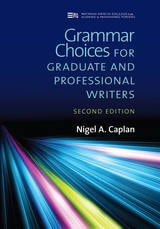
Grammar Choices for Graduate and Professional Writers, Second Edition
Nigel A. Caplan
University of Michigan Press, 2019
Each of the eight units in Grammar Choices contains: an overview of the grammar topic; a preview test that allows students to assess their control of the target grammar and teachers to diagnose areas of difficulty; an authentic example of graduate-student writing showing the unit grammar in use; clear descriptions of essential grammar structures using the framework of functional grammar, cutting-edge research in applied linguistics, and corpus studies; vocabulary relevant to the grammar point is introduced—for example, common verbs in the passive voice, summary nouns used with this/these, and irregular plural nouns; authentic examples for every grammar point from corpora and published texts; exercises for every grammar point that help writers develop grammatical awareness and use, including completing sentences, writing, revising, paraphrasing, and editing; and a section inviting writers to investigate discipline-specific language use and apply it to an academic genre.
Among the changes in the Second Edition are:
- new sections on parallel form (Unit 2) and possessives (Unit 5)
- revised and expanded explanations, but particularly regarding verb complementation, complement noun clauses, passive voice, and stance/engagement
- a restructured Unit 2 and significantly revised/updated Unit 7
- new Grammar Awareness tasks in Units 3, 5, and 6
- new exercises plus revision/updating of many others
- self-editing checklists in the Grammar in Your Discipline sections at the end of each unit
- representation of additional academic disciplines (e.g., engineering, management) in example sentences and texts and in exercises.
Grammatical Theory
Its Limits and Its PossibilitiesFrederick J. Newmeyer
University of Chicago Press, 1983
Newmeyer's formidable scholarship raises the level of debate on transformational generative grammar. He stresses the central importance of an autonomous formal grammar, discusses the limitations of "discourse-based" approaches to syntax, cites support for generativist theory in recent research, and clarifies misunderstood concepts associated with generative grammar.
Grammaticalization
A Conceptual FrameworkBernd Heine, Ulrike Claudi, and Friederike Hünnemeyer
University of Chicago Press, 1991
This volume challenges theories which describe language as a static system, as well as those which assume that linguistic categorization is based on discrete morpheme types, word classes, or sentence constituents. In contrast, the book's central argument is that both language structure and language use are dynamic phenomena and that linguistic behavior is essentially a creative activity. That creativity manifests itself, for example, in conceptual transfer leading to the encoding of more abstract concepts and of grammatical categories. Another key element of this theory is captured in the term "grammaticalization chain," which refers to a specific kind of linguistic category which cuts across morpheme types and word classes and has both a synchronic and diachronic dimension.
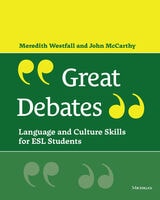
Great Debates
Language and Culture Skills for ESL StudentsMeredith Westfall and John McCarthy
University of Michigan Press, 2004
This book provides vocabulary, conversation tips, language learning tips, and discussion activities to help students debate on a wide variety of fairly non-controversial topics, from dining in or eating out, using the phone or e-mail, type A or type B, fiction or non-fiction, love at first sight or love over time, to diet or exercise.
Along with the discussion activities, the book contains some reading, writing, and vocabulary activities.
Each of the 30 units includes:
pre-debate discussion questions
new vocabulary words
a reading that outlines both sides of the debate
comprehension questions
discussion activities that include expressions used in debate-related speech acts and those pertaining to language learning
writing assignments
idiom and vocabulary review.

Greek Grammar of the New Testament and Other Early Christian Literature
Edited by Robert W. Funk
University of Chicago Press, 1961
This work was created by Friedrich Blass, professor of classical philology at the University of Halle-Wittenberg, and was continued after his death by Albert Debrunner, professor of Indo-European and classical philology at the University of Bern until his retirement in 1954. The grammar has passed through ten editions from 1896 to 1960.
Robert W. Funk, in translating this long-established classic, has also revised it and, in doing so, has incorporated the notes which Professor Debrunner had prepared for a new German edition on which he was working at the time of his death in 1958. Dr. Funk has also had the co-operation of leading British, Continental, and American scholars. The translation places in the hands of English-speaking students a book that belongs in their libraries and in the libraries of every theologian, philologist and pastor alongside the Gingrich-Danker Greek-English Lexicon.
This grammar sets the Greek of the New Testament in the context of Hellenistic Greek and compares and contrasts it with the classical norms. It relates to the New Testament language to its Semitic background, to Greek dialects, and to Latin and has been kept fully abreast of latest developments and manuscript discoveries. It is at no point exclusively dependent on modern editions of the Greek New Testament text but considers variant readings wherever they are significant. It is designed to compress the greatest amount of information into the smallest amount of space consistent with clarity. There are subsections discussing difficult or disputed points and copious citations of primary texts in addition to generous bibliographies for those who wish to pursue specific items further.
Greek for Reading
Gerda Seligson
University of Michigan Press, 1994