320 books match the query 'Legal status, laws, etc' and 13 start with g

cover of Game Faces: Sport Celebrity and the Laws of Reputation

Game Faces

Sport Celebrity and the Laws of Reputation

Sarah K. Fields

University of Illinois Press, 2016

Sports figures cope with a level of celebrity once reserved for the stars of stage and screen. In Game Faces , Sarah K. Fields looks at the legal ramifications of the cases brought by six of them--golfer Tiger Woods, quarterback Joe Montana, college football coach Wally Butts, baseball pitchers Warren Spahn and Don Newcombe, and hockey enforcer Tony Twist--when faced with what they considered attacks on their privacy and image. Placing each case in its historical and legal context, Fields examines how sports figures in the U.S. have used the law to regain control of their image. As she shows, decisions in the cases significantly affected the evolution of laws related to privacy, defamation, and publicity--areas pertinent to the lives of the famous sports figure and the non-famous consumer alike. She also tells the stories of why the plaintiffs sought relief in the courts, uncovering motives that delved into the heart of issues separating individual rights from the public's perceived right to know. A fascinating exploration of a still-evolving phenomenon, Game Faces is an essential look at the legal playing fields that influence our enjoyment of sports.
[more]
cover of Gangs on Trial: Challenging Stereotypes and Demonization in the Courts

Gangs on Trial

Challenging Stereotypes and Demonization in the Courts

John M. Hagedorn

Temple University Press, 2022

John Hagedorn, who has long been an expert witness in gang-related court cases, claims that what transpires in the trials of gang members is a far cry from what we would consider justice. In Gangs on Trial, he recounts his decades of experience to show how stereotypes are used against gang members on trial and why that is harmful. Hagedorn uses real-life stories to explain how implicit bias often replaces evidence and how the demonization of gang members undermines fairness. Moreover, a “them and us” mentality leads to snap judgments that ignore the complexity of gang life in America.

Gangs on Trial dispels myths about gangs and recommends tactics for lawyers, mitigation specialists, and expert witnesses as well as offering insights for jurors. Hagedorn describes how minds are subconsciously “primed” when a defendant is identified as a gang member, and discusses the “backfire effect,” which occurs when jurors hear arguments that run counter to their beliefs. He also reveals how attributional errors, prejudice, and racism impact sentences of nonwhite defendants.

Hagedorn argues that dehumanization is the psychological foundation of mass incarceration. Gangs on Trial advocates for practical sentencing reforms and humanizing justice.

[more]
cover of Gay Priori: A Queer Critical Legal Studies Approach to Law Reform

Gay Priori

A Queer Critical Legal Studies Approach to Law Reform

Libby Adler

Duke University Press, 2018

Libby Adler offers a comprehensive critique of the mainstream LGBT legal agenda in the United States, showing how LGBT equal rights discourse drives legal advocates toward a narrow array of reform objectives that do little to help the lives of the most marginalized members of the LGBT community.
[more]
cover of Gender and Justice in Family Law Disputes: Women, Mediation, and Religious Arbitration

Gender and Justice in Family Law Disputes

Women, Mediation, and Religious Arbitration

Edited by Samia Bano

Brandeis University Press, 2017

Recently, new methods of dispute resolution in matters of family law—such as arbitration, mediation, and conciliation—have created new forms of legal culture that affect minority communities throughout the world. There are now multiple ways of obtaining restitution through nontraditional alternative dispute resolution (ADR) mechanisms. For some, the emergence of ADRs can be understood as part of a broader liberal response to the challenges presented by the settlement of migrant communities in Western liberal democracies. Questions of rights are framed as “multicultural challenges” that give rise to important issues relating to power, authority, agency, and choice. Underpinning these debates are questions about the doctrine and practice of secularism, citizenship, belonging, and identity. Gender and Justice in Family Law Disputes offers insights into how women’s autonomy and personal decision-making capabilities are expressed via multiple formal and nonformal dispute-resolution mechanisms, and as part of their social and legal lived realities. It analyzes the specific ways in which both mediation and religious arbitration take shape in contemporary and comparative family law across jurisdictions. Demarcating lines between contemporary family mediation and new forms of religious arbitration, Bano illuminates the complexities of these processes across multiple national contexts.
[more]
cover of Gender and Violence in Haiti: Women’s Path from Victims to Agents

Gender and Violence in Haiti

Women’s Path from Victims to Agents

Benedetta Faedi Duramy

Rutgers University Press, 2014

Women in Haiti are frequent victims of sexual violence and armed assault. Yet an astonishing proportion of these victims also act as perpetrators of violent crime, often as part of armed groups. Award-winning legal scholar Benedetta Faedi Duramy visited Haiti to discover what causes these women to act in such destructive ways and what might be done to stop this tragic cycle of violence.

Gender and Violence in Haiti is the product of more than a year of extensive firsthand observations and interviews with the women who have been caught up in the widespread violence plaguing Haiti. Drawing from the experiences of a diverse group of Haitian women, Faedi Duramy finds that both the victims and perpetrators of violence share a common sense of anger and desperation. Untangling the many factors that cause these women to commit violence, from self-defense to revenge, she identifies concrete measures that can lead them to feel vindicated and protected by their communities.

Faedi Duramy vividly conveys the horrifying conditions pervading Haiti, even before the 2010 earthquake. But Gender and Violence in Haiti also carries a message of hope—and shows what local authorities and international relief agencies can do to help the women of Haiti.
[more]
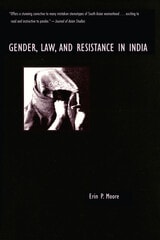
cover of Gender, Law, and Resistance in India

Gender, Law, and Resistance in India

Erin P. Moore

University of Arizona Press, 1988
Theft, poisoning, affairs, flights home, refusals to work, eat or have sex, threats to divide the joint household, and sly acts of sabotage are some of the domestic warfare tactics employed by Muslim women attempting to resist patriarchy. Gender, Law, and Resistance in India dramatically illustrates how a patriarchal ideology is upheld and reinforced through male-governed social and legal institutions and how women defy that control. Based on anthropological fieldwork in rural Rajasthan in northern India, Erin Moore's book details the life of an extended Muslim family she has known for twenty years. In many ways the plight of the central character, Hunni, is representative of dilemmas experienced by the majority of north Indian peasant women. Ultimately an account of cultural hegemony and defiance, Gender, Law, and Resistance in India reveals how so-called "modern" state institutions and practices reinforce traditional arrangements, resulting in women being silenced, deprived of equal rights before the law, and returned to their male guardians. Still, women resist in overt and covert ways. The first ethnographic work to focus principally on the law and legal institutions of gender and agency in South Asia, this unique volume examines the interpenetrations of north India's pluralistic legal systems. Moore adeptly connects engrossing case histories to national dialogues over women's rights, discussing these issues in terms of Muslim personal laws, secularism, and communal violence. Gender, Law, and Resistance in India is a rich and truly significant contribution to gender studies, South Asian studies, and sociolegal studies.
[more]
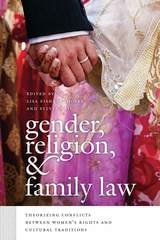
cover of Gender, Religion, and Family Law: Theorizing Conflicts between Women’s Rights and Cultural Traditions

Gender, Religion, and Family Law

Theorizing Conflicts between Women’s Rights and Cultural Traditions

Edited by Lisa Fishbayn Joffe and Sylvia Neil

Brandeis University Press, 2012
In many regions of the world, rights guaranteed under the civil law, including rights to gender equality within marriage and rights in the distribution of family property and child custody upon divorce, are in conflict with the principles of religious law. Women’s rights issues are often at the heart of these tensions, which present pressing challenges for theorists, lawyers, and policymakers. This anthology brings together leading scholars and activists doing innovative work in Jewish law, Muslim law, Christian law, and African customary law. Using examples drawn from a variety of nations and religions, they interrogate the utility of recent theoretical models for engaging with gender and multicultural conflicts, explore contextual differences, and analyze and celebrate stories of successful initiatives that have transformed legal and cultural norms to improve women’s lives.
[more]
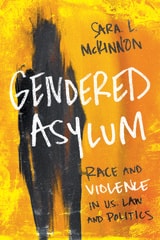
cover of Gendered Asylum: Race and Violence in U.S. Law and Politics

Gendered Asylum

Race and Violence in U.S. Law and Politics

Sara L. McKinnon

University of Illinois Press, 2016

Women filing gender-based asylum claims long faced skepticism and outright rejection within the United States immigration system. Despite erratic progress, the United States still fails to recognize gender as an established category for experiencing persecution. Gender exists in a sort of limbo segregated from other aspects of identity and experience.

Sara L. McKinnon exposes racialized rhetorics of violence in politics and charts the development of gender as a category in American asylum law. Starting with the late 1980s, when gender-based requests first emerged in case law, McKinnon analyzes gender- and sexuality-related cases against the backdrop of national and transnational politics. Her focus falls on cases as diverse as Guatemalan and Salvadoran women sexually abused during the Dirty Wars and transgender asylum seekers from around the world fleeing brutally violent situations. She reviews the claims, evidence, testimony, and message strategies that unfolded in these legal arguments and decisions, and illuminates how legal decisions turned gender into a political construct vulnerable to American national and global interests. She also explores myriad related aspects of the process, including how subjects are racialized and the effects of that racialization, and the consequences of policies that position gender as a signifier for women via normative assumptions about sex and heterosexuality.

Wide-ranging and rich with human detail, Gendered Asylum uses feminist, immigration, and legal studies to engage one of the hotly debated issues of our time.

[more]
cover of Girls of Liberty: The Struggle for Suffrage in Mandatory Palestine

Girls of Liberty

The Struggle for Suffrage in Mandatory Palestine

Margalit Shilo

Brandeis University Press, 2016

Following the Balfour Declaration and the British conquest of Palestine (1917–1918), the small Jewish community that lived there wanted to establish an elected assembly as its representative body. The issue that hindered this aim was whether women would be part of it. A group of feminist Zionist women from all over the country created a political party that participated in the elections, even before women’s suffrage was enacted. This unique phenomenon in Mandatory Palestine resulted in the declaration of women’s equal rights in all aspects of life by the newly founded Assembly of Representatives. Margalit Shilo examines the story of these activists to elaborate on a wide range of issues, including the Zionist roots of feminism and nationalism; the ultra-Orthodox Jewish sector’s negation of women’s equality; how traditional Jewish concepts of women fashioned rabbinical attitudes on the question of women’s suffrage; and how the fight for women’s suffrage spread throughout the country. Using current gender theories, Shilo compares the Zionist suffrage struggle to contemporaneous struggles across the globe, and connects this nearly forgotten episode, absent from Israeli historiography, with the present situation of Israeli women. This rich analysis of women’s right to vote within this specific setting will appeal to scholars and students of Israel studies, and to feminist and social historians interested in how contexts change the ways in which activism is perceived and occurs.
[more]
cover of Global Indios: The Indigenous Struggle for Justice in Sixteenth-Century Spain

Global Indios

The Indigenous Struggle for Justice in Sixteenth-Century Spain

Nancy E. van Deusen

Duke University Press, 2015
In the sixteenth century hundreds of thousands of indios—indigenous peoples from the territories of the Spanish empire—were enslaved and relocated throughout the Iberian world. Although various laws and decrees outlawed indio enslavement, several loopholes allowed the practice to continue. In Global Indios Nancy E. van Deusen documents the more than one hundred lawsuits between 1530 and 1585 that indio slaves living in Castile brought to the Spanish courts to secure their freedom. Because plaintiffs had to prove their indio-ness in a Spanish imperial context, these lawsuits reveal the difficulties of determining who was an indio and who was not—especially since it was an all-encompassing construct connoting subservience and political personhood and at times could refer to people from Mexico, Peru, or South or East Asia. Van Deusen demonstrates that the categories of free and slave were often not easily defined, and she forces a rethinking of the meaning of indio in ways that emphasize the need to situate colonial Spanish American indigenous subjects in a global context.
 
[more]
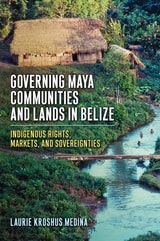
cover of Governing Maya Communities and Lands in Belize: Indigenous Rights, Markets, and Sovereignties

Governing Maya Communities and Lands in Belize

Indigenous Rights, Markets, and Sovereignties

Laurie Kroshus Medina

Rutgers University Press, 2024

Confronting a debt crisis, the Belizean government has strategized to maximize revenues from lands designated as state property, privatizing lands for cash crop production and granting concessions for timber and oil extraction. Meanwhile, conservation NGOs have lobbied to establish protected areas on these lands to address a global biodiversity crisis. They promoted ecotourism as a market-based mechanism to fund both conservation and debt repayment; ecotourism also became a mechanism for governing lands and people—even state actors themselves—through the market. Mopan and Q’eqchi’ Maya communities, dispossessed of lands and livelihoods through these efforts, pursued claims for Indigenous rights to their traditional lands through Inter-American and Belizean judicial systems. This book examines the interplay of conflicting forms of governance that emerged as these strategies intersected: state performances of sovereignty over lands and people, neoliberal rule through the market, and Indigenous rights-claiming, which challenged both market logics and practices of sovereignty.
[more]
cover of Governing the Global Clinic: HIV and the Legal Transformation of Medicine

Governing the Global Clinic

HIV and the Legal Transformation of Medicine

Carol A. Heimer

University of Chicago Press, 2025

A deep examination of how new, legalistic norms affected the trajectory of global HIV care and altered the practice of medicine.

HIV emerged in the world at a time when medicine and healthcare were undergoing two major transformations: globalization and a turn toward legally inflected, rule-based ways of doing things. It accelerated both trends. While pestilence and disease are generally considered the domain of biological sciences and medicine, social arrangements—and law in particular—are also crucial.

Drawing on years of research in HIV clinics in the United States, Thailand, South Africa, and Uganda, Governing the Global Clinic examines how growing norms of legalized accountability have altered the work of healthcare systems and how the effects of legalization vary across different national contexts. A key feature of legalism is universalistic language, but, in practice, rules are usually imported from richer countries (especially the United States) to poorer ones that have less adequate infrastructure and fewer resources with which to implement them. Challenging readers to reconsider the impulse to use law to organize and govern social life, Governing the Global Clinic poses difficult questions: When do rules solve problems, and when do they create new problems? When do rules become decoupled from ethics, and when do they lead to deeper moral commitments? When do rules reduce inequality? And when do they reflect, reproduce, and even amplify inequality?

[more]
cover of Grounded Authority: The Algonquins of Barriere Lake against the State

Grounded Authority

The Algonquins of Barriere Lake against the State

Shiri Pasternak

University of Minnesota Press, 2017

Western Political Science Association's Clay Morgan Award for Best Book in Environmental Political Theory
Canadian Studies Network Prize for the Best Book in Canadian Studies
Nominated for Best First Book Award at NAISA
Honorable Mention: Association for Political and Legal Anthropology Book Prize


Since Justin Trudeau’s election in 2015, Canada has been hailed internationally as embarking on a truly progressive, post-postcolonial era—including an improved relationship between the state and its Indigenous peoples. Shiri Pasternak corrects this misconception, showing that colonialism is very much alive in Canada. From the perspective of Indigenous law and jurisdiction, she tells the story of the Algonquins of Barriere Lake, in western Quebec, and their tireless resistance to federal land claims policy. 

Grounded Authority chronicles the band’s ongoing attempts to restore full governance over its lands and natural resources through an agreement signed by settler governments almost three decades ago—an agreement the state refuses to fully implement. Pasternak argues that the state’s aversion to recognizing Algonquin jurisdiction stems from its goal of perfecting its sovereignty by replacing the inherent jurisdiction of Indigenous peoples with its own, delegated authority. From police brutality and fabricated sexual abuse cases to an intervention into and overthrow of a customary government, Pasternak provides a compelling, richly detailed account of rarely documented coercive mechanisms employed to force Indigenous communities into compliance with federal policy.

A rigorous account of the incredible struggle fought by the Algonquins to maintain responsibility over their territory, Grounded Authority provides a powerful alternative model to one nation’s land claims policy and a vital contribution to current debates in the study of colonialism and Indigenous peoples in North America and globally.

[more]