Results by title
328 books match the query 'Literature and society' and 4 start with g

German Writing, American Reading
Women and the Import of Fiction, 1866–1917Lynne Tatlock
The Ohio State University Press, 2012
In postbellum America, publishers vigorously reprinted books that were foreign in origin, and Americans thus read internationally even at a moment of national consolidation. A subset of Americans’ international reading—nearly 100 original texts, approximately 180 American translations, more than 1,000 editions and reprint editions, and hundreds of thousands of books strong—comprised popular fiction written by German women and translated by American women. German Writing, American Reading: Women and the Import of Fiction, 1866–1917 by Lynne Tatlock examines the genesis and circulation in America of this hybrid product over four decades and beyond. These entertaining novels came to the consumer altered by processes of creative adaptation and acculturation that occurred in the United States as a result of translation, marketing, publication, and widespread reading over forty years. These processes in turn de-centered and disrupted the national while still transferring certain elements of German national culture. Most of all, this mass translation of German fiction by American women trafficked in happy endings that promised American readers that their fondest wishes for adventure, drama, and bliss within domesticity and their hope for the real power of love, virtue, and sentiment could be pleasurably realized in an imagined and quaintly old-fashioned Germany—even if only in the time it took to read a novel.
[more]
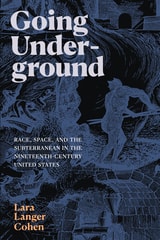
Going Underground
Race, Space, and the Subterranean in the Nineteenth-Century United StatesLara Langer Cohen
Duke University Press, 2023
First popularized by newspaper coverage of the Underground Railroad in the 1840s, the underground serves as a metaphor for subversive activity that remains central to our political vocabulary. In Going Underground, Lara Langer Cohen excavates the long history of this now familiar idea while seeking out versions of the underground that were left behind along the way. Outlining how the underground’s figurative sense first took shape through the associations of literal subterranean spaces with racialized Blackness, she examines a vibrant world of nineteenth-century US subterranean literature that includes Black radical manifestos, anarchist periodicals, sensationalist exposés of the urban underworld, manuals for sex magic, and the initiation rites of secret societies. Cohen finds that the undergrounds in this literature offer sites of political possibility that exceed the familiar framework of resistance, suggesting that nineteenth-century undergrounds can inspire new modes of world-making and world-breaking for a time when this world feels increasingly untenable.
[more]
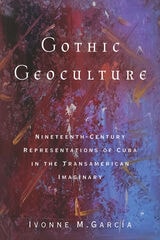
Gothic Geoculture
Nineteenth-Century Representations of Cuba in the Transamerican ImaginaryIvonne M. García
The Ohio State University Press, 2019
In the nineteenth century, the island of Cuba was a popular site for US travelers, who wrote dozens of travelogues about their experiences. At the same time, Cuban exiles living in the United States, escaping from Spanish colonial repression, wrote about their island and about their US experiences. Within the trove of writings about Cuba in relation to slavery and a rising US empire in the region, Ivonne M. García’s Gothic Geoculture: Nineteenth-Century Representations of Cuba in the Transamerican Imaginary shows how a group of writers, on both sides, used the language of fear to construct gothicizations of the island (and of the United States) through tropes of corruption, doubleness, and monstrosity. García coins the term “gothic geoculture” to show Cuba’s identity in the nineteenth century as existing at the crossroads between colonialism, slavery, and transamericanity. Specifically looking at a period of colonial anxiety between 1830 and 1890, García exposes the ways some writers code Cuba as dangerous and destructive, demonstrating how these transamerican figurations created a series of uncanny simultaneities that expand on and complicate the ways we understand how Cuba and the hemisphere were imagined at that time.
[more]
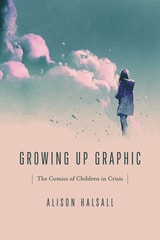
Growing Up Graphic
The Comics of Children in CrisisAlison Halsall
The Ohio State University Press, 2023
Honor Book, Children's Literature Association Book Award 2025
In Growing Up Graphic, Alison Halsall considers graphic texts for young readers to interrogate how they help children develop new ideas about social justice and become potential agents of change. With a focus on comics that depict difficult experiences affecting young people, Halsall explores the complexities of queer graphic memoirs, narratives of belonging, depictions of illness and disability, and explorations of Indigenous experiences. She discusses, among others, Child Soldier by Jessica Dee Humphreys and Michel Chikwanine, War Brothers by Sharon E. McKay, Baddawi by Leila Abdelrazaq, Matt Huynh’s interactive adaptation of Nam Le’s The Boat, and David Alexander Robertson’s 7 Generations. These examples contest images of childhood victimization, passivity, and helplessness, instead presenting young people as social actors who attempt to make sense of the challenges that affect them. In considering comics for children and about children, Growing Up Graphic centers a previously underexplored vein of graphic narratives and argues that these texts offer important insights into the interests and capabilities of children as readers.
In Growing Up Graphic, Alison Halsall considers graphic texts for young readers to interrogate how they help children develop new ideas about social justice and become potential agents of change. With a focus on comics that depict difficult experiences affecting young people, Halsall explores the complexities of queer graphic memoirs, narratives of belonging, depictions of illness and disability, and explorations of Indigenous experiences. She discusses, among others, Child Soldier by Jessica Dee Humphreys and Michel Chikwanine, War Brothers by Sharon E. McKay, Baddawi by Leila Abdelrazaq, Matt Huynh’s interactive adaptation of Nam Le’s The Boat, and David Alexander Robertson’s 7 Generations. These examples contest images of childhood victimization, passivity, and helplessness, instead presenting young people as social actors who attempt to make sense of the challenges that affect them. In considering comics for children and about children, Growing Up Graphic centers a previously underexplored vein of graphic narratives and argues that these texts offer important insights into the interests and capabilities of children as readers.
[more]