Results by title
683 books match the query 'Middle East' and 13 start with g

German Jerusalem
The Remarkable Life of a German-Jewish Neighborhood in the Holy CityThomas Sparr
Haus Publishing, 2024
In the 1920s, before the establishment of Israel, a group of German Jews settled in a garden city on the outskirts of Jerusalem. During World War II, their quiet community, nicknamed Grunewald on the Orient, emerged as both an immigrant safe haven and a lively expatriate hotspot, welcoming many famous residents including poet-playwright Else Lasker-Schüler, historian Gershom Scholem, and philosopher Martin Buber. It was an idyllic setting, if fraught with unique tensions on the fringes of the long-divided holy city. After the war, despite the weight of the Shoah, the neighborhood miraculously repaired shattered bonds between German and Israeli residents. In German Jerusalem, Thomas Sparr opens up the history of this remarkable community and the forgotten borderland they called home.
German Literature on the Middle East
Discourses and Practices, 1000-1989Nina Berman
University of Michigan Press, 2013
German Literature on the Middle East explores the dynamic between German-speaking and Middle Eastern states and empires from the time of the Crusades to the end of the Cold War. This insightful study illuminates the complex relationships among literary and other writings on the one hand, and economic, social, and political processes and material dimensions on the other. Focusing on German-language literary and nonfiction writings about the Middle East (including historical documents, religious literature, travel writing, essays, and scholarship), Nina Berman evaluates the multiple layers of meaning contained in these works by emphasizing the importance of culture contact; a wide web of political, economic, and social practices; and material dimensions as indispensible factors for the interpretive process.
This analysis of literary and related writing reveals that German views about the Middle East evolved over the centuries and that various forms of action toward the Middle East differed substantially as well. Ideas about religion, culture, race, humanism, nation, and modernity, which emerged successively but remain operative to this day, have fashioned Germany's changed attitudes toward the Middle East. Exploring the interplay between textual discourses and social, political, and economic practices and materiality, German Literature on the Middle East offers insights that challenge accepted approaches to the study of literature, particularly approaches that insist on the centrality of the linguistic construction of the world. In addition, Berman presents evidence that the German encounter with the Middle East is at once distinct and yet at the same time characterized by patterns shared with other European countries. By addressing the individual nature of the German encounter in the larger European context, this study fills a considerable gap in current scholarship.
The interdisciplinary approach of German Literature on the Middle East will be of interest to the humanities in general, and specifically to scholars of German studies, comparative literature, Middle Eastern studies, and history.
Nina Berman is Professor of Comparative Studies at The Ohio State University.
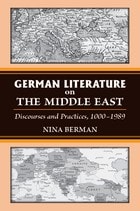
Jacket image: Map of Europe by Giovanni Magini, from his “Geography.” Venice, [1598]. From the University of Michigan Map Library.
Political Map of the World, April 2008. From the University of Texas Perry-Castañeda Library, Map Collection.
Getting Rich in Late Antique Egypt
Ryan E. McConnell
University of Michigan Press, 2017
Ryan E. McConnell connects the family’s rise in wealth and status to its role in tax collection on behalf of the Byzantine state, rather than a reliance on productive surpluses. Close analysis of low- and high-level accounts from the Apion estate, as well as documentation from comparable Roman and Byzantine Egyptian estates, corroborate this conclusion. Additionally, McConnell offers a third way into the ongoing debate over whether the Apions’ relationship with the state was antagonistic or cooperative, concluding that the relationship was that of parties in a negotiation, with each side seeking to maximize its own benefit. The application of modern economic concepts—as well as comparisons to the economies of Athens, Rome, Ptolemaic Egypt, and Early Modern France—further illuminate the structure and function of the estate in Late Antique Egypt.
Getting Rich in Late Antique Egypt will be a valuable resource for philologists, archaeologists, papyrologists, and scholars of Late Antiquity. It will also interest scholars of agricultural, social, and economic history.
Ghady & Rawan
By Fatima Sharafeddine and Samar Mahfouz Barraj, translated by M. Lynx Qualey and Sawad Hussain
University of Texas Press, 2019
Ghady and Rawan is a heartfelt and timely novel by the award-winning author Fatima Sharafeddine (The Servant, Cappuccino) and Samar Mahfouz Barraj. The novel follows the close-knit friendship of two Lebanese teenagers, Ghady, who lives with his family in Belgium, and Rawan, who lives in Lebanon. Ghady’s family travels every summer to Beirut, where Ghady gets to spend all his time with Rawan and their other friends, enjoying their freedom from school. During the rest of the year, he and Rawan keep in touch by email. Through this correspondence, we learn about the daily ups and downs of their lives in Brussels and Beirut, including Ghady’s homesickness and his struggles with racism at school, as well as Rawan’s changing relationship to her family. The novel offers a glimpse into the lives of Lebanese adolescents while exploring a range of topics relevant to young people everywhere: bullying, parental conflicts, racism, belonging and identity, and peer pressure. Through the connection between the two main characters, Sharafeddine and Mahfouz Barraj show how the love and support of a good friend can help you through difficulties as well as sweeten life’s triumphs and good times.
Ghost Riders of Baghdad
Soldiers, Civilians, and the Myth of the SurgeDaniel A. Sjursen
University Press of New England, 2015
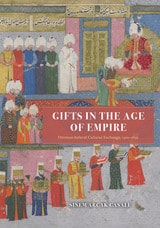
Gifts in the Age of Empire
Ottoman-Safavid Cultural Exchange, 1500–1639Sinem Arcak Casale
University of Chicago Press, 2023
When the Safavid dynasty, founded in 1501, built a state that championed Iranian identity and Twelver Shi'ism, it prompted the more established Ottoman Empire to align itself definitively with Sunni legalism. The political, religious, and military conflicts that arose have since been widely studied, but little attention has been paid to their diplomatic relationship. Sinem Arcak Casale here sets out to explore these two major Muslim empires through a surprising lens: gifts. Countless treasures—such as intricate carpets, gilded silver cups, and ivory-tusk knives—flowed from the Safavid to the Ottoman Empire throughout the sixteenth century. While only a handful now survive, records of these gifts exist in court chronicles, treasury records, poems, epistolary documents, ambassadorial reports, and travel narratives. Tracing this elaborate archive, Casale treats gifts as representative of the complicated Ottoman-Safavid coexistence, demonstrating how their rivalry was shaped as much by culture and aesthetics as it was by religious or military conflict. Gifts in the Age of Empire explores how gifts were no mere accessories to diplomacy but functioned as a mechanism of competitive interaction between these early modern Muslim courts.

Girls of Liberty
The Struggle for Suffrage in Mandatory PalestineMargalit Shilo
Brandeis University Press, 2016
Global Lynching and Collective Violence
Volume 1: Asia, Africa, and the Middle EastEdited by Michael J. Pfeifer
University of Illinois Press, 2017
Gods in Dwellings
Temples and Divine Presence in the Ancient Near EastMichael B. Hundley
SBL Press, 2013
In this book devoted exclusively to temples and perceptions of the divine presences that inhabit them, Michael B. Hundley focuses on the official religions of the ancient Near East and explores the interface between the human and the divine within temple environs.
Hundley identifies common ancient Near Eastern temple systems and examines issues that include what temple structures communicate, how temples were understood to function, temple ideology, the installation of divine presence in a temple, the connection between presence and physical representation, and human service to the deity.
Drawing on architectural and spatial theory, ritual theory, theories of language, art history, archaeology, sociocultural anthropology, and comparative studies, Hundley offers a single interpretive lens through which to view temple worship.
Features:
- A close examination of temples in Egypt, Mesopotamia, Hittite Anatolia, and Syria-Palestine
- An interdisciplinary treatment of architecture, language, ritual, and art
- A dual focus on how a deity's divine presence connects to space and art and how human service to the deity maintains the deity's active presence
Governing Gaza
Bureaucracy, Authority, and the Work of Rule, 1917–1967Ilana Feldman
Duke University Press, 2008
Drawing on archival research in Gaza, Cairo, Jerusalem, and London, as well as two years of ethnographic research with retired civil servants in Gaza, Feldman identifies two distinct, and in some ways contradictory, governing practices. She illuminates mechanisms of “reiterative authority” derived from the minutiae of daily bureaucratic practice, such as the repetitions of filing procedures, the accumulation of documents, and the habits of civil servants. Looking at the provision of services, she highlights the practice of “tactical government,” a deliberately restricted mode of rule that makes limited claims about governmental capacity, shifting in response to crisis and operating without long-term planning. This practice made it possible for government to proceed without claiming legitimacy: by holding the question of legitimacy in abeyance. Feldman shows that Gaza’s governments were able to manage under, though not to control, the difficult conditions in Gaza by deploying both the regularity of everyday bureaucracy and the exceptionality of tactical practice.

Governing Genealogies of International Film Education
Hadi Gharabaghi and Terri Ginsberg
Temple University Press, 2026
The editors of and contributors to Governing Genealogies of International Film Education offer a critical historiographic understanding of governmentalized film education during the Cold War. Chapters examine the production of hygiene and cultural films in Travancore, India during the postcolonial period, and Michigan State University’s documentary collaboration with Iran during the 1970s, among other topics, elucidating cinema’s deployment as a state apparatus and its implications for global cultures, subject positions, and social relations.
Governing Genealogies of International Film Education investigates this distinct modality of cultural production and policy to shed necessary light on the ideological overdetermination of institutionalized film education as well as on audiovisual education as an international academic discipline. The contributors show how governmentalized film education has taught American exceptionalism, hegemony, and colonialism. They also theorize about and provide methodological examples of how film archives and film studies have framed prevailing understandings of cinema’s role in American and world history.
Contributors: Kaveh Askari, Zoë Druick, Bindu Menon Mannil, Wissam Mouawad, and the editors
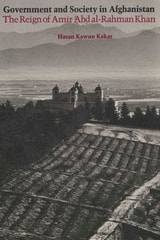
Government and Society in Afghanistan
The Reign of Amir ‘Abd al-Rahman KhanBy Hasan Kawun Kakar
University of Texas Press, 1979
This is an authoritative study of the administrative, social, and economic structure of Afghanistan during a decisive stage in its history. The period covered—the reign of the "Iron" Amir Rahman Khan—was in many ways the beginning of modern Afghanistan as a cohesive nation. Although Afghanistan had emerged as an entity in 1747, it was actually under the Amir that its borders were established, its internal unification completed, and the modern concept of nationhood implanted.
Kakar approaches this complex process by taking into consideration both the internal and the external forces that influenced its development. Thus, modernization, centralization, and nationalization are seen as both defensive reactions to European imperialism and necessary preconditions to capital formation and, consequently, industrialization.
The first part of the book covers the government of the Amir, from the personality of the ruler down to the operation of his new bureaucrats at the local level. Here Kakar presents a comprehensive treatment of the Afghan system of taxation and local government. The second part views these economic and social institutions from the perspective of the major segments of the populace—nomads, townsmen, tribes, women, slaves, landowners, mullahs, merchants, and so forth.
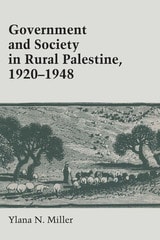
Government and Society in Rural Palestine, 1920-1948
By Ylana N. Miller
University of Texas Press, 1985
In 1947, Arabs made up two-thirds of the population of Palestine, and they owned most of its cultivable land. Why then, did they "lose" their homes and land to a relatively small Jewish community just emerging from the shocks of World War II? Did the Palestinians "lose" their homeland because they were backward, primitive, and reactionary? Or was Israel the product of persistent victimization of Palestinian Arabs by an imperialist power which supported Zionist colonization? Did the Palestinians sell each other out? Or were they helpless sufferers in the face of a sophisticated enemy with endless resources?
Too often discussions of Palestine are couched in such rhetorical language, based on the assumption that either Jews or Arabs are morally to blame for historical realities. This study seeks to go beyond attributions of responsibility to investigate the concrete conditions which determined and limited Palestinian Arab actions between 1920 and 1948. It was during that period, while Great Britain governed the area under a League of Nations mandate, that Palestine both emerged and disappeared as a modern political entity.
Many studies of Palestinian Arab nationalism have looked to Zionism as the primary agent of change in the region. Miller assumes the impact of Jewish settlement but goes beyond these earlier studies to explore the way in which policies of the Palestine government affected the daily lives of villagers—the majority of the population—and their understanding of the changes occurring around them. In this way, what emerges is a detailed analysis of the influence, for good or ill, that government policy had on village community life.
Based largely on archival sources never before used, this work allows the reader to gain a deeper appreciation of the internal life of the rural community, which had previously received relatively little attention. Understanding the experiences of Palestinians before 1948 helps us to comprehend immeasurably better the continuity of movements for Palestinian statehood as well as the continuing tensions and problems on the West Bank today.