Results by title
30 books match the query 'Before'
After and Before the Lightning
Simon J. Ortiz
University of Arizona Press, 1994
Acoma Pueblo poet Ortiz spent a winter in South Dakota, teaching at Sinte Gleska College on the Rosebud Lakota Sioux Reservation. The bitter cold and driving snow of a prairie winter were a reality commanding his attention through its absolute challenge to survival and the meaning of survival.
Ortiz's way of dealing with the hard elements of winter was to write After and Before the Lightning, prose and verse poems that were his response to that long season between the thunderstorms of autumn and spring. "I needed a map of where I was and what I was doing in the cosmos," he writes. In these poems, which he regards as a book-length poetic work, he charts the vast spaces of prairie and time that often seem indistinguishable. As he faces the reality of winter on the South Dakota reservation, he also confronts the harsh political reality for its Native community and culture and for Indian people everywhere.
"Writing this poetry reconnected me to the wonder and awe of life," Ortiz states emphatically. Readers will feel the reality of that wonder and awe—and the cold of that South Dakota winter—through the gentle ferocity of his words.
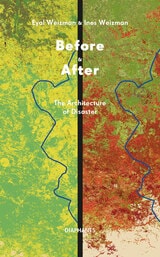
Before & After
The Architecture of DisasterEyal Weizman and Ines Weizman
Diaphanes, 2025
Catastrophes, bombed-out cities, large-scale political transformations: “Image complexes” of humanitarian and ecological upheaval document the world as a sequence of catastrophes. But who decides how events are presented, determines the resolution of our visual worlds, and controls the circulation or censorship of images?
Eyal and Ines Weizman trace the history of the before-and-after image from nineteenth-century photography to contemporary satellite images and discover a gap that not only conceals the devastating event: it is the human subject itself that is in danger of disappearing from the images. Does humanitarian work, the documentation and reconstruction of war crimes, in which people’s fates and rights should be at the center of attention, paradoxically enter a post-human phase? How can the gap between images become a site of critical counter-reading rather than a symbol of erasure?
In the context of their current research, Eyal and Ines Weizman discuss the history, present, and future of the paradigm of the before-and-after image in an exclusive conversation with Marie Glassl.
Before Before
A Story of Discovery and Loss in Sierra LeoneBetsy Small
University of Michigan Press, 2025
2025 Foreword INDIES Finalist for Political and Social Sciences
- 2026 Nautilus Silver Book Award in World Cultures' Transformational Growth & Development
Sierra Leone is often sensationalized as a place of extreme violence and suffering—of blood diamonds, child soldiers, war amputations, and Ebola and now the highly addictive drug Kush. Before Before captures daily life in a different country, one Betsy Small first encountered as a Peace Corps worker between 1984–1987, and then rediscovered when she returned decades later with her daughter. Living in Tokpombu, a remote community of forty rice-farming families, the author faced struggles that changed her forever and witnessed the growing tensions in this rainforest village—between the young and old, between the traditions of oral history and honoring the ancestors valued by the elders and the siren call of the illicit diamond mines faced by the youth.
Before Before offers a rare portrait of everyday people, with particular focus on the lives of women and girls, before the brutal war of 1991 tore the country apart. Through Small’s account of immersion in another world as she witnessed injustice and was welcomed as a friend, readers are invited to explore the shared ground of our humanity.
Before THE BIG BONANZA
Dan De Quille's Early Comstock AccountsEdited by Donnelyn Curtis and Lawrence I. Berkove
University of Missouri Press, 2015

Before and After Gender
Sexual Mythologies of Everyday LifeMarilyn Strathern
HAU, 2016
Strathern incisively engages some of the leading feminist thinkers of the time, including Shulamith Firestone, Simone de Beauvoir, Ann Oakley, and Kate Millett. Building with characteristic precision toward a bold conclusion in which she argues that we underestimate the materializing grammars of sex and gender at our own peril, she offers a powerful challenge to the intransigent mythologies of sex that still plague contemporary society. The result is a sweeping display of Strathern’s vivid critical thought and an important contribution to feminist studies that has gone unpublished for far too long.
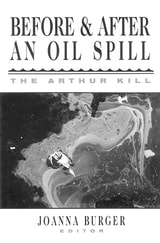
Before and After an Oil Spill
The Arthur KillBurger, Joanna
Rutgers University Press, 1994
In January 1990, the New York Harbor suffered a major oil spill when an underwater pipe at an Exxon refinery leaked into the Arthur Kill, the fifteen-mile strait that runs between New Jersey and Staten Island. The waterway is home to herons and egrets, fiddler crabs and sea turtles, and a favorite place for recreational fishing, bird-watching, hiking, and boating. It is also lined with refineries and a busy corridor for oil tankers. Because this industrial activity posed such an imposing threat to the fragile ecosystem, biologists had been monitoring the region’s water, soil, vegetation, and wildlife for some time before the oil spill. Thus, we have before -and-after data about the habitat—the only oil spill anywhere for which this is true.
This unique book discusses the human consequences of the oil spill as well as providing detailed studies of its effects on the plants and animals of the Arthur Kill. Biologists, environmentalists, lawyers, and officials worldwide will find this book an essential guide to dealing with—and possibly preventing—future environmental disasters.
The contributors areJohn Brzorad, Angela Christini, Keith Cooper, Lynn Frink, Michael Gochfeld, Paul Hauge, Gordon Johnson, Alan D. Maccarone, Katherine Parsons, Carolyn Summers, Robert Tucker.
Before the Ballot
Building Political Support for Library FundingJohn Chrastka
American Library Association, 2018
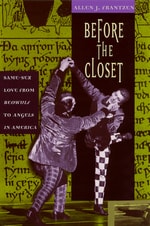
Before the Closet
Same-Sex Love from "Beowulf" to "Angels in America"Allen J. Frantzen
University of Chicago Press, 1998
With its ambitious scope and elegant style, Before the Closet sets same-sex relations in Anglo-Saxon sources in relation to the sexual themes of contemporary opera, dance, and theatre. Frantzen offers a comprehensive analysis of sources from the seventh to the twelfth century and traces Anglo-Saxon same-sex behavior through the age of Chaucer and into the Renaissance.
"Frantzen's marvelous book . . . opens up a world most readers will never have even known was there. It's a difficult topic, but Frantzen's comprehensive, readable and even wryly funny treatment makes this an unexpected pleasure."—Publishers Weekly, starred review
Before the Convention
Strategies and Choices in Presidential Nomination CampaignsJohn H. Aldrich
University of Chicago Press, 1980
Campaigns to win the Democratic and Republican presidential nominations are longer, more complex, and more confusing to the observer than the general election itself. The maze of delegate-selection procedures includes state primaries and caucuses as well as the traditional "smoke-filled room." Complicated federal election laws govern campaign financing. Sometimes many candidates enter and drop out of the race, while sometimes a stable two-way contest occurs: the 1976 nomination campaigns of Jimmy Carter and Gerald Ford exemplified each extreme. Is it possible to propose general principles to explain the apparent chaos of our presidential nomination system? Can those principles account for two such starkly different campaigns as occurred in 1976? In Before the Convention, political scientist John H. Aldrich presents a systematic analysis of presidential nomination politics, based on application of rational-choice models to candidate behavior. Aldrich views the candidates as decision makers with limited resources in a highly competitive environment. From this perspective, he seeks to determine why and how candidates choose to run, why some succeed and others fail, and what consequences the nomination process has for the general election and, later, for the President in office.
Aldrich begins with a brief history of the presidential selection process, focusing on the continuing shift of power from political elites to the mass electorate. He then turns to a detailed analysis of the 1976 nomination campaigns. Using data from a variety of sources, Aldrich demonstrates that the very different patterns in these races both conform to the rational-choice model. The analysis includes consideration of numerous questions of strategy. Is there a "momentum" to campaigns? How does a candidate identify and exploit this intangible quality? How do candidates decide where to contend and where not to contend? What is the nature of policy competition among candidates? When does a candidate prefer a "fuzzy" position to a clearly stated one? Other topics include reforms in campaign financing and the expanded and changed role of news coverage.
Before the Convention fills a significant gap in the literature on presidential politics, and therefore should be of particular importance to specialists in this area. It will be ofinterest also to everyone who is concerned with understanding the "rules of the game" for a complicated but vitally important exercise of American democracy.
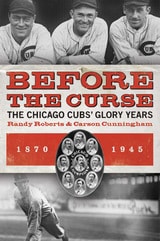
Before the Curse
The Chicago Cubs' Glory Years, 1870-1945Edited by Randy Roberts and Carson Cunningham
University of Illinois Press, 2012
Before the Dissertation
A Textual Mentor for Doctoral Students at Early Stages of a Research ProjectChristine Pearson Casanave
University of Michigan Press, 2014
“This very readable book is what every graduate student needs as they start a program. I wish my own MA and PhD students, during my 40 years of supervising, could have been demystified by having Casanave's ‘textual mentor' as a companion."
--Merrill Swain, Professor Emerita, OISE, University of Toronto
“Before the Dissertation is an insightful, relevant, and accessible resource for doctoral students at any stage. Full of reflections and advice not found in other books, it serves as an indispensable guide for students and their supervisors. And the dispelling of myths is a superb idea!”
--Robert Kohls, PhD candidate, University of Toronto
Before the Dissertation speaks to an audience in the social sciences, but in particular to doctoral students who have experience with and interest in international, multilingual, as well as native English speaking students and settings and who wish to investigate topics in (second) language and multicultural-transcultural education. Athough appropriate for use in English-dominant doctoral programs throughout the world, the book will relate more closely to students in the North American educational system than to ones, for example, in the British system. The main audience for this book is thus doctoral students who are first or second/additional users of English, who are interested in pursuing topics in one of the social sciences, including education and multilingual inquiry, and who may just be finishing course work in an English-dominant university and are wondering what might happen next.
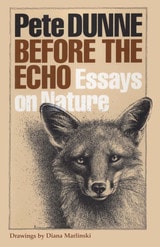
Before the Echo
Essays on NatureBy Pete Dunne
University of Texas Press, 1995
"The natural world is a lot like a game of musical chairs," observes Pete Dunne. "Everywhere you turn, everywhere you go, there are places where living things sit down, niches that support their specific needs. But just as in musical chairs, there aren't enough places to go around. Our species keeps removing them—forcing other creatures to leave the game."
In these twenty-nine essays, one of America's top nature writers trains his sights on the beauties and the vulnerabilities of the natural world. Writing to infuse others with a sense of the richness and diversity that nature holds, Pete Dunne ranges over topics from the wonder of the year's first snowfall to the lost art of stargazing to the mysterious forces that impel people to hunt—and not to hunt. Running like a thread through all the essays is Dunne's desire to preserve all that is "natural" in nature, to stop our unthinking destruction of wild places and wild creatures before we humans find ourselves with "the last chair, in an empty room" on an impoverished earth.

Before the Fire Dogs Steal the Sun
An ElegyCrystal Mun-hye Baik
Duke University Press, 2026
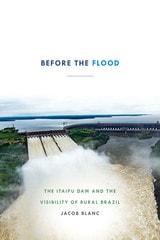
Before the Flood
The Itaipu Dam and the Visibility of Rural BrazilJacob Blanc
Duke University Press, 2019
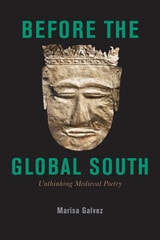
Before the Global South
Unthinking Medieval PoetryMarisa Galvez
University of Chicago Press, 2026
A bold approach to the work of contemporary, Indigenous, and other emergent artists as revisionist adaptations of medieval lyric poetry.
In this book, Marisa Galvez gathers an eclectic array of contemporary poets, artists, writers, and translators—from Brazilian poet Augusto de Campos and Irish painter Louis le Brocquy, to Occitanists Gérard Zuchetto and Jean-Louis Séverac, to Martinican writer Édouard Glissant, poet Rosanna Warren, and essayist Eliot Weinberg—to explore how they reimagine medieval European lyric forms. Galvez calls these adaptations unthought medievalism, and in Before the Global South, she argues that we should understand them as a mode of inquiry that is at once scholarly, critical, and creative. In these modern innovations, Galvez finds an expression of the medieval that challenges popular and scholarly dogmas alike, one she believes can inspire us to create a more shared, global world.
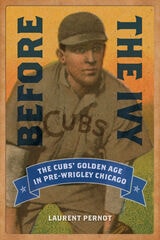
Before the Ivy
The Cubs' Golden Age in Pre-Wrigley ChicagoLaurent Pernot
University of Illinois Press, 2015
BEHOLD the 1871 team as it plays for the title in nine different borrowed uniforms after losing everything in the Great Chicago Fire
ATTEND West Side Grounds at Polk and Wolcott with its barbershop quartet
MARVEL as superstar Cap Anson hits .399, makes extra cash running a ballpark ice rink, and strikes out as an elected official
WONDER at experiments with square bats and corked balls, the scandal of Sunday games and pre-game booze-ups, the brazen spitters and park dimensions changed to foil Ty Cobb
RAZZ Charles Comiskey as he adopts a Cubs hand-me-down moniker for his team's name
THRILL to the poetic double-play combo of Tinker, Evers, and Chance even as they throw tantrums at umpires and punches at each other
CHEER as Merkle's Boner and the Cubs' ensuing theatrics send the team to the 1908 World Series
Rich with Hall of Fame personalities and oddball stories, Before the Ivy opens a door to Chicago's own field of dreams and serves as every Cub fan's guide to a time when thoughts of "next year" filled rival teams with dread.

Before the Law
Humans and Other Animals in a Biopolitical FrameCary Wolfe
University of Chicago Press, 2012

Before the Law
The Complete Text of PréjugésJacques Derrida
University of Minnesota Press, 2018
Thinking judgment in relation to the work of Jean-François Lyotard
“How to judge—Jean-François Lyotard?” It is from this initial question that one of France’s most heralded philosophers of the twentieth century begins his essay on the origin of the law, of judgment, and the work of his colleague Jean-François Lyotard. If Jacques Derrida begins with the term préjugés, it is in part because of its impossibility to be rendered properly in other languages and also contain all its meanings: to pre-judge, to judge before judging, to hold prejudices, to know “how to judge,” and more still, to be already prejudged oneself.
Striving to contain that which comes before the law, that is in front of the law and also prior to it, how to judge Jean-François Lyotard then becomes perhaps a beneficial attempt for Derrida to explore humanity’s rapport with judgment, origins, and naming. For how does one come to judge the author of the Differend? How does one abstain from judgment to accept the term préjugés as suspending judgment and at once as taking into account the impossibility of speaking before the law, prior to naming or judging? If this task indeed seems insurmountable, it is the site where Lyotard’s work itself is played out. Hence this sincere and intriguing essay presented by Jacques Derrida, published here for the first time in English.
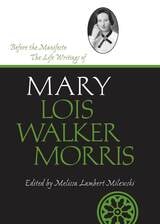
Before the Manifesto
The Life Writings of Mary Lois Walker MorrisMelissa Lambert Milewski
Utah State University Press, 2007
Mary Morris's memoir frames her 1879 to 1887 diary with both reflections on earlier years and passages that parallel entries in the day book, giving readers a better understanding of how she retrospectively saw her life. The thoroughly annotated diary offers the daily experience of a woman who kept a largely self-sufficient household, had a wide social network, ran her own business, wrote poetry, and was intellectually curious. The years of "the Raid" (federal prosecution of polygamists) led Mary and Elias Morris to hide their marriage on "the underground," and her to perjury in court during Elias's trial for unlawful cohabitation. The book ends with Mary Lois's arrival at the Salt Lake Depot after three years in exile in Mexico with a polygamist colony.
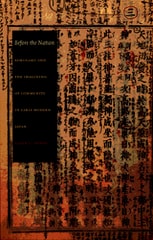
Before the Nation
Kokugaku and the Imagining of Community in Early Modern JapanSusan L. Burns
Duke University Press, 2003
Central to Burns's analysis is Motoori Norinaga’s Kojikiden, arguably the most important intellectual work of Japan's early modern period. Burns situates the Kojikiden as one in a series of attempts to analyze and interpret the mythohistories dating from the early eighth century, the Kojiki and Nihon shoki. Norinaga saw these texts as keys to an original, authentic, and idyllic Japan that existed before being tainted by "flawed" foreign influences, notably Confucianism and Buddhism. Hailed in the nineteenth century as the begetter of a new national consciousness, Norinaga's Kojikiden was later condemned by some as a source of Japan's twentieth-century descent into militarism, war, and defeat. Burns looks in depth at three kokugaku writers—Ueda Akinari, Fujitani Mitsue, and Tachibana Moribe—who contested Norinaga's interpretations and produced competing readings of the mythohistories that offered new theories of community as the basis for Japanese social and cultural identity. Though relegated to the footnotes by a later generation of scholars, these writers were quite influential in their day, and by recovering their arguments, Burns reveals kokugaku as a complex debate—involving history, language, and subjectivity—with repercussions extending well into the modern era.
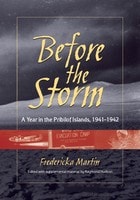
Before the Storm
A Year in the Pribilof Islands, 1941-1942Fredericka Martin
University of Alaska Press, 2010
From June of 1941 through the following summer, Fredericka Martin lived with her husband, Dr. Samuel Berenberg, on remote St. Paul Island in Alaska. During that time, Martin delved into the complex history of the Unangan people, and Before the Storm draws from her personal accounts of that year and her research to present a fascinating portrait of a time and a people facing radical change. A government-ordered evacuation of all Aleuts from the island in the face of World War II, which Martin recounts in her journal, proved but the first step in a long struggle by native peoples to gain independence, and, as editor Raymond L. Hudson explains, Martin came to play a significant role in the effort.
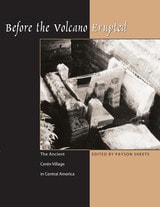
Before the Volcano Erupted
The Ancient Cerén Village in Central AmericaEdited by Payson Sheets
University of Texas Press, 2002
On an August evening around AD 600, residents of the Cerén village in the Zapotitán Valley of what is now El Salvador were sitting down to their nightly meal when ground tremors and loud steam emissions warned of an impending volcanic eruption. The villagers fled, leaving their town to be buried under five meters of volcanic ash and forgotten until a bulldozer uncovered evidence of the extraordinarily preserved town in 1976. The most intact Precolumbian village in Latin America, Cerén has been called the "Pompeii of the New World."
This book presents complete and detailed reports of the excavations carried out at Cerén since 1978 by a multidisciplinary team of archaeologists, ethnographers, volcanologists, geophysicists, botanists, conservators, and others. The book is divided into sections that discuss the physical environment and resources, household structures and economy, special buildings and their uses, artifact analysis, and topical and theoretical issues.
As the authors present and analyze Cerén's houses and their goods, workshops, civic and religious buildings, kitchen gardens, planted fields, and garbage dumps, a new and much clearer picture of how commoners lived during the Maya Classic Period emerges. These findings constitute landmark contributions to the anthropology and archaeology of Central America.
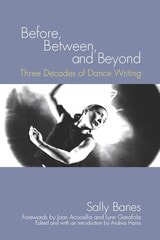
Before, Between, and Beyond
Three Decades of Dance WritingSally Banes; Edited and with an introduction by Andrea Harris
University of Wisconsin Press, 2007
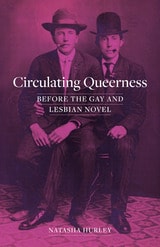
Circulating Queerness
Before the Gay and Lesbian NovelNatasha Hurley
University of Minnesota Press, 2018
A new history of the queer novel shows its role in constructing gay and lesbian lives
The gay and lesbian novel has long been a distinct literary genre with its own awards, shelving categories, bookstore spaces, and book reviews. But very little has been said about the remarkable history of its emergence in American literature, particularly the ways in which the novel about homosexuality did not just reflect but actively produced queer life.
Drawing on Mikhail Bakhtin’s insight that the history of society is connected to the history of language, author Natasha Hurley charts the messy, complex movement by which the queer novel produced the very frames that made it legible as a distinct literature and central to the imagination of queer worlds. Her vision of the queer novel's development revolves around the bold argument that literary circulation is the key ingredient that has made the gay and lesbian novel and its queer forebears available to its audiences.
Challenging the narrative that the gay and lesbian novel came into view in response to the emergence of homosexuality as a concept, Hurley posits a much longer history of this novelistic genre. In so doing, she revises our understanding of the history of sexuality, as well as of the processes of producing new concepts and the evolution of new categories of language.
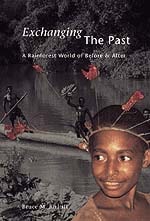
Exchanging the Past
A Rainforest World of Before and AfterBruce M. Knauft
University of Chicago Press, 2002
In this book, Knauft explores the Gebusi's encounter with modern institutions and highlights what their experience tells us more generally about the interaction between local peoples and global forces. As desire for material goods grew among Gebusi, Knauft shows that they became more accepting of and subordinated by Christian churches, community schools,and government officials in their attempt to benefit from them—a process Knauft terms "recessive agency." But the Gebusi also respond actively to modernity, creating new forms of feasting, performance, and music that meld traditional practices with Western ones, all of which Knauft documents in this fascinating study.

FRBR, Before and After
A Look at Our Bibliographic ModelsKaren Coyle
American Library Association, 2015
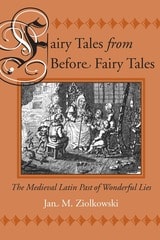
Fairy Tales from Before Fairy Tales
The Medieval Latin Past of Wonderful LiesJan M. Ziolkowski
University of Michigan Press, 2009
When did fairy tales begin? What qualifies as a fairy tale? Is a true fairy tale oral or literary? Or is a fairy tale determined not by style but by content? To answer these and other questions, Jan M. Ziolkowski not only provides a comprehensive overview of the theoretical debates about fairy tale origins but includes an extensive discussion of the relationship of the fairy tale to both the written and oral sources. Ziolkowski offers interpretations of a sampling of the tales in order to sketch the complex connections that existed in the Middle Ages between oral folktales and their written equivalents, the variety of uses to which the writers applied the stories, and the diverse relationships between the medieval texts and the expressions of the same tales in the "classic" fairy tale collections of the nineteenth century. In so doing, Ziolkowski explores stories that survive in both versions associated with, on the one hand, such standards of the nineteenth-century fairy tale as the Brothers Grimm, Hans Christian Andersen, and Carlo Collodi and, on the other, medieval Latin, demonstrating that the literary fairy tale owes a great debt to the Latin literature of the medieval period.
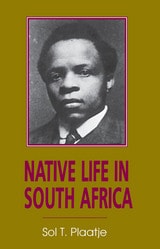
Native Life In South Africa
Before and Since the European War and the Boer RebellionSol T. Plaatje
Ohio University Press, 1991
First published in 1916 and one of South Africa’s great political books, Native Life in South Africa was first and foremost a response to the Native’s Land Act of 1913, and was written by one of the most gifted and influential writers and journalists of his generation. Sol T. Plaatje provides an account of the origins of this crucially important piece of legislation and a devastating description of its immediate effects.

The Book of Before and After
The Liturgy of the Hours of the Church of the EastAndrew Younan
Catholic University of America Press, 2025
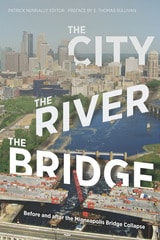
The City, the River, the Bridge
Before and after the Minneapolis Bridge CollapsePatrick Nunnally
University of Minnesota Press, 2011
The City, the River, the Bridge represents another set of responses to the disaster. Stemming from a 2008 University of Minnesota symposium on the bridge collapse and the building of a new bridge, it addresses the ramifications of the disaster from the perspectives of history, engineering, architecture, water science, community-based journalism, and geography. Contributors examine the factors that led to the collapse, the lessons learned from the disaster and the response, the policy and planning changes that have occurred or are likely to occur, and the impact on the city and the Mississippi River. The City, the River, the Bridge demonstrates the University's commitment to issues that concern the community and shares insights on public questions of city building, infrastructure, and design policy.
Contributors: John O. Anfinson; Roberto Ballarini; Heather Dorsey; Thomas Fisher; Minmao Liao; Judith A. Martin; Roger Miller; Mark Pedelty; Deborah L. Swackhamer; Melissa Thompson.