Results by title
279 books match the query 'Slavery' and 7 start with g
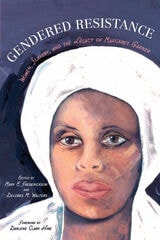
Gendered Resistance
Women, Slavery, and the Legacy of Margaret GarnerEdited by Mary E. Frederickson and Delores M. Walters
University of Illinois Press, 2013
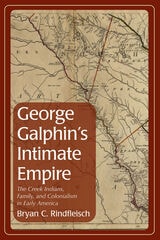
George Galphin's Intimate Empire
The Creek Indians, Family, and Colonialism in Early AmericaBryan C. Rindfleisch
University of Alabama Press, 2019
A native of Ireland, George Galphin arrived in South Carolina in 1737 and quickly emerged as one of the most proficient deerskin traders in the South. This was due in large part to his marriage to Metawney, a Creek Indian woman from the town of Coweta, who incorporated Galphin into her family and clan, allowing him to establish one of the most profitable merchant companies in North America. As part of his trade operations, Galphin cemented connections with Indigenous and European peoples across the South, while simultaneously securing links to merchants and traders in the British Empire, continental Europe, and beyond.
In George Galphin’s Intimate Empire: The Creek Indians, Family, and Colonialism in Early America, Bryan C. Rindfleisch presents a complex narrative about eighteenth-century cross-cultural relationships. Reconstructing the multilayered bonds forged by Galphin and challenging scholarly understandings of life in the Native South, the American South more broadly, and the Atlantic World, Rindfleisch looks simultaneously at familial, cultural, political, geographical, and commercial ties—examining how eighteenth-century people organized their world, both mentally and physically. He demonstrates how Galphin’s importance emerged through the people with whom he bonded. At their most intimate, Galphin’s multilayered relationships revolved around the Creek, Anglo-French, and African children who comprised his North American family, as well as family and friends on the other side of the Atlantic.
Through extensive research in primary sources, Rindfleisch reconstructs an expansive imperial world that stretches across the American South and reaches into London and includes Indians, Europeans, and Africans who were intimately interconnected and mutually dependent. As a whole, George Galphin’s Intimate Empire provides critical insights into the intensely personal dimensions and cross-cultural contours of the eighteenth-century South and how empire-building and colonialism were, by their very nature, intimate and familial affairs.
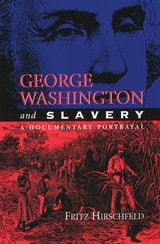
George Washington and Slavery
A Documentary PortrayalFritz Hirschfeld
University of Missouri Press, 1997
"I never mean (unless some particular circumstance should compel me to it) to possess another slave by purchase; it being among my first wishes to see some plan adopted, by which slavery in this country may be abolished by slow, sure and imperceptible degrees."—George Washington, September 9, 1786
No history of racism in America can be considered complete without taking into account the role that George Washington—the principal founding father—played in helping to mold the racist cast of the new nation. Because General Washington—the universally acknowledged hero of the Revolutionary War—in the postwar period uniquely combined the moral authority, personal prestige, and political power to influence significantly the course and the outcome of the slavery debate, his opinions on the subject of slaves and slavery are of crucial importance to understanding how racism succeeded in becoming an integral and official part of the national fabric during its formative stages.The successful end of the War for Independence in 1783 brought George Washington face-to-face with a fundamental dilemma: how to reconcile the proclaimed ideals of the revolution with the established institution of slavery. So long as black human beings in America could legally be considered the chattel property of whites, the rhetoric of equality and individual freedom was hollow. Progressive voices urged immediate emancipation as the only way to resolve the contradiction; the Southern slave owners, of course, stood firm for the status quo. Washington was caught squarely in the middle.
As a Virginia plantation proprietor and a lifelong slaveholder, Washington had a substantial private stake in the economic slave system of the South. However, in his role as the acknowledged political leader of the country, his overriding concern was the preservation of the Union. If Washington publicly supported emancipation, he would almost certainly have to set an example and take steps to dispose of his Mount Vernon slaves. If he spoke out on the side of slavery, how could he legitimately and conscientiously expect to uphold and defend the humanistic goals and moral imperatives of the new nation as expressed in the Declaration of Independence and embodied in the Constitution and the Bill of Rights? His was a balancing act that became more and more difficult to sustain with the passing years.
Relying primarily on Washington's own words—his correspondence, diaries, and other written records—supplemented by letters, comments, and eyewitness reports of family members, friends, employees, aides, correspondents, colleagues, and visitors to Mount Vernon, together with contemporary newspaper clippings and official documents pertaining to Washington's relationships with African Americans, Fritz Hirschfeld traces Washington's transition from a conventional slaveholder to a lukewarm abolitionist. George Washington and Slavery will be an essential addition to the historiography of eighteenth-century America and of Washington himself.
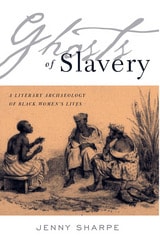
Ghosts Of Slavery
A Literary Archaeology of Black Women’s LivesJenny Sharpe
University of Minnesota Press, 2002
Questions traditional assumptions about power and agency in slave women’s everyday lives.
Through their open defiance, women like Harriet Tubman and Sojourner Truth had a significant impact on the institution of slavery. But what of the countless other women who did not commit public or even private acts of resistance? Are their stories worthy of our attention? While some scholars imply that only the struggle for freedom was legitimate, Jenny Sharpe complicates the linear narrative-from slavery to freedom and literacy-that emerged from the privileging of autobiographical accounts like that of Frederick Douglass. She challenges a paradigm that equates agency with resistance and self-determination, and introduces new ways to examine negotiations for power within the constraints of slavery.
In Ghosts of Slavery, Sharpe introduces a wider range of everyday practices by examining the lives of three distinctive Caribbean women: a maroon leader, a mulatto concubine, and a fugitive slave. Through them she explains how the diasporic experience of slavery enabled black women to claim an authority that they didn’t possess in Africa, how concubines empowered themselves through their mimicry of white women, and how less-privileged slave women manipulated situations that they were powerless to change. Finding the highly mediated portrayal of slave women in the historical records limited and sometimes misleading, Sharpe turns to unconventional sources for investigating these women’s lives. In this fascinating and historically rich account, she calls for new strategies of reading that question traditional narratives of history, and she finds alternative ways to integrate oral storytelling, slave songs, travel writing, court documents, proslavery literature, and contemporary literature into black history. Ultimately, this layered approach not only produces a more complex picture of the slave women’s agency than conventional readings, it encourages a more nuanced understanding of the roles of slaves in the history of slavery.
Gleanings of Freedom
Free and Slave Labor along the Mason-Dixon Line, 1790-1860Max Grivno
University of Illinois Press, 2014
Go Down, Old Hannah
The Living History of African American TexansBy Naomi Mitchell Carrier
University of Texas Press, 2010
Living history is a style of instructive and entertaining performance that seeks to bring history to life with the use of costumes, tools, and reenactments appropriate to a specific time period. Done well, living history performances illuminate human experience in powerful, unforgettable ways.
The fifteen living history plays in this collection were commissioned by museums and historic sites in Texas to show the interdependence of African American experiences and contributions to the living history of Texas. The plays cover subject matter ranging from slave celebrations, family breakups, and running away, to the Civil War, emancipation, and Reconstruction. Each play is research based and performed by Talking Back Living History Theatre as a festival production. These scripts are easily performed, and author Naomi Mitchell Carrier has included production notes in the overviews that precede each play. Lesson plans are also included, which add to the collection's appeal as a classroom tool.
Carrier's talent for bringing historical figures to life is exceptional. The names of most primary characters in these plays are real. By giving them faces, feelings, intelligence, and dignity, Carrier aims to give them new life.
Goodbye iSlave
A Manifesto for Digital AbolitionJack Linchuan Qiu
University of Illinois Press, 2016
Focusing on the alliance between Apple and the notorious Taiwanese manufacturer Foxconn, Jack Linchuan Qiu examines how corporations and governments everywhere collude to build systems of domination, exploitation, and alienation. His interviews, news analysis, and first-hand observation show the circumstances faced by Foxconn workers--circumstances with vivid parallels in the Atlantic slave trade. Ironically, the fanatic consumption of digital media also creates compulsive free labor that constitutes a form of bondage for the user. Arguing as a digital abolitionist, Qiu draws inspiration from transborder activist groups and incidents of grassroots resistance to make a passionate plea aimed at uniting--and liberating--the forgotten workers who make our twenty-first-century lives possible.