Results by title
3027 books match the query 'Sociology' and 80 start with g
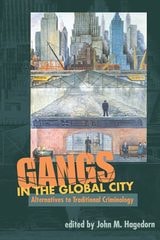
GANGS IN THE GLOBAL CITY
Alternatives to Traditional CriminologyEdited by John M. Hagedorn
University of Illinois Press, 2006
Although they were originally considered an American phenomenon, gangs today have grown and transformed into global enterprises. Despite these changes, criminologists have not yet reassessed worldwide gangs in terms of the other changes associated with globalization.
John M. Hagedorn aims to correct this oversight by incorporating important theoretical advances in urban political economy and understanding changes in gangs around the world as a result of globalization and the growth of the information economy. Contrary to older conceptions, today’s gangs are international, are often institutionalized, and may be explicitly concerned with race and ethnicity. Gangs in the Global City presents the work of an assortment of international scholars that challenges traditional approaches to problems in criminology from many different perspectives and includes theoretical discussions, case studies, and examinations of gang members’ identities. The contributors consider gangs not as fundamentally a crime problem but as variable social organizations in poor communities that are transitioning to the new economy.

Gabriel Tarde On Communication and Social Influence
Selected PapersGabriel Tarde
University of Chicago Press, 1969
Gabriel Tarde ranks as one of the most outstanding sociologists of nineteenth-century France, though not as well known by English readers as his peers Comte and Durkheim. This book makes available Tarde’s most important work and demonstrates his continuing relevance to a new generation of students and thinkers.
Tarde’s landmark research and empirical analysis drew upon collective behavior, mass communications, and civic opinion as elements to be explained within the context of broader social patterns. Unlike the mass society theorists that followed in his wake, Tarde integrated his discussions of societal change at the macrosocietal and individual levels, anticipating later twentieth-century thinkers who fused the studies of mass communications and public opinion research.
Terry N. Clark’s introduction, considered the premier guide to Tarde’s opus, accompanies this important work, reprinted here for the first time in forty years.
Gabriel Tarde On Communication and Social Influence
Selected PapersGabriel Tarde
University of Chicago Press, 1969
This is an auto-narrated audiobook version of this book.
Gabriel Tarde ranks as one of the most outstanding sociologists of nineteenth-century France, though not as well known by English readers as his peers Comte and Durkheim. This book makes available Tarde’s most important work and demonstrates his continuing relevance to a new generation of students and thinkers.
Tarde’s landmark research and empirical analysis drew upon collective behavior, mass communications, and civic opinion as elements to be explained within the context of broader social patterns. Unlike the mass society theorists that followed in his wake, Tarde integrated his discussions of societal change at the macrosocietal and individual levels, anticipating later twentieth-century thinkers who fused the studies of mass communications and public opinion research.
Terry N. Clark’s introduction, considered the premier guide to Tarde’s opus, accompanies this important work, reprinted here for the first time in forty years.
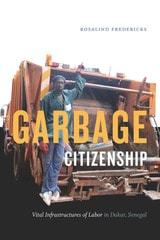
Garbage Citizenship
Vital Infrastructures of Labor in Dakar, SenegalRosalind Fredericks
Duke University Press, 2018
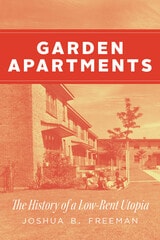
Garden Apartments
The History of a Low-Rent UtopiaJoshua B. Freeman
University of Chicago Press, 2026
Eminent historian Joshua Freeman rescues garden apartments—typically low-rise multifamily residences that enclose or are surrounded by landscaped gardens—from their invisibility in the American landscape. He details their outsized influence on housing policy and social policy as they helped upgrade living standards for working people. Inspired by the architectural innovations and socialist politics of British garden cities, Red Vienna, and German modernist housing in the 1920s, these large, centrally managed projects were mostly not public housing, but their capitalist developers worked with governments to keep down rents. The results were often relatively small apartments and large communal spaces, aimed at fostering actual American community.

Gastrodiplomacy
Chinese Exclusion and the Ascent of Chinese Restaurants in New York City, 1870–1943Heather Ruth Lee
University of Chicago Press, 2027
Traces how Chinese migrants challenged racialization and disenfranchisement by establishing Chinese restaurants during the Gilded Age.
In Gastrodiplomacy, Heather Ruth Lee dives deep into not just the history of Chinese restaurants in early twentieth-century New York City but the delicate, inchoate, and constantly evolving dynamics among their owners, workers, and their predominantly white clientele. Lee argues that the stylistic and capitalist choices made by restaurateurs (“gastrodiplomats”) had outsized political effects on paternalistic white diners (“gastroliberals”) who patronized their establishments, particularly when it came to racial relations in cities that were growing and diversifying. Lee is not starry-eyed—satisfying white tongues and stomachs didn’t lead to an urban utopia of peace, harmony, and brotherhood—but she shows the great and subtle influences of Chinese migrants on American urban space, culture, and metropolitan identity in a defining time.
In Lee’s capable and compelling telling, the Chinese restaurant becomes a distinctive locus for the negotiation of political power, cultural influence, urban identity, and more. Gastrodiplomacy reveals much about burgeoning and increasingly cosmopolitan American cities, as well as about their dynamic relationships with the fluidities of the American character.

Gateway to Vacationland
The Making of Portland, MaineJohn F. Bauman
University of Massachusetts Press, 2012
Situated on a peninsula jutting into picturesque Casco Bay, Portland has long been admired for its geographical setting—the “beautiful city by the sea,” as native son Henry Wadsworth Longfellow called it. At the same time, Portland's deep, ice-free port has made it an ideal site for the development of coastal commerce and industry. Much of the city's history, John F. Bauman shows, has been defined by the effort to reconcile the competing interests generated by these attributes—to balance the imperatives of economic growth with a desire to preserve Portland's natural beauty.
Caught in the crossfire of British and French imperial ambitions throughout the colonial era, Portland emerged as a prosperous shipbuilding center and locus of trade in the decades following the American Revolution. During the nineteenth century it became a busy railroad hub and winter port for Canadian grain until a devastating fire in 1866 reduced much of the city to ruins. Civic leaders responded by reinventing Portland as a tourist destination, building new hotels, parks, and promenades, and proclaiming it the “Gateway to Vacationland.”
After losing its grain trade in the 1920s and suffering through the Great Depression, Portland withered in the years following World War II as it wrestled with the problems of deindustrialization, suburbanization, and an aging downtown. Efforts at urban renewal met with limited success until the 1980s, when a concerted plan of historic preservation and the restoration of the Old Port not only revived the tourist trade but eventually established Portland as one of America's “most livable cities.”

Gay Fatherhood
Narratives of Family and Citizenship in AmericaEllen Lewin
University of Chicago Press, 2009
Men are often thought to have less interest in parenting than women, and gay men are generally assumed to prefer pleasure over responsibility. The toxic combination of these two stereotypical views has led to a lack of serious attention being paid to the experiences of gay fathers. But the truth is that more and more gay men are setting out to become parents and succeeding—and Gay Fatherhood aims to tell their stories.
Ellen Lewin takes as her focus people who undertake the difficult process of becoming fathers as gay men, rather than having become fathers while married to women. These men face unique challenges in their quest for fatherhood, negotiating specific bureaucratic and financial conditions as they pursue adoption or surrogacy and juggling questions about their future child’s race, age, sex, and health. Gay Fatherhood chronicles the lives of these men, exploring how they cope with political attacks from both the "family values" right and the "radical queer" left—while also shedding light on the evolving meanings of family in twenty-first-century America.
Gen Z, Explained
The Art of Living in a Digital AgeRoberta Katz, Sarah Ogilvie, Jane Shaw, and Linda Woodhead
University of Chicago Press, 2021
Born since the mid-1990s, members of Generation Z comprise the first generation never to know the world without the internet, and the most diverse generation yet. As Gen Z starts to emerge into adulthood and enter the workforce, what do we really know about them? And what can we learn from them? Gen Z, Explained is the authoritative portrait of this significant generation. It draws on extensive interviews that display this generation’s candor, surveys that explore their views and attitudes, and a vast database of their astonishingly inventive lexicon to build a comprehensive picture of their values, daily lives, and outlook. Gen Z emerges here as an extraordinarily thoughtful, promising, and perceptive generation that is sounding a warning to their elders about the world around them—a warning of a complexity and depth the “OK Boomer” phenomenon can only suggest.
Much of the existing literature about Gen Z has been highly judgmental. In contrast, this book provides a deep and nuanced understanding of a generation facing a future of enormous challenges, from climate change to civil unrest. What’s more, they are facing this future head-on, relying on themselves and their peers to work collaboratively to solve these problems. As Gen Z, Explained shows, this group of young people is as compassionate and imaginative as any that has come before, and understanding the way they tackle problems may enable us to envision new kinds of solutions. This portrait of Gen Z is ultimately an optimistic one, suggesting they have something to teach all of us about how to live and thrive in this digital world.
Gender Flashpoints
The Power of DialogueAbigail C. Saguy
Russell Sage Foundation, 2026
Americans are deeply divided about gender. Like other issues in the U.S., debates about gender are extremely polarized and can spark intense anger and conflict. These “gender flashpoints” include gender identity, gender and parenting, gender-neutral restrooms, the use of identifying pronouns, and participation in women’s sports. Even the term gender itself has become contested. In this divisive social context, advocates on both sides have reduced complex issues to all-or-nothing propositions. Many people are confused about these topics, embarrassed about what they do not know, or afraid that they will be called a bigot if they say the “wrong thing.” In Gender Flashpoints, sociologist Abigail C. Saguy gets to the root of these major disagreements about gender.
Saguy interviews activists across the full political spectrum about a wide range of contemporary debates over gender to better understand points of contention as well as surprising areas of agreement. She finds that at the crux of many of these debates are disputes about the goals of gender-related advocacy, the strategies to achieve these goals, and whose rights are being advocated for. For example, when discussing pregnancy-related policy issues, there is disagreement as to whether the term “pregnant person” or “pregnant woman” should be used. While some believe “pregnant person” affirms the existence of nonbinary people and trans men, others believe it erases women. These differences often appear to be simply about language, but they are, in fact, disagreements on worldviews, identities, and legitimacy.
One of the conflicts Saguy dives into is the issue of gender-neutral restrooms. She finds when interviewing different activists about what they thought of the topic, they initially repeated the familiar, mainstream polarized discourse. LGBTQ+ activists and mainstream feminists emphasized the importance of restroom access, especially for transgender and gender-nonconforming people. Conservatives and gender-critical feminists emphasized women’s and girls’ vulnerability and need for privacy and safety in public restrooms. Across the political spectrum, activists spoke about how those on the “other side” were unwilling to engage in productive dialogue. However, Saguy also finds that activists on both sides recognized the complexity of the issue and agreed on the need for public bathrooms that provided everyone with greater safety and privacy. Activists across the spectrum showed enthusiasm for desegregated public restrooms that include an open space for sinks and mirrors—along with toilets with European style, fully enclosed floor-to-ceiling doors. Saguy advocates for engaging in dialogue about charged issues, such as gender-neutral bathrooms, in order to help identify workable solutions to seemingly intractable social problems.
Gender Flashpoints is a fascinating and comprehensive view of the deeply personal and divisive topic of gender that offers hope for finding common ground and a path forward.

Gender Violence and the Press
The St. Kizito StoryH. Leslie Steeves
Ohio University Press, 1997
Gender and Family Issues in the Workplace
Francine D. Blau
Russell Sage Foundation, 1997
Gender and International Migration
KATHARINE M. DONATO is professor and chair of sociology at Vanderbilt University. DONNA GABACCIA is professor of history in the Department of Historical and Cultural Studies at the University of Toronto-Scarborough.
Russell Sage Foundation, 2015

Gender and the Science of Difference
Cultural Politics of Contemporary Science and MedicineFisher, Jill A
Rutgers University Press, 2011
How does contemporary science contribute to our understanding about what it means to be women or men? What are the social implications of scientific claims about differences between "male" and "female" brains, hormones, and genes? How does culture influence scientific and medical research and its findings about human sexuality, especially so-called normal and deviant desires and behaviors? Gender and the Science of Difference examines how contemporary science shapes and is shaped by gender ideals and images.
Prior scholarship has illustrated how past cultures of science were infused with patriarchal norms and values that influenced the kinds of research that was conducted and the interpretation of findings about differences between men and women. This interdisciplinary volume presents empirical inquiries into today's science, including examples of gendered scientific inquiry and medical interventions and research. It analyzes how scientific and medical knowledge produces gender norms through an emphasis on sex differences, and includes both U.S. and non-U.S. cases and examples.

Gender, Work and Property
An Ethnographic Study of Value in a Spanish VillageNancy Konvalinka
Campus Verlag, 2013

Gendered Tradeoffs
Women, Family, and Workplace Inequality in Twenty-One CountriesBecky Pettit
Russell Sage Foundation, 2009
Generations and Collective Memory
Amy Corning and Howard Schuman
University of Chicago Press, 2015
Their key finding—built on historical research and interviews in the United States and seven other countries (including China, Japan, Germany, Lithuania, Russia, Israel, and Ukraine)—is that our most powerful generational memories are of shared experiences in adolescence and early adulthood, like the 1963 Kennedy assassination for those born in the 1950s or the fall of the Berlin Wall for young people in 1989. But there are exceptions to that rule, and they're significant: Corning and Schuman find that epochal events in a country, like revolutions, override the expected effects of age, affecting citizens of all ages with a similar power and lasting intensity.
The picture Corning and Schuman paint of collective memory and its formation is fascinating on its face, but it also offers intriguing new ways to think about the rise and fall of historical reputations and attitudes toward political issues.

Generations of Exclusion
Mexican-Americans, Assimilation, and RaceEdward E. Telles
Russell Sage Foundation, 2008
Genetics and the Unsettled Past
The Collision of DNA, Race, and HistoryWailoo, Keith
Rutgers University Press, 2012
Our genetic markers have come to be regarded as portals to the past. Analysis of these markers is increasingly used to tell the story of human migration; to investigate and judge issues of social membership and kinship; to rewrite history and collective memory; to right past wrongs and to arbitrate legal claims and human rights controversies; and to open new thinking about health and well-being. At the same time, in many societies genetic evidence is being called upon to perform a kind of racially charged cultural work: to repair the racial past and to transform scholarly and popular opinion about the “nature” of identity in the present.
Genetics and the Unsettled Past considers the alignment of genetic science with commercial genealogy, with legal and forensic developments, and with pharmaceutical innovation to examine how these trends lend renewed authority to biological understandings of race and history.
This unique collection brings together scholars from a wide range of disciplines—biology, history, cultural studies, law, medicine, anthropology, ethnic studies, sociology—to explore the emerging and often contested connections among race, DNA, and history. Written for a general audience, the book’s essays touch upon a variety of topics, including the rise and implications of DNA in genealogy, law, and other fields; the cultural and political uses and misuses of genetic information; the way in which DNA testing is reshaping understandings of group identity for French Canadians, Native Americans, South Africans, and many others within and across cultural and national boundaries; and the sweeping implications of genetics for society today.
Genocide
Truth, Memory, and RepresentationAlexander Laban Hinton and Kevin Lewis O Neill, eds.
Duke University Press, 2009
Specialists on the societies about which they write, these anthropologists draw on ethnographic research to provide on-the-ground analyses of communities in the wake of mass brutality. They investigate how mass violence is described or remembered, and how those representations are altered by the attempts of others, from NGOs to governments, to assert “the truth” about outbreaks of violence. One contributor questions the neutrality of an international group monitoring violence in Sudan and the assumption that such groups are, at worst, benign. Another examines the consequences of how events, victims, and perpetrators are portrayed by the Rwandan government during the annual commemoration of that country’s genocide in 1994. Still another explores the silence around the deaths of between eighty and one hundred thousand people on Bali during Indonesia’s state-sponsored anticommunist violence of 1965–1966, a genocidal period that until recently was rarely referenced in tourist guidebooks, anthropological studies on Bali, or even among the Balinese themselves. Other contributors consider issues of political identity and legitimacy, coping, the media, and “ethnic cleansing.” Genocide: Truth, Memory, and Representation reveals the major contribution that cultural anthropologists can make to the study of genocide.
Contributors. Pamela Ballinger, Jennie E. Burnet, Conerly Casey, Elizabeth Drexler, Leslie Dwyer, Alexander Laban Hinton, Sharon E. Hutchinson, Uli Linke, Kevin Lewis O’Neill, Antonius C. G. M. Robben, Debra Rodman, Victoria Sanford
Gentlemen's Disagreement
Alfred Kinsey, Lewis Terman, and the Sexual Politics of Smart MenPeter Hegarty
University of Chicago Press, 2013
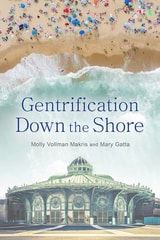
Gentrification Down the Shore
Molly Vollman Makris
Rutgers University Press, 2021
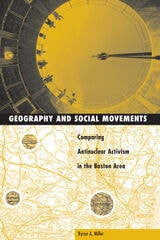
Geography And Social Movement
Comparing Antinuclear Activism in the Boston AreaByron A. Miller
University of Minnesota Press, 2000
A comparative analysis of the implications of space, place, and scale in political mobilization.
A comparative analysis of the implications of space, place, and scale in political mobilization.
Context matters, as students of social movements increasingly agree, and yet very little attention has been paid to the role geography plays in activism. Geography and Social Movements corrects this oversight, bringing a geographical perspective to the study of social movements. Byron A. Miller directly addresses the implications of space, place, and scale in social movement mobilization, and then demonstrates their significance in a detailed comparative analysis of peace movements in three municipalities around Boston. In focusing on the Boston area-an old northeastern region, heavily industrialized with many companies working on military contracts, and also a center of education-Miller is able to explore how campaigns aimed at curbing nuclear arms operate within the cultural, political, social, and economic confines of particular places and spaces. He shows how the decisions and actions of local peace movement organizations played a central role in the movement’s successes and failures, and how local organizations had to respond to the differing class, race, and gender characteristics of different locales. Miller’s empirical analysis clearly demonstrates that geographic strategies for social movement organizations have direct consequences for the successes and failures of specific campaigns.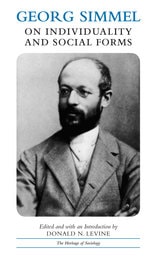
Georg Simmel on Individuality and Social Forms
Georg Simmel
University of Chicago Press, 1972
Half of the material included in this edition of Simmel's writings represents new translations. This includes Simmel's important, lengthy, and previously untranslated "Group Expansion and Development of Individuality," as well as three selections from his most neglected work, Philosophy of Money; in addition, the introduction to Probleme der Geschichtsphilosophie, chapter one of the Lebensanschauung, and three essays are translated for the first time.

Georg Simmel
Essays on Art and AestheticsGeorg Simmel
University of Chicago Press, 2020
Fascinated by the relationship between culture, society, and economic life, Simmel took an interest in myriad phenomena of aesthetics and the arts. A friend of writers and artists such as Auguste Rodin, Rainer Maria Rilke, and Stefan George, he wrote dozens of pieces engaging with topics such as the work of Michelangelo, Rembrandt, and Rodin, Japanese art, naturalism and symbolism, Goethe, “art for art’s sake”, art exhibitions, and the aesthetics of the picture frame.
This is the first collection to bring together Simmel’s finest writing on art and aesthetics, and many of the items appear in English in this volume for the first time. The more than forty essays show the protean breadth of Simmel’s reflections, covering landscape painting, portraiture, sculpture, poetry, theater, form, style, and representation. An extensive introduction by Austin Harrington gives an overview of Simmel’s themes and elucidates the significance of his work for the many theorists who would be inspired by his ideas.
Something of an outsider to the formal academic world of his day, Simmel wrote creatively with the flair of an essayist. This expansive collection of translations preserves the narrative ease of Simmel’s prose and will be a vital source for readers with an interest in Simmel’s trailblazing ideas in modern European philosophy, sociology, and cultural theory.
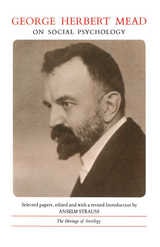
George Herbert Mead on Social Psychology
George Herbert Mead
University of Chicago Press, 1964
This volume is a revised and enlarged edition of the book formerly published under the title The Social Psychology of George Herbert Mead. It contains selections from Mead's posthumous books: Mind, Self, and Society; Movements of Thought in the Nineteenth Century; The Philosophy of the Act; and The Philosophy of the Present, together with an incisive, newly revised, introductory essay by Anselm Strauss on the importance of Mead for contemporary social psychology.
"Required reading for the social scientist."—Milton L. Barron, Nation
George Herbert Mead on Social Psychology
George Herbert Mead
University of Chicago Press, 1964
One of the most brilliantly original of American pragmatists, George Herbert Mead published surprisingly few major papers and not a single book during his lifetime. Yet his influence on American sociology and social psychology since World War II has been exceedingly strong.
This volume is a revised and enlarged edition of the book formerly published under the title The Social Psychology of George Herbert Mead. It contains selections from Mead's posthumous books: Mind, Self, and Society; Movements of Thought in the Nineteenth Century; The Philosophy of the Act; and The Philosophy of the Present, together with an incisive, newly revised, introductory essay by Anselm Strauss on the importance of Mead for contemporary social psychology.
"Required reading for the social scientist."—Milton L. Barron, Nation
George Herbert Mead
THE MAKING OF A SOCIAL PRAGMATISTGary A. Cook
University of Illinois Press, 1993

German Dis/Continuities, Volume 96
Martin Morris
Duke University Press, 0
The contributions presented here include Fredric Jameson’s “Ramblings in Old Berlin,” Günter Grass’s “Lonesome Capitalism,” and Peter Weiss’s “Aesthetics of Resistance.” Among the topics discussed in the volume are the debate over Holocaust memorials in Germany and the significance of their connections to the German past, the problematic continuity that identifies the new unified Germany with the former Federal Republic; the dangers to women posed by the neoliberal project; the legacy of the avant-garde in today’s media theory; Ars nova and Doktor Faustus; nostalgia for the old German Democratic Republic; and reflections on traumatic memory and history as trauma.
Contributors. Ulrich Baer, Michael Geyer, Günter Grass, Frigga Haug, Julia Hell, Fredric Jameson, Juliet Koss, Andreas Michel, Martin Morris, Arkady Plotnitsky, Pierra Vidal-Naquet, Peter Weiss, James E. Young

German Ideology
From France to Germany and BackLouis Dumont
University of Chicago Press, 1995
Anyone interested in the fate of national ideology and the concept of the individual will benefit from this radical reinterpretation of modern values and the place of modernity in history.
"What François Furet did for French history, Dumont did for anthropology, turning it away from engaged politics and towards the sober study of the modern age." —Mark Lilla, London Review of Books
"There are many fine things in Dumont's study. Beyond any doubt, his cultural anthropology of the modern spirit highlights some of the key energies of the of the last two centuries. . . . [An] impressive . . . detailed analysis." —Martin Swales, Times Higher Education Supplement
"[An] unsettling, rich, demanding, profound study." —Publishers Weekly

Get Out of My Room!
A History of Teen Bedrooms in AmericaJason Reid
University of Chicago Press, 2016
Even in our era of Snapchat and hoverboards, bedrooms remain a key part of teenage life, one of the only areas where a teen can exert control and find some privacy. And while these separate bedrooms only became commonplace after World War II, the idea of the teen bedroom has been around for a long time. With Get Out of My Room!, Jason Reid digs into the deep historical roots of the teen bedroom and its surprising cultural power. He starts in the first half of the nineteenth century, when urban-dwelling middle-class families began to consider offering teens their own spaces in the home, and he traces that concept through subsequent decades, as social, economic, cultural, and demographic changes caused it to become more widespread. Along the way, Reid shows us how the teen bedroom, with its stuffed animals, movie posters, AM radios, and other trappings of youthful identity, reflected the growing involvement of young people in American popular culture, and also how teens and parents, in the shadow of ongoing social changes, continually negotiated the boundaries of this intensely personal space.
Richly detailed and full of surprising stories and insights, Get Out of My Room! is sure to offer insight and entertainment to anyone with wistful memories of their teenage years. (But little brothers should definitely keep out.)
Getting Paid While Taking Time
The Women's Movement and the Development of Paid Family Leave Policies in the United StatesMegan Sholar
Temple University Press, 2016
The United States remains the only industrialized nation in the world that does not provide paid family leave at the national level for either men or women. In the more than two decades since the passage of the Family and Medical Leave Act, there have been numerous unsuccessful attempts to expand family leave benefits nationally. However, in the United States, it is common for innovations in family policies to arise at the state level.
In her timely book, Getting Paid While Taking Time, Megan Sholar explains the development of family leave policies at both the national and state levels in the United States. She provides cogent studies of states that have passed and proposed family leave legislation, and she pays special attention to the ways in which women’s movement actors and other activists (e.g., labor unions) exert pressure on public officials to help influence the policymaking process. In her conclusion, Sholar considers the future of paid family leave policies in the United States and the chances for it ever equaling the benefits in other countries.
Getting Your Way
Strategic Dilemmas in the Real WorldJames M. Jasper
University of Chicago Press, 2006
Getting other people to do what we want is a useful skill for anyone. Whether you’re seeking a job, negotiating a deal, or angling for that big promotion, you’re engaged in strategic thought and action. In such moments, you imagine what might be going on in another person’s head and how they’ll react to what you do or say. At the same time, you also try to pick the best way to realize your goals, both with and without the other person’s cooperation. Getting Your Way teaches us how to win that game by offering a fuller understanding of how strategy works in the real world.
As we all know, rules of strategy are regularly discovered and discussed in popular books for business executives, military leaders, and politicians. Those works with their trendy lists of pithy maxims and highly effective habits can help people avoid mistakes or even think anew about how to tackle their problems. But they are merely suggestive, as each situation we encounter in the real world is always more complex than anticipated, more challenging than we had hoped. James M. Jasper here shows us how to anticipate those problems before they actually occur—by recognizing the dilemmas all strategic players must negotiate, with each option accompanied by a long list of costs and risks. Considering everyday dilemmas in a broad range of familiar settings, from business and politics to love and war, Jasper explains how to envision your goals, how to make the first move, how to deal with threats, and how to employ strategies with greater confidence.
Alexander the Great, Genghis Khan, Rosa Parks, Hugo Chávez, and David Koresh all come into play in this smart and engaging book, one that helps us recognize and prepare for the many dilemmas inherent in any strategic action.
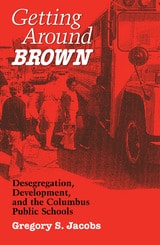
Getting around Brown
Desegregation, Development, and the Columbus Public SchoolsGregory S. Jacobs
The Ohio State University Press, 1998
Getting Around Brown is both the first history of school desegregation in Columbus, Ohio, and the first case study to explore the interplay of desegregation, business, and urban development in America.
Drawing on a broad range of sources, including over sixty interviews, the book details the causes and consequences of Penick v. Columbus Board of Education (1977). Gregory S. Jacobs argues that school desegregation in Columbus failed to produce equal educational opportunity, not because it was inherently detrimental to learning, but because it was incompatible with urban development. As a consequence, the long-term health of the city school district was sacrificed to preserve the growth of the city itself. The resulting middle-class abandonment of urban education in Columbus produced an increasingly poor, African-American city school system and a powerful form of defensive activism within the overwhelmingly white suburban systems.
The title of the book refers not only to the elaborate tools used to circumvent the spirit of the Supreme Court’s landmark 1954 Brown v. Board of Education decision but also to the need to move beyond the flawed dichotomies and failed policies that have come to define desegregation. The book calls for a reconsideration of the complicated relationship race, class, and housing patterns have with city school reform efforts, a relationship obscured by this country’s vitriolic and occasionally violent battle over busing. Jacobs concludes his study with a “modest proposal,” in which he recommends the abolition of the Columbus Public School District, the dispersal of its students throughout surrounding suburban systems, and the creation of a choice-based “experimental education zone” within the old city school district boundaries.
Readable and relevant, Getting around Brownis essential reading for scholars of recent American history, urban studies, civil rights and race relations, and educational policy, as well as anyone interested in public education and politics.
Ghostly Matters
Haunting and the Sociological ImaginationAvery F. Gordon
University of Minnesota Press, 1996
Ghostly Matters
Haunting and the Sociological ImaginationAvery F. Gordon
University of Minnesota Press, 2008
“Avery Gordon’s stunningly original and provocatively imaginative book explores the connections linking horror, history, and haunting. ” —George Lipsitz
“The text is of great value to anyone working on issues pertaining to the fantastic and the uncanny.” —American Studies International
“Ghostly Matters immediately establishes Avery Gordon as a leader among her generation of social and cultural theorists in all fields. The sheer beauty of her language enhances an intellectual brilliance so daunting that some readers will mark the day they first read this book. One must go back many more years than most of us can remember to find a more important book.” —Charles Lemert
Drawing on a range of sources, including the fiction of Toni Morrison and Luisa Valenzuela (He Who Searches), Avery Gordon demonstrates that past or haunting social forces control present life in different and more complicated ways than most social analysts presume. Written with a power to match its subject, Ghostly Matters has advanced the way we look at the complex intersections of race, gender, and class as they traverse our lives in sharp relief and shadowy manifestations.
Avery F. Gordon is professor of sociology at the University of California, Santa Barbara.
Janice Radway is professor of literature at Duke University.
Ghosts of Organizations Past
Communities of Organizations as Settings for ChangeDan Ryan
Temple University Press, 2015
Ryan draws on concepts from the study of organizations, social capital, and social networks to re-think questions such as “What kind of thing is a community?” and “Why is it so difficult to build community initiatives out of organizations?” He provides a social organizational explanation for problems familiar to anyone who has been involved in community programs, issues that are usually understood as personal incompetence, turf wars, greed, or corruption.
Ghosts of Organizations Past describes the challenges of using organizations to create change in places in dire need of it.

Girls in Trouble with the Law
Schaffner, Laurie
Rutgers University Press, 2006
Offering a critical assessment of what she describes as a gender-insensitive juvenile legal system, Schaffner makes a compelling argument that current policies do not go far enough to empower disadvantaged girls so that communities can assist them in overcoming the social limitations and gender, sexual, and racial/ethnic discrimination that continue to plague young women growing up in contemporary United States.
Give a Man a Fish
Reflections on the New Politics of DistributionJames Ferguson
Duke University Press, 2015

Global Cities of the South, Volume 22
Ashley Dawson and Brent Hayes Edwards, eds.
Duke University Press, 0
This special issue challenges postcolonial theorists to engage with urban studies and challenges urban analysts to turn their focus to the postcolonial societies where these cities have developed. Gathering well-known scholars in postcolonial theory and urban studies, the collection opens an interdisciplinary exchange through a series of case studies focused on cities in Africa and Asia. One essay argues that the world’s urban spaces are key to the continuance of inequity under capitalist globalization (exemplified by rapidly expanding urban slums), as well as to any possible resistance to that inequity. Another article considers the history and politics of Harlem from the perspective of a well-known academic, activist, and postcolonial theorist whose work here is interwoven with the photographic art of Alice Attie. A third reflects on the politics of representation of Hindu and Muslim populations in Mumbai, evaluating popular media including film and the cosmopolitan fiction of Salman Rushdie.
Contributors. Alice Attie, Mike Davis, Ashley Dawson, Brent Hayes Edwards, Brian Larkin, Rossana Reguillo, Gayatri Chakravorty Spivak, Rashmi Varma, Victor Vich
Global Cities
Cinema, Architecture, and Urbanism in a Digital AgePetro, Patrice
Rutgers University Press, 2003
Global Decisions, Local Collisions
Urban Life In The New World OrderDavid Ranney
Temple University Press, 2002

Global Dynamics of Shi'a Marriages
Religion, Gender, and BelongingYafa Shanneik
Rutgers University Press, 2022
Global Encyclopaedia of Informality, Volume 3
A Hitchhiker's Guide to Informal Problem-Solving in human lifeEdited by Alena Ledeneva
University College London, 2024
For a post-human hitchhiker, human life–with its anxiety, aging, illness, and constant need for problem-solving–may look unviable. Yet, for humans, the life struggle is softened by human touch, human emotion, and human cooperation.
The Global Encyclopaedia of Informality, Volume 3 continues the journey of the two previous volumes into the world’s open secrets, unwritten rules, and hidden practices. It focuses on issues of emotional ambivalence and pressures of the digital age. The informal practices presented in this volume demonstrate the urgency of alleviating tensions between continuity and all-too-rapid change and the need to tackle the central problem of modern societies—uncertainty.
The volume takes the reader on a biographical journey through elusive, taken-for-granted, or banal ways of getting things done from over seventy countries and world regions. It offers an innovative understanding of the significance of fringes and challenges the assumption that informality is associated exclusively with poverty, underdevelopment, the Global South, oppressive regimes, or the former socialist countries of Eastern Europe and Central Asia. It also maps the patterns of informality around the globe, identifies specific informal practices in a context-sensitive way, and documents their ambivalent impact on people engaged in problem-solving, on societies in which these problems arise, and on humanity overall.

Global Energy Shifts
Fostering Sustainability in a Turbulent AgeBruce Podobnik
Temple University Press, 2005
In Global Energy Shifts, Bruce Podobnik draws intriguing parallels between the "coal panics" that once swept through Britain and the "oil panics" that grip the world today. His concise history of global energy use contextualizes the coal and oil scares, demonstrating how the convergence of specific geopolitical, commercial, and social conditions can generate rapid and far-reaching transformations in the energy foundations of our world.
Ultimately, Podobnik informs readers on how a "crisis" of one fuel system is quickly averted with the introduction of another, and describes opportunities for shifting our problematic, oil-based system toward a renewable energy system.
Global Homophobia
States, Movements, and the Politics of OppressionEdited by Meredith L. Weiss and Michael J. Bosia
University of Illinois Press, 2013
Combining rich empirical analysis with theoretical synthesis, these studies examine how homophobia travels across complex and ambiguous transnational networks, how it achieves and exerts decisive power, and how it shapes the collective identities and strategies of those groups it targets. The first comparative volume to focus specifically on the global diffusion of homophobia and its implications for an emerging worldwide LGBT movement, Global Homophobia opens new avenues of debate and dialogue for scholars, students, and activists.
Contributors are Mark Blasius, Michael J. Bosia, David K. Johnson, Kapya J. Kaoma, Christine (Cricket) Keating, Katarzyna Korycki, Amy Lind, Abouzar Nasirzadeh, Conor O'Dwyer, Meredith L. Weiss, and Sami Zeidan.

Global Perspectives on the United States
Pro-Americanism, Anti-Americanism, and the Discourses BetweenEdited by Virginia R. Dominguez and Jane C. Desmond
University of Illinois Press, 2017

Global Prescriptions
The Production, Exportation, and Importation of a New Legal OrthodoxyYves Dezalay and Bryant G. Garth, Editors
University of Michigan Press, 2002
Comprised of two sections, the volume first develops theoretical perspectives key to an understanding of the production and impact of new "global legal prescriptions." The second part shifts attention to the national importation of these legal orthodoxies. The scholars provide a diverse set of sophisticated approaches, both to the circumstances promoting the production of these prescriptions and to the limitations of the prescriptions in the different national settings. Thus, Global Prescriptions provides a unique treatment for readers interested in globalization generally or the potential spread of the "rule of law" in particular.
This volume will intrigue scholars and students interested in a political science, economics, history, anthropology, law, and sociology.
Contributors are Jeremy Adelman, Robert Boyer, Elizabeth Heger Boyle, Miguel Angel Centeno, Heinz Klug, Larissa Adler Lomnitz, John W. Meyer, Setsuo Miyazawa, Hiroshi Otsuka, Rodrigo Salazar, Kathryn Sikkink, Anne-Marie Slaughter, and Catalina Smulovitz.
Yves Dezalay is Director of Research, National Center for Scientific Research, Paris. Bryant G. Garth is Director of the American Bar Foundation.

Globalization and Culture
John Tomlinson
University of Chicago Press, 1999
Tomlinson begins this ambitious project by studying the relationship between globalization and contemporary culture, explaining the importance of time and space concerns, cultural imperialism, "deterritorialization," the impact of the media and communication technologies, and the possible growth of more cosmopolitan culture. We come to understand how someone may face unemployment as a result of downsizing decisions made at a company's head office on another continent, or how the food we find in our grocery stores is radically different today from twenty years ago. He discusses the uneven nature of the experience of global modernity in relation to first and third world countries, and concludes that a genuinely cosmopolitan culture is unlikely to emerge unless we respect cultural differences and share a common sense of commitment about the world.

Globalization and the Post-Creole Imagination
Notes on Fleeing the PlantationMichaeline A. Crichlow
Duke University Press, 2009
Engaging with the thought of Michel Foucault, Michel Rolph-Trouillot, Achille Mbembe, Henri Lefebvre, Margaret Archer, Saskia Sassen, Pierre Bourdieu, and others, Crichlow argues for understanding creolization as a continual creative remaking of past and present moments to shape the future. She draws on sociology, philosophy, postcolonial studies, and cultural studies to illustrate how national histories are lived personally and how transnational experiences reshape individual lives and collective spaces. Critically extending Bourdieu’s idea of habitus, she describes how contemporary Caribbean subjects remake themselves in and beyond the Caribbean region, challenging, appropriating, and subverting older, localized forms of creolization. In this book, Crichlow offers a nuanced understanding of how Creole citizens of the Caribbean have negotiated modern economies of power.