Results by title
461 books match the query 'Teaching' and 12 start with g
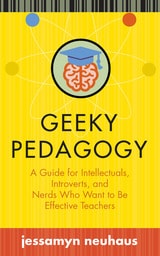
Geeky Pedagogy
A Guide for Intellectuals, Introverts, and Nerds Who Want to Be Effective TeachersJessamyn Neuhaus
West Virginia University Press, 2019
Geeky Pedagogy is a funny, evidence-based, multidisciplinary, pragmatic, highly readable guide to the process of learning and relearning how to be an effective college teacher. It is the first college teaching guide that encourages faculty to embrace their inner nerd, inviting readers to view themselves and their teaching work in light of contemporary discourse that celebrates increasingly diverse geek culture and explores stereotypes about super-smart introverts.
Geeky Pedagogy avoids the excessive jargon, humorlessness, and endless proscriptions that plague much published advice about teaching. Neuhaus is aware of how embodied identity and employment status shape one’s teaching context, and she eschews formulaic depictions of idealized exemplar teaching, instead inviting readers to join her in an engaging, critically reflective conversation about the vicissitudes of teaching and learning in higher education as a geek, introvert, or nerd. Written for the wonks and eggheads who want to translate their vast scholarly expertise into authentic student learning, Geeky Pedagogy is packed with practical advice and encouragement for increasing readers’ pedagogical knowledge.
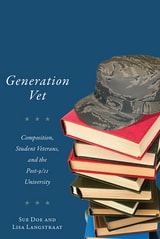
Generation Vet
Composition, Student Veterans, and the Post-9/11 UniversitySue Doe
Utah State University Press, 2014
Institutions of higher education are experiencing the largest influx of enrolled veterans since World War II, and these student veterans are transforming post-secondary classroom dynamics. While many campus divisions like admissions and student services are actively moving to accommodate the rise in this demographic, little research about this population and their educational needs is available, and academic departments have been slower to adjust. In Generation Vet, fifteen chapters offer well-researched, pedagogically savvy recommendations for curricular and programmatic responses to student veterans for English and writing studies departments.
In work with veterans in writing-intensive courses and community contexts, questions of citizenship, disability, activism, community-campus relationships, and retention come to the fore. Moreover, writing-intensive courses can be sites of significant cultural exchanges—even clashes—as veterans bring military values, rhetorical traditions, and communication styles that may challenge the values, beliefs, and assumptions of traditional college students and faculty.
This classroom-oriented text addresses a wide range of issues concerning veterans, pedagogy, rhetoric, and writing program administration. Written by diverse scholar-teachers and written in diverse genres, the essays in this collection promise to enhance our understanding of student veterans, composition pedagogy and administration, and the post-9/11 university.
Genre Explained
Frequently Asked Questions and Answers about Genre-Based InstructionChristine M. Tardy, Nigel A. Caplan & Ann M. Johns
University of Michigan Press, 2023
Genre and Graduate-Level Research Writing
An Cheng
University of Michigan Press, 2018
Genre and Graduate-Level Research Writing is grounded in genre-based theory and full of best practices examples. The book opens by presenting the case for the use of genre in graduate-level research writing and by examining rhetorical consciousness-raising and its ties to genre. Unique to the volume is a thorough analysis of the materials designed to teach genre and research writing—focused on the textbooks of Swales & Feak (e.g., Academic Writing for Graduate Students) and similar texts. Other chapters provide examples of discovery-based genre tasks, evaluative methods for assessing discipline-specific writing, and techniques for becoming a more confident instructor of graduate-level research writing.
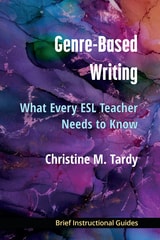
Genre-Based Writing
What Every ESL Teacher Needs to KnowChristine M. Tardy
University of Michigan Press, 2019
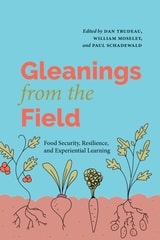
Gleanings from the Field
Food Security, Resilience, and Experiential LearningEdited by Dan Trudeau, William Moseley, and Paul Schadewald
Lever Press, 2025
This timely essay collection frames our food security challenges as “wicked problems,” puzzles without clear solutions that are characterized by evolving complexities and divergent stakeholder priorities. In classroom settings, they argue for the usage of experiential learning to cultivate “wicked problem-solving skills” among students. Gleanings from the Field exemplifies this approach, offering pedagogical interventions to prepare students for tackling these wicked problems, while advocating for high-impact learning experiences that enable students to grapple with the interconnected systems influencing food security. Through hands-on experiences and reflective practice, students gain a deeper understanding of these systems and their societal implications. Importantly, the contributions outlined in this volume underscore the need for a multidimensional view of food security, thus examining the intersections of economic interests, government policies, and social movements. By contextualizing food security within broader political-economic arrangements, educators can empower students to enact meaningful change.
Gleanings from the Field argues for a holistic approach to food security education, one that acknowledges the fraught nature of wicked problems and equips students with the skills and knowledge needed for effective action. By integrating experiential learning, conceptual frameworks about food security and resilience, and real-world engagement, educators can cultivate a new generation of resilient problem-solvers committed to addressing food insecurity and other wicked problems.
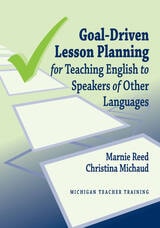
Goal-Driven Lesson Planning for Teaching English to Speakers of Other Languages
Marnie Reed and Christina Michaud
University of Michigan Press, 2010
This book is more than a collection of activities or ready-made lesson plans to add to a teaching repertoire. Instead, Goal-Driven Lesson Planning is intended to empower teachers and help them create a principled framework for their teaching—a framework that will shape the varied activities of the ESL classroom into a coherent teaching and learning partnership. After reading this book, teachers and prospective teachers will be able to articulate their individual teaching philosophies.
Goal-Driven Lesson Planning shows readers how to take any piece from English language materials—an assigned text, a random newspaper article, an ESL activity from a website, etc.—and use it to teach students something about language. Readers are walked through the process of reflecting on their role in diagnosing what that “something” is—what students really need—and planning how to get them there and how to know when they got there in a goal-driven principled manner.
This book has chapters on the theory of setting specific language goals for students; how to analyze learner needs (including an initial diagnostic and needs-analysis); templates to use when planning goal-driven English language lessons; explicit instruction on giving corrective feedback; how to recognize and assess student progress; and the mechanics and logistics that facilitate the goal-driven language classroom.

Going Beyond Google Again
Strategies for Using and Teaching the Invisible WebJane Devine
American Library Association, 2014
Going Beyond Google
The Invisible Web in Learning and TeachingJane Devine
American Library Association, 2009
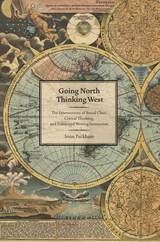
Going North Thinking West
The Intersections of Social Class, Critical Thinking, and Politicized Writing InstructionIrvin Peckham
Utah State University Press, 2010
Graduate Writing Across the Disciplines
Identifying, Teaching, and SupportingMarilee Brooks-Gillies
University Press of Colorado, 2020
Guerrilla Theory
Political Concepts, Critical Digital HumanitiesMatthew Applegate
Northwestern University Press, 2019
In this penetrating study, Matthew Applegate uses the guerrilla to connect popular iterations of digital humanities’ practice to its political rhetoric and infrastructure. By doing so, he reorients DH’s conceptual lexicon around practices of collective becoming, mediated by claims to conflict, antagonism, and democratic will.
Applegate traces Michael Hardt and Antonio Negri’s radical democratic ingresses into network theory, the guerrilla’s role in its discourse, and concerns for the digital humanities’ own invocation of the figure. The book also connects post- and decolonial, feminist, and Marxist iterations of DH praxis to the aesthetic histories of movements such as Latin American Third Cinema and the documentary cinema of the Black Panther Party. Concluding with a meditation on contemporary political modalities inherent in DH’s disciplinary expansion, Guerrilla Theory challenges the current political scope of the digital humanities and thus its future institutional impact.