527 books match the query 'Translations into English' and 12 start with g

cover of German Writing, American Reading: Women and the Import of Fiction, 1866–1917

German Writing, American Reading

Women and the Import of Fiction, 1866–1917

Lynne Tatlock

The Ohio State University Press, 2012

In postbellum America, publishers vigorously reprinted books that were foreign in origin, and Americans thus read internationally even at a moment of national consolidation. A subset of Americans’ international reading—nearly 100 original texts, approximately 180 American translations, more than 1,000 editions and reprint editions, and hundreds of thousands of books strong—comprised popular fiction written by German women and translated by American women. German Writing, American Reading: Women and the Import of Fiction, 1866–1917 by Lynne Tatlock examines the genesis and circulation in America of this hybrid product over four decades and beyond. These entertaining novels came to the consumer altered by processes of creative adaptation and acculturation that occurred in the United States as a result of translation, marketing, publication, and widespread reading over forty years. These processes in turn de-centered and disrupted the national while still transferring certain elements of German national culture. Most of all, this mass translation of German fiction by American women trafficked in happy endings that promised American readers that their fondest wishes for adventure, drama, and bliss within domesticity and their hope for the real power of love, virtue, and sentiment could be pleasurably realized in an imagined and quaintly old-fashioned Germany—even if only in the time it took to read a novel.
[more]
cover of Ghetto Kingdom: Tales of the Lodz Ghetto

Ghetto Kingdom

Tales of the Lodz Ghetto

Isaiah Spiegel

Northwestern University Press, 1998

Isaiah Spiegel was an inmate of the Lodz Ghetto from its inception in 1940 until its liquidation in 1944. While there, he wrote short stories depicting Jewish life in the ghetto and managed to hide them before he was deported to Auschwitz. After being freed, he returned to Lodz to retrieve and publish his stories.
​
The stories examine the relationship between inmates and their families, their friends, their Christian former neighbors, the German soldiers, and, ultimately, the world of hopelessness and desperation that surrounded them. In using his creative powers to transform the suffering and death of his people into stories that preserve their memory, Spiegel succeeds in affirming the humanity and dignity the Germans were so intent on destroying.

Originally published as Malchut geto (Malkhes geto) in Yiddish.
[more]
cover of Global Voices: Picture Books from Around the World

Global Voices

Picture Books from Around the World

Susan Stan

American Library Association, 2014

[more]
cover of God and The End of Satan / Dieu and La Fin de Satan: Selections: In a Bilingual Edition

God and The End of Satan / Dieu and La Fin de Satan

Selections: In a Bilingual Edition

Victor Hugo

Swan Isle Press, 2014

While living in exile with his family on the Channel Islands off the coast of Normandy, Victor Hugo wrote some of his greatest poetry and prose, including Les Misérables and two epic poems: Dieu and La Fin de Satan. Dieu pictures the imaginary search for God by a nameless protagonist, who must face the possibility of failure in this quest. La Fin de Satan, an indictment of prison, war, and capital punishment, depicts an attempt at reconciliation between good and evil.

This book brings together abbreviated editions of these two book-length poems—unfinished and unpublished at the time of the author’s death—comprised of selections that capture their visionary and mystical essence. The poems are accompanied by an introduction framing them within the author’s experience as an exile and tracing their publication history.

Victor Hugo is one of the most important figures in the history of French literature, and this beautifully rendered translation brings two of his lesser-known works deservedly to the forefront.

[more]
cover of Godzilla and Godzilla Raids Again

Godzilla and Godzilla Raids Again

Shigeru Kayama

University of Minnesota Press, 2023

The first English translations of the original novellas about the iconic kaijū Godzilla

Godzilla emerged from the sea to devastate Tokyo in the now-classic 1954 film, produced by Tōhō Studios and directed by Ishirō Honda, creating a global sensation and launching one of the world’s most successful movie and media franchises. Awakened and transformed by nuclear weapons testing, Godzilla serves as a terrifying metaphor for humanity’s shortsighted destructiveness: this was the intent of Shigeru Kayama, the science fiction writer who drafted the 1954 original film and its first sequel and, in 1955, published these novellas. 


Although the Godzilla films have been analyzed in detail by cultural historians, film scholars, and generations of fans, Kayama’s two Godzilla novellas—both classics of Japanese young-adult science fiction—have never been available in English. This book finally provides English-speaking fans and critics the original texts with these first-ever English-language translations of Godzilla and Godzilla Raids Again. The novellas reveal valuable insights into Kayama’s vision for the Godzilla story, feature plots that differ from the films, and clearly display the author’s strong antinuclear, proenvironmental convictions.


Kayama’s fiction depicts Godzilla as engaging in guerrilla-style warfare against humanity, which has allowed the destruction of the natural world through its irresponsible, immoral perversion of science. As human activity continues to cause mass extinctions and rapid climatic change, Godzilla provides a fable for the Anthropocene, powerfully reminding us that nature will fight back against humanity’s onslaught in unpredictable and devastating ways.


Retail e-book files for this title are screen-reader friendly.
[more]
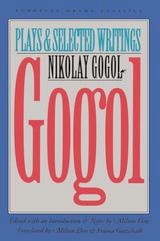
cover of Gogol: Plays and Selected Writings

Gogol

Plays and Selected Writings

Nikolai Gogol

Northwestern University Press, 1994

The theatrical genius of Gogol has gone largely unappreciated by English-speaking audiences because literal translations have left his plays virtually impossible to perform. These fresh translations restore the vitality of Gogol's language and humor, allowing his dramatic art to speak to readers, directors, actors, and theater-goers.
[more]
cover of Good-Bye Samizdat: Twenty Years of Czechoslovak Underground Writing

Good-Bye Samizdat

Twenty Years of Czechoslovak Underground Writing

Marketa Goetz-Stankiewicz

Northwestern University Press, 1992

Good-bye, Samizdat offers the first collection of the best of Czechoslovakia's samizdat, underground texts from the era 1948 through 1990. Divided into three sections, the volume includes fiction, cultural and political works, and philosophical essays. The writings reflect the thought of some of Czechoslovakia's best-known minds--Klima, Vaculik, and Havel--as well as others yet unknown in the West. Taken together, they capture the artistic and intellectual mood of a country situated at a focal point between East and West at a fascinating point in history.
[more]
cover of Gossip & Metaphysics: Russian Modernist Poems & Prose

Gossip & Metaphysics

Russian Modernist Poems & Prose

Edited by Katie Farris, Ilya Kaminsky, and Valzhyna Mort

Tupelo Press, 2014
There has been no anthology in English dedicated to the poetics of the great generation of Russian modernists. For a group of poets so widely admired, relatively little seems known about their philosophy of poetry and their poetic influences, and although there is tremendous aesthetic diversity in this group, they have more in common than many readers assume. Russian poetry was a small world, made even smaller by the arrests, disappearances, pogroms, famines, assassinations, and political conflagration of the revolutionary era, and literary differences were often overcome by a mutual sense of historic cataclysm. This anthology’s structure is like textile, with many common threads intertwining, doubling back, sometimes unraveling—creating a matrix of poetic conversation: Mayakovsky on Khlebnikov, Pasternak on Mayakovsky, Tsvetaeva on Pasternak, Brodsky on Tsvetaeva, Akhmatova on Mandelstam. Shared themes range from expected (the word) to serendipitous (the ocean). Above all these poets are obsessed with proximity—to God, to nature and place, to poetic predecessors, to language (their own and others), and always, forever, to the inexpressible.
[more]
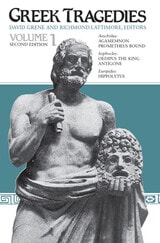
cover of Greek Tragedies, Volume 1

Greek Tragedies, Volume 1

Edited by David Grene and Richmond Lattimore

University of Chicago Press, 1991
In three paperback volumes, the Grene and Lattimore editions offer a selection of the most important and characteristic plays of Aeschylus, Sophocles, and Euripides from the nine-volume anthology of The Complete Greek Tragedies. Over the years these authoritative, critically acclaimed editions have been the preferred choice of more than three million readers for personal libraries and individual study as well as for classroom use.
[more]
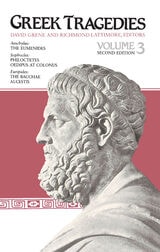
cover of Greek Tragedies, Volume 3

Greek Tragedies, Volume 3

Edited by David Grene and Richmond Lattimore

University of Chicago Press, 1991
In three paperback volumes, the Grene and Lattimore editions offer a selection of the most important and characteristic plays of Aeschylus, Sophocles, and Euripides from the nine-volume anthology of The Complete Greek Tragedies. Over the years these authoritative, critically acclaimed editions have been the preferred choice of more than three million readers for personal libraries and individual study as well as for classroom use.
[more]
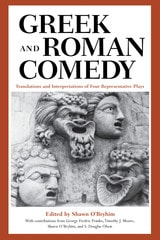
cover of Greek and Roman Comedy: Translations and Interpretations of Four Representative Plays

Greek and Roman Comedy

Translations and Interpretations of Four Representative Plays

Edited by Shawn O'Bryhim

University of Texas Press, 2001

Much of what we know of Greco-Roman comedy comes from the surviving works of just four playwrights—the Greeks Aristophanes and Menander and the Romans Plautus and Terence. To introduce these authors and their work to students and general readers, this book offers a new, accessible translation of a representative play by each playwright, accompanied by a general introduction to the author's life and times, a scholarly article on a prominent theme in the play, and a bibliography of selected readings about the play and playwright.

This range of material, rare in a single volume, provides several reading and teaching options, from the study of a single author to an overview of the entire Classical comedic tradition. The plays have been translated for readability and fidelity to the original text by established Classics scholars. Douglas Olson provides the translation and commentary for Aristophanes' Acharnians, Shawn O'Bryhim for Menander's Dyskolos, George Fredric Franco for Plautus' Casina, and Timothy J. Moore for Terence's Phormio.
[more]
cover of Gregory of Nyssa: Homilies on the Song of Songs

Gregory of Nyssa

Homilies on the Song of Songs

Richard A. Norris Jr.

SBL Press, 2012

Gregory of Nyssa’s fifteen Homilies on the Song of Songs offer an important resource for the history of Christian biblical exegesis, as well as for the history of Christian ascetical and spiritual teaching, and stand alongside Origen’s commentary on the Song as a source for the later interpretative tradition. In addition to offering the original text and an English translation of all fifteen homilies, Norris provides an analysis of the characteristic themes of Gregory’s ascetical teaching, emphasizes its connection in his mind with the institution of baptism, and stresses the degree to which Gregory sees the teaching of the Song as addressed not to a special class of believers but to any and all Christians.
[more]