Results by title
3576 books match the query 'American' and 75 start with g
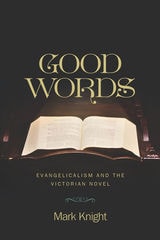
Good Words
Evangelicalism and the Victorian NovelMark Knight
The Ohio State University Press, 2019
Rather than getting lost in historical and theological rabbit holes, Good Words invites readers to think about why evangelicalism still matters for the stories we tell about fiction in the Victorian period. The result has major implications for our understanding of the Victorian novel, our conception of the relationship between nineteenth-century literature and religion, the way in which we think about evangelical culture in the modern world, and our ideas about the practices and protocols of scholarly reading.
Good night the pleasure was ours
David Grubbs
Duke University Press, 2022

Good-bye, Son and Other Stories
Janet Lewis
Ohio University Press, 1986
Good-bye, Son and Other Stories, Janet Lewis’s only collection of short fiction, was first published in 1946, but remains as quietly haunting today as it was then. Set in small communities of the upper Midwest and northern California in the ’30s and ’40s, these midcentury gems focus on the quiet cycles connecting youth and age, despair and hope, life and death. A mother’s encounters with her deceased son, an aging woman sitting with the new knowledge of her troubled older sister’s death, and a teenager disillusioned by her own mortality are among the characters, mostly women and girls, whom Lewis delivers. Her understated style and knack for unadorned observation embed us with them as they reckon with the disquieting forces—incomprehensible and destructive to some, enlightening to others—that move us from birth, through life, to death. In the process, Lewis has crafted a paean to the living.
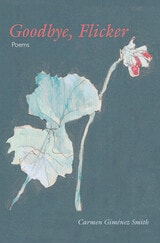
Goodbye, Flicker
PoemsCarmen Giménez Smith
University of Massachusetts Press, 2012
This distinctive collection introduces a new type of mythmaking, daring in its marriage of fairy tale tropes with American mundanities. Conspiratorial, Goodbye, Flicker describes the interior life of a girl whose prince is a deadbeat dad and whose escape into a fantasy world is also an escape into language, beauty, and the surreal.
Goodnight, Gracie
Lloyd Schwartz
University of Chicago Press, 1992
"Like a latter-day Whitman, an addict of contraries or its victim, Schwartz sets out to understand that network in as many ways as his imagination allows. Once you get the hang of what Schwartz is tuning into, you can't stop tuning into it yourself. . . .A master of timing."—Robyn Selman, Voice Literary Supplement
"[Schwartz's] poems seem to think in musical structures; he hears those evanescent snatches of conversation that compose our emotional lives, recognizes their fluid importance, and organizes them for us."—Stephen Tapscott, Boston Phoenix
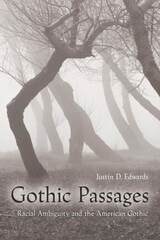
Gothic Passages
Racial Ambiguity and the American GothicJustin D. Edwards
University of Iowa Press, 2003
This groundbreaking study analyzes the development of American gothic literature alongside nineteenth-century discourses of passing and racial ambiguity.
By bringing together these areas of analysis, Justin Edwards considers the following questions. How are the categories of “race” and the rhetoric of racial difference tied to the language of gothicism? What can these discursive ties tell us about a range of social boundaries—gender, sexuality, class, race, etc.—during the nineteenth century? What can the construction and destabilization of these social boundaries tell us about the development of the U.S. gothic?
The sources used to address these questions are diverse, often literary and historical, fluidly moving between “representation” and “reality.” Works of gothic literature by Edgar Allan Poe, Herman Melville, Frances Harper, and Charles Chesnutt, among others, are placed in the contexts of nineteenth-century racial “science” and contemporary discourses about the formation of identity. Edwards then examines how nineteenth-century writers gothicized biracial and passing figures in order to frame them within the rubric of a “demonization of difference.” By charting such depictions in literature and popular science, he focuses on an obsession in antebellum and postbellum America over the threat of collapsing racial identities—threats that resonated strongly with fears of the transgression of the boundaries of sexuality and the social anxiety concerning the instabilities of gender, class, ethnicity, and nationality.
Gothic Passages not only builds upon the work of Americanists who uncover an underlying racial element in U.S. gothic literature but also sheds new light on the pervasiveness of gothic discourse in nineteenth-century representations of passing from both sides of the color line. This fascinating book will be of interest to scholars of American literature, cultural studies, and African American studies.
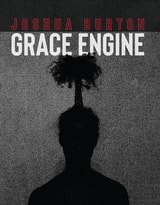
Grace Engine
Joshua Burton
University of Wisconsin Press, 2023
Burton experiments with spaces, absences, and forms in navigating the tensions between shame and accountability, guilt and forgiveness, to understand how one finds the ability to cope under the worst of conditions. With patience and ferocity, he delves into generational and familial trauma to question whether black strength is inherent to blackness and to build a mechanism to survive and heal.
both at the moment they unwed
themselves of shame
and before that.
—Excerpt from “Grace Engine”
Grace Paley
Illuminating Dark LivesBy Jacqueline Taylor
University of Texas Press, 1990
Grace Paley is a "writer's writer," admired by both scholars and the reading public for her originality and unique voice. In this first book-length study of her work, Jacqueline Taylor explores the source of Paley's originality, locating it in the way Paley transforms language to create strongly woman-centered stories.
Drawing on interviews with the author, as well as the stories themselves, Taylor emphasizes Paley's awareness that women's voices have been muted and their stories ignored or left untold in our culture's male-oriented dominant discourse. She watches Paley in the process of reshaping language at both the semantic and narrative levels to make it express women's perceptions and experiences. In Paley's stories, it becomes possible to ignore traditional heroic and dramatic themes and instead talk about women and children in such everyday settings as the playground, the kitchen, and the grocery store.
Some of the specific techniques Paley uses to accomplish this include identifying and repudiating sexist language in the dominant discourse and redefining ordinary words from the perspective of women. At the narrative level, Taylor reveals how she draws on women's oral traditions to tell open-ended stories that resist rigid beginning-middle-and-end structuring.
This transformed language enables Paley to construct a social world where woman-centered meanings can flourish. In her nontraditional stories, no single narrator or version of events dominates. Anyone can be a storyteller and no one has the last word.
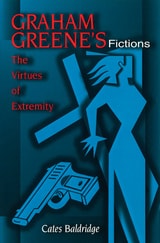
Graham Greene's Fictions
The Virtues of ExtremityCates Baldridge
University of Missouri Press, 2000
The first critical evaluation of Greene's novels since his death in 1991, Graham Greene's Fictions: The Virtues of Extremity is a reconsideration of the author's major literary achievements, as well as a recasting of his overall worldview. Hitherto, most criticism of Greene's fiction has forced him into the constricting category of the "Catholic novelist," consequently flattening the peaks and valleys of his uncompromising vision of life. Graham Greene's Fictions is Cates Baldridge's response to this critical disservice—an exploration that ignores the conventional preconceptions about Greene's fiction and reveals him to be one of the leading British novelists of the twentieth century.
More than a general assessment, Graham Greene's Fictions offers a fresh interpretation of familiar texts and attempts to discover within Greene's work a structure of thought that has not yet been seen with sufficient clarity. Each chapter focuses on a major aspect of Greene's vision as expressed through his novels. Greene's caustic attitude toward middle-class orthodoxies and his critiques of the three reigning ideologies of his time--Christianity, Marxism, and liberalism—are just two of the areas that Baldridge explores. Although five of Greene's novels are singled out for extensive evaluation—Brighton Rock, The Power and the Glory, The Heart of the Matter, The Comedians, and The Honorary Consul—what Baldridge attempts is nothing less than a comprehensive re-imagination of "Greeneland's" fictional topography.
Written for both the scholar and the general audience, this innovative study successfully captures the attention of all readers whether it is the first or the fifty-first work of Greene criticism one has read.
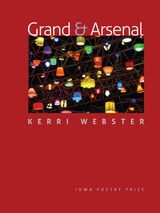
Grand & Arsenal
Kerri Webster
University of Iowa Press, 2012
Grand & Arsenal begins “Bless me I am not myself,” but it is not long before the probability of being blessed is revealed to be as remote as the concept of a whole self. Thus begins the book’s defining struggle, enacted by a multitude of voices which move from rush to stumble and back again—meanwhile using all the tools we as a culture use to hold fear at arm’s length.
We hear a familiar irony, as in “On a trip West, porn in the hotel room. I can take or leave it. The climax that puts me in the seats? World’s end.” We hear humor, as in “I believed in . . . / . . . a certain apocalypse not so much foretold as crafted / by large-brained monkeys.” We hear understatement, as in “knowing it does not matter / in the grand—she would say scheme, I would say / mishap—.” Most importantly, though, these poems allow for the fleeting triumph of an undefended voice, which appears often to emerge tentatively from a sort of exhausted collapse.
Grand Concourse
A PlayHeidi Schreck
Northwestern University Press, 2015
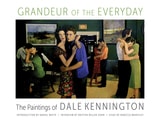
Grandeur of the Everyday
The Paintings of Dale KenningtonDale Kennington, Introduction by Daniel White, Conversation with Kristen Miller Zohn, Essay by Rebecca Brantley
University of Alabama Press, 2017
Grandeur of the Everyday is the first full-length volume dedicated to the life and work of Dale Kennington—an accomplished master of contemporary American realism. Kennington’s works often hold a strange familiarity, even for those coming to her work for the first time. Her paintings are at once familiar and yet defy specificity of place, clear and lucid while also dense in content. These effects derive from her unique ability to capture the essence of everyday living, the ordinary “in between” moments we often overlook in our day-to-day habits and transactions.
Kennington referred to her paintings as “merged memories.” Combining elements of photography, memory, and imagination, Kennington’s art is an entrancing blend of contemporary and magical realism, with themes ranging from loneliness to community and culture, from class and race relations to the juxtaposition of private and public life. Rather than study the spectacular, she concentrated on commonplace moments of human interaction, inviting observers of her paintings to ponder their significance and to complete their implicit narratives. Often relying on local subjects for her paintings—barbershops, bars, restaurants, gospel concerts, motel rooms, nursing homes—she presented a diversity of local experience.
Grandeur of the Everyday is a treasure trove of her most accomplished creations and includes more than eighty-five examples of both Kennington’s easel paintings on canvas and her freestanding wooden folding screens. The volume also offers an original interview with the artist conducted by Kristen Miller Zohn, an introduction by art historian Daniel White, and a critical essay by the director of the Wiregrass Museum of Art, Rebecca Brantley.
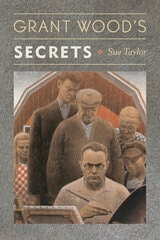
Grant Wood’s Secrets
Sue Taylor
University of Delaware Press, 2011
Published by University of Delaware Press. Distributed worldwide by Rutgers University Press.
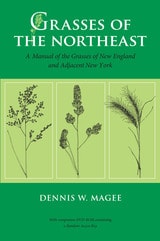
Grasses of the Northeast
A Manual of the Grasses of New England and Adjacent New YorkDennis W. Magee
University of Massachusetts Press, 2014
This book is designed to serve as a reference work, classroom textbook, and field manual for botanists, naturalists, and students interested in learning to identify and learn about the distinguishing features of grasses of the northeastern United States. Included are more than 380 species of grasses that have been documented as occurring in the region. The volume contains 246 range maps and 269 line drawings that clarify descriptions used in the keys and illustrate characteristics of the various kinds of grasses. Dennis Magee also provides a description of each genus and species along with synonyms and habitats. For anyone interested in an up-to-date treatment of the grasses of greater New England, this volume will be an invaluable resource. It is the only comprehensive technical guide devoted exclusively to the grasses of this region and presents a wealth of information in a precise, clear format.
The geographic scope of the work extends from the Canadian border south through Long Island and west to the Hudson River. But given the considerable overlap with the grass flora to the adjacent north, south, and west, the book will also be useful beyond New England and the bordering New York counties.
The volume includes an illustrated glossary of essential terms and concepts and a “how to use this manual” section. A CD-ROM with a multiple-entry identification guide, and hundreds of accompanying photographic images of individual species, is provided in a sleeve inside the back cover of the book.
Gravel and Hawk
PoemsNick Norwood
Ohio University Press, 2012
Gravel and Hawk dwells on the physical and cultural landscapes of the Texarkana border region, an area of stark natural beauty and even starker manifestations of its human habitation: oil derricks and pump jacks, logging trucks, chicken houses, come-to-Jesus billboards, and greasy catfish joints, a patchwork of dying farm towns and ragtag municipalities laced together by county roads, state highways, and that treacherous, rust-hued slurry known as the Red River. Gravel and Hawk charts the emotional landscape of a single extended family, its history of loss and gain, and, especially, its encounters with violent death. It is an eminently readable collection, rooted in a distinctly American place and united by a poetic voice that is honest, sophisticated, and persuasive.

Great Gatsby and Modern Times
Ronald Berman
University of Illinois Press, 1994
work. If Fitzgerald could have wished for one reader of The Great Gatsby,
it would have been Ronald Berman. Berman's criticism creates an ideal
companion piece to the novel--as brilliantly illuminating about America
as it is about fiction, and composed with as much thought and style."
-- Roger Rosenblatt
"An impressive study
that brilliantly highlights the oneness of Fitzgerald's art with the overall
context of modernism." -- Milton R. Stern, author of The Golden
Moment: The Novels of F. Scott Fitzgerald
"Citing films, dates,
places, schedules, Broadway newsstands, and the spoils of manufacture,
the author, never lapsing into critical jargon, locates the characters
in 'the moving present.' Gatsby, the first of the great novels
to emerge from B movies, uses the language of commodities, advertisements,
photography, cinematography, and Horatio Alger to present models of identity
for characters absorbed in and by what is communicated. . . . Berman concludes
that Gatsby 'reassembled' rather than 'invented' himself."
-- A. Hirsh, Choice
Greening The Lyre
Environmental Poetics And EthicsDavid W. Gilcrest
University of Nevada Press, 2002
This work covers important and neglected ground—environmental language theory. Gilcrest poses two overarching questions: To what extent does contemporary nature poetry represent a recapitulation of familiar poetics? And, to what extent does contemporary nature poetry engage a poetics that stakes out new territory? He addresses these questions with important thinkers, especially Kenneth Burke, and considers such poets as Frost, Kunitz, Heaney, Ammons, Cardenal, and Rich.
Gregory Corso
Doubting ThomistKirby Olson
Southern Illinois University Press, 2002
Gregory Corso is the most intensely spiritual of the Beat generation poets and still by far the least explored. The virtue of Kirby Olson’s Gregory Corso: Doubting Thomist is that it is the first book to place all of Corso’s work in a philosophical perspective, concentrating on Corso as a poet torn between a static Catholic Thomist viewpoint and that of a progressive surrealist.
While Corso is a subject of great controversy—his work often being seen as nihilistic and wildly comic—Olson argues that Corso’s poetry, in fact, maintains an insistent theme of doubt and faith with regard to his early Catholicism. Although many critics have attempted to read his poetry, and some have done so brilliantly, Olson—in his approach and focus—is the first to attempt to give a holistic understanding of the oeuvre as essentially one not of entertainment or hilarity but of a deep spiritual and philosophical quest by an important and profound mind.
In nine chapters, Olson addresses Corso from a broad philosophical perspective and shows how Corso takes on particular philosophical issues and contributes to new understandings. Corso’s concerns, like his influence, extend beyond the Beat generation as he speaks about concerns that have troubled thinkers from the beginning of the Western tradition, and his answers offer provocative new openings for thought.
Corso may very well be the most important Catholic poet in the American literary canon, a visionary like Burroughs and Ginsberg, whose work illuminated a generation. Written in a lively and engaging style, Gregory Corso: Doubting Thomist seeks to keep Corso’s memory alive and at last delve fully into Corso’s poetry.
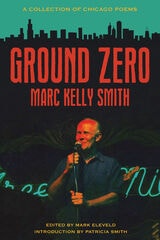
Ground Zero
A Collection of Chicago PoemsMarc Kelly Smith; Edited by Mark Eleveld; With an introduction by Patricia Smith
Northwestern University Press, 2021
Inception and implosion, Chicago’s grit and grandiosity all come together in the finite poetic power of the original Slam igniter, renowned poet Marc Kelly Smith and his retrospect denotation, Ground Zero.
A cultural, community, and adversarial figure, Smith has challenged the status quo and raised new questions about an environment in a state of continuous calamity. Smith’s power and influence have inspired celebrated figures who cut their teeth on both the stage and the page under his watchful eye—always speaking in the traditions of Carl Sandburg and Gwendolyn Brooks. Ground Zero challenges but pays homage to the thousand underbellies of Chicago with Smith’s wicked, cigarette-in-the-beer language: “I ain’t diggin’ no concrete coffin, / No backyard mausoleum / To keep me a pickle sweet aplenty / Plied with sardines and pork sausage wieners / Livin’ out the chance that some bubble-flesh victim / Will come puckered up and scabby lipped / To kiss me in the name of a new mankind.”
Ground Zero leaves no doubt. The Slampapi / instigator / visionary / you-may-love-me-or-hate-me-but-my-history-will-always-be-chiseled-in-everything-the-poetry-world-does-next collects a survey of his land and his experience, no matter how beautiful or flawed. This book lets the landmines of imagery and Chicago’s slow and uneasy drawl showcase one of our most original voices.
Guidebooks for the Dead
Cynthia Cruz
Four Way Books, 2020

Gulf
Pimone Triplett
University of Iowa Press, 2027
Gunslinger
Edward Dorn
Duke University Press, 1968
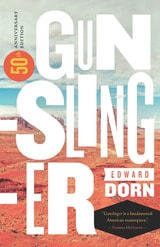
Gunslinger
Edward Dorn
Duke University Press, 1968
"Gunslinger is a fundamental American masterpiece."---Thomas McGuane
This fiftieth anniversary edition commemorates Edward Dorn’s masterpiece, Gunslinger, a comic, anti-epic critique of American capitalism that still resonates today. Set in the American West, the Gunslinger, his talking horse Claude Lévi-Strauss, a saloon madam named Lil, and the narrator called “I” set out in search of the billionaire Howard Hughes. As they travel along the Rio Grande to Truth or Consequences, New Mexico, and finally on to Colorado, they are joined by a whole host of colorful characters: Dr. Jean Flamboyant, Kool Everything, and Taco Desoxin and his partner Tonto Pronto. During their adventures and hijinks, as captured in Dorn’s multilayered, absurd, and postmodern voice, they joke and smoke their way through debates about the meaning of existence. Put simply, Gunslinger is an American classic.
In a new foreword Marjorie Perloff discusses Gunslinger's continued relevance to contemporary politics. This new edition also includes a critical essay by Michael Davidson and Charles Olson’s idiosyncratic “Bibliography on America for Ed Dorn,” which he wrote to provide guidance for Dorn's study of, and writing about, the American West.
Guy Davenport
Postmodern and AfterAndre Furlani
Northwestern University Press, 2007
Guy Davenport (1927–2005), an American writer of fiction, poetry, criticism, and essays, a translator, painter, intellectual, and teacher, brought a breadth and depth of knowledge to his pursuits that few other writers could approach, let alone appraise. In Andre Furlani, this twentieth-century American master has finally found an apt critical reader. In this first sustained critical study of Davenport, Furlani elucidates the depths of Davenport's fiction and its poetic precedents, brings a rare understanding to the author's reworking of twentieth-century literature and intellectual history, and offers unusual insight into his compositional technique.
Furlani explores key themes across the spectrum of Davenport's fiction: pastoral utopia; twentieth-century dystopia; sexual ethics; the mythologizing of childhood; the inseparability of the archaic and the modern; and a celebration of the union of sophia, eros, and poesia. Whether Davenport's view of art and the cosmos should be called "postmodern" is a question that Furlani considers closely--offering, finally, a new aesthetic for this American original who, in these pages, at last receives the thorough and meticulous attention he has long merited.
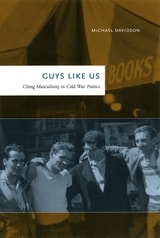
Guys Like Us
Citing Masculinity in Cold War PoeticsMichael Davidson
University of Chicago Press, 2003