Results by title
3071 books match the query 'Business & Economics' and 66 start with g
Government and the American Economy
A New HistoryPrice V. Fishback et al.
University of Chicago Press, 2007
The American economy has provided a level of well-being that has consistently ranked at or near the top of the international ladder. A key source of this success has been widespread participation in political and economic processes. In The Government and the American Economy, leading economic historians chronicle the significance of America’s open-access society and the roles played by government in its unrivaled success story.
America’s democratic experiment, the authors show, allowed individuals and interest groups to shape the structure and policies of government, which, in turn, have fostered economic success and innovation by emphasizing private property rights, the rule of law, and protections of individual freedom. In response to new demands for infrastructure, America’s federal structure hastened development by promoting the primacy of states, cities, and national governments. More recently, the economic reach of American government expanded dramatically as the populace accepted stronger limits on its economic freedoms in exchange for the increased security provided by regulation, an expanded welfare state, and a stronger national defense.
Grain Supply of England During the Napoleonic Period
a thesisW. Freeman Galpin
University of Michigan Press, 1925

Grass Roots
A History of Cannabis in the American WestNick Johnson
Oregon State University Press, 2017
To understand how we got here and how the legal cannabis industry might become more environmentally sustainable, Grass Roots looks at the history of marijuana growing in the American West, from early Mexican American growers on sugar beet farms to today’s sophisticated greenhouse gardens. Over the past eighty years, federal marijuana prohibition has had a multitude of consequences, but one of the most important is also one of the most overlooked—environmental degradation. Grass Roots argues that the most environmentally negligent farming practices—such as indoor growing—were borne out of prohibition. Now those same practices are continuing under legalization.
Grass Roots uses the history of cannabis as a crop to make sense of its regulation in the present, highlighting current efforts to make the marijuana industry more sustainable. In exploring the agricultural history of cannabis, There are many social and political histories of cannabis, but in considering cannabis as a plant rather than as a drug, Grass Roots offers the only agriculturally focused history to date.

Great Lakes Lumber on the Great Plains
The Laird, Norton Lumber Company In South DakotaJohn N. Vogel
University of Iowa Press, 1992
Focusing on the Plains territory of east central South Dakota as well as the Great Lakes lumber-producing region of Wisconsin's Chippewa Valley, John Vogel carefully and thoroughly examines the pattern and process by which lumber reached South Dakota. The Great Dakota Boom of 1878 to 1887 and the Laird, Norton Lumber Company of Winona, Minnesota, provide the basis for his engrossing book.
The westward expansion of the railroad and the continuing settlement of the Great Plains in the late nineteenth century allowed the lumber companies of Minnesota and Wisconsin to send their boards and beams and fenceposts and millwork to a market characterized by great demand and small supply. Laird, Norton followed settlers across southern Dakota as they arrived on the trains. The eastern portions of Dakota were settled first, and thus early lumberyards were found there; as settlement moved west, so did the lumberyards. Beyond its all-important function of distribution, the railroad forced Laird, Norton to alter the very structure of its operation. Experimenting with nearly complete vertical integration, the company pioneered organizational models that would serve significant purposes as frontier America—a republic of wood—solidified itself economically and culturally.
Green Barons, Force-of-Circumstance Entrepreneurs, Impotent Mayors
Rural Change in the Early Years of Post-Socialist Capitalist DemocracyNigel Swain
Central European University Press, 2013
Green Gold
Alabama's Forests and Forest IndustriesJames E. Fickle
University of Alabama Press, 2014
Green Gold is a thorough and valuable compilation of information on Alabama’s timber and forest products industry, the largest manufacturing industry in the state.
Alabama has the third-largest commercial forest in the nation, after only Georgia and Oregon. Fully two-thirds of the state’s land supports the growth of over fifteen billion trees on twenty-two million acres, which explains why Alabama looks entirely green from space. Green Gold presents the story of human use of and impact on Alabama’s forests from pioneer days to the present, as James E. Fickle chronicles the history of the industry from unbridled greed and exploitation through virtual abandonment to revival, restoration, and enlightened stewardship.
As the state’s largest manufacturing industry, forest products have traditionally included naval stores such as tar, pitch, and turpentine, especially in the southern longleaf stands; sawmill lumber, both hardwood and pine; and pulp and paper milling. Green Gold documents all aspects of the industry, including the advent of “scientific forestry” and the development of reforestation practices with sustained yields. Also addressed are the historical impacts of Native Americans and of early settlers who used axes, saws, and water- and steam-powered sawmills to clear and utilize forests. Along with an account of railroad logging and the big mills of the lumber bonanza days of the late nineteenth and early twentieth centuries, the book also chronicles the arrival of professional foresters to the state, who began to deal with the devastating legacy of “cut out and get out” logging and to fight the perennial curse of woods arson. Finally, Green Gold examines the rise of the tree farm movement, the rebirth of large-scale lumbering, the advent of modern environmental concerns, and the movement toward the “Fourth Forest” in Alabama.
A Copublication with the Alabama Forestry Foundation
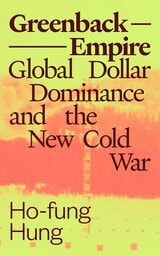
Greenback Empire
Global Dollar Dominance and the New Cold WarHo-fung Hung
University of Chicago Press, 2026
A critical history of the US dollar’s dominance in the world economy—and what has kept China’s currency from overtaking it.
The dollar is the primary currency of the world economy. With China now rivaling the United States on the world stage, a critical question hangs in the balance: will the Chinese renminbi challenge the status of the dollar and, in doing so, deprive America of its “exorbitant privilege”?
In GreenbackEmpire, Ho-fung Hung offers a powerful account of why, even as American shares of global production, ownership, and trade continue to decline, its currency has retained the support of governments and investors around the world. For six decades, Hung shows, the dominance of the dollar has rested on the security umbrella that the US offers to the world’s wealthiest countries—including oil producers. To these countries, support for the value of the dollar is tantamount to maintaining US protection. While China has become a serious geopolitical and economic rival to the US, the Chinese state’s airtight control of its financial system has delayed the free trading of the renminbi, limiting the currency’s internationalization. In short, the same strategy that engineered growth in China’s economy is restraining its currency's rise in opposition to the dollar. Hung’s Greenback Empire is an essential history of the dollar’s prowess, indispensable for understanding the future of the global monetary system.

Greenback Planet
How the Dollar Conquered the World and Threatened Civilization as We Know ItBy H. W. Brands
University of Texas Press, 2011
The world runs on the U.S. dollar. From Washington to Beijing, governments, businesses, and individuals rely on the dollar to conduct commerce and invest profitably and safely—even after the global financial meltdown in 2008 revealed the potentially catastrophic cost of the dollar's hegemony. But how did the greenback achieve this planetary dominance a mere century and a half after President Lincoln issued the first currency backed only by the credit—and credibility—of the federal government?
In Greenback Planet, acclaimed historian H. W. Brands charts the dollar's astonishing rise to become the world's principal currency. Telling the story with the verve of a novelist, he recounts key episodes in U.S. monetary history, from the Civil War debate over fiat money (greenbacks) to the recent worldwide financial crisis. Brands explores the dollar's changing relations to gold and silver and to other currencies and cogently explains how America's economic might made the dollar the fundamental standard of value in world finance. He vividly describes the 1869 Black Friday attempt to corner the gold market, banker J. P. Morgan's bailout of the U.S. treasury, the creation of the Federal Reserve, and President Franklin Roosevelt's handling of the bank panic of 1933. Brands shows how lessons learned (and not learned) in the Great Depression have influenced subsequent U.S. monetary policy, and how the dollar's dominance helped transform economies in countries ranging from Germany and Japan after World War II to Russia and China today. He concludes with a sobering dissection of the 2008 world financial debacle, which exposed the power—and the enormous risks—of the dollar's worldwide reign.
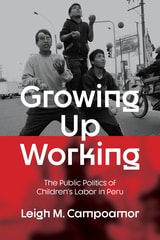
Growing Up Working
The Public Politics of Children's Labor in PeruLeigh M. Campoamor
University of Texas Press, 2026
A deep ethnography on children who work in Lima, Peru, and a critique of the global anti-child labor effort.
Children juggling at traffic lights and selling candy from car to car are ubiquitous in Lima, Peru’s capital, making the country a hotspot for child labor reformers. Even when the intentions behind the anti-child labor movement are benevolent, in practice this effort affects children and their families in unexpected and often harmful ways.
Anthropologist Leigh Campoamor argues that the concept of child labor is stuck in an industrial-era framing that fails to capture the reality of working youth in the global south today. Following children who work on Lima’s streets through their daily routines, Campoamor shows how these youth—and often their mothers—become subjects of moral intervention by state institutions, NGOs, and the general public. Arguing that reformers reinforce hierarchies of race, class, gender and age in the name of children's rights, Growing Up Working shows how working youth assert agency while also performing invisible caring and affective labor that doesn't count as work under neoliberal capitalism. Campoamor follows the children at the center of her ethnography into adulthood, providing an intimate and dynamic portrait of their lives while critiquing the ways anti–child labor discourses imagine working children’s futures.
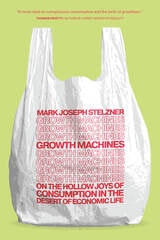
Growth Machines
On the Hollow Joys of Consumption in the Desert of Economic LifeMark Joseph Stelzner
University of Chicago Press, 2026
A provocative look at America’s compulsion to consume and our obsession’s surprising—and strange—origins.
In a capitalist society, people sell their labor to purchase staples like food, shelter, and anxiety medication. That’s the equation of everyday economic life that we’ve always been told is true. Except, is it really that simple anymore? No matter how unmaterialistic you may think you are, odds are that deep within is a drive to consume because it feels good: books you won’t read, clothes you won’t like and might wear even less, a replacement phone whose novelty runs out as quickly as its upgrade hits the market. But what drives this impulse?
In Growth Machines, Mark Joseph Stelzner shows how today’s consumers are now programmed by a US economy intent on infinite growth to work for goods they’ve been convinced they need and conditioned to want. Stelzner establishes the gaps between economic thinking and economic reality, arguing that consumption is no longer just a reflection of needs, but rather, it reflects a need for transaction—in many cases, a treat we seek out because it feels good. We work not only to be able to consume the essentials for living, but also to consume for consumption's sake. Yet such consumption doesn’t make us happier. Stelzner traces this strange nature of consumption to an environmental source: an economy that demands growth. To keep its economy pumping, the US must keep Americans consuming. This makes Stelzner’s book an uncomfortable reflection on how we internalize our economy. To be an American is to consume; to consume is what makes America.
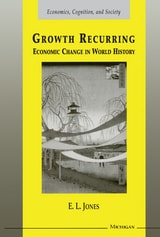
Growth Recurring
Economic Change in World HistoryE.L. Jones
University of Michigan Press, 2000
Eric Jones has written a substantial new introduction for this edition, which includes discussions of early evidence of growth episodes and the relation of these points to the Industrial Revolution, and the relevance of the East Asian "miracle" to his thesis.
Growth Theories in Light of the East Asian Experience
Edited by Takatoshi Ito and Anne O. Krueger
University of Chicago Press, 1995
The theory explored in this volume attributes the phenomenal economic success of these countries to, among other factors, the role of an outward orientation—a focus on exporting rather than on protecting home markets. In addition, the importance of exchange rate behavior, of the supportive role of government policy, and of the accumulation and promotion of physical and human capital are explored in detail. This collection also examines the extent to which growth in each country became self-sustaining once it began.
Demonstrating the relevance of endogenous growth theory for studying this important region, this fourth volume in the NBER-East Asia Seminar on Economics series will be of interest to observers of East Asian affairs.
Growth Triumphant
The Twenty-first Century in Historical PerspectiveRichard A. Easterlin
University of Michigan Press, 1998
Growth and Productivity in East Asia
Edited by Takatoshi Ito and Andrew K. Rose
University of Chicago Press, 2004
Takatoshi Ito and Andrew K. Rose have organized a group of collaborators from several Asian countries, the United States, and other parts of the globe who ably balance both macroeconomic and microeconomic study with theoretical and empirical approaches. Growth and Productivity in East Asia gives special attention to the causes for the unusual success of Australia, one of the few nations to maintain unprecedented economic growth despite the 1997 Asian financial crisis and the 2001 global downturn. A new database comprising eighty-four Japanese sectors reveals new findings for the last thirty years of sectoral productivity and growth in Japan. Studies focusing on Indonesia, Taiwan, and Korea also consider productivity and its relationship to research and development, foreign ownership, and policy reform in such industries as manufacturing, automobile production, and information technology.

Guest Workers and Resistance to U.S. Corporate Despotism
Immanuel Ness
University of Illinois Press, 2011
Political scientist Immanuel Ness thoroughly investigates the use of guest workers in the United States, the largest recipient of migrant labor in the world. Ness argues that the use of migrant labor is increasing in importance and represents despotic practices calculated by key U.S. business leaders in the global economy to lower labor costs and expand profits under the guise of filling a shortage of labor for substandard or scarce skilled jobs.
Drawing on ethnographic field research, government data, and other sources, Ness shows how worker migration and guest worker programs weaken the power of labor in both sending and receiving countries. His in-depth case studies of the rapid expansion of technology and industrial workers from India and hospitality workers from Jamaica reveal how these programs expose guest workers to employers' abuses and class tensions in their home countries while decreasing jobs for American workers and undermining U.S. organized labor.
Where other studies of labor migration focus on undocumented immigrant labor and contend immigrants fill jobs that others do not want, this is the first to truly advance understanding of the role of migrant labor in the transformation of the working class in the early twenty-first century. Questioning why global capitalists must rely on migrant workers for economic sustenance, Ness rejects the notion that temporary workers enthusiastically go to the United States for low-paying jobs. Instead, he asserts the motivations for improving living standards in the United States are greatly exaggerated by the media and details the ways organized labor ought to be protecting the interests of American and guest workers in the United States.

Guide to Sustainable Development and Environmental Policy
Natalia Mirovitskaya and William L. Ascher, eds.
Duke University Press, 2001
The guide combines formal, objective entries with critical commentaries that emphasize different opinions and controversies. With succinct explanations of more than a thousand terms, thoughtful interpretations by international experts, and helpful cross-referencing, this resource is designed to serve as a roadmap for understanding the issues and debates in the overlapping fields of environment and development. Intended for use by activists, journalists, policymakers, students, scholars, and interested citizens, the Guide to Sustainable Development and Environmental Policy will be a helpful tool for anyone trying to get a comprehensive look at the many environmental organizations, schools of thought, development programs, international environmental treaties, conventions, and strategies that have proliferated in the past few decades.