Results by title
522 books match the query 'Gender' and 72 start with g

Gender, Emotions and Power, 1750–2020
Edited by Hannah Parker and Josh Doble
University of London Press, 2023
The fact that emotional expectations have gendered, racialized, and class-based components has only recently begun to be a topic of discussion in general society. This book tackles contemporary debates around the issue, considering the ways emotional expectations have been attained, stratified, and maintained by institutions, societies, media, and those with access to structural or personal power. The contributors draw upon a diverse set of case studies to present a chronologically and geographically broad intervention. The authors identify and explore connections between the depiction of twentieth-century transnational radical feminists, the settler colonies of southern Africa, post-unification Italy, Maoist China, the twentieth-century Soviet Union, and the medicalized spaces of the British Raj. Contributions also move across time from notions of eighteenth-century British masculinity through Victorian Britain to the Liverpool docks of the 1990s and contemporary Russia. Collectively, the volume’s authors seek to understand how the normalization of emotions as a range of gendered feelings forms the basis upon which notions of self and social identities are performed.
Gender, Health, and History in Modern East Asia
Edited by Angela Ki Che Leung and Izumi Nakayama
Hong Kong University Press, 2017
Gender, Identity, and Place
Understanding Feminist GeographiesLinda Mcdowell
University of Minnesota Press, 1999
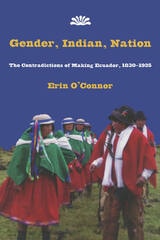
Gender, Indian, Nation
The Contradictions of Making Ecuador, 1830–1925Erin O'Connor
University of Arizona Press, 2007
O’Connor begins her investigations by examining the multilayered links between gender and Indian-state relations in nineteenth-century Ecuador. Disentangling issues of class and culture from issues of gender, she uncovers overlapping, conflicting, and ever-evolving patriarchies within both indigenous communities and the nation’s governing bodies. She finds that gender influenced sociopolitical behavior in a variety of ways, mediating interethnic struggles and negotiations that ultimately created the modern nation. Her deep research into primary sources—including congressional debates, ministerial reports, court cases, and hacienda records—allows a richer, more complex, and better informed national history to emerge.
Examining gender during Ecuadorian state building from “above” and “below,” O’Connor uncovers significant processes of interaction and agency during a critical period in the nation’s history. On a larger scale, her work suggests the importance of gender as a shaping force in the formation of nation-states in general while it questions recountings of historical events that fail to demonstrate an awareness of the centrality of gender in the unfolding of those events.
Gender, Intersections, and Institutions
Intersectional Groups Building Alliances and Gaining Voice in GermanyEdited by Louise K. Davidson-Schmich
University of Michigan Press, 2017
Gender, Law, and Resistance in India
Erin P. Moore
University of Arizona Press, 1988
Gender, Politics, and Islam
Edited by Therese Saliba, Carolyn Allen, and Judith A. Howard
University of Chicago Press, 2002
This collection shows Islam to be a diverse set of variable practices and beliefs shaped by region, nation, ethnicity, sect, and class, as well as by responses to many cultural and economic processes. In examining women's participation in religious and nationalist projects, these critics debate controversial issues: Does Islamic feminism provide an alternative, revolutionary paradigm to Eurocentric liberal humanism and western feminism? Is Islam more oppressive to women than the modern secular state? How are the lives and texts of Arab and Muslim women constructed for local or western consumption? These essays expose the shortcomings of the secularist assumptions of many recent feminist analyses, which continue to treat religion in general and fundamentalism in particular as a tool of oppression used against women, rather than as a viable form of feminist agency producing contradictory effects for its participants.
The essays in this book first appeared in Signs: Journal of Women in Culture and Society.
Contributors:
S. M. Shamsul Alam
Amal Amireh
Mary Elaine Heglund
Shahnaz Khan
Anouar Majid
Val Moghadam
Julia Peteet
Elora Shehabbudin
Gabriele vom Bruck.

Gender, Race and Religion in Video Game Music
Thomas B. Yee
Intellect Books, 2024
This book provides semiotically focused analyses and interpretations of video game music, focusing specifically on the musical representation of three demographic diversity traits. Adopting a narratologist orientation to supplement existing ludological scholarship, these analyses apply music semiotics to crucial modern-day issues such as the representation of gender, race, and religion in video games.
An original and welcome contribution to the field, it considers musical meaning in relation to the aspects of gender, race, and religion. This book will help readers develop language and context in which to consider video game music in terms of society and representation and will encourage future research in these critical areas. Containing twenty-five detailed analytical case studies of musical representation in video game music, the book sets out theoretical and conceptual frameworks beneficial for interpreting musical meaning from video game soundtracks. Though players and commentators may be tempted to view a game’s soundtrack as mere background music, this research demonstrates video game music’s social relevance as a major factor impacting players’ cultural attitudes, values, and beliefs.
Part I explores immersion, interactivity, and interpretation in video game music, proposing a theory of interpretative interactivity to account for players’ semiotic agency in dialogue with their ludic agency. Part II explores musical gender representation in a trajectory from conventional gender construction, alternative femininities and masculinities, and the potential for nonbinary representational possibilities. Part III explores the musical representation of nationality, culture, and race, proposing the concept of racialized fantasy and applying frameworks from race scholarship to connect media representations of race to real-world racial justice movements. Part IV examines religion, introducing the concept of sonic iconography to connect theological meanings to the use of sacred music in video game music.
Gender, Religion, and Family Law
Theorizing Conflicts between Women’s Rights and Cultural TraditionsEdited by Lisa Fishbayn Joffe and Sylvia Neil
Brandeis University Press, 2012
Gender, Separatist Politics, and Embodied Nationalism in Cameroon
Jacqueline-Bethel Tchouta Mougoué
University of Michigan Press, 2019
Gender, Separatist Politics, and Embodied Nationalism in Cameroon illuminates how issues of ideal womanhood shaped the Anglophone Cameroonian nationalist movement in the first decade of independence in Cameroon, a west-central African country. Drawing upon history, political science, gender studies, and feminist epistemologies, the book examines how formally educated women sought to protect the cultural values and the self-determination of the Anglophone Cameroonian state as Francophone Cameroon prepared to dismantle the federal republic. The book defines and uses the concept of embodied nationalism to illustrate the political importance of women’s everyday behavior—the clothes they wore, the foods they cooked, whether they gossiped, and their deference to their husbands. The result, in this fascinating approach, reveals that West Cameroon, which included English-speaking areas, was a progressive and autonomous nation. The author’s sources include oral interviews and archival records such as women’s newspaper advice columns, Cameroon’s first cooking book, and the first novel published by an Anglophone Cameroonian woman.
Gender, Sex, and Sexuality in Musical Theatre
He/She/They Could Have Danced All NightEdited by Kelly Kessler
Intellect Books, 2023
Critics and fans alike often mistake theatrical song and dance as simplistic, heteronormative, and traditional. This collection troubles this over-idealized notion of musical theatre, tackling divas, chorus boys, and the Rockettes; hit shows such as Hamilton and Spring Awakening; and lesser-known but groundbreaking gems like Erin Markey’s A Ride on The Irish Cream and Kirsten Childs’s Bella: An American Tall Tale.
The book takes a broad look at musical theater across a range of intersecting lenses including race, nation, form, dance, casting, marketing, pedagogy, industry, stardom, politics, and platform. Undermining the musical form’s conservative façade, scholars drive home the fact that gender and desire have long been at the heart of the musical. This exciting and vibrant collection of articles takes sex, sexuality, and gendered complexity out of the musical’s liner notes and back above the marquee.
Gender, Sexual Identity, and Families
The Personal Is Political: Groves Monographs on Marriage and Family (Volume 5)Kevin P. Lyness
Michigan Publishing Services, 2020
Gender, Sexuality, and the Cold War
A Global PerspectivePhilip E. Muehlenbeck
Vanderbilt University Press, 2017
Gender, Sexuality, and the Cold War brings together a diverse group of scholars whose combined research spans fifteen countries across five continents, claiming a place as the first volume to examine how issues of gender and sexuality impacted both the domestic and foreign policies of states, far beyond the borders of the United States, during the tumult of the Cold War.
Table of Contents
Preface
Introduction: Hidden in Plain Sight: The Histories of Gender and Sexuality during the Cold War
Marko Dumančić
Part I: Sexuality
Faceless and Stateless: French Occupation Policy toward Women and Children in Postwar Germany (1945-1949)
Katherine Rossy
Patriarchy and Segregation: Policing Sexuality in US-Icelandic Military Relations
Valur Ingimundarson
Queering Subversives in Cold War Canada
Patrizia Gentile
"Nonreligious Activities": Sex, Anticommunism, and Progressive Christianity in Late Cold War Brazil
Benjamin A. Cowan
Manning the Enemy: US Perspectives on International Birthrates during the Cold War
Kathleen A. Tobin
Part II: Femininities
Indian Peasant Women's Activism in a Hot Cold War
Elisabeth Armstrong
The Medicalization of Childhood in Mexico during the Early Cold War, 1945-1960
Nichole Sanders
Africa's Kitchen Debate: Ghanaian Domestic Space in the Age of the Cold War
Jeffrey S. Ahlman
Mobilizing Women? State Feminisms in Communist Czechoslovakia and Socialist Egypt
May Hawas and Philip E. Muehlenbeck
A Vietnamese Woman Directs the War Story: Duc Hoan, 1937-2003
Karen Turner
Global Feminism and Cold War Paradigms: Women's International NGOs and the United Nations, 1970-1985
Karen Garner
Part III: Masculinities
"Men of the World" or "Uniformed Boys"? Hegemonic Masculinity and the British Army in the Era of the Korean War
Grace Huxford
Yuri Gagarin and Celebrity Masculinity in Soviet Culture
Erica L. Fraser

Gender, Work and Property
An Ethnographic Study of Value in a Spanish VillageNancy Konvalinka
Campus Verlag, 2013

Gender
An Ethnomethodological ApproachSuzanne J. Kessler and Wendy McKenna
University of Chicago Press, 1985

Ghosts of Passion
Martyrdom, Gender, and the Origins of the Spanish Civil WarBrian D. Bunk
Duke University Press, 2007
In commemorating the uprising, revolutionaries and conservatives used the same methods to promote radically different political agendas: they deployed religious imagery to characterize the political situation as a battle between good and evil, with the fate of the nation hanging in the balance, and exploited traditional gender stereotypes to portray themselves as the defenders of social order against chaos. The resulting atmosphere of polarization combined with increasing political violence to plunge the country into civil war.
Global Dynamics of Shi'a Marriages
Religion, Gender, and BelongingYafa Shanneik
Rutgers University Press, 2022
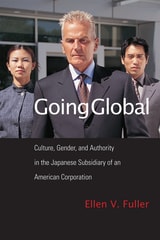
Going Global
Culture, Gender, and Authority in the Japanese Subsidiary of an American CorporationEllen V. Fuller
Temple University Press, 2009
In this intriguing ethnography, Ellen Fuller investigates how issues of gender and identity as they relate to authority are addressed in a globalizing corporate culture. Going Global goes behind the office politics, turf wars and day-to-day workings of a transnational American company in Japan in the late 1990s as employees try to establish a comfortable place within the company.
Fuller looks at how relationships among Asians and between Asians and Americans are tested as individuals are promoted to positions of power and authority. Is there pressure for the Japanese to be more “American” to get ahead in business? Do female employees have to subscribe to certain stereotypes to be promoted or respected? How these American and Japanese workers assess one another raises important questions about international business management and human resources.

Gossip, Markets, and Gender
How Dialogue Constructs Moral Value in Post-Socialist KilimanjaroTuulikki Pietilä
University of Wisconsin Press, 2007
"All traders are thieves, especially women traders," people often assured social anthropologist Tuulikki Pietilä during her field work in Kilimanjaro, Tanzania, in the mid-1990s. Equally common were stories about businessmen who had "bought a spirit" for their enrichment. Pietilä places these and similar comments in the context of the liberalization of the Tanzanian economy that began in the 1980s, when many men and women found themselves newly enmeshed in the burgeoning market economy. Even as emerging private markets strengthened the position of enterprising people, economic resources did not automatically lead to heightened social position. Instead, social recognition remained tied to a complex cultural negotiation through stories and gossip in markets, bars, and neighborhoods.
With its rich ethnographic detail, Gossip, Markets, and Gender shows how gossip and the responses to it form an ongoing dialogue through which the moral reputations of trading women and businessmen, and cultural ideas about moral value and gender, are constructed and rethought. By combining a sociolinguistic study of talk, storytelling, and conversation with analysis of gender, the political economy of trading, and the moral economy of personhood, Pietilä reveals a new perspective on the globalization of the market economy and its meaning and impact on the local level.
Winner, Aidoo-Snyder Prize, African Studies Association Women’s Caucus

Grandmothers on Guard
Gender, Aging, and the Minutemen at the US-Mexico BorderBy Jennifer L. Johnson
University of Texas Press, 2021
For about a decade, one of the most influential forces in US anti-immigrant politics was the Minuteman Project. The armed volunteers made headlines patrolling the southern border. What drove their ethno-nationalist politics?
Jennifer L. Johnson spent hundreds of hours observing and interviewing Minutemen, hoping to answer that question. She reached surprising conclusions. While the public face of border politics is hypermasculine—men in uniforms, fatigues, and suits—older women were central to the Minutemen. Women mobilized support and took part in border missions. These women compel us to look beyond ideological commitments and material benefits in seeking to understand the appeal of right-wing politics. Johnson argues that the women of the Minutemen were motivated in part by the gendered experience of aging in America. In a society that makes old women irrelevant, aging white women found their place through anti-immigrant activism, which wedded native politics to their concern for the safety of their families. Grandmothers on Guard emphasizes another side of nationalism: the yearning for inclusion. The nation the Minutemen imagined was not only a space of exclusion but also one in which these women could belong.
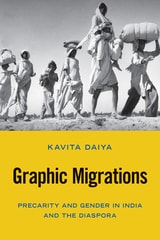
Graphic Migrations
Precarity and Gender in India and the DiasporaKavita Daiya
Temple University Press, 2020
In Graphic Migrations, Kavita Daiya provides a literary and cultural archive of refugee stories and experiences to respond to the question “What is created?” after decolonization and the 1947 Partition of India. She explores how stories of Partition migrations shape and influence the political and cultural imagination of secularism and contribute to gendered citizenship for South Asians in India and its diasporas.
Daiya analyzes modern literature, Bollywood films, Margaret Bourke-White’s photography, advertising, and print culture to show how they memorialize or erase refugee experiences. She also uses oral testimonies of Partition refugees from Hong Kong, South Asia, and North America to draw out the tensions of the nation-state, ethnic discrimination, and religious difference. Employing both Critical Refugee Studies and Feminist Postcolonial Studies frameworks, Daiya traces the cultural, affective, and political legacies of Partition migrations.
The precarity generated by modern migration and expressed through public culture prompts a rethinking of how dominant media represents gendered migrants and refugees. Graphic Migrations demands that we redraw the boundaries of how we tell the story of modern world history and the intricately interwoven, intimate production of statelessness and citizenship across the world’s communities.

Gridiron Gourmet
Gender and Food at the Football TailgateMaria J. Veri
University of Arkansas Press, 2019
Tailgating, which began in the early 1900s as a quaint picnic lunch outside of the stadium, has evolved into a massive public social event with complex menus, extravagant creative fare, and state-of-art grilling equipment. Unlike traditional notions of the home kitchen, the blacktop is a highly masculine culinary environment in which men and the food they cook are often the star attractions.
Gridiron Gourmet examines tailgating as shown in television, film, advertising, and cookbooks, and takes a close look at the experiences of those tailgaters who are as serious about their brisket as they are about cheering on their favorite team, demonstrating how and why the gendered performances on the football field are often matched by the intensity of the masculine displays in front of grills, smokers, and deep fryers.