Results by title
1104 books match the query 'Gender Studies' and 80 start with g

Gender/Body/Knowledge
Feminist Reconstructions of Being and KnowingJaggar, Alison M
Rutgers University Press, 1989

Gender
An Ethnomethodological ApproachSuzanne J. Kessler and Wendy McKenna
University of Chicago Press, 1985
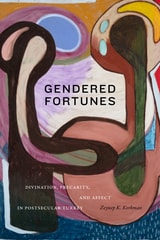
Gendered Fortunes
Divination, Precarity, and Affect in Postsecular TurkeyZeynep K. Korkman
Duke University Press, 2023
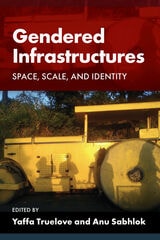
Gendered Infrastructures
Space, Scale, and IdentityYaffa Truelove
West Virginia University Press, 2024
The first book to take a feminist geographical approach to infrastructure, Gendered Infrastructures delves into the complex relationships between identity, social relations, and infrastructure. By drawing on feminist scholarship to enable new frameworks for critical study, this edited volume explores the gendered nature of infrastructures as diverse as Senegal’s waste disposal, Vietnam’s cement industry, and Lilongwe’s water kiosks. The chapters consider how infrastructural assemblages rework and shape gendered relations, identities, and meanings across space, while tracing the intersectionality of relations and uneven geographies that surround infrastructure. Ultimately, the contributors show how gender is always present in the quotidian building blocks that organize the socio-material world and daily life.
Edited by Yaffa Truelove and Anu Sabhlok, and the third book in Amy Trauger and Jennifer Fluri’s Gender, Feminism, and Geography series, the original essays in Gendered Infrastructures respond to and build upon a “new infrastructural turn in critical scholarship”—one that has helped enliven studies of identity across scale. The volume is relevant to geographers, anthropologists, architects, sociologists, urban researchers, and other interdisciplinary scholars interested in the gendered and social dimensions of infrastructure.
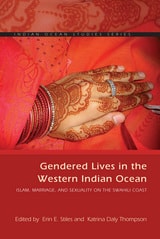
Gendered Lives in the Western Indian Ocean
Islam, Marriage, and Sexuality on the Swahili CoastErin E. Stiles
Ohio University Press, 2015
Muslim communities throughout the Indian Ocean have long questioned what it means to be a “good Muslim.” Much recent scholarship on Islam in the Indian Ocean considers debates among Muslims about authenticity, authority, and propriety. Despite the centrality of this topic within studies of Indian Ocean, African, and other Muslim communities, little of the existing scholarship has addressed such debates in relation to women, gender, or sexuality. Yet women are deeply involved with ideas about what it means to be a “good Muslim.”
In Gendered Lives in the Western Indian Ocean, anthropologists, historians, linguists, and gender studies scholars examine Islam, sexuality, gender, and marriage on the Swahili coast and elsewhere in the Indian Ocean. The book examines diverse sites of empowerment, contradiction, and resistance affecting cultural norms, Islam and ideas of Islamic authenticity, gender expectations, ideologies of modernity, and British education. The book’s attention to both masculinity and femininity, broad examination of the transnational space of the Swahili coast, and inclusion of research on non-Swahili groups on the East African coast makes it a unique and indispensable resource.
Contributors: Nadine Beckmann, Pat Caplan, Corrie Decker, Rebecca Gearhart, Linda Giles, Meghan Halley, Susan Hirsch, Susi Keefe, Kjersti Larsen, Elisabeth McMahon, Erin Stiles, and Katrina Daly Thompson
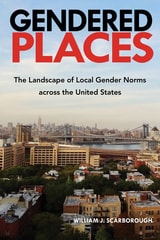
Gendered Places
The Landscape of Local Gender Norms across the United StatesWilliam J. Scarborough
Temple University Press, 2023
Every place has its quirky attributes, cultural reputation, and distinctive flair. But when we travel across America, do we also experience distinct gender norms and expectations? In his groundbreaking Gendered Places, William Scarborough examines metropolitan commuting zones to see how each region’s local culture reflects gender roles and gender equity. He uses surveys and social media data to measure multiple dimensions of gender norms, including expectations toward women in leadership, attitudes toward working mothers, as well as the division of household labor.
Gendered Places reveals that different locations, even within the same region of the country, such as Milwaukee and Madison Wisconsin, have distinct gender norms and highly influential cultural environments. Scarboroughshows how these local norms shape the attitudes and behaviors of residents with implications on patterns of inequality such as the gender wage gap. His findings offer valuable insight for community leaders and organizers making efforts to promote equality in their region.
Scarboroughrecognizes local culture as not value-neutral, but highly crucial to the gender structure that perpetuates, or challenges, gender inequality. Gendered Places questions how these gender norms are sustained and their social consequences.
Gendered Power
Educated Women of the Meiji Empress' CourtMamiko C. Suzuki
University of Michigan Press, 2019

Gendered Tradeoffs
Women, Family, and Workplace Inequality in Twenty-One CountriesBecky Pettit
Russell Sage Foundation, 2009

Gendered Vulnerability
How Women Work Harder to Stay in OfficeJeffrey Lazarus and Amy Steigerwalt
University of Michigan Press, 2018
Gendering Disability
Smith, Bonnie G
Rutgers University Press, 2004
Disability and gender, terms that have previously seemed so clear-cut, are becoming increasingly complex in light of new politics and scholarship. These words now suggest complicated sets of practices and ways of being.
Contributors to this innovative collection explore the intersection of gender and disability in the arts, consumer culture, healing, the personal and private realms, and the appearance of disability in the public sphere—both in public fantasies and in public activism. Beginning as separate enterprises that followed activist and scholarly paths, gender and disability studies have reached a point where they can move beyond their boundaries for a common landscape to inspire new areas of inquiry. Whether from a perspective in the humanities, social sciences, sciences, or arts, the shared subject matter of gender and disability studies—the body, social and cultural hierarchy, identity, discrimination and inequality, representation, and political activism—insistently calls for deeper conversation. This volume provides fresh findings not only about the discrimination practiced against women and people with disabilities, but also about the productive parallelism between these two categories.

Gendering Historiography
Beyond National CanonsEdited by Angelika Epple and Angelika Schaser
Campus Verlag, 2009
Comparing various European and American historiographies from the past two hundred years, Gendering Historiography provides insights into the establishment and cultivation of gendered power relations in different societies and outlines the devastating effects that exclusionary practices can have on each national canon. This detailed and revealing book will change the face of history writing, bringing overlooked and previously excluded histories back into modern historiography.
Gendering Labor History
Alice Kessler-Harris
University of Illinois Press, 2006
This collection represents the thirty-year intellectual trajectory of one of today’s leading historians of gender and labor in the United States. The seventeen essays are divided into four sections, narrating the evolution and refinement of Alice Kessler-Harris's central project: showing gender’s fundamental importance in the shaping of United States history and working class culture.
The first section considers women and organized labor while the second pushes this analysis toward a gendered labor history as the essays consider the gendering of male as well as female workers and how gender operates with and within the social category of class. Subsequent sections broaden this framework to examine U.S. social policy as a whole, the question of economic citizenship, and wage labor from a global perspective. While each essay represents an important intervention in American historiography in itself, the collection taken as a whole shows Kessler-Harris continuing to push the field of American history to greater levels of inclusion and analysis.
Gendering the Recession
Media and Culture in an Age of AusterityDiane Negra and Yvonne Tasker, eds.
Duke University Press, 2014
Contributors. Sarah Banet-Weiser, Hamilton Carroll, Hannah Hamad, Anikó Imre, Suzanne Leonard, Isabel Molina-Guzmán, Sinéad Molony, Elizabeth Nathanson, Diane Negra, Tim Snelson, Yvonne Tasker, Pamela Thoma

Genealogy Of Queer Theory
William Turner
Temple University Press, 2000
Turner shows how Michal Foucault's work contributed to feminists' investigations into the ways that power relates to identity. In the last decades of the twentieth century, feminists were the first to challenge the assumption that a claim to universal identity -- the white male citizen -- should serve as the foundation of political thought and action. Difference matters. Race, ethnicity, class, gender, and sexuality interact, producing a wide array of identities that resist rigid definition and are mutable. By understanding the notion of transhistorical categories -- woman, man, homosexual, and so forth -- feminist and gay male scholars launched queer theoretical work as a new way to think about the politics of gender and sexuality.
A Geneology of Queer Theory probes the fierce debates among scholars and activists, weighing the charges that queer readings of texts and identity politics do not constitute and might inhibit radical social change. Written by a historian, it considers the implications of queer theory for historical inquiry and the distinction between philosophy and history. As such, the book will interest readers of gay/lesbian/bisexual/transgender studies, intellectual history, political theory, and the history of gender/sexuality.

Geschlecht III
Sex, Race, Nation, HumanityJacques Derrida
University of Chicago Press, 2020
Amid new revelations about Heidegger’s anti-Semitism and the contemporary context of nationalist resurgence, this third piece of the Geschlecht series is timelier and more necessary than ever. Meticulously edited and expertly translated, this volume brings Derrida’s mysterious and much awaited text to light.
Getting It, Having It, Keeping It Up
Straight Men’s Sexuality in Public and PrivateBeth Montemurro
Rutgers University Press, 2022

Girl of New Zealand
Colonial Optics in AotearoaMichelle Erai
University of Arizona Press, 2020
Viewed through Māori, feminist, queer, and film theories, Erai shows how images such as Girl of New Zealand (1793) and later images, cartoons, and travel advertising created and deployed a colonial optic. Girl of New Zealand reveals how the phantasm of the Māori woman has shown up in historical images, how such images shape our imagination, and how impossible it has become to maintain the delusion of the “innocent eye.” Erai argues that the process of ascribing race, gender, sexuality, and class to imagined bodies can itself be a kind of violence.
In the wake of the Me Too movement and other feminist projects, Erai’s timely analysis speaks to the historical foundations of negative attitudes toward Indigenous Māori women in the eyes of colonial “others”—outsiders from elsewhere who reflected their own desires and fears in their representations of the Indigenous inhabitants of Aotearoa, New Zealand. Erai resurrects Māori women from objectification and locates them firmly within Māori whānau and communities.
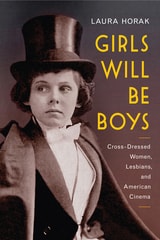
Girls Will Be Boys
Cross-Dressed Women, Lesbians, and American Cinema, 1908-1934Horak, Laura
Rutgers University Press, 2016
Finalist for 2016 Richard Wall Memorial Award from the Theatre Library Association
Long-listed for the 2017 Best Photography Book Award from the Kraszna-Krausz Foundation
Marlene Dietrich, Greta Garbo, and Katharine Hepburn all made lasting impressions with the cinematic cross-dressing they performed onscreen. What few modern viewers realize, however, is that these seemingly daring performances of the 1930s actually came at the tail end of a long wave of gender-bending films that included more than 400 movies featuring women dressed as men.
Laura Horak spent a decade scouring film archives worldwide, looking at American films made between 1908 and 1934, and what she discovered could revolutionize our understanding of gender roles in the early twentieth century. Questioning the assumption that cross-dressing women were automatically viewed as transgressive, she finds that these figures were popularly regarded as wholesome and regularly appeared onscreen in the 1910s, thus lending greater respectability to the fledgling film industry. Horak also explores how and why this perception of cross-dressed women began to change in the 1920s and early 1930s, examining how cinema played a pivotal part in the representation of lesbian identity.
Girls Will Be Boys excavates a rich history of gender-bending film roles, enabling readers to appreciate the wide array of masculinities that these actresses performed—from sentimental boyhood to rugged virility to gentlemanly refinement. Taking us on a guided tour through a treasure-trove of vintage images, Girls Will Be Boys helps us view the histories of gender, sexuality, and film through fresh eyes.
Given to the Goddess
South Indian Devadasis and the Sexuality of ReligionLucinda Ramberg
Duke University Press, 2014

Glikl
Memoirs 1691-1719Annotated by and with an Introduction by Chava Turniansky
Brandeis University Press, 2019
These words from the memoirs Glikl bas Leib wrote in Yiddish between 1691 and 1719 shed light on the life of a devout and worldly woman. Writing initially to seek solace in the long nights of her widowhood, Glikl continued to record the joys and tribulations of her family and community in an account unique for its impressive literary talents and strong invocation of self. Through intensely personal recollections, Glikl weaves stories and traditional tales that express her thoughts and beliefs. While influenced by popular Yiddish moral literature, Glikl’s frequent use of first person and the significance she assigns her own life experience set the work apart. Informed by fidelity to the original Yiddish text, this authoritative new translation is fully annotated to explicate Glikl’s life and times, offering readers a rich context for appreciating this classic work.
Glitter Up the Dark
How Pop Music Broke the BinaryBy Sasha Geffen
University of Texas Press, 2020
Why has music so often served as an accomplice to transcendent expressions of gender? Why did the query "is he musical?" become code, in the twentieth century, for "is he gay?" Why is music so inherently queer? For Sasha Geffen, the answers lie, in part, in music’s intrinsic quality of subliminal expression, which, through paradox and contradiction, allows rigid gender roles to fall away in a sensual and ambiguous exchange between performer and listener. Glitter Up the Dark traces the history of this gender fluidity in pop music from the early twentieth century to the present day.
Starting with early blues and the Beatles and continuing with performers such as David Bowie, Prince, Missy Elliot, and Frank Ocean, Geffen explores how artists have used music, fashion, language, and technology to break out of the confines mandated by gender essentialism and establish the voice as the primary expression of gender transgression. From glam rock and punk to disco, techno, and hip-hop, music helped set the stage for today’s conversations about trans rights and recognition of nonbinary and third-gender identities. Glitter Up the Dark takes a long look back at the path that led here.
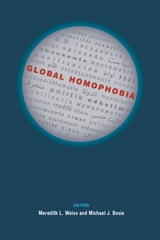
Global Homophobia
States, Movements, and the Politics of OppressionEdited by Meredith L. Weiss and Michael J. Bosia
University of Illinois Press, 2013
Combining rich empirical analysis with theoretical synthesis, these studies examine how homophobia travels across complex and ambiguous transnational networks, how it achieves and exerts decisive power, and how it shapes the collective identities and strategies of those groups it targets. The first comparative volume to focus specifically on the global diffusion of homophobia and its implications for an emerging worldwide LGBT movement, Global Homophobia opens new avenues of debate and dialogue for scholars, students, and activists.
Contributors are Mark Blasius, Michael J. Bosia, David K. Johnson, Kapya J. Kaoma, Christine (Cricket) Keating, Katarzyna Korycki, Amy Lind, Abouzar Nasirzadeh, Conor O'Dwyer, Meredith L. Weiss, and Sami Zeidan.
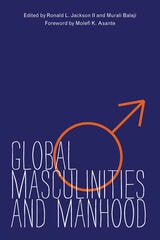
Global Masculinities and Manhood
Edited by Ronald L. Jackson II and Murali Balaji
University of Illinois Press, 2013

Going Stealth
Transgender Politics and U.S. Surveillance PracticesToby Beauchamp
Duke University Press, 2018
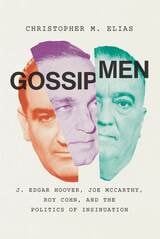
Gossip Men
J. Edgar Hoover, Joe McCarthy, Roy Cohn, and the Politics of InsinuationChristopher M. Elias
University of Chicago Press, 2021
By using gossip as a lens to examine profound issues of state security and institutional power, Elias thoroughly transforms our understanding of the development of modern American political culture.
Gossip Men
J. Edgar Hoover, Joe McCarthy, Roy Cohn, and the Politics of InsinuationChristopher M. Elias
University of Chicago Press, 2021
This is an auto-narrated audiobook edition of this book.
J. Edgar Hoover, Joseph McCarthy, and Roy Cohn were titanic figures in midcentury America, wielding national power in government and the legal system through intimidation and insinuation. Hoover’s FBI thrived on secrecy, threats, and illegal surveillance, while McCarthy and Cohn will forever be associated with the infamous anticommunist smear campaign of the early 1950s, which culminated in McCarthy’s public disgrace during televised Senate hearings. In Gossip Men, Christopher M. Elias takes a probing look at these tarnished figures to reveal a host of startling new connections among gender, sexuality, and national security in twentieth-century American politics. Elias illustrates how these three men solidified their power through the skillful use of deliberately misleading techniques like implication, hyperbole, and photographic manipulation. Just as provocatively, he shows that the American people of the 1950s were particularly primed to accept these coded threats because they were already familiar with such tactics from widely popular gossip magazines.
By using gossip as a lens to examine profound issues of state security and institutional power, Elias thoroughly transforms our understanding of the development of modern American political culture.

Grandmothers on Guard
Gender, Aging, and the Minutemen at the US-Mexico BorderBy Jennifer L. Johnson
University of Texas Press, 2021
For about a decade, one of the most influential forces in US anti-immigrant politics was the Minuteman Project. The armed volunteers made headlines patrolling the southern border. What drove their ethno-nationalist politics?
Jennifer L. Johnson spent hundreds of hours observing and interviewing Minutemen, hoping to answer that question. She reached surprising conclusions. While the public face of border politics is hypermasculine—men in uniforms, fatigues, and suits—older women were central to the Minutemen. Women mobilized support and took part in border missions. These women compel us to look beyond ideological commitments and material benefits in seeking to understand the appeal of right-wing politics. Johnson argues that the women of the Minutemen were motivated in part by the gendered experience of aging in America. In a society that makes old women irrelevant, aging white women found their place through anti-immigrant activism, which wedded native politics to their concern for the safety of their families. Grandmothers on Guard emphasizes another side of nationalism: the yearning for inclusion. The nation the Minutemen imagined was not only a space of exclusion but also one in which these women could belong.

Grant Wood’s Secrets
Sue Taylor
University of Delaware Press, 2011
Published by University of Delaware Press. Distributed worldwide by Rutgers University Press.
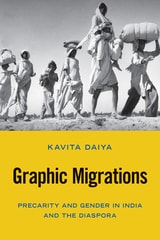
Graphic Migrations
Precarity and Gender in India and the DiasporaKavita Daiya
Temple University Press, 2020
In Graphic Migrations, Kavita Daiya provides a literary and cultural archive of refugee stories and experiences to respond to the question “What is created?” after decolonization and the 1947 Partition of India. She explores how stories of Partition migrations shape and influence the political and cultural imagination of secularism and contribute to gendered citizenship for South Asians in India and its diasporas.
Daiya analyzes modern literature, Bollywood films, Margaret Bourke-White’s photography, advertising, and print culture to show how they memorialize or erase refugee experiences. She also uses oral testimonies of Partition refugees from Hong Kong, South Asia, and North America to draw out the tensions of the nation-state, ethnic discrimination, and religious difference. Employing both Critical Refugee Studies and Feminist Postcolonial Studies frameworks, Daiya traces the cultural, affective, and political legacies of Partition migrations.
The precarity generated by modern migration and expressed through public culture prompts a rethinking of how dominant media represents gendered migrants and refugees. Graphic Migrations demands that we redraw the boundaries of how we tell the story of modern world history and the intricately interwoven, intimate production of statelessness and citizenship across the world’s communities.

Gridiron Gourmet
Gender and Food at the Football TailgateMaria J. Veri
University of Arkansas Press, 2019
Tailgating, which began in the early 1900s as a quaint picnic lunch outside of the stadium, has evolved into a massive public social event with complex menus, extravagant creative fare, and state-of-art grilling equipment. Unlike traditional notions of the home kitchen, the blacktop is a highly masculine culinary environment in which men and the food they cook are often the star attractions.
Gridiron Gourmet examines tailgating as shown in television, film, advertising, and cookbooks, and takes a close look at the experiences of those tailgaters who are as serious about their brisket as they are about cheering on their favorite team, demonstrating how and why the gendered performances on the football field are often matched by the intensity of the masculine displays in front of grills, smokers, and deep fryers.